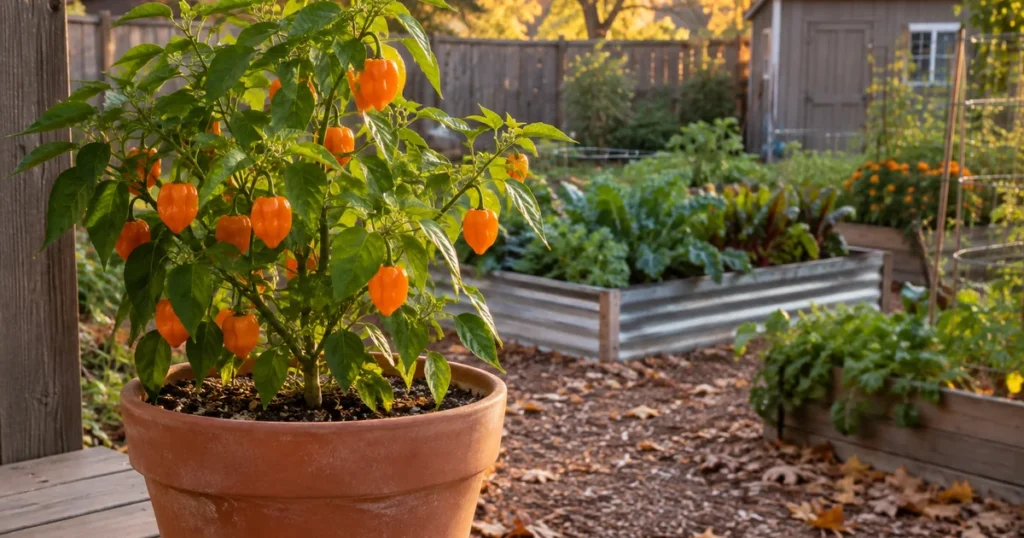
Overwintering peppers means bringing a pepper plant indoors before cold weather and keeping it alive until spring, either as a houseplant or in a cool, semi-dormant state. Peppers are perennials in frost-free climates, so a plant you save this fall can start producing weeks earlier next summer. Bring plants in when nights start dropping below about 50°F, check them carefully for pests, and replant outside after your last frost.
Quick answer
- Bring pepper plants in before nights fall below about 50°F, well ahead of your first frost.
- Easiest method: prune to a “Y”, keep the plant at roughly 50-60°F, and water lightly every few weeks until spring.
- Want peppers all winter? Keep the plant warm (above 50°F at night, about 70°F by day) under a grow light.
- Hot peppers, especially habaneros and other Capsicum chinense types, are the most worth saving.
- Rinse, inspect and isolate plants for 2-3 weeks to keep aphids and spider mites out of your house.
In this guide
- Why overwinter pepper plants?
- Which peppers are worth overwintering?
- When to bring pepper plants inside
- Prepare pepper plants before you bring them in
- Method 1: grow peppers as a houseplant
- Method 2: the dormant method (prune to a Y)
- Method 3: take cuttings
- Waking peppers up in spring
- Overwintering rosemary
- Common mistakes to avoid
- FAQ
 Every planting date for your region in one place: The Year-Round Vegetable Garden ($27, PDF).
Why overwinter pepper plants?
Peppers (Capsicum) are short-lived perennial shrubs in their native tropical range. In most of the US, frost kills them in fall, so we grow them as annuals. Overwintering skips that reset.
- Earlier harvests. An overwintered plant already has a woody stem and a full root system, so it fruits well before a spring seedling would.
- Saves slow growers. Habaneros, ghost peppers and other superhots can take 100 days or more to ripen fruit. Northern gardeners often run out of season before they get a big crop.
- Keeps a favorite plant you could not easily replace from seed.
The tradeoff: overwintered plants take space and can carry pests into spring.
Which peppers are worth overwintering?
- Hot peppers first. Extension specialists note that hot peppers tend to tolerate overwintering better than sweet bell peppers.
- Capsicum chinense (habanero, Scotch bonnet, ghost pepper, Carolina Reaper) and Capsicum baccatum (aji amarillo, lemon drop) benefit most because they are slow to mature.
- Small-fruited and ornamental types such as Thai, tabasco and chiltepin are compact and adapt well to pots.
- Bell peppers and big sweet types can be saved, but they are cheap and quick to grow from seed. Most gardeners start them fresh.
Only save healthy plants. Skip any with spotted, mottled or curled leaves, which can signal a virus or bacterial leaf spot.
When to bring pepper plants inside
Peppers are chilling-sensitive: nights in the 40s °F slow them down and can damage leaves, well before frost. Plan to move plants in once night temperatures start dropping below about 50°F. University of Minnesota Extension gives the same cue for tender houseplants summering outdoors: bring them in when nights fall into the 40s and 50s.
| USDA zone | Typical time to bring peppers in | Notes |
|---|---|---|
| 3-4 | Late August to early September | Cool nights arrive early; dig or move pots first |
| 5 | Early to mid September | Watch for the first nights in the 40s |
| 6 | Mid to late September | Often several weeks before first frost |
| 7 | Late September to mid October | Long fall season; harvest ripe fruit first |
| 8 | Mid October to November | Some plants survive mild winters outdoors with frost cloth |
| 9-10 | Often not needed | Cover during rare frosts; peppers can live for years outdoors |
These are rough windows. Check your local frost dates and the 10-day forecast, since microclimates and elevation shift them by weeks. Our frost dates by zone guide shows how to look yours up, and how to cover plants for frost helps you buy a few extra weeks in zones 7-9.
Prepare pepper plants before you bring them in
- Harvest the fruit. Pick every pepper, ripe or not. Fruit drains energy the plant needs to settle indoors.
- Dig or pot up. For in-ground plants, dig a root ball about 8 to 10 inches wide and set it in a container with fresh potting mix. A 1- to 3-gallon pot is plenty for a pruned plant.
- Inspect closely. Look under leaves and along stems for aphids, spider mites (fine webbing, tiny speckles), whiteflies and mealybugs. A hand lens helps.
- Rinse. Spray the whole plant, especially leaf undersides, with a strong stream of water. Repeat after a few days. If pests persist, use an insecticidal soap labeled for use on vegetables or houseplants and follow the label.
- Isolate. Keep new arrivals away from your other houseplants for 2 to 3 weeks, as University of Minnesota Extension recommends for any plant coming in from outdoors.
Watch out: Aphids and spider mites explode indoors because warm, dry air and no predators suit them perfectly. Check overwintered peppers every week, especially the newest growth and leaf undersides. One missed colony can spread to every plant in the house.
Gear that helps
- Insecticidal soap labeled for vegetables: Helps knock out aphids and spider mites before plants come inside.
As an Amazon Associate we earn from qualifying purchases. Check current prices and reviews on Amazon.
Method 1: grow peppers as a houseplant
This method keeps the plant actively growing and can even give you a small winter harvest. It needs the most light and space.
- Temperature: Aim for nights above 50°F and days around 70°F, the range an Extension expert recommends for continued fruiting.
- Light: A south-facing window is rarely enough in winter. Plan on a grow light for 12 to 16 hours a day, a few inches to a foot above the plant depending on the fixture. Our guide to grow lights covers distances and timers.
- Water: When the top inch of soil is dry. Do not let the pot sit in a saucer of water.
- Feed lightly: A diluted balanced fertilizer every few weeks. Over-feeding pushes soft, pest-prone growth.
- Pollinate by hand: No bees indoors. Tap open flowers or brush them with a small paintbrush to set fruit.
Gear that helps
- Full-spectrum LED grow light with timer: Winter windows rarely give peppers enough light to keep growing.
As an Amazon Associate we earn from qualifying purchases. Check current prices and reviews on Amazon.
Method 2: the dormant method (prune to a Y)

This is the most popular way to overwinter peppers because it takes little light and almost no care. The plant goes semi-dormant and simply waits for spring.
- Prune hard. Cut the main branches back to leave a “Y” shape: the main stem plus two or three short branches, each with a few nodes, roughly 4 to 8 inches tall in total.
- Trim the roots. Shake off old soil, trim the root ball back by about a third, and repot in a small container with fresh, slightly damp potting mix.
- Keep it cool. Find a spot at about 50 to 60°F, such as a cool basement, an attached garage that never freezes or a cold spare room. Oregon State Extension notes that peppers can be held in “stasis” at 40 to 55°F, but most growers find losses rise near the bottom of that range.
- Water sparingly. Water only when the soil is dry an inch or two down, often every 2 to 4 weeks. Soggy, cold soil is the main cause of dead overwintered peppers.
- Light optional, but helpful. A dim window or a basic light keeps a few leaves going. If the plant drops all its leaves, that is normal; the green stem means it is alive.
- No fertilizer. The plant is not growing, so it cannot use it.
Garden hack: Scratch the main stem lightly with a fingernail in mid-winter. Green tissue underneath means the plant is alive and resting. Brown and dry means it is time to compost it and start seeds.
Gear that helps
- Bypass pruning shears: Clean cuts when pruning pepper plants down to a Y.
As an Amazon Associate we earn from qualifying purchases. Check current prices and reviews on Amazon.
Method 3: take cuttings
If you do not have room for whole plants, root a few cuttings instead.
- In late summer or early fall, before nights turn cold, cut 4- to 6-inch shoot tips just below a leaf node.
- Strip the lower leaves and any flowers or fruit. Dip the base in rooting hormone if you have it.
- Stick the cuttings in moist seed-starting mix or perlite, or stand them in a glass of water.
- Keep them warm (70 to 80°F), in bright indirect light, under a clear dome or bag for humidity.
- Expect roots in about 2 to 4 weeks. Pot them up and grow them as small houseplants until spring.
Gear that helps
- Rooting hormone: Speeds root formation on pepper cuttings.
As an Amazon Associate we earn from qualifying purchases. Check current prices and reviews on Amazon.
Waking peppers up in spring
About 6 to 8 weeks before your last frost, start bringing dormant plants back.
- Move to warmth and light. Set plants at 65 to 75°F under a grow light or in your sunniest window.
- Water more often as new leaves appear, and begin a half-strength fertilizer every 2 weeks.
- Pot up into a larger container with fresh mix once new growth is strong.
- Harden off. Over 7 to 10 days, give plants a few hours of shade and wind outdoors, increasing daily. Our hardening off schedule works the same for overwintered plants.
- Plant out after your last frost, once nights stay above 50°F and the soil has warmed to at least 60°F.
Overwintering rosemary
Rosemary is often brought in alongside peppers, and it needs a very similar cool, bright spot. It is reliably hardy outdoors in zones 8 and warmer, borderline in zone 7, and generally has to come inside in zones 6 and colder. Illinois Extension notes that a few cultivars such as ‘Arp’ and ‘Hill Hardy’ survive somewhat colder winters with a sheltered spot, but potted plants are the safest bet in the North.
- Grow it in a pot all year. Garden rosemary does not transplant well, so keep it in a container you can move.
- Cool and bright: The ideal is a very sunny window in a room around 50 to 60°F. Warm, dry houses are rosemary’s biggest problem.
- Water carefully: Let the top of the soil dry, but do not let the whole root ball dry out completely. Overwatering causes root rot.
- Raise humidity: Set the pot on a pebble tray filled with water.
- Watch for powdery mildew: A white dusting on leaves indoors usually means poor air movement. Space plants out or run a small fan nearby.
For more herbs that handle winter indoors, see our indoor herb garden guide.
Common mistakes to avoid
- Waiting for frost. Chilled pepper plants struggle to recover. Bring them in when nights hit the low 50s.
- Skipping the pest check. One plant with aphids or spider mites can infest every houseplant you own.
- Overwatering dormant plants. Cold, wet soil rots roots fast. Water only when the pot is dry.
- Keeping dormant plants too warm. A warm, dim room makes weak, leggy growth that attracts pests.
- Moving plants straight outside in spring. Leaves that grew indoors sunburn without hardening off.
- Saving diseased plants. Mottled or spotted foliage often means a virus or bacterial disease you do not want back.
FAQ
Can you overwinter bell peppers?
Yes, with the same methods, but bell and other sweet peppers tend to tolerate overwintering less well than hot peppers. Many gardeners only save hot varieties and start bells fresh from seed.
Do overwintered peppers produce more?
They usually produce earlier, because they start spring with an established stem and roots. Total yield varies, and a vigorous new plant can match an old one by late summer.
Why are my overwintered pepper leaves falling off?
Leaf drop is normal after moving a plant indoors or into a cool, dim spot. As long as the stem is green and firm, the plant is alive and will regrow in spring.
How cold can pepper plants tolerate?
Peppers are damaged by temperatures below about 50°F over time and killed by frost. Dormant plants can sit at 50 to 60°F for months if the soil stays on the dry side.
How many years can you keep a pepper plant?
In frost-free climates, pepper plants can live and produce for several years. Indoors, many gardeners keep the same habanero or Scotch bonnet going for 2 to 5 seasons.
Can I overwinter rosemary in a garage?
Only if it gets bright light and stays above freezing. Rosemary does not go fully dormant, so a dark garage usually kills it. A cool, sunny window is better.
How do I know if my dormant pepper plant is still alive?
Scratch the main stem lightly with a fingernail. Green, moist tissue underneath means the plant is alive, even if it has dropped every leaf. If the stem is brown and dry all the way down to the soil line and nothing has budded weeks after you brought it back into warmth and light, the plant has died: compost it and start seeds.
Keep reading
Sources
- Five home-garden plants that are suitable for overwintering – Oregon State University Extension
- Overwintering peppers and herbs – Ask Extension (Cooperative Extension)
- Bringing houseplants in for winter – University of Minnesota Extension
- How to overwinter plants – Iowa State University Extension
- Rosemary – University of Illinois Extension
- Rosemary (The Garden Scoop) – University of Illinois Extension