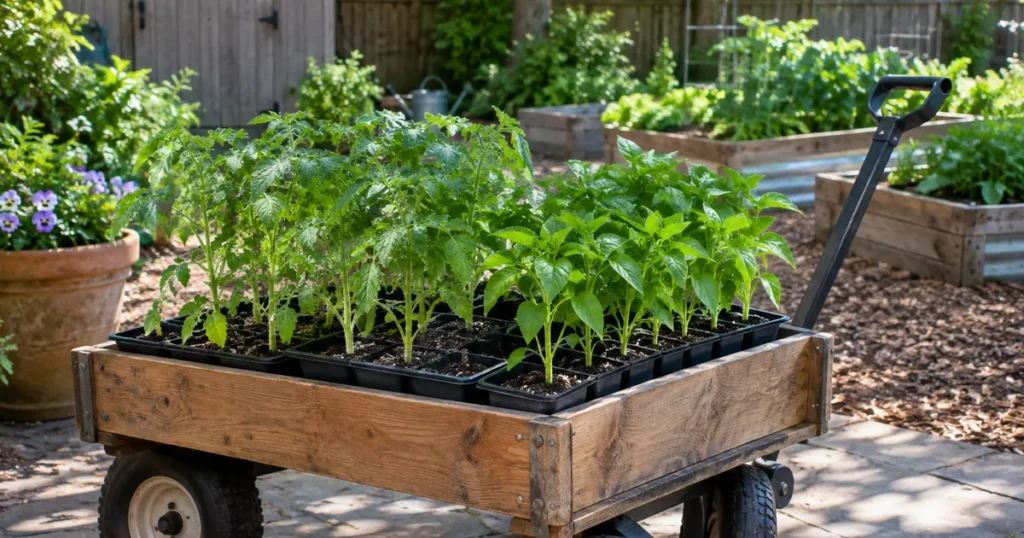
To harden off seedlings, move them outdoors a little longer each day for 7-10 days, starting with 2-3 hours in shade out of the wind and working up to full sun and nights outside. This gradual exposure toughens leaves and stems so indoor-grown plants don’t burn, wilt or stall when you transplant them into the garden.
Quick answer
- Plan 7-10 days, more if the weather turns cold, windy or very sunny.
- Day 1: 2-3 hours in shade. Add a couple of hours and a little more sun each day.
- Bring warm-season seedlings like tomatoes indoors if nights drop below about 50°F; peppers below about 55°F.
- Water less often, but never let seedlings wilt hard, and skip fertilizer until after transplanting.
- A cold frame lets you harden off with less carrying back and forth.
In this guide
Want every planting date for your region in one place? Get The Year-Round Vegetable Garden (225 pages, $27).
What is hardening off and why does it matter?
Seedlings grown indoors have only known still air, steady temperatures and light that’s far weaker than sunshine. Their leaves are thin, with a light waxy coating, and their stems have never bent in a breeze.
Hardening off seedlings is the slow introduction to real outdoor conditions: direct sun, wind, cooler nights and drier air. The plants respond by thickening their leaf cuticles and stems and storing more carbohydrates. Skip it, and a single sunny, breezy afternoon can bleach leaves and set plants back by weeks.
Seedlings bought from a garden center have often been hardened off already, but ask. Those still sitting inside a greenhouse benefit from a few days of the same routine. Seedlings grown by winter sowing are hardened off from the start.
When to start hardening off seedlings
Count back 7-10 days from the day you plan to transplant. Cool-season crops go out first, warm-season crops after your last frost. Here’s typical timing by zone, based on average last frost dates. Check your local frost dates or extension office, since microclimates vary.
| Zone | Start hardening off cool-season crops (broccoli, cabbage, lettuce, onions) | Start hardening off warm-season crops (tomatoes, peppers, eggplant) |
|---|---|---|
| 3-4 | Late April to mid-May | Late May to early June |
| 5 | Early to mid-April | Early to mid-May |
| 6 | Late March to mid-April | Late April to early May |
| 7 | Early to mid-March | Early to mid-April |
| 8 | Mid-February (and late summer for fall crops) | Mid to late March |
| 9-10 | Late summer to fall, for the main cool-season crop | January to February for spring; late summer for fall tomatoes |
In zones 9-10, the threat is usually intense sun and heat rather than cold, so lean on shade during the first several days. For transplant dates by crop, see our frost dates by zone guide.
How to harden off seedlings: a 7-10 day schedule
This schedule follows the gradual approach from University of Nebraska-Lincoln and University of Minnesota Extension. Start on a mild, calm or overcast day if you can.
| Day | Time outside | Exposure |
|---|---|---|
| 1 | 2-3 hours | Full shade, sheltered from wind |
| 2 | 3-4 hours | Shade, maybe 1 hour of morning sun |
| 3 | 4-5 hours | Morning sun, afternoon shade |
| 4 | 5-6 hours | 2-3 hours of sun |
| 5 | 6-8 hours | Half day of sun, light breeze is fine |
| 6 | 8-10 hours | Most of the day in sun |
| 7 | 10-12 hours | Full sun all day |
| 8-10 | Day and night | Outside overnight if temperatures allow, then transplant |
If you lose a day to rain, wind or a cold snap, don’t skip ahead. Repeat the last step that went well. When in doubt, go slower: University of Maryland Extension notes hardening off can take anywhere from 5 to 14 days depending on the crop.
Watering and feeding during hardening off
- Water a bit less often than indoors so plants toughen, but don’t let them wilt badly. Small cells in sun and wind dry out in hours, so check twice a day.
- Don’t fertilize during hardening off. University of Nebraska-Lincoln recommends waiting until after transplanting, then using a weak solution.
Garden hack: Keep seedlings on a wagon, a cart or a big boot tray. Rolling them in and out takes seconds, so you’ll actually stick to the schedule, and you can shift them into shade at noon without touching a single pot.
Gear that helps
- Garden cart or wagon: Rolls trays in and out daily so the schedule is easy to follow
As an Amazon Associate we earn from qualifying purchases. Check current prices and reviews on Amazon.
Minimum night temperatures for warm-season crops
Cool-season crops like broccoli, cabbage and lettuce tolerate nights in the 40s, and hardened plants can handle a light frost. Warm-season crops cannot; even hardened tomatoes are damaged by freezing temperatures. Use these guidelines when deciding whether seedlings stay out overnight.
| Crop | Bring indoors if night falls below | Transplant when |
|---|---|---|
| Tomatoes | About 50°F | After last frost, nights steadily above 50°F, soil above 60°F |
| Peppers | About 55°F | Nights above 50°F, ideally 55°F or more |
| Eggplant | About 55°F | Nights above 50-55°F, warm soil |
| Cucumbers, squash, melons | About 50°F | After last frost, soil 60°F or warmer |
| Basil | About 50°F | Nights steadily above 50°F |
| Broccoli, cabbage, kale, lettuce, onions | 32°F (freezing) until hardened | 2-4 weeks before last frost |
University of Maryland Extension advises keeping seedlings indoors when it’s below 45°F and bringing warm-season crops inside below 50°F. University of Minnesota Extension notes that pepper growth suffers when nights fall below 60°F, so there’s no reward for rushing them out.
Watch out: A forecast low of 50°F in town can mean mid-40s in a low spot in your yard. Leave a margin, and if frost is possible after you transplant, have row cover ready. See how to protect plants from frost.
The Year-Round Vegetable Garden (2027 Edition)
Plan the whole season in one place: a 225-page month-by-month guide with calendars for six US growing regions, 50 plant profiles (tomatoes included), 5 copy-ready garden plans and 7 printable pages.
Tomato lover? Add Tomato Mastery, our seed-to-harvest tomato blueprint, for just $10 at checkout.
Get the guide ($27)Gear that helps
- Wireless min-max thermometer: Shows how cold it actually got where seedlings sat overnight
As an Amazon Associate we earn from qualifying purchases. Check current prices and reviews on Amazon.
The cold frame shortcut
A cold frame turns hardening off into a matter of opening a lid. University of Nebraska-Lincoln recommends it as a way to protect plants from cold while still exposing them to outdoor conditions.
- Move seedlings into the frame with the lid closed, shaded with an old sheet or shade cloth for the first two days.
- Prop the lid open a few inches during the day, a little more each day.
- By days 5-7, remove the shading and open the lid fully during the day.
- For the last 2-3 nights, leave the lid open overnight if temperatures allow.
Vent on sunny days. A closed cold frame can climb well above 80°F even in early spring and cook seedlings.
No cold frame? A spot on the north or east side of the house, a porch, or a few stakes holding up shade cloth or floating row cover gives similar protection for the first few days.
Gear that helps
- Cold frame with vented lid: Lets you harden off by opening a lid instead of carrying trays
As an Amazon Associate we earn from qualifying purchases. Check current prices and reviews on Amazon.
Signs of sunscald, windburn and cold injury
- Sunscald: white, bleached or papery patches on the leaves facing the sun, sometimes within an hour of strong sun. Tomatoes, peppers and eggplant are prone.
- Windburn: dry, brown or torn leaf edges, and stems bent or snapped at the base.
- Cold injury: leaves turning purplish, whitish or water-soaked, then dark and limp after a cold night.
- Drought stress: wilting by midday, crispy leaf edges. Small pots outside dry fast.
What to do
Move damaged plants back into shade, water them, and restart the schedule a couple of steps back. University of Maryland Extension notes that healthy plants usually outgrow sunburn and minor cold injury as new leaves form. Remove only leaves that are fully dead. A plant with a healthy growing tip will recover.
Garden hack: Transplant on a cloudy afternoon or in the evening. Your freshly hardened seedlings then get a full night to settle their roots before facing their first full day of sun in the ground.
Gear that helps
- Shade cloth (30-40%): Softens strong sun during the first days outdoors
As an Amazon Associate we earn from qualifying purchases. Check current prices and reviews on Amazon.
Common mistakes to avoid
- Putting seedlings straight into full midday sun on day one.
- Forgetting them outside overnight during a cold snap.
- Letting small cells dry out on a windy day.
- Setting trays on cold concrete or right on the ground where slugs and pets can reach them.
- Fertilizing heavily right before or during hardening off.
- Rushing tomatoes and peppers into cold soil because the calendar says May.
FAQ
How long does it take to harden off seedlings?
Usually 7-10 days. Plan up to two weeks if the weather is cold, windy or unusually sunny, or if your seedlings were grown under weak light.
Can I skip hardening off?
It’s risky. Unhardened seedlings often get sunscald or windburn and can stall for weeks. Warm-season crops planted into warm soil after frost may cope, but a short hardening period is cheap insurance.
What temperature is too cold to harden off seedlings?
Keep warm-season seedlings like tomatoes indoors below about 50°F, and peppers and eggplant below about 55°F. Cool-season seedlings handle the 40s but should come inside if a freeze is forecast.
Can seedlings stay out overnight while hardening off?
Yes, for the last 2-3 nights of the process, once they’ve handled full sun all day, as long as nights stay above the crop’s minimum temperature.
Do I need to harden off seedlings in a greenhouse?
Yes, for a few days. Greenhouses block wind and some UV light, so plants still need a short adjustment period before going into the garden.
What does sunscald look like on seedlings?
White or bleached, papery patches on the leaves most exposed to the sun. Damaged leaves won’t recover, but healthy plants grow new leaves and move on.
Keep reading
Sources
- Hardening Off Transplants – University of Nebraska-Lincoln Extension in Lancaster County
- Planting Vegetable Transplants – University of Maryland Extension
- Vegetable Seedlings or Transplant Leaves Yellowing, Turning White, or Scorched – University of Maryland Extension
- Starting Seeds Indoors – University of Minnesota Extension
- Growing Peppers – University of Minnesota Extension
- Starting Vegetable Seeds Indoors: Seedling Culture and Transplanting – Utah State University Extension