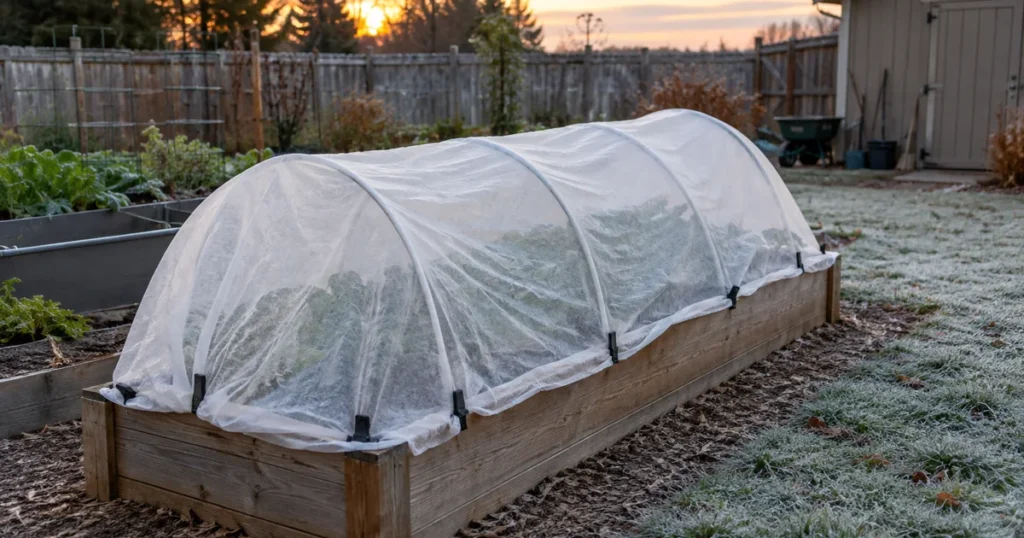
To cover plants for frost, drape a breathable cover such as frost cloth, an old bedsheet or a blanket over them in the late afternoon, let it reach all the way to the ground, and weigh down the edges so it traps heat rising from the soil. Take it off the next morning once temperatures climb above freezing. That simple routine can carry tender crops through a light frost of around 32°F, but no home cover reliably saves tomatoes or peppers from a hard freeze of 28°F and below.
Quick answer
- A light frost (about 32°F) is easy to beat with a cover; a hard freeze (28°F or lower for several hours) kills most tender crops even under a sheet.
- Use breathable fabric that touches the ground on all sides. Frost cloth adds roughly 2-8°F of protection depending on its weight.
- Cover in late afternoon, before the sun goes down, and uncover the next morning once it is above freezing.
- Never let plastic touch the leaves: cold passes right through it and burns the foliage underneath.
- Kale, spinach, carrots and cabbage shrug off light frosts. Tomatoes, peppers, beans, squash and basil need covering every time.
In this guide
- Light frost vs hard freeze: what the numbers mean
- How to cover plants for frost, step by step
- What to cover plants with for frost
- Frost protection for plants: cover types compared
- Which vegetables need covering for frost?
- When to cover and when to uncover
- Go beyond one-night covers
- Common mistakes to avoid
- FAQ
Want every planting date for your region in one place? Get The Year-Round Vegetable Garden (225 pages, $27).
Light frost vs hard freeze: what the numbers mean
Weather terms matter here because they tell you whether a cover will work. The National Weather Service defines a freeze as air temperatures of 32°F or below, and a hard freeze as 28°F or lower for an extended period, enough to kill most types of vegetation. Many forecast offices also issue a frost advisory when lows are expected in the 33-36°F range on clear, calm nights, because frost can form on leaves even when the thermometer at head height reads above 32°F.
South Dakota State University Extension groups the cold this way:
- Light frost: 28-32°F. Tender crops are damaged; semi-hardy crops come through.
- Moderate freeze: 24-28°F. Cabbage-family crops usually survive.
- Severe freeze: below 24°F. Only the toughest crops (parsnips, horseradish, some kale) keep going.
Clear skies and still air are the danger signs; clouds and wind slow the loss of heat from the ground. Low spots in your yard collect cold air and often frost first.
How to cover plants for frost, step by step
A cover works by holding in the warmth the soil soaked up during the day. It does not create heat. That is why the details below make the difference between a saved crop and a soggy, blackened one.
- Check the forecast by mid-afternoon. If your local low is predicted at 36°F or lower with clear skies, plan to cover tender plants.
- Water dry soil earlier in the day. Moist soil stores and releases more heat than dry soil. UF/IFAS Extension notes that well-watered ground can raise nighttime temperatures near plants by up to about 2°F. Water the soil, not the leaves, and do it a day or so ahead when you can.
- Add supports for tall or delicate plants. Stakes, tomato cages or wire hoops keep the fabric from crushing stems and from pressing directly on leaves.
- Cover before sunset. Put covers on in late afternoon so you capture the day’s stored heat.
- Take the cover all the way to the ground. Covers that stop at the branches (like an umbrella) let the warm air escape. Anchor the edges with bricks, rocks, soil or landscape pins.
- Uncover in the morning. Remove covers once the air is above freezing, usually mid-morning. Frost cloth can stay on for a few days in a cold spell; sheets and plastic should come off so plants get light and do not overheat.
Garden hack: Keep a “frost kit” in a bin by the back door: frost cloth, a dozen landscape pins or clothespins, a few bricks and a bundle of 4-foot wire hoops. When a surprise frost hits the forecast at 5 p.m., you can cover a whole raised bed in about ten minutes.
Gear that helps
- Garden landscape staples / pins: Anchors the edges of covers to the ground so warm air stays trapped
As an Amazon Associate we earn from qualifying purchases. Check current prices and reviews on Amazon.
What to cover plants with for frost
You do not need to buy anything for a one-night light frost. For repeated cold nights, frost cloth is worth the money because it breathes, lets light through and can stay on for days.
Frost cloth and row covers
Frost cloth (also sold as floating row cover, frost blanket or garden fleece) is a lightweight spun polyester or polypropylene fabric. It comes in weights measured in ounces per square yard, and heavier fabric gives more cold protection but lets less light through. Utah State University Extension lists medium-weight covers (about 0.5-0.55 oz/yd²) as protecting down to roughly 28°F with about 85% light transmission, while heavyweight covers (0.9-2.0 oz/yd²) protect to about 24-28°F but pass only 30-50% of sunlight. UF/IFAS Extension puts the gain from 1-1.5 oz frost cloth at about 4-8°F, depending on conditions.
Product labels sometimes promise far more, so plan on a few degrees, not a force field.
Old sheets, blankets and towels
Cotton sheets, quilts and moving blankets work well for a night or two. They are heavier than frost cloth, so support them on stakes or cages. If rain or dew soaks them, they get heavy and lose much of their value, so remove them in the morning and let them dry.
Buckets, boxes and cloches
Overturned 5-gallon buckets, plant pots, cardboard boxes and laundry baskets lined with a towel are perfect for single plants such as a pepper or a young broccoli. Glass or plastic cloches (bell jars, or milk jugs with the bottoms cut off) do the same job for seedlings. Lift them in the morning; a sealed container on a sunny day turns into an oven.
Water jugs and water walls
Water releases heat slowly as it cools. Gallon jugs of water set next to plants under a cover add stored warmth, and water-filled plant protectors wrapped around tomato transplants can let you plant earlier in spring. University of Minnesota Extension notes these protectors allow planting about three weeks earlier than normal.
Plastic sheeting: use with care
Plastic tarps and painter’s plastic do block wind, but they are poor insulators, and the cold transfers straight through to any leaf they touch. If plastic is all you have, put a sheet or frost cloth underneath it, hold it off the plants with a frame and remove it before the sun hits it. Under clear plastic, a sunny morning can cook plants quickly.
Watch out: Plastic laid directly on foliage usually does more harm than good. The leaves touching it freeze, and trapped moisture can turn to ice on the plant. Always keep a breathable layer or an air gap between plastic and leaves.
Gear that helps
- Frost cloth / floating row cover (1-1.5 oz): Breathable, reusable cover that adds several degrees and can stay on through a cold spell
As an Amazon Associate we earn from qualifying purchases. Check current prices and reviews on Amazon.
Frost protection for plants: cover types compared
| Cover | Typical gain | Best for | Leave on during the day? |
|---|---|---|---|
| Lightweight row cover (about 0.5 oz/yd²) | About 2-4°F | Light frosts, insect control | Yes, lets most light through |
| Medium/heavy frost cloth (1-2 oz/yd²) | About 4-8°F | Several cold nights in a row | A few days at most; it cuts light |
| Bedsheets, blankets | A few degrees | One-night light frost | No, remove in the morning |
| Buckets, boxes, pots | A few degrees | Single small plants | No, overheating risk |
| Cloches, cut milk jugs | A few degrees | Seedlings and transplants | Vent or remove on sunny days |
| Water jugs or water walls | Adds stored heat | Spring tomatoes, peppers | Yes (water walls are open on top) |
| Plastic sheeting over a frame | Wind block, little insulation | Backup layer only | No, it overheats fast |
Gains are approximate and depend on wind, cloud cover and how well the edges are sealed to the ground.
Gear that helps
- Plant cloches: Reusable protection for single seedlings and transplants
As an Amazon Associate we earn from qualifying purchases. Check current prices and reviews on Amazon.
Which vegetables need covering for frost?
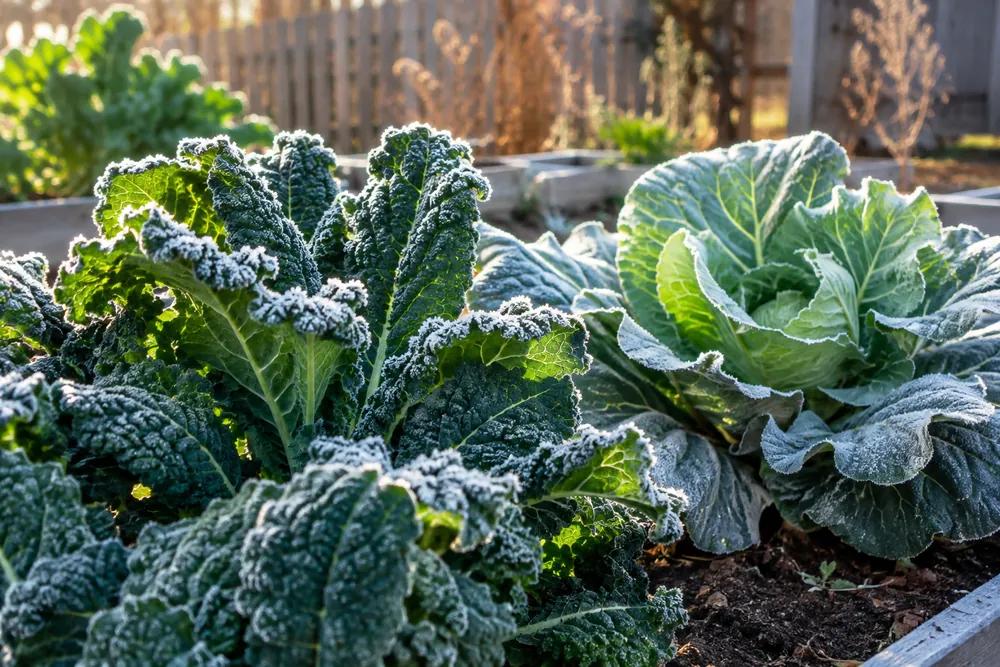
Not everything needs a blanket. Many cool-season crops taste sweeter after a frost, because the plants convert starches to sugars as temperatures drop. Use this as a guide, based on SDSU Extension’s frost tolerance groupings.
Frost-tender: cover or harvest before any frost
- Tomatoes, peppers, eggplant
- Beans, sweet corn
- Cucumbers, summer squash, winter squash, pumpkins, melons
- Sweet potatoes, potatoes (foliage), okra
- Basil
If a hard freeze is coming, harvest these instead of covering them. Bring in mature green tomatoes and ripen the green tomatoes indoors.
Semi-hardy: handle light frost (28-32°F)
- Beets, carrots, cauliflower, lettuce
- Onions, garlic, chives, parsley
- Peas, radishes, Swiss chard, spinach
Cover lettuce and cauliflower when lows drop into the upper 20s. Root crops in the ground are well insulated and usually fine.
Hardy: take moderate freezes (24-28°F)
- Kale, cabbage, broccoli, Brussels sprouts, kohlrabi, turnips
- Parsnips and collards, which improve after several freezes
For a list of crops that keep producing into the cold months, see our guide to cold-hardy winter vegetables.
When to cover and when to uncover
Cover when the forecast low is 36°F or below on a clear, calm night, or 32°F or below on any night. Put covers on in the late afternoon, ideally while the soil is still warm from the sun.
Uncover once the air is above freezing the next morning. For tender crops, a heavy frost cloth can stay on through a short cold spell of two or three days, but sheets, buckets and plastic should come off daily. If plants are frozen solid, leave the cover on until they thaw slowly; rapid warming in direct sun can add to the damage.
Timing of your first fall frost depends on where you live. In zones 3-5 it often arrives in September or early October, while zones 8-10 may see only a handful of frosty nights all winter, and fall is a main growing season there. Look up your averages in our guide to frost dates by zone, and check your local extension office, because microclimates vary.
| USDA zone | Typical first fall frost | What to have ready |
|---|---|---|
| 3-4 | Early to late September | Frost cloth on hand by Labor Day |
| 5 | Late September to mid-October | Covers for tomatoes and peppers by late September |
| 6 | Early to late October | Covers ready in early October |
| 7 | Late October to early November | Covers ready mid-October |
| 8 | Early to late November | Protect winter greens and young transplants |
| 9-10 | December to February, or rare | Cover tender crops on the few frosty nights |
These are broad, approximate ranges; your exact dates can differ by weeks.
The Year-Round Vegetable Garden (2027 Edition)
Plan the whole season in one place: a 225-page month-by-month guide with calendars for six US growing regions, 50 plant profiles (tomatoes included), 5 copy-ready garden plans and 7 printable pages.
Tomato lover? Add Tomato Mastery, our seed-to-harvest tomato blueprint, for just $10 at checkout.
Get the guide ($27)Go beyond one-night covers
If you want to keep harvesting well past your first frost, a sturdier structure pays off. Wire hoops covered with heavyweight frost cloth make a low tunnel that can stay up for weeks over a bed of greens. A cold frame with a clear lid goes further, keeping spinach, lettuce and scallions growing into early winter in many zones.
Mulch helps too. A few inches of straw or shredded leaves around carrots, beets and leeks keep the soil from freezing hard, so you can keep digging them later in the season.
Garden hack: Set an inexpensive min/max thermometer at plant height in your garden. After a few frosty nights you will learn how your yard compares with the forecast, and whether your low spot runs 3-4°F colder than the official reading.
Gear that helps
- Garden hoops for row cover tunnels: Holds frost cloth off the plants and turns a bed into a low tunnel
As an Amazon Associate we earn from qualifying purchases. Check current prices and reviews on Amazon.
Common mistakes to avoid
- Covering after dark, once the soil has already lost much of its heat.
- Draping a cover over the top of a plant without bringing it down to the ground.
- Laying plastic directly on leaves.
- Leaving buckets, sheets or plastic on through a sunny day.
- Trying to save tomatoes and peppers through a hard freeze instead of harvesting them.
- Assuming the forecast low applies to your low-lying beds.
FAQ
What temperature should I cover my plants?
Cover tender plants when the forecast low is 36°F or below on a clear, calm night, since frost can form on leaves before the air reaches 32°F. Hardy greens like kale need protection only in the low to mid 20s.
Can I use a bedsheet for frost protection?
Yes. A cotton sheet or blanket works well for a light frost if it reaches the ground and is anchored. Remove it in the morning so the plants get light and the fabric can dry.
Is it OK to cover plants with plastic?
Only as an outer layer over a frame or over fabric. Plastic touching leaves transfers cold and can freeze them, and it overheats plants quickly in the sun.
Should I water plants before a frost?
Yes, if the soil is dry. Moist soil holds more heat and releases it overnight. Water the soil earlier in the day and keep the leaves dry.
How many degrees does frost cloth protect?
Lightweight row cover adds about 2-4°F and heavier frost cloth about 4-8°F, according to extension research. Results depend on wind, clouds and how well the edges are sealed.
Will covered tomatoes survive a hard freeze?
Usually not. At 28°F or below for several hours, covers rarely save tomatoes. Harvest mature green fruit and ripen it indoors instead.
Keep reading
Sources
- Glossary: Freeze and Hard Freeze – NOAA National Weather Service
- Frost and Freeze Information – NWS Raleigh
- Fall Frost Tolerance of Common Vegetables – SDSU Extension
- Row Covers – Utah State University Extension
- Frost in the Panhandle? Practical Tips for Protecting Your Garden – UF/IFAS Extension
- Cold Protection of Landscape Plants – UF/IFAS Extension Okaloosa County
- Extending the Growing Season – University of Minnesota Extension