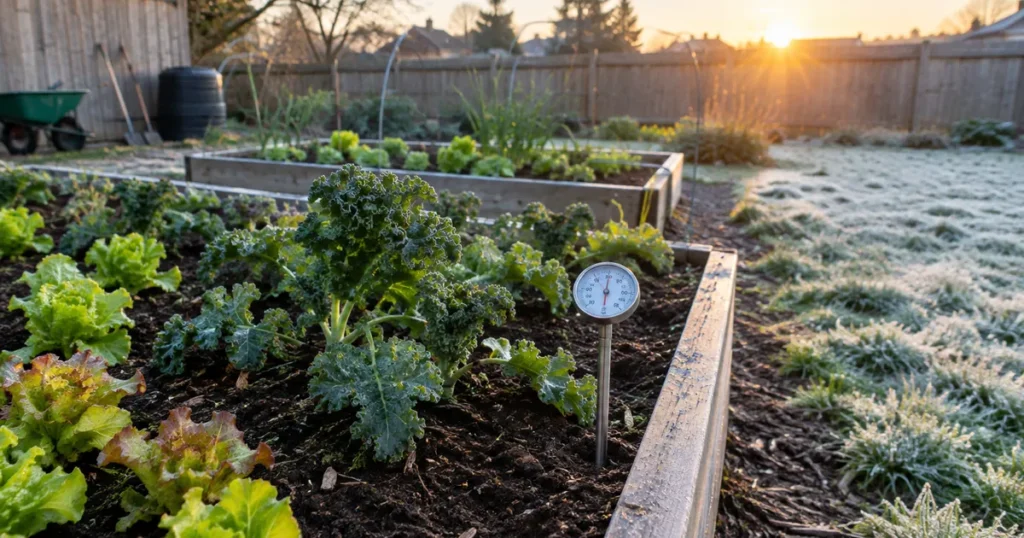
USDA hardiness zones divide the country by the average coldest winter night, so your zone tells you which perennials, fruit and overwintering crops can survive where you live. To find yours, type your ZIP code into the official USDA Plant Hardiness Zone Map. For annual vegetables like tomatoes and beans, though, your frost dates and the length of your growing season matter more than the zone number itself.
Quick answer
- A hardiness zone is based on the average annual extreme minimum temperature, the coldest night of a typical winter, averaged over 1991-2020.
- Each zone spans 10°F and splits into “a” (colder) and “b” (warmer) half zones of 5°F each. Zone 6a, for example, means -10°F to -5°F.
- Find your zone by ZIP code on the official USDA Plant Hardiness Zone Map (planthardiness.ars.usda.gov). The current version was released in November 2023.
- Zones do not give you frost dates. For vegetables, plan with your last spring frost, first fall frost and frost-free season length.
- Use your zone for perennials, fruit, garlic and anything you leave in the ground over winter.
In this guide
- What USDA hardiness zones measure
- What changed with the 2023 USDA zone map?
- What zone am I in? How to find your zone
- USDA planting zones chart: zones 3-10 with temperatures
- Why hardiness zones are not frost dates
- How to use your hardiness zone in the vegetable garden
- Planting zones in the South: a different calendar
- Microclimates: why your yard may not match your zone
- Zone-by-zone planting schedules
- Common mistakes to avoid
- FAQ
Want every planting date for your region in one place? Get The Year-Round Vegetable Garden (225 pages, $27).
What USDA hardiness zones measure
The USDA Plant Hardiness Zone Map sorts every location in the U.S. by one number: the average annual extreme minimum winter temperature. In plain terms, researchers took the single coldest temperature recorded each winter at a location, then averaged those lows over 30 years. The current map uses 1991-2020 weather data.
That average is turned into zones. Each full zone covers a 10°F band, and each is split into two half zones of 5°F. The “a” half is the colder one and the “b” half is the warmer one. So zone 5 covers -20°F to -10°F, zone 5a is -20°F to -15°F, and zone 5b is -15°F to -10°F.
The map runs from zone 1 in interior Alaska to zone 13 in parts of Puerto Rico. Most of the lower 48 states fall between zone 3 along the Canadian border and zone 10 in South Florida and coastal Southern California, with small pockets of zone 11 in the Florida Keys and Miami area.
Here is what the zone number does tell you: how cold your winters typically get. That is why nursery tags for shrubs, fruit trees, asparagus and strawberries say things like “hardy to zone 4.” A plant rated for zone 4 should handle a typical zone 4 winter low of -30°F to -20°F.
What changed with the 2023 USDA zone map?
USDA’s Agricultural Research Service and Oregon State University’s PRISM Climate Group released the updated map on November 15, 2023. It replaced the 2012 edition, which was based on 1976-2005 data.
- Newer data: The 2023 map averages winter lows from 1991-2020.
- More weather stations: It draws on more than 13,000 stations, compared with about 8,000 for the 2012 map, which sharpens the boundaries in hilly and mountainous areas.
- Many areas shifted warmer: About half of the country moved into the next warmer half zone (for example, from 5b to 6a), and the other half stayed in the same half zone. USDA describes the new map as about a quarter zone warmer than the 2012 map across much of the country.
- New zones: Zones 12 and 13 now appear in Hawaii and Puerto Rico.
USDA points out that the shifts come partly from the newer averaging period and partly from more stations and better mapping methods, and that some spots became cooler. Because the map averages extreme events, the agency says zone changes alone are not reliable evidence of climate change.
What it means in practice: if your zone moved up half a step, you do not need to rip anything out. Plants that thrived for you before will still thrive. You may simply have a bit more room to try plants rated for the warmer half zone, ideally in a sheltered spot.
Watch out: A zone is an average, not a guarantee. A winter colder than your zone’s range happens from time to time, and plants at the very edge of their rating are the first to die. For anything expensive or slow-growing, like fruit trees or asparagus, choose varieties rated at least one zone colder than yours.
What zone am I in? How to find your zone
The quickest and most reliable way to answer “what zone am I in” is the official USDA tool. It takes about 30 seconds.
- Go to the official map. Visit planthardiness.ars.usda.gov, the USDA Agricultural Research Service site.
- Enter your ZIP code. Type it into the ZIP code search box. The tool returns your half zone (such as 6b) and its temperature range.
- Or click the map. If you live in a large ZIP code with mountains or valleys, zoom in and click your exact location. The map is drawn at about a half-mile resolution, finer than ZIP code areas.
- Write down the half zone. Note “6b,” not just “6.” Many seed and nursery catalogs now list half zones.
- Look up your frost dates next. Your zone does not include them, so follow up with our guide to frost dates by zone, which shows how to find your local averages.
Older printed maps, seed packets and garden apps may still show the 2012 zones. If something lists you a half zone colder than the USDA site does, the source is probably out of date.
Garden hack: Save a note on your phone with three lines: your half zone, your average last spring frost and your average first fall frost. Those three facts answer almost every “when do I plant?” question you will run into on seed packets, plant tags and garden blogs.
Gear that helps
- Garden planner journal: A place to record half zone, frost dates and planting notes year to year
As an Amazon Associate we earn from qualifying purchases. Check current prices and reviews on Amazon.
USDA planting zones chart: zones 3-10 with temperatures
The table below covers the zones where most U.S. vegetable gardeners live. Example cities are based on the 2023 map; neighborhoods and nearby suburbs can sit in a different half zone, so always check your own ZIP code.
| Zone | Average extreme winter low | Half zones | Example cities and areas |
|---|---|---|---|
| 3 | -40°F to -30°F | 3a: -40 to -35°F; 3b: -35 to -30°F | International Falls and Bemidji, MN; northern North Dakota; northern Maine; high Rockies |
| 4 | -30°F to -20°F | 4a: -30 to -25°F; 4b: -25 to -20°F | Fargo and Bismarck, ND; Aberdeen, SD; St. Cloud and Rochester, MN; Wausau, WI; Laramie, WY; Presque Isle, ME |
| 5 | -20°F to -10°F | 5a: -20 to -15°F; 5b: -15 to -10°F | Minneapolis and Duluth, MN; Des Moines, IA; Madison and Green Bay, WI; Sioux Falls, SD; Burlington, VT; Concord, NH; Cheyenne, WY |
| 6 | -10°F to 0°F | 6a: -10 to -5°F; 6b: -5 to 0°F | Chicago, IL; Columbus and Cincinnati, OH; Indianapolis, IN; Detroit, MI; Denver, CO; Omaha, NE; Kansas City, MO; Hartford, CT; Albany, NY |
| 7 | 0°F to 10°F | 7a: 0 to 5°F; 7b: 5 to 10°F | Boston, MA; Pittsburgh, PA; St. Louis, MO; Philadelphia, PA; New York City; Nashville, TN; Richmond, VA; Salt Lake City, UT; Boise, ID |
| 8 | 10°F to 20°F | 8a: 10 to 15°F; 8b: 15 to 20°F | Atlanta, GA; Baltimore, MD; Dallas, TX; Portland, OR; much of the Carolinas, Alabama and Mississippi |
| 9 | 20°F to 30°F | 9a: 20 to 25°F; 9b: 25 to 30°F | Houston, TX; Seattle, WA; north and central Florida; much of California’s Central Valley; southern Louisiana |
| 10 | 30°F to 40°F | 10a: 30 to 35°F; 10b: 35 to 40°F | Phoenix, AZ; Orlando and Tampa, FL; Los Angeles, CA; much of coastal Southern California |
Notice how far apart cities in the same zone can be. Seattle and Houston are both zone 9, and Denver shares zone 6 with Columbus. Their winters bottom out at similar temperatures, but their summers, rainfall and frost dates are completely different. That is the main reason a zone number alone cannot run your vegetable calendar.
Why hardiness zones are not frost dates
This is the most common mix-up in vegetable gardening. Your zone describes one night in the dead of winter. Your frost dates describe when freezing nights end in spring and start again in fall. They come from different data sets: zones from the USDA map, frost dates from NOAA’s 1991-2020 U.S. Climate Normals for local weather stations.
For annual vegetables, frost dates and season length do almost all the work:
- Tomatoes, peppers, squash and beans die at 32°F and sulk below 50°F. They do not care how cold January was; they care when the last spring frost happens and how many warm days follow.
- Seed starting is counted backward from your last frost. Tomatoes typically go in pots 6-8 weeks before transplant, peppers 8-10 weeks.
- Fall crops are counted backward from your first fall frost, using each crop’s days to maturity.
- Season length decides which varieties ripen. A 100-day watermelon is easy with 190 frost-free days and a gamble with 110.
Zones and frost dates are linked loosely, because colder places usually have shorter seasons. The table below shows typical ranges, but two towns in one zone can have last frost dates three or four weeks apart because of elevation, latitude and nearby water. Our frost dates by zone guide shows how to find the exact averages for your location.
| Zone | Typical last spring frost | Typical first fall frost | Approximate frost-free season |
|---|---|---|---|
| 3 | Mid-May to early June | Early to mid-September | 90-120 days |
| 4 | Early to late May | Mid to late September | 110-140 days |
| 5 | Late April to mid-May | Late September to mid-October | 140-170 days |
| 6 | Mid-April to early May | Early to late October | 160-190 days |
| 7 | Late March to mid-April | Late October to mid-November | 190-220 days |
| 8 | Early March to early April | Early November to early December | 220-260 days |
| 9 | Late January to early March | Late November to late December | 260-330 days |
| 10 | Frost rare; occasional in January | Frost rare | Nearly year-round |
These are approximate ranges, not your dates. Check your local frost dates or call your county extension office, because microclimates vary.
How to use your hardiness zone in the vegetable garden
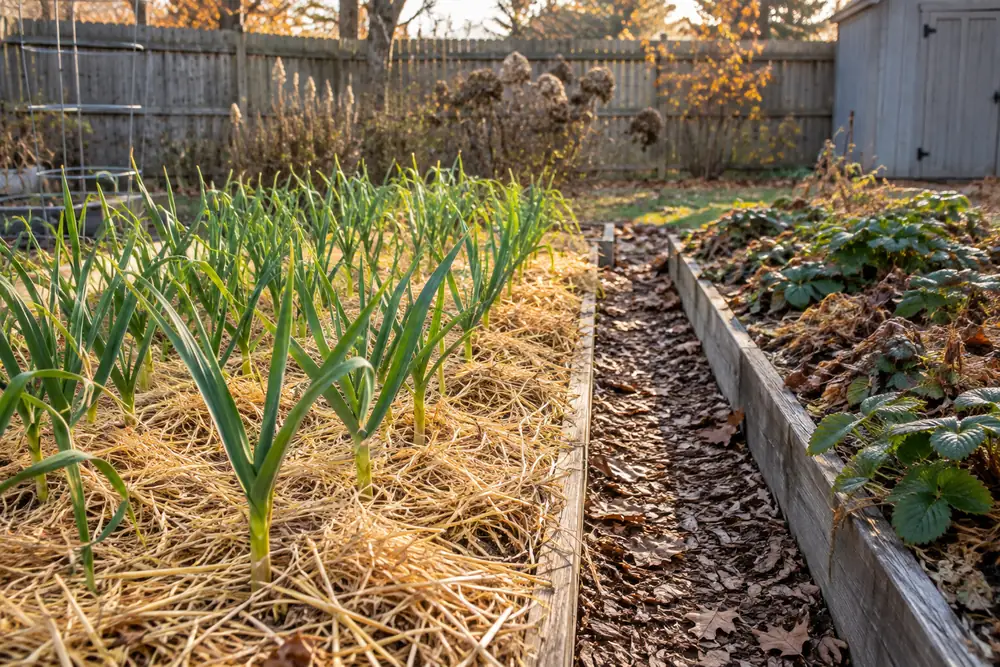
Your zone still earns its place in your notebook. Use it for anything that has to live through winter.
Perennial vegetables and fruit
Asparagus, rhubarb, horseradish, strawberries, raspberries, blueberries and fruit trees stay in the ground for years, so they must survive your coldest nights. Match the plant tag to your zone. Rhubarb and asparagus are hardy into zone 3, while artichokes behave as perennials mostly in zones 7-10 and are grown as annuals farther north.
Garlic and other overwintering crops
Garlic, shallots, multiplier onions, overwintering spinach and winter cover crops all spend the cold months outside. Your zone shapes what you plant and how much protection you give it:
- Zones 3-5: hardneck garlic is the safer choice, planted in fall and mulched with 3-4 inches of straw. See when to plant garlic for zone-by-zone dates.
- Zones 6-7: both hardneck and softneck garlic do well, and spinach or kale often overwinter under a row cover or cold frame.
- Zones 8-10: softneck and Creole garlic suit mild winters, and many gardeners pre-chill cloves in the refrigerator before planting.
Choosing between similar varieties
When a catalog lists one strawberry or raspberry for zones 4-8 and another for zones 5-9, your half zone settles it. If you are in 5a, the zone 4-8 variety is the safer pick.
When to use frost dates instead
For annual vegetables, switch to frost dates. Tomatoes, peppers, eggplant, cucumbers, squash, melons, corn and beans are all planted after your last spring frost, once soil warms. Cool-season crops like peas, spinach, lettuce, broccoli and cabbage go in a few weeks before it. Seed starting, transplanting and fall sowing are all counted from frost dates, which is how our zone schedules below are built. For the indoor side of that math, see when to start seeds indoors.
Gear that helps
- Hardneck seed garlic: Overwintering crop where the zone matters most; readers in zones 3-6 need hardy types
As an Amazon Associate we earn from qualifying purchases. Check current prices and reviews on Amazon.
Planting zones in the South: a different calendar
In zones 8-10, the zone map matters less for vegetables than heat does. Summer highs above 90°F stop tomatoes from setting fruit and turn lettuce bitter, so fall, winter and early spring become the main growing seasons.
In much of zone 9 and 10, gardeners plant broccoli, cabbage, carrots, lettuce, onions and strawberries in fall and harvest through winter. Tomatoes and peppers often get two shorter windows: late winter to early summer, and late summer to late fall. If you garden in the South, read the zone schedule for your area rather than a national calendar built around a May planting date.
Microclimates: why your yard may not match your zone
The USDA map cannot capture every slope and wall. USDA itself notes that wind, soil, moisture, snow cover and local “heat islands” and “frost pockets” all change how plants survive. Your garden can easily behave half a zone warmer or colder than the map suggests.
- Warmer spots: south-facing walls, beds next to brick or stone, paved urban areas and gentle south slopes. These spots warm first in spring and stay frost-free longer in fall.
- Colder spots: low ground and valley bottoms, where cold air pools on still nights. A frost pocket can freeze when the rest of the yard stays a few degrees above 32°F.
- Snow cover: a steady blanket of snow insulates soil, which is why garlic and strawberries often survive harsh zone 3-4 winters under snow but suffer in a bare, windy winter.
- Large water: the Great Lakes and coasts moderate temperatures. Lakeshore towns often have later first frosts than inland neighbors in the same zone.
- Elevation: in the mountain West, a few hundred feet of elevation can shift both your zone and your frost dates.
Garden hack: Put an inexpensive min-max thermometer at plant height in your garden for one winter and one spring. Compare its lows with the nearest weather station. If your garden runs a few degrees colder, plan your tender plantings a week or so later than the averages say.
Gear that helps
- Wireless indoor/outdoor min-max thermometer: Records the real winter and spring lows in the garden to spot frost pockets and warm spots
As an Amazon Associate we earn from qualifying purchases. Check current prices and reviews on Amazon.
Zone-by-zone planting schedules
Ready for dates? Each zone page below has a month-by-month table, a crop chart for about 20 common vegetables, season-extension ideas and the mistakes that trip up gardeners in that climate.
- Zone 4 planting schedule: short seasons, late May transplants, fast varieties.
- Zone 5 planting schedule: mid-May planting and a solid fall garden.
- Zone 6 planting schedule: early spring crops, long summers and October garlic.
- Zone 7 planting schedule: an April start and fall crops into November.
- Zone 8 planting schedule: March planting, summer heat and a big fall season.
- Zone 9 planting schedule: fall and winter as the main vegetable seasons.
- Zone 10 planting schedule: nearly frost-free, year-round gardening.
For every crop and every zone in one place, use our vegetable planting calendar.
The Year-Round Vegetable Garden (2027 Edition)
Plan the whole season in one place: a 225-page month-by-month guide with calendars for six US growing regions, 50 plant profiles (tomatoes included), 5 copy-ready garden plans and 7 printable pages.
Tomato lover? Add Tomato Mastery, our seed-to-harvest tomato blueprint, for just $10 at checkout.
Get the guide ($27)Common mistakes to avoid
- Planting tomatoes by zone instead of frost date. “Zone 6” does not mean “plant on April 15.” Wait until after your local last frost, when nights stay above 50°F.
- Using an old zone map. Many seed packets, apps and books still show the 2012 map. Check the USDA site for your current half zone.
- Ignoring the half zone. 5a and 5b differ by 5°F, which can decide whether a borderline fruit tree or perennial makes it.
- Assuming the same zone means the same climate. Seattle and Houston share zone 9 but need very different vegetable calendars.
- Pushing perennials to the limit. Plants at the edge of their range survive mild winters, then die in the first hard one. Pick a zone of margin for long-lived plants.
- Forgetting microclimates. A low corner or a windy, snowless bed can act half a zone colder than your map reading.
FAQ
What zone am I in?
Enter your ZIP code on the official USDA Plant Hardiness Zone Map at planthardiness.ars.usda.gov. It shows your half zone, such as 6a, and its average extreme winter low based on 1991-2020 data.
What do USDA hardiness zones mean?
They group places by the average coldest winter temperature. Each zone covers 10°F and splits into “a” and “b” half zones of 5°F, so they tell you which perennials can survive your winters.
Did my zone change in 2023?
Possibly. About half of the U.S. moved to the next warmer half zone on the 2023 map, while the rest stayed the same. Look up your ZIP code to see your current zone.
Are planting zones the same as hardiness zones?
Yes. “Planting zones,” “growing zones” and “gardening zones” usually mean the USDA hardiness zones. For vegetable timing, pair your zone with your local frost dates.
Is my zone the same as my frost date?
No. Your zone reflects winter lows, while frost dates come from NOAA climate records for nearby weather stations. Towns in the same zone can have last frost dates weeks apart.
What is the difference between zone 6a and 6b?
Zone 6a has an average extreme winter low of -10°F to -5°F, and 6b has -5°F to 0°F. The “b” half is 5°F warmer than the “a” half.
Keep reading
Sources
- USDA Plant Hardiness Zone Map – USDA Agricultural Research Service
- Map Creation (2023 map data and methods) – USDA Agricultural Research Service
- How to Use the Maps – USDA Agricultural Research Service
- USDA Announces 2023 Updates to the Plant Hardiness Zone Maps – Ohio State University CFAES
- U.S. Climate Normals – NOAA National Centers for Environmental Information
- Extending the growing season – University of Minnesota Extension
- Indiana Vegetable Planting Calendar (HO-186) – Purdue Extension