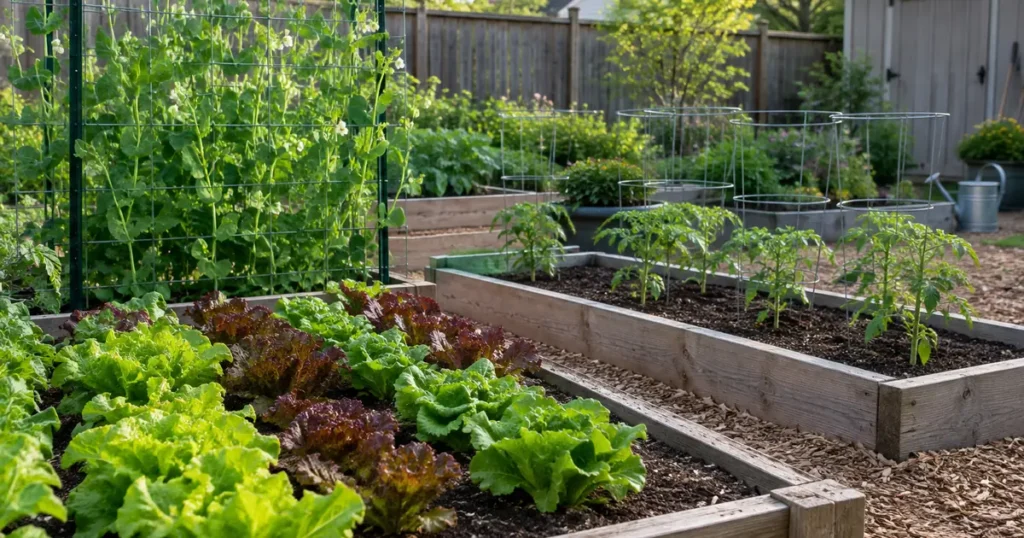
The best vegetable planting calendar is built around two dates: your average last spring frost and your average first fall frost. Hardy crops like peas and spinach go in 4-6 weeks before the last frost, tender crops like beans and corn go in around the frost date, and heat lovers like peppers and melons wait 2-3 weeks after it. Check soil temperature before you sow, and you have a calendar that works anywhere in the US.
Quick answer
- 4-6 weeks before last frost: peas, spinach, radishes, onion sets, asparagus crowns.
- 2-4 weeks before: broccoli, cabbage and kale transplants, lettuce, turnips, potatoes, then carrots and beets.
- On to 2 weeks after: sweet corn, bush and pole beans, cucumbers, summer squash, tomatoes.
- 2-3 weeks after: peppers, eggplant, melons, winter squash, okra, sweet potatoes.
- Soil temperature rule: cool-season seeds sprout from about 40°F; most warm-season seeds need 60°F soil.
In this guide
- How this vegetable planting calendar works
- When to plant vegetables: the master table
- The soil-temperature rule: why the calendar is only half the answer
- Worked example: one calendar, three frost dates
- How fall planting dates are calculated
- Cool-season vs. warm-season vegetables
- The South is different: zones 8-10
- Vegetable planting calendar by zone
- Common mistakes to avoid
- FAQ
Want every planting date for your region in one place? Get The Year-Round Vegetable Garden (225 pages, $27).
How this vegetable planting calendar works
Calendar dates like “plant tomatoes May 10” only work for one town. Frost-relative timing works everywhere. Once you know your average last spring frost date, every entry in the table below becomes a real date on your calendar: just count the weeks forward or back.
Your USDA hardiness zone is a helpful shortcut, but it is not the same thing. The 2023 USDA Plant Hardiness Zone Map is based on the average annual extreme minimum winter temperature. Frost dates come from NOAA climate normals for weather stations near you. Two gardens in zone 6 can have last frost dates two or three weeks apart, so look up your own dates on our frost dates by zone page or through your local extension office, because microclimates vary.
Every crop on the list falls into one of four groups, a system used by Colorado State and Utah State Extension:
- Hardy (cool season): survive frost and light freezes. Plant 2-6 weeks before the last frost.
- Semi-hardy (cool season): tolerate light frost. Plant 0-3 weeks before the last frost.
- Tender (warm season): killed by frost. Plant around the last frost date.
- Very tender (warm season): need warm soil and warm nights. Plant 2 or more weeks after the last frost.
When to plant vegetables: the master table
Use this table as your vegetable planting guide for about 30 common crops. “Before” and “after” refer to your average last spring frost. The fall column counts back from your average first fall frost and assumes you live where summers are not brutally hot; in zones 8-10, fall planting starts once the heat breaks.
| Vegetable | Season | Spring planting (vs. last frost) | How | Soil temp to germinate: minimum / ideal range (°F) | Fall planting (vs. first fall frost) |
|---|---|---|---|---|---|
| Asparagus | Cool (perennial) | 4-6 weeks before | Crowns | 50 / 60-85 | Not planted in fall |
| Beans, bush | Warm | 0-2 weeks after | Seed | 60 / 60-85 | 10-12 weeks before |
| Beans, pole | Warm | 1-2 weeks after | Seed | 60 / 60-85 | Zones 8-10 only, 12-14 weeks before |
| Beets | Cool | 1-3 weeks before | Seed | 40 / 50-85 | 8-10 weeks before |
| Broccoli | Cool | 2-4 weeks before | Transplant | 40 / 45-85 | 10-12 weeks before (transplants) |
| Brussels sprouts | Cool | 2-4 weeks before | Transplant | 40 / 45-85 | 12-14 weeks before (transplants) |
| Cabbage | Cool | 2-4 weeks before | Transplant | 40 / 45-85 | 10-12 weeks before (transplants) |
| Carrots | Cool | 1-3 weeks before | Seed | 40 / 45-85 | 10-12 weeks before |
| Cauliflower | Cool | 1-2 weeks before | Transplant | 40 / 45-85 | 10-12 weeks before (transplants) |
| Collards | Cool | 2-4 weeks before | Seed or transplant | 40 / 45-85 | 8-10 weeks before |
| Corn, sweet | Warm | On the frost date to 2 weeks after | Seed | 50 / 60-95 | Zones 7-10 only, 12-14 weeks before |
| Cucumbers | Warm | 1-2 weeks after | Seed | 60 / 60-95 | 10-12 weeks before |
| Eggplant | Warm | 2-3 weeks after | Transplant | 60 / 75-90 | Zones 8-10 only |
| Garlic | Cool | Fall-planted crop | Cloves | Not applicable | 3-6 weeks before the ground freezes |
| Kale | Cool | 3-5 weeks before | Seed or transplant | 40 / 45-85 | 8-10 weeks before (seed), 6-8 (transplants) |
| Kohlrabi | Cool | 2-4 weeks before | Seed | 40 / 45-85 | 8-10 weeks before |
| Leeks | Cool | 0-2 weeks before | Transplant | 40 / 50-85 | Not usually; plant in spring |
| Lettuce | Cool | 2-4 weeks before | Seed or transplant | 35 / 40-80 | 6-8 weeks before |
| Melons (cantaloupe) | Warm | 2-3 weeks after | Seed or transplant | 60 / 75-95 | Not a fall crop |
| Okra | Warm | 2-3 weeks after | Seed | 65 / 70-95 | Not a fall crop |
| Onions | Cool | 2-4 weeks before | Sets or transplants | 35 / 50-95 | Fall planting in zones 7-10 |
| Parsnips | Cool | 0-2 weeks before | Seed | 35 / 50-70 | Not a fall crop |
| Peas | Cool | 4-6 weeks before | Seed | 40 / 40-75 | 10-12 weeks before |
| Peppers | Warm | 2-3 weeks after | Transplant | 60 / 65-95 | Zones 8-10 only |
| Potatoes | Cool | 0-3 weeks before | Seed potatoes | 45 at planting | Zones 8-10 only |
| Pumpkins and winter squash | Warm | 2-3 weeks after | Seed or transplant | 60 / 70-90 | Not a fall crop |
| Radishes | Cool | 4-6 weeks before | Seed | 40 / 45-90 | 4-6 weeks before |
| Spinach | Cool | 4-6 weeks before | Seed | 35 / 45-75 | 6-8 weeks before (later to overwinter) |
| Squash, summer (zucchini) | Warm | 1-2 weeks after | Seed or transplant | 60 / 70-95 | 10-12 weeks before |
| Sweet potatoes | Warm | 2-4 weeks after | Slips | 65 at planting | Not a fall crop |
| Swiss chard | Cool | 1-3 weeks before | Seed | 40 / 50-85 | 8-10 weeks before |
| Tomatoes | Warm | 1-2 weeks after | Transplant | 50 / 60-85 | Zones 8-10 only, 12-14 weeks before |
| Turnips | Cool | 2-4 weeks before | Seed | 40 / 60-105 | 6-8 weeks before |
| Watermelon | Warm | 2-3 weeks after | Seed or transplant | 60 / 70-95 | Not a fall crop |
Germination ranges come from Oregon State University Extension data; for brassicas without their own entry, the cabbage and cauliflower figures are used. The potato and sweet potato figures are planting temperatures rather than germination temperatures, since you plant tubers and slips, not seeds.
Garden hack: Write your last frost date on the first page of a notebook, then pencil in every crop’s date for the year in one sitting. Ten minutes of counting in January saves you from guessing in April.
The soil-temperature rule: why the calendar is only half the answer
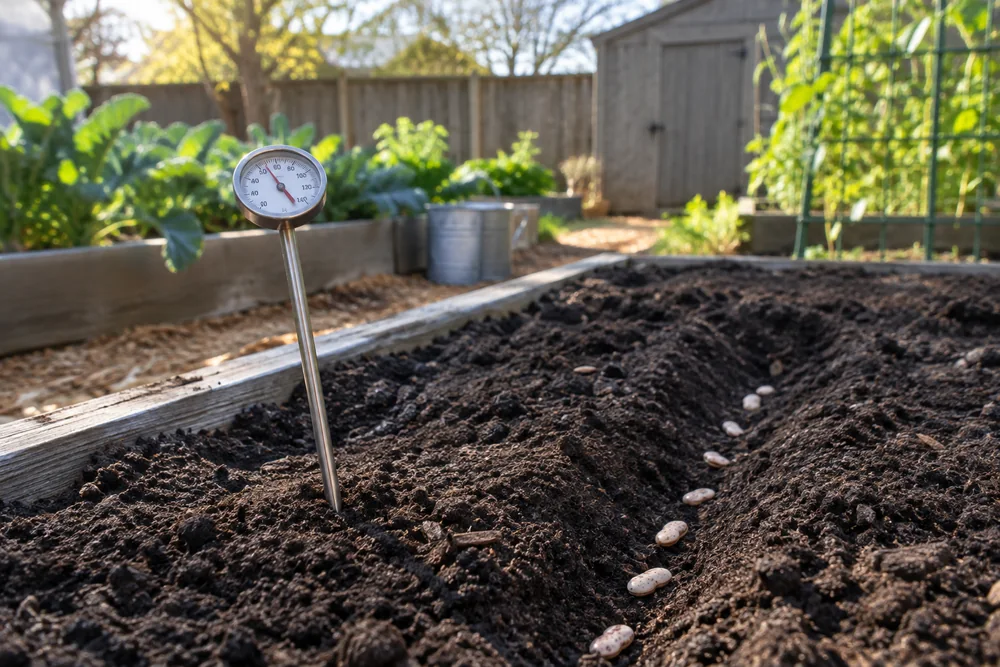
Frost dates tell you when plants will survive above ground. Soil temperature tells you whether seeds will sprout below it. A cold, wet spring can leave soil too chilly for beans even a week after your frost date, and seeds sitting in cold soil are prone to rot.
Oregon State’s germination data shows the effect clearly:
- Carrots take about 51 days to emerge at 41°F, but about 6 days at 77-86°F.
- Tomato seeds take about 43 days at 50°F, versus about 6 days at 77-86°F.
- Sweet corn takes about 22 days at 50°F, but only 3 days at 95°F.
- Lettuce can sprout at very low temperatures, while beans, cucumbers, peppers and squash all list 60°F as the minimum.
Colorado State Extension recommends measuring soil temperature at 8 a.m., 4 inches deep (6 inches for beans), and planting once the reading reaches the crop’s minimum. Morning is the coldest point of the day, so a morning reading is a conservative one. Take readings for several days in a row rather than trusting one warm afternoon.
How to use both rules together
- Find the crop’s window in the table above using your last frost date.
- When the window opens, check the soil with a probe thermometer at 4 inches in the morning.
- If the soil is at or above the minimum, plant. If not, wait a few days and check again.
- For transplants of tomatoes, peppers and eggplant, also check the forecast: these crops stall when nights drop below about 50°F, so a warm week matters more than the date.
Watch out: An average frost date is a 50-50 bet. In about half of years, a frost still arrives after it. Keep frost cloth or old sheets handy for the two weeks after you set out tender transplants, and see our guide to protecting plants from frost.
Gear that helps
- Soil thermometer: Lets readers check the 8 a.m., 4-inch soil reading before sowing.
As an Amazon Associate we earn from qualifying purchases. Check current prices and reviews on Amazon.
Worked example: one calendar, three frost dates
Here is how the same rules translate into real dates for three typical locations. An April 1 last frost is common in zones 7-8, April 20 is typical of zone 6, and May 15 fits much of zones 4-5. Indoor seed-starting dates assume peppers start 8-10 weeks and tomatoes 6-8 weeks before they go outside.
| Task | Last frost April 1 | Last frost April 20 | Last frost May 15 |
|---|---|---|---|
| Start peppers and eggplant indoors | Early to mid-February | Late February to early March | Late March to early April |
| Start tomatoes indoors | Mid to late February | Early to mid-March | Early to mid-April |
| Sow peas, spinach, radishes | Feb 18 – Mar 4 | Mar 9 – Mar 23 | Apr 3 – Apr 17 |
| Set out broccoli and cabbage; sow lettuce | Mar 4 – Mar 18 | Mar 23 – Apr 6 | Apr 17 – May 1 |
| Plant potatoes | Mar 11 – Apr 1 | Mar 30 – Apr 20 | Apr 24 – May 15 |
| Sow carrots, beets, chard | Mar 11 – Mar 25 | Mar 30 – Apr 13 | Apr 24 – May 8 |
| Sow sweet corn and bush beans | Apr 1 – Apr 15 | Apr 20 – May 4 | May 15 – May 29 |
| Transplant tomatoes | Apr 8 – Apr 15 | Apr 27 – May 4 | May 22 – May 29 |
| Transplant peppers; sow melons and winter squash | Apr 15 – Apr 22 | May 4 – May 11 | May 29 – Jun 5 |
| Typical first fall frost | Around Nov 5 | Around Oct 15 | Around Sept 20 |
| Set out fall broccoli transplants | Aug 13 – Aug 27 | Jul 23 – Aug 6 | Jun 28 – Jul 12 |
| Sow fall lettuce | Sept 10 – Sept 24 | Aug 20 – Sept 3 | Jul 26 – Aug 9 |
| Plant garlic | Late October to November | Early to late October | Mid-September to early October |
The first fall frost dates in this example are typical pairings, not rules. Look up both of your own dates, because a short or long season changes your fall column a lot. For more on indoor timing, see when to start seeds indoors.
Gear that helps
- Seedling heat mat: Speeds germination of peppers and tomatoes started indoors on the schedule.
As an Amazon Associate we earn from qualifying purchases. Check current prices and reviews on Amazon.
How fall planting dates are calculated
Fall crops are timed backward from the first fall frost. Virginia Cooperative Extension suggests adding up the crop’s days to maturity, its usual harvest period, and a “fall factor” of about two weeks, since growth slows as days shorten and nights cool. For frost-tender crops such as beans, cucumbers, squash and tomatoes, add another two weeks so they mature before frost.
Example: a 60-day bush bean, plus about 2 weeks of harvest, plus the 2-week fall factor, plus the 2-week frost-tender factor, comes to roughly 102 days. Count back about 14 weeks from your first frost, then trim the harvest-period allowance if you only want one big picking. That math is why the table lists 10-12 weeks for beans.
Cool-season crops are more forgiving. Kale, collards, cabbage, turnips, spinach and carrots tolerate frost, and many taste sweeter after a light one. Our fall vegetable garden guide covers the full list.
Garden hack: When a seed packet lists days to maturity for a transplant crop like broccoli, it usually counts from transplanting, not from seeding. Add the 5-7 weeks the seedling spends indoors when you plan a fall crop from seed.
Gear that helps
- Floating row cover: Protects early spring and late fall plantings from frost.
As an Amazon Associate we earn from qualifying purchases. Check current prices and reviews on Amazon.
Cool-season vs. warm-season vegetables
Every crop in the table is either cool season or warm season, and that one label explains most of its timing.
Cool-season vegetables grow best in the cool weather of spring and fall and tolerate frost. They include leafy crops (lettuce, spinach, kale, collards, chard), the cabbage family (broccoli, cabbage, cauliflower, Brussels sprouts, kohlrabi, turnips, radishes), root crops (carrots, beets, parsnips), onions, garlic, peas and potatoes. Many of them bolt, turn bitter or stop producing once summer heat arrives, which is why they get two windows: early spring and fall.
Warm-season vegetables need warm soil and warm nights, and frost kills them. Tomatoes, peppers, eggplant, beans, corn, cucumbers, squash, melons, okra and sweet potatoes belong here. They have one long window, from shortly after the last spring frost until the first fall frost, so most of the planning for them happens indoors in late winter.
The South is different: zones 8-10
In the Deep South, Gulf Coast, Southern California and Florida, summer heat limits gardens as much as frost does. Lettuce bolts, tomatoes stop setting fruit in high heat, and peas struggle. That flips the calendar: fall, winter and early spring are prime time for cool-season crops, while summer belongs to heat-tolerant crops like okra, sweet potatoes and Southern peas.
The frost-relative rules still apply in spring, but in zones 9-10 the frost date can be in January or February, or frost may be rare. UF/IFAS Extension, for example, lists tomato planting from August through February in South Florida and late March through April in North Florida. Use your state extension service’s planting chart, which is written for exactly these conditions.
The Year-Round Vegetable Garden (2027 Edition)
Plan the whole season in one place: a 225-page month-by-month guide with calendars for six US growing regions, 50 plant profiles (tomatoes included), 5 copy-ready garden plans and 7 printable pages.
Tomato lover? Add Tomato Mastery, our seed-to-harvest tomato blueprint, for just $10 at checkout.
Get the guide ($27)Vegetable planting calendar by zone
For a month-by-month version of this calendar, pick your zone below. Frost date ranges are typical for each zone, and the dates in your own town may fall outside them. Not sure of your zone? Start with our USDA hardiness zones guide.
| USDA zone | Typical last spring frost | Typical first fall frost | Month-by-month schedule |
|---|---|---|---|
| 3 | Mid-May to early June | Early to mid-September | Hardiness zones hub |
| 4 | Early to late May | Mid to late September | Zone 4 planting schedule |
| 5 | Late April to mid-May | Late September to mid-October | Zone 5 planting schedule |
| 6 | Mid-April to early May | Early to late October | Zone 6 planting schedule |
| 7 | Late March to mid-April | Late October to mid-November | Zone 7 planting schedule |
| 8 | Early March to early April | Early November to early December | Zone 8 planting schedule |
| 9 | Late January to early March | Late November to late December | Zone 9 planting schedule |
| 10 | Frost rare | Frost rare | Zone 10 planting schedule |
Common mistakes to avoid
- Using your zone as a frost date. Zones describe winter lows. Always plan from your local frost dates.
- Planting warm-season seeds in cold soil. Beans, cucumbers and squash planted into 50°F soil often rot. Check the soil thermometer first.
- Setting out tomatoes on the frost date “to get a head start.” Cold nights stall growth, and plants set out a week or two later often catch up.
- Waiting too long on cool-season crops. Peas, spinach and lettuce sown late run into heat and bolt or stop producing. Early is the point.
- Forgetting the fall garden. Fall crops are planted in mid-summer, when most people are busy harvesting. Put those dates on the calendar now.
- Planting everything at once. Sow lettuce, radishes and bush beans in small batches every 1-3 weeks for a steady harvest instead of one glut.
FAQ
When should I start planting my vegetable garden?
Start with hardy crops like peas, spinach and radishes about 4-6 weeks before your average last spring frost, as soon as the soil can be worked and is not soggy. Warm-season crops follow around and after the frost date.
What vegetables can be planted before the last frost?
Peas, spinach, lettuce, radishes, onions, kale, collards, turnips, broccoli and cabbage transplants, potatoes, carrots, beets and Swiss chard can all go in before the last frost. The hardiest go in first, 4-6 weeks ahead.
Is it better to plant by soil temperature or by date?
Use both. The date window keeps plants safe from frost, and a soil thermometer reading at 4 inches deep in the morning confirms that seeds will germinate. If the soil is still below the crop’s minimum, wait a few days.
What soil temperature is needed to plant vegetables?
Most cool-season seeds, like peas, carrots, beets and cabbage, can germinate from about 40°F, and lettuce and spinach from about 35°F. Beans, cucumbers, squash, melons and peppers need at least 60°F, and okra and sweet potatoes do best from about 65°F.
What is the easiest way to know when to plant vegetables in my area?
Look up your average last spring and first fall frost dates through NOAA data or your extension office, then count weeks forward or back using a frost-relative planting calendar like the table on this page.
Keep reading
Sources
- Vegetable Planting Guide – Colorado State University Extension
- Soil temperature conditions for vegetable seed germination – Oregon State University Extension
- Suggested Vegetable Planting Dates for Utah – Utah State University Extension
- Fall Vegetable Gardening – Virginia Cooperative Extension
- Growing Okra in a Home Garden – University of Maryland Extension
- Growing Sweet Potatoes in a Home Garden – University of Maryland Extension
- Florida Vegetable Gardening Guide – UF/IFAS Extension
- USDA Plant Hardiness Zone Map – USDA Agricultural Research Service