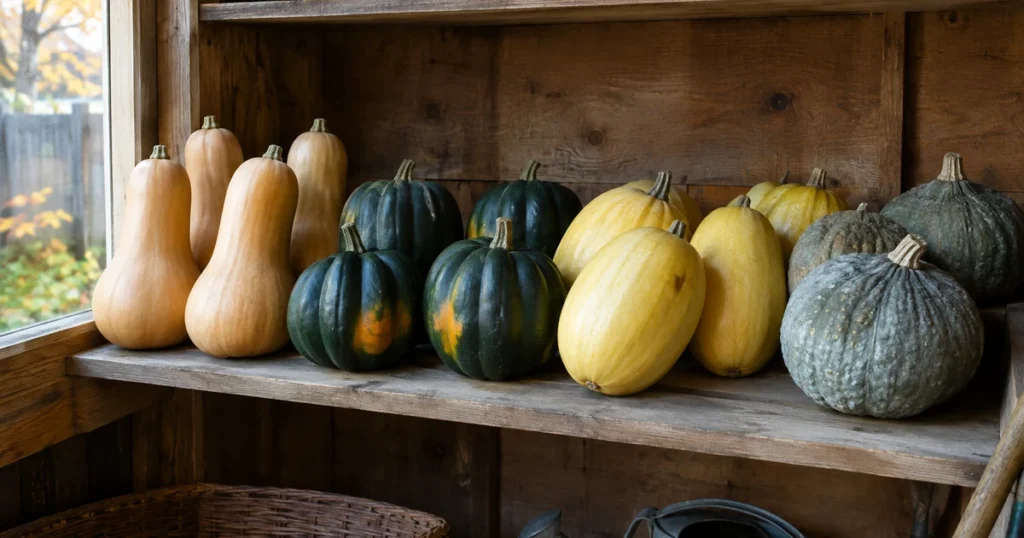
To store winter squash, harvest it fully ripe with a hard rind and 1-4 inches of stem, cure most types at 80-85°F for about 10 days (skip this for acorn squash), then keep it at 50-55°F with 50-70% humidity. Stored that way, butternut lasts 2-6 months and hubbard up to 6 months, while acorn and spaghetti squash are best eaten within 1-2 months.
Quick answer
- Harvest when the rind resists your thumbnail, the color is deep and even, and the stem is turning dry and corky.
- Cut, do not pull: leave 1-4 inches of stem and never carry squash by the stem.
- Cure butternut, hubbard, buttercup and pumpkins at 80-85°F and 80-85% humidity for 5-10 days. Do not cure acorn squash.
- Store at 50-55°F, 50-70% humidity, in a single layer with air around each fruit.
- Bring squash in before a hard freeze, and eat any frost-nicked or stemless fruit first.
In this guide
 Every planting date for your region in one place: The Year-Round Vegetable Garden ($27, PDF).
When to harvest winter squash
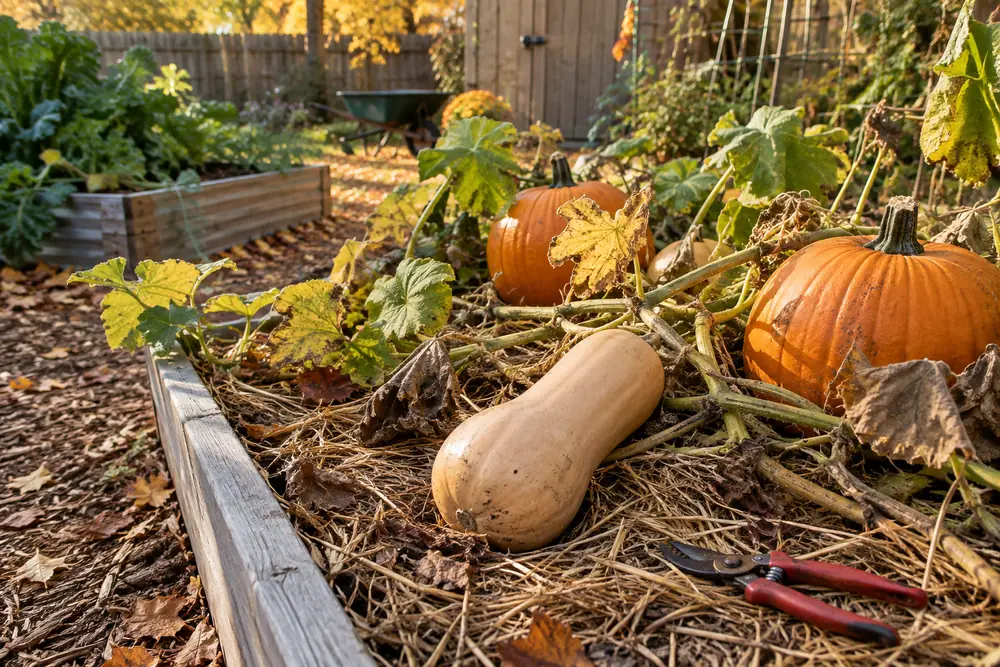
Winter squash is harvested fully mature, not young like zucchini. The fruit should have reached its final color, the skin should be dull rather than shiny, and the rind should be hard enough that your thumbnail cannot dent it. Iowa State University Extension and Oregon State University Extension both use that fingernail test as the main sign.
Most varieties need 80-110 days from planting, so in the North the harvest usually falls in September or early October, before the first hard frost. In zones 8-10, summer-planted squash is often ready in October or November.
| Zone | Typical first fall frost | Usual winter squash harvest |
|---|---|---|
| 3-4 | Early to mid-September | Late August to mid-September |
| 5 | Late September to early October | Mid-September to early October |
| 6 | Early to mid-October | Late September to mid-October |
| 7 | Late October | Late September to October |
| 8 | November | Summer crop in July-August; fall crop in October-November |
| 9-10 | Rare or none | Depends on planting date, often summer and late fall |
These are rough averages. Look up your own dates in our frost dates by zone guide or ask your local extension office, since microclimates vary.
When to harvest butternut squash
Butternut turns from green-striped to a solid, uniform tan with no green streaks left. UMass Extension notes that butternut turns tan around 45 days after pollination but still needs about two more weeks on the vine to finish maturing, so do not rush to cut it the day the color changes. A dry, corky stem and a rind your nail cannot scratch confirm it is ready.
Acorn squash
Look at the spot where the fruit rests on the soil. When that ground spot turns from pale yellow to dark orange-yellow, acorn squash is mature. The dark green rind also loses its gloss. Acorn types can be eaten right away.
Spaghetti squash
Spaghetti squash is ripe when the rind changes from pale or greenish white to golden yellow and hardens. Pale, soft fruit will have watery, bland strands.
Hubbard, buttercup and kabocha
These large Cucurbita maxima squash are ready when the stem turns dry and corky and the rind is very hard. They improve in sweetness after a month or two in storage, according to UMass Extension, so you do not need to eat them right away.
When to harvest pumpkins
Pumpkins are ready when they have reached full, even color for the variety, the rind resists your thumbnail and sounds hollow when tapped, and the stem has started to dry and harden. Vines often die back around the same time.
| Squash type | Ripeness signs | Cure? |
|---|---|---|
| Butternut | Solid tan, no green streaks, hard rind | Yes |
| Acorn | Ground spot dark orange, rind loses gloss | No |
| Spaghetti | Golden yellow, hard rind | Optional, short |
| Hubbard, buttercup, kabocha | Corky stem, very hard rind | Yes |
| Pumpkins | Full even color, hard rind, drying stem | Yes |
Garden hack: Slide a scrap of board, a paver or a piece of cardboard under each fruit a few weeks before harvest. Lifting squash off damp soil cuts down on rot on the ground side and keeps the skin cleaner for storage.
How to harvest squash with the stem
Use pruning shears or a sharp knife to cut the stem; do not twist or pull the fruit off the vine. Iowa State recommends leaving about 1 inch of stem, and Oregon State suggests 2-4 inches for pumpkins and large squash. A squash or pumpkin without a stem deteriorates quickly in storage because the open scar lets decay in.
Never carry squash or pumpkins by the stem. If it snaps, set that fruit aside to eat first. Handle every fruit gently; small cuts and bruises are where storage rot starts.
Gear that helps
- Bypass pruning shears: Makes a clean cut that leaves a stem on each squash instead of tearing it off the vine.
As an Amazon Associate we earn from qualifying purchases. Check current prices and reviews on Amazon.
What about frost?
A light frost that blackens the leaves does not usually harm mature fruit with a hard rind, and it can make the fruit easier to see and pick. A hard freeze is a different story: frozen fruit develops soft, water-soaked areas and will not store. Oregon State Extension advises gathering all squash and pumpkins before frost.
Cold damage also builds up without a freeze. Squash held below 50°F for long periods suffers chilling injury, which shows up later as sunken spots and rot. If a hard freeze is in the forecast, harvest every mature fruit and bring it in. For a cold night with mature fruit still on the vine, an old sheet or frost cover buys a little time.
Watch out: Immature green squash picked just before a freeze will not ripen in storage and keeps poorly. Cook it soon, and save storage space for fully mature fruit.
How to cure winter squash
Curing hardens the skin, heals small wounds and, in some types, helps convert starch to sugar. Iowa State and Oregon State recommend holding squash at 80-85°F and 80-85% relative humidity for about 10 days; UMass gives 5-10 days.
- Brush off soil. Wipe fruit with a dry cloth. Do not soak or scrub.
- Find a warm spot. A sunny porch, greenhouse, warm room near a furnace or a spot in the sun on dry days all work. In zones 8-10, curing outdoors in the shade during warm fall weather is often enough.
- Space them out. Set fruit in a single layer so air moves around each one.
- Wait 7-10 days. The rind should feel harder and the stem should be dry.
- Move to storage. Sort out any fruit with soft spots and eat those first.
Why acorn squash should not be cured
Acorn squash and other Cucurbita pepo types such as delicata and sweet dumpling actually lose quality when cured. Iowa State notes that high curing temperature and humidity reduce their quality and storage life. Move them straight to cool storage after harvest.
How to store winter squash
After curing, squash needs cool, dry and airy conditions. Aim for 50-55°F and 50-70% relative humidity, the range given by Oregon State and Iowa State. Above 60°F squash lose weight and get stringy; below 50°F they risk chilling injury.
- Single layer: Set fruit on shelves, not piled, with a little space between them.
- Off cold floors: Keep them off bare concrete, which stays cold and damp.
- Away from fruit: Apples, pears and other ripening fruit release ethylene gas, which shortens squash storage life.
- Not in the fridge: Whole squash suffer chilling injury at refrigerator temperatures.
- Check regularly: Look over your squash every couple of weeks and use any with soft spots right away.
A cool bedroom closet, a spare room with the heat turned down or a dry corner of the basement often hits the right range. Avoid a damp root cellar; it is too humid for squash. For more ideas on what keeps where, our guide to storing potatoes and storing onions covers the other big winter keepers.
Gear that helps
- Wire shelving unit: Keeps squash in a single layer off cold floors with air around every fruit.
- Digital thermometer hygrometer: Confirms the storage room stays at 50-55°F and 50-70% humidity.
As an Amazon Associate we earn from qualifying purchases. Check current prices and reviews on Amazon.
How long does winter squash last?
| Type | Storage life at 50-55°F | Notes |
|---|---|---|
| Acorn, delicata | 1-2 months | Do not cure; eat first |
| Spaghetti | 1-2 months | Use while rind is golden |
| Butternut | 2-6 months | Flavor improves after a few weeks |
| Hubbard, buttercup, kabocha, banana | 3-6 months | Sweetest after 1-2 months |
| Pie and carving pumpkins | 2-3 months | Pie types store better than carving types |
Ranges vary by variety, ripeness at harvest and storage conditions.
Garden hack: Write the harvest date on each squash with a marker. When you shop your stash in January, grab the oldest acorns first and leave the hubbards and butternuts for late winter.
Should you wash squash with bleach?
This is one of the most debated squash storage tips. Oregon State Extension suggests wiping fruit with a solution of 1 part household bleach to 10 parts water to reduce fungal growth, and UT Gardens (University of Tennessee) also recommends a mild bleach wash before storage or display. Other horticulturists recommend a much weaker sanitizing solution, about 1 tablespoon of bleach per gallon of water, which matches produce-safety guidance and is gentler on the rind.
The key points everyone agrees on:
- A bleach wipe can cut surface mold, but it will not save fruit that is bruised, immature or already rotting inside.
- Whatever you use, dry the fruit completely afterward. Water left on the skin encourages rot.
- Never soak squash or scrub it hard; damage to the rind shortens storage life.
- Use plain, unscented household bleach in a well-ventilated area, and do not mix it with other cleaners.
If your squash comes in clean and dry from a healthy patch, careful harvest and proper curing do far more than any wash.
Common mistakes to avoid
- Harvesting too early. A soft or shiny rind means immature fruit that will not keep.
- Breaking off the stem. Stemless squash rots quickly; eat it first.
- Curing acorn squash. Heat and humidity shorten its storage life.
- Leaving squash out in a hard freeze. Frozen fruit will not store.
- Storing squash in the fridge or a damp cellar. Too cold or too humid leads to rot.
- Stacking fruit. Piles trap moisture and hide early rot.
FAQ
How do you know when butternut squash is ready to pick?
It is solid tan with no green streaks, the rind resists your thumbnail and the stem is drying. Leave it on the vine about two weeks after it first turns tan.
Can winter squash ripen off the vine?
Mature squash will color up a little more during curing, but immature, soft fruit will not ripen properly. Harvest fully mature fruit for storage.
Does frost hurt pumpkins and squash?
A light frost that kills the leaves rarely hurts mature fruit, but a hard freeze damages the flesh. Bring squash in before temperatures drop well below freezing.
Should winter squash be stored in the refrigerator?
No. Whole squash suffer chilling injury below 50°F. Refrigerate only cut or cooked squash.
How long does butternut squash last after harvest?
Cured butternut squash stored at 50-55°F usually lasts 2-6 months, depending on variety and condition.
Keep reading
Sources
- What Is the Proper Way to Harvest and Store Winter Squash? – Iowa State University Extension and Outreach
- Storing Pumpkins and Winter Squash for Extended Use – Oregon State University Extension Service
- Pumpkin and Winter Squash Harvest, Curing and Storage – UMass Amherst Extension Vegetable Program
- October Gardening Tasks – UT Gardens, University of Tennessee
- Smashing Pumpkin Myths: Bleaching to Extend Shelf Life – The Garden Professors