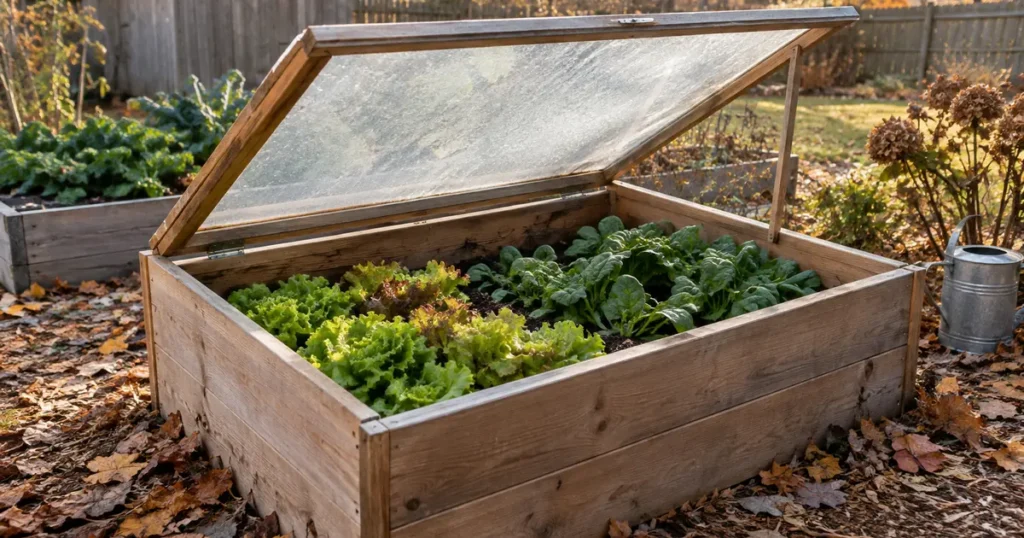
A cold frame is a low, bottomless box with a clear lid that sits on the soil and traps the sun’s warmth, like a mini greenhouse without heat. It typically keeps plants several degrees warmer than the open garden, enough to harvest lettuce and spinach weeks after your first frost and to start greens weeks before your last one. You can build one in an afternoon from untreated boards and an old window or a sheet of polycarbonate.
Quick answer
- A cold frame runs about 5-10°F warmer than outside air at night, according to UVM Extension, and much warmer on sunny days.
- Face the lid south, slope it about 1 inch per foot, and put it in full sun, sheltered from wind.
- Open the lid whenever the inside tops about 75°F. On a sunny day it can overheat even when it is 40°F outside.
- Grow cold-hardy greens (spinach, lettuce, mâche, kale, scallions) in fall and winter, and harden off seedlings in spring.
- An automatic vent opener saves plants on days you are not home.
In this guide
Want every planting date for your region in one place? Get The Year-Round Vegetable Garden (225 pages, $27).
What is a cold frame?
A cold frame is the simplest season-extension structure: four sides, no bottom, and a hinged transparent top. Sunlight passes through the lid and warms the soil and air inside. The walls block wind, and the closed lid slows the loss of that heat overnight.
Unlike a hotbed, a cold frame has no added heat source, so it can only stretch the season, not create summer in January. Gardeners use them to:
- Keep fall crops going past the first frost
- Overwinter hardy greens and harvest on mild days
- Start cool-season crops early in spring
- Harden off indoor seedlings before transplanting
How much does a cold frame extend the season?
UVM Extension notes cold frame interiors stay roughly 5-10°F warmer than the outside air. In practice, that often adds several weeks of harvest at each end of the season, depending on your zone, the crop and how well the frame is sealed and insulated.
Think of it as moving your garden one or two zones south for a few weeks. Spinach that would stall in late October in zone 5 can keep growing into December, and lettuce sown in a frame in March can be ready weeks before lettuce in the open bed. In the coldest stretch of winter in zones 3-5, growth nearly stops because days are short, but hardy greens survive inside and resume growing as days lengthen in late winter.
To see where your season starts and ends, check our guide to frost dates by zone.
Where to put a cold frame
- Facing south. The sloped lid should face south (southeast works too) to catch the low winter sun.
- Full sun. Pick a spot with no shade from buildings or evergreens between fall and spring, when the sun sits low.
- Out of the wind. A south-facing wall, fence or hedge behind the frame blocks cold north winds and reflects some heat.
- Well-drained soil. Avoid low spots where water or cold air pools.
- Close to water and the house. You will check and vent it often, and winter crops still need watering.
You can also set a frame directly on top of a raised bed, which gives you good drainage and loose soil from day one.
How to build a cold frame
A simple cold frame is a wooden box built to fit the lid you have. University of Nebraska-Lincoln Extension suggests a frame at least 3 by 6 feet, with the front lower than the back by about 1 inch per foot of depth. Keep it no deeper than you can reach across, about 3 feet.
Materials
- Lid: an old window, a sheet of twin-wall polycarbonate (about 6-8 mm), or clear plastic film stapled to a light frame. Polycarbonate is lighter than glass, does not shatter and insulates better than a single pane.
- Sides: untreated cedar or redwood boards, 2 inches thick if you can. Avoid treated lumber and painted wood near food crops. Straw bales, cinder blocks or bricks also work.
- Hardware: two hinges, exterior screws, corner blocks (2×2 or 2×4), and a prop stick or vent opener.
Step by step
- Size the box to the lid. Measure your window or polycarbonate panel. The box should match its outside dimensions so the lid rests on all four sides.
- Cut the back and front. For a 3-foot-deep frame, make the back about 15-18 inches tall and the front about 12-15 inches, so the lid drops about 3 inches. In zones 3-5, a steeper slope (up to about 6 inches) sheds snow and catches more low winter sun.
- Cut the sides at an angle. Mark each side board from the back height down to the front height and cut along the line, so the sloped top is the same length as the side of your lid.
- Assemble. Screw the boards to corner blocks on the inside. Check that the box is square.
- Attach the lid. Hinge it along the back so it opens from the front.
- Seat the frame. Set it on level ground or dig it in a few inches. UNL suggests excavating a cold frame 6 to 15 inches deep for extra insulation; banking soil or leaves around the outside walls helps too.
- Prep the soil. Loosen the soil inside and mix in a couple of inches of compost before planting.
Watch out: Windows made before 1978 may have lead paint on the frame. Do not scrape or sand them near your garden. Use a newer window, wrap the frame edges, or choose polycarbonate. Old glass also breaks easily, so keep children and pets clear.
Gear that helps
- Twin-wall polycarbonate panel: Light, shatter-resistant, insulating lid material
As an Amazon Associate we earn from qualifying purchases. Check current prices and reviews on Amazon.
Venting: the rule that saves your plants
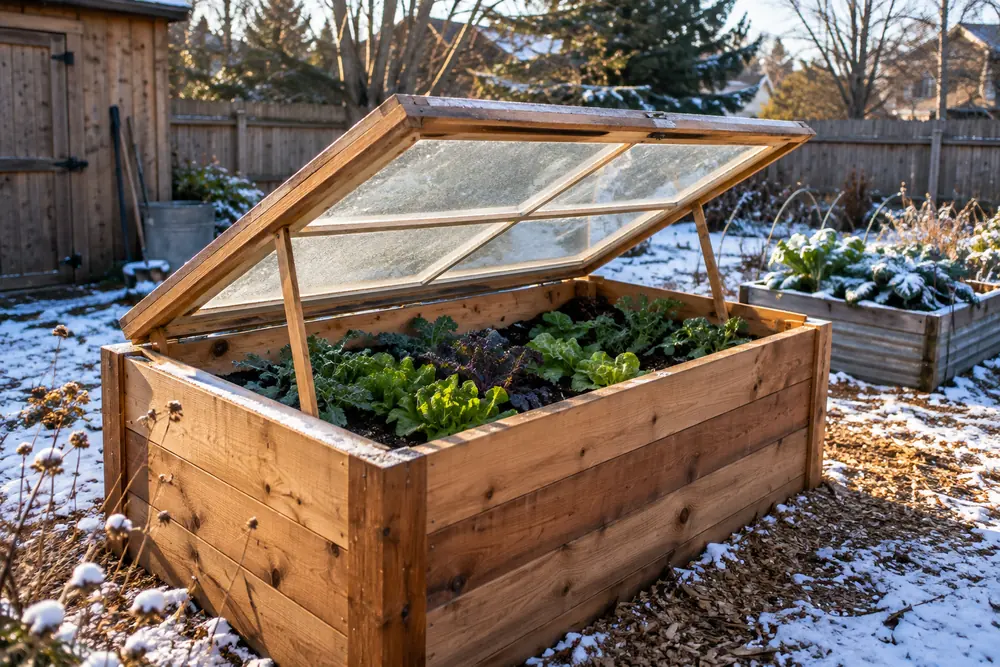
Overheating kills more cold-frame crops than cold does. On a clear day, the inside can climb from freezing to well over 90°F in a couple of hours, even with snow on the ground.
UNL Extension recommends keeping cool-season crops at about 60-65°F during the day. A practical rule is to open the lid whenever the inside tops about 75°F, and to close it in mid to late afternoon so it traps warmth for the night.
- Keep a thermometer inside, shaded from direct sun.
- Prop the lid a few inches on mild sunny days and open it fully above about 50°F outside.
- Close it early when a frost is forecast.
Automatic vent openers use a wax-filled cylinder that expands as it warms and pushes the lid up, then lowers it as the air cools. They need no electricity. Check the lifting capacity against the weight of your lid (a glass window is much heavier than polycarbonate) and set the opening temperature to your target range.
Garden hack: Fill a few dark gallon jugs with water and set them against the back wall of the frame. They absorb heat on sunny days and release it overnight, smoothing out temperature swings.
Gear that helps
- Automatic solar vent opener: Opens the lid on sunny days without electricity so plants don't overheat
As an Amazon Associate we earn from qualifying purchases. Check current prices and reviews on Amazon.
Cold frame gardening: what to grow by season
Stick to cold-hardy crops for fall and winter. For a longer list, see our guide to winter vegetables.
- Fall and winter: spinach, mâche (corn salad), lettuce, arugula, kale, Swiss chard, scallions, claytonia, radishes and baby carrots.
- Late winter and early spring: sow lettuce, spinach, radishes, peas and salad mixes.
- Spring: harden off tomato, pepper and broccoli seedlings for 7-14 days before transplanting.
- Summer: remove or prop the lid fully, or use the frame to start fall transplants under shade cloth.
| USDA zone | Fall: sow or transplant into the frame | Winter | Spring: start sowing |
|---|---|---|---|
| 3-4 | Mid-August to early September | Hardy greens survive; little growth December-January | Early to mid-March |
| 5 | Late August to mid-September | Harvest spinach, mâche, kale on mild days | Late February to mid-March |
| 6 | September | Steady harvest of hardy greens | Mid to late February |
| 7 | Mid-September to mid-October | Lettuce, arugula, spinach, scallions keep growing | Early February |
| 8 | October to November | Wide range of greens; vent often | Late January (mostly for seedlings) |
| 9-10 | Rarely needed | Use only on the few frosty nights | Harden off seedlings |
Timings are approximate; your local frost dates and extension office give the best guide, because microclimates vary.
The Year-Round Vegetable Garden (2027 Edition)
Plan the whole season in one place: a 225-page month-by-month guide with calendars for six US growing regions, 50 plant profiles (tomatoes included), 5 copy-ready garden plans and 7 printable pages.
Tomato lover? Add Tomato Mastery, our seed-to-harvest tomato blueprint, for just $10 at checkout.
Get the guide ($27)Gear that helps
- Cold-hardy greens seed collection: Varieties suited to fall and winter growing in a frame
As an Amazon Associate we earn from qualifying purchases. Check current prices and reviews on Amazon.
Cold frame vs mini greenhouse vs hoop tunnel
| Feature | Cold frame | Mini greenhouse | Low hoop tunnel |
|---|---|---|---|
| Typical cost | Low (often free with salvaged parts) | Low to moderate | Low |
| Cold protection | Good, with solid insulated walls | Fair; thin plastic loses heat fast | Fair to good with frost cloth or plastic |
| Size | Small, one bed section | Shelves for trays and pots | Covers a whole row or bed |
| Wind and snow | Sturdy | Prone to blowing over | Can sag under heavy snow |
| Venting | Prop the lid or use an auto opener | Unzip door panels | Lift or open the ends |
| Best use | Winter greens, early sowings, hardening off | Seedlings in pots in spring | Stretching fall harvest on full beds |
Many gardeners combine them: a hoop tunnel over the main bed for fall and a cold frame for the hardiest winter greens. On very cold nights, add a layer of frost cloth or an old blanket over the frame. Our guide on how to cover plants for frost covers which fabrics work best.
Gear that helps
- Cedar cold frame kit: Ready-made option for readers who would rather not build
As an Amazon Associate we earn from qualifying purchases. Check current prices and reviews on Amazon.
Common mistakes to avoid
- Forgetting to vent on sunny days and cooking the plants.
- Placing the frame where buildings or trees shade it in winter.
- Building it deeper than you can reach across.
- Using treated or painted lumber around food crops.
- Sowing warm-season crops in fall and expecting them to survive.
- Letting the soil inside dry out; frames block rain and snow.
- Leaving heavy snow on a glass lid.
FAQ
How much warmer is a cold frame than outside?
UVM Extension puts it at about 5-10°F warmer than the outside air, and much warmer on sunny days. Insulation and a tight lid add a little more protection.
At what temperature should I open my cold frame?
Open the lid whenever the inside tops about 75°F, and aim for roughly 60-65°F for cool-season crops. Close it in the afternoon to keep warmth for the night.
Which direction should a cold frame face?
South, so the sloped lid catches as much winter sun as possible. Southeast is the next best choice.
Can you grow vegetables in a cold frame all winter?
Yes, hardy greens like spinach, mâche, kale and scallions can survive all winter in most zones. In zones 3-5, growth nearly stops in the darkest weeks and picks up again in late winter.
What is the best material for a cold frame lid?
Twin-wall polycarbonate is light, shatter-resistant and insulates better than a single pane of glass. An old window works too if the frame is free of lead paint.
Do I need to water plants in a cold frame?
Yes, but less often than in summer. Check the soil every week or two and water on mild mornings so leaves dry before night.
Keep reading
Sources
- Coldframes and Hotbeds – University of Nebraska-Lincoln Extension
- Cold Frames as Season Extenders – University of Vermont Extension
- Extending the Growing Season – University of Minnesota Extension
- Row Covers – Utah State University Extension
- Protect Your Family from Sources of Lead – U.S. Environmental Protection Agency