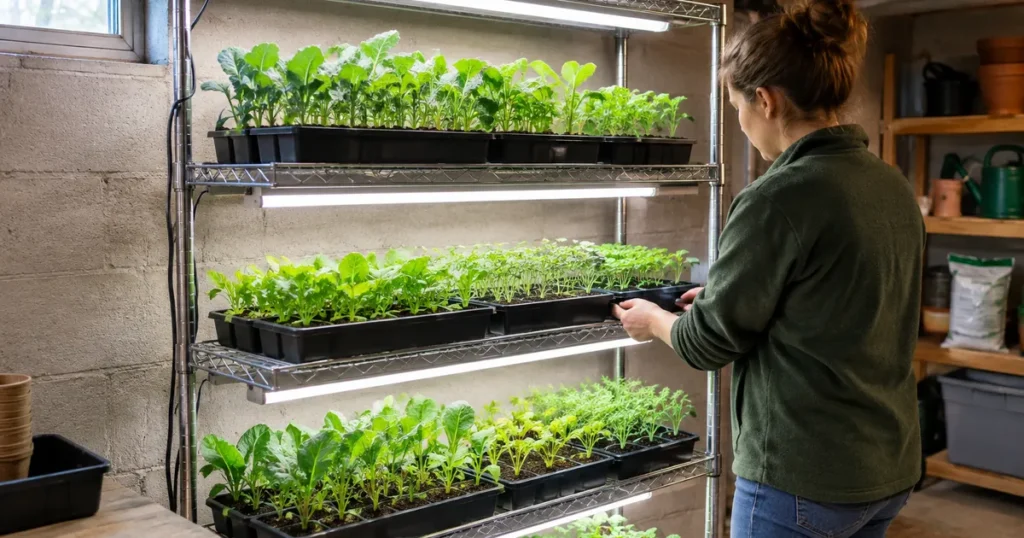
Grow lights for seedlings should be bright, close and on for 14-16 hours a day. Inexpensive LED shop lights or fluorescent T5 or T8 tubes, hung on adjustable chains a few inches above the leaves and run on a timer, will grow stocky vegetable transplants. What matters most is getting enough light intensity onto the seedlings, not the brand or a special color.
Quick answer
- LED fixtures are the best all-round choice today: efficient, cool-running and long-lasting. Fluorescent T5 and T8 tubes still work well.
- Run lights 14-16 hours a day on a timer, and give seedlings at least 8 hours of darkness.
- Keep fluorescent tubes 2-4 inches above the leaves; position LEDs according to their output, typically a few inches for shop lights and farther for powerful panels.
- Raise lights as seedlings grow. Stretching means too little light; bleached patches mean too much.
- A 4-foot, 2-tube fixture lights roughly one row of standard seed trays.
In this guide
- Do seedlings need grow lights?
- LED vs fluorescent grow lights for seedlings
- What matters when choosing grow lights for seedlings
- How many hours of light do seedlings need?
- When should you turn grow lights on?
- How far should grow lights be from seedlings?
- Signs of too little or too much light
- DIY seed starting shelf setup
- Grow light buying checklist
- Common mistakes to avoid
- FAQ
Want every planting date for your region in one place? Get The Year-Round Vegetable Garden (225 pages, $27).
Do seedlings need grow lights?
For most gardeners, yes. Seedlings started in late winter need strong light from the moment they emerge, and a windowsill gives them only a few hours of weak, one-sided light. The result is the classic leggy seedling: tall, pale, floppy and leaning toward the glass.
A south-facing window can work for a few fast crops in a sunny climate, but for tomatoes, peppers and cabbage-family crops started in February or March, supplemental lighting is the single most effective upgrade you can make. If your seedlings are already stretching, see our guide to leggy seedlings.
LED vs fluorescent grow lights for seedlings
| LED | Fluorescent T5 | Fluorescent T8 | |
|---|---|---|---|
| Energy use | Lowest for the light delivered | Moderate | Moderate |
| Heat | Low at the leaf; heat sinks get warm | Low | Low |
| Lifespan | Longest; output fades slowly | Tubes need replacing every few seasons | Tubes need replacing every few seasons |
| Typical distance above seedlings | Depends on output; follow the maker’s chart | 2-4 inches | 2-4 inches |
| Upfront cost | Low for shop lights, higher for horticultural panels | Moderate | Low |
| Notes | Huge range of quality and power | Brighter than T8 per tube; 5/8 inch diameter | 1 inch diameter; common and cheap |
LED lights have improved quickly in intensity and efficiency, and University of Maine Extension notes their lower running cost offsets a higher purchase price. Plain white LED shop lights grow good seedlings; horticultural fixtures cost more and deliver more light per square foot, which helps for large setups or fruiting plants grown indoors.
Fluorescent tubes were the extension standard for decades, often a 4-foot, two-tube fixture with one cool white and one warm white tube. They still work, but their light fades fast with distance, so they must hang very close. Oklahoma State University Extension adds that light is weaker near the tube ends, so keep the best seedlings toward the middle.
Skip incandescent bulbs. They produce mostly red and far-red light, which makes seedlings stretch, and enough heat to scorch leaves.
Gear that helps
- 4 ft full-spectrum LED grow light strip: Efficient, cool-running light sized for standard seed trays
As an Amazon Associate we earn from qualifying purchases. Check current prices and reviews on Amazon.
What matters when choosing grow lights for seedlings
Light intensity
Intensity is the amount of usable light reaching the leaves. Horticultural fixtures describe it as PPFD, in micromoles per square meter per second. Utah State University Extension puts seedling needs at roughly 200-400 µmol/m²/s. Iowa State University Extension groups seedlings in the medium daily light range, about 6-10 moles per square meter per day, and gives a simple formula: daily light = PPFD × hours × 0.0036.
Shop lights rarely list PPFD, and lumen ratings measure brightness to the human eye, not to plants. In practice, a bright fixture hung close works; a dim one hung far away does not. If a maker publishes a PPFD map, check the value at the height you plan to use.
Coverage
Light drops off quickly toward the edges of a fixture. A 4-foot, 2-tube fluorescent or LED strip covers a strip about 1 foot wide by 4 feet long, enough for two standard 10 x 20 inch trays placed end to end. For two rows of trays, hang two fixtures side by side.
Adjustable height
Seedlings grow fast, and the light has to rise with them. Fixtures that hang from chains or ropes with ratchet hangers are the easiest to raise an inch at a time. Stacking trays on books or upturned pots works too.
A timer
A basic plug-in outlet timer is the most useful accessory you can buy. It keeps the photoperiod consistent and stops you from leaving lights on all night.
Color
Seedlings need a broad spectrum with plenty of blue light, which keeps them compact. White “daylight” or “full spectrum” LEDs are ideal, and they let you see true leaf color, so you can spot problems. Purple-pink fixtures grow plants but make yellowing or pests hard to notice.
Gear that helps
- Digital outlet timer: Keeps a consistent 14-16 hour photoperiod
As an Amazon Associate we earn from qualifying purchases. Check current prices and reviews on Amazon.
How many hours of light do seedlings need?
Aim for 14-16 hours a day. Extension recommendations range from 12 to 16 hours, and longer days help make up for lights that are slightly weaker than ideal. Do not run lights 24 hours a day. Seedlings use the dark period, and continuous light can stress some crops.
Set the timer to run the lights during the warmest part of the day in your home, for example 6 a.m. to 10 p.m.
When should you turn grow lights on?
Most vegetable seeds germinate in the dark, so lights are not needed while the tray sits under its dome on the heat mat. The moment the first loops of stem break the surface, though, move the tray under the lights and switch them on. Seedlings that emerge in the dark can stretch noticeably in a single day.
A few crops, such as lettuce and celery, need light to germinate. Sow them on the surface and set them under the lights right away, on a cool shelf rather than a heat mat. Keep the lights on the same 14-16 hour schedule until the seedlings move outside to harden off.
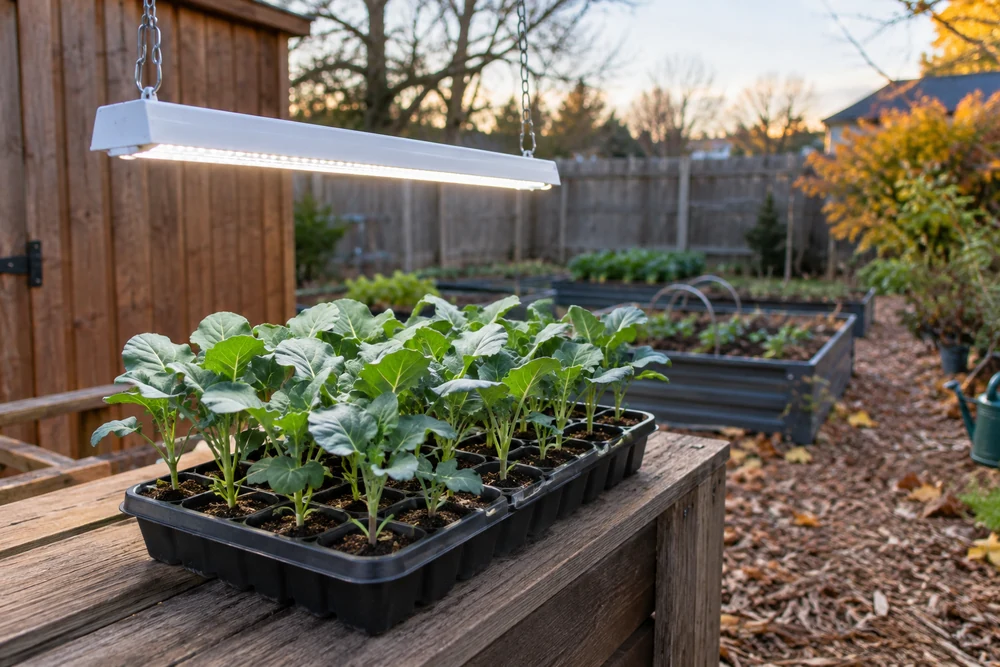
How far should grow lights be from seedlings?
| Light type | Starting distance above seedlings |
|---|---|
| Fluorescent T8 or T12 tubes | 2-4 inches |
| Fluorescent T5 tubes | 2-4 inches, up to about 6 inches for high-output fixtures |
| LED shop lights and strips | About 3-8 inches, depending on brightness |
| High-power LED grow panels | Per the manufacturer’s chart, often 12 inches or more for seedlings |
These are starting points. University of Minnesota Extension advises keeping fluorescents no more than 4 inches above seedlings, with 2 inches ideal. LED output varies so much that the manufacturer’s chart is the best guide. Then watch the plants and adjust over the next few days.
Garden hack: Hold the back of your hand at seedling height under the light for a minute. If it feels warm, the light is too close for a fixture that runs hot. With LEDs, which feel cool, watch the leaves instead: stretching means lower it, bleaching means raise it.
Signs of too little or too much light
Too little light:
- Long, thin stems with wide gaps between leaves
- Pale green leaves and slow growth
- Seedlings leaning toward the light or toward a window
Too much light or light too close:
- White, bleached or yellow patches on the top leaves
- Leaf edges curling down or turning crisp
- Upper leaves noticeably paler than lower ones, directly under the brightest spot
Too little light is by far the more common problem with home setups.
Watch out: Keep electrical cords, power strips and timers away from water. Plug everything into a GFCI-protected outlet, never let water drip onto fixtures or connections, and use fixtures rated for damp locations when you can.
DIY seed starting shelf setup
A wire shelving unit is the classic home seed-starting station, and it fits in a basement, spare room or garage that stays above 60°F.
- Choose a shelf unit about 4 feet wide and 18-24 inches deep, with 18 inches or more between shelves.
- Hang two 4-foot LED or fluorescent fixtures per shelf from the shelf above, using chains or adjustable ratchet hangers.
- Plug all fixtures into one power strip connected to an outlet timer, set for 14-16 hours.
- Set trays on the shelf in solid bottom trays to catch water, two trays end to end under each fixture.
- Lower lights to the right height as soon as seedlings emerge, and raise them as they grow.
- Add a small clip-on fan for gentle air movement.
Surrounding the shelf with white foam board or reflective film bounces stray light back onto the plants. The same setup works year-round for an indoor herb garden or for growing microgreens.
The Year-Round Vegetable Garden (2027 Edition)
Plan the whole season in one place: a 225-page month-by-month guide with calendars for six US growing regions, 50 plant profiles (tomatoes included), 5 copy-ready garden plans and 7 printable pages.
Tomato lover? Add Tomato Mastery, our seed-to-harvest tomato blueprint, for just $10 at checkout.
Get the guide ($27)Gear that helps
- Wire shelving unit 48 inch: The classic frame for a multi-tier seed starting station
As an Amazon Associate we earn from qualifying purchases. Check current prices and reviews on Amazon.
Grow light buying checklist
- White, full-spectrum light, ideally with a published PPFD at a stated height
- Size matched to your trays: 4-foot fixtures fit standard shelves and two trays end to end
- Enough fixtures for full coverage, usually one per row of trays
- Easy height adjustment: chains, ropes or ratchet hangers
- Linkable fixtures if you plan several on one shelf, to cut down on cords
- A timer, built-in or plug-in
- Damp-location rating and a reasonable warranty
- For fluorescents: T5 or T8 tubes, and a plan to replace them every few seasons as output fades
Once your lights are up, follow our full guide on how to start seeds indoors and choose the right seed starting trays to fit under them.
Gear that helps
- Adjustable rope ratchet hangers: Makes raising lights as seedlings grow quick and easy
As an Amazon Associate we earn from qualifying purchases. Check current prices and reviews on Amazon.
Common mistakes to avoid
- Hanging lights too high, especially fluorescents. A foot away, most of their useful light is lost.
- Waiting to turn lights on until the seedlings look up. Seedlings stretch within a day of emerging.
- Running lights 24/7, which wastes power and can stress plants.
- Leaving trays at the ends of tubes, where fluorescent light is weakest.
- Relying on lumen ratings alone. They describe brightness to people, not plants.
- Keeping old fluorescent tubes long after their output has faded.
FAQ
What is the best grow light for seedlings?
A white, full-spectrum LED fixture you can hang close to the plants and adjust as they grow. Fluorescent T5 or T8 tubes also work well if kept 2-4 inches above the leaves.
Can I use regular LED shop lights for seedlings?
Yes. Bright white LED shop lights grow good vegetable seedlings when hung a few inches above them and run 14-16 hours a day.
How long should grow lights be on for seedlings?
Run them 14-16 hours a day on a timer. Extension guidance ranges from 12 to 16 hours, and seedlings need at least several hours of darkness.
Can seedlings get too much light?
Yes, a very bright light hung too close can bleach or scorch the top leaves. Raise the fixture a few inches if you see white or yellow patches.
Do seeds need light to germinate?
Most vegetable seeds do not need light to sprout, but lettuce and celery do. All seedlings need bright light as soon as they emerge.
Are purple grow lights better than white?
Not for seedlings. They grow plants, but white full-spectrum light works just as well and lets you see true leaf color.
Keep reading
Sources
- Starting seeds indoors – University of Minnesota Extension
- Starting Vegetable Seeds Indoors: II. Materials – Utah State University Extension
- Important Considerations for Providing Supplemental Light to Indoor Plants – Iowa State University Extension
- Lighting Can Be Tricky When Starting Seeds Indoors – Oklahoma State University Extension
- Bulletin #2751, Starting Seeds at Home – University of Maine Cooperative Extension
- Starting Seeds Indoors – Clemson Cooperative Extension, Home & Garden Information Center