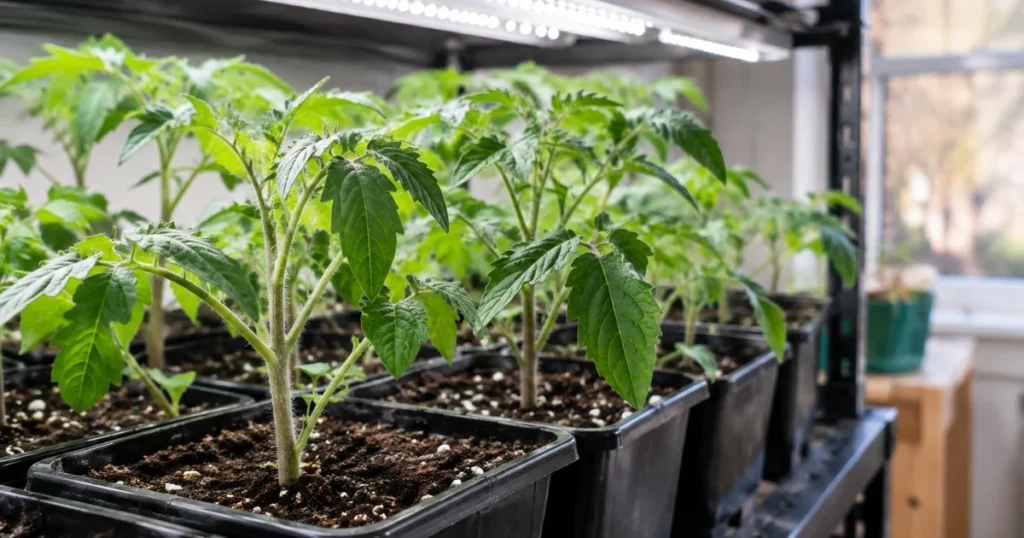
Tomato seedlings need four things once they sprout: strong light 14 to 16 hours a day, cool-but-not-cold temperatures, careful watering, and a bigger pot when the first true leaves show. Bury part of the stem every time you pot up, harden plants off for a week or two, and move them outside only when the soil is about 60°F and nights stay above 50°F.
Quick answer
- Keep grow lights 2 to 4 inches above the leaves for 14 to 16 hours a day.
- Aim for 65-75°F by day and 55-65°F at night after germination.
- Pot up into 3- to 4-inch pots when the first true leaves appear, burying the stem up to the seed leaves.
- Harden off for 7 to 14 days, then transplant when soil reaches about 60°F, usually 1 to 3 weeks after your last frost.
- Ideal transplants are 6 to 8 weeks old, 6 to 10 inches tall, with stems about as thick as a pencil.
In this guide
- Tomato seedling care: the first three weeks
- When and how to feed tomato seedlings
- Potting up tomato seedlings
- Leggy tomato seedlings: causes and fixes
- Yellow or purple tomato seedlings: what it means
- Hardening off tomato seedlings
- When to transplant tomato seedlings outside
- Transplanting tomato seedlings: step by step
- Common mistakes to avoid
- FAQ
 Grow tomatoes in season for your region, month by month: The Year-Round Vegetable Garden ($27, PDF).
This guide picks up where sowing ends. If your seeds have not sprouted yet, start with our guide to growing tomatoes from seed, then come back here once the first green loops break the surface.
Tomato seedling care: the first three weeks
The moment seedlings emerge, their needs change. Remove any humidity dome, take trays off the heat mat, and get them under bright light the same day. Warm, dim conditions are exactly what produces thin, floppy stems.
Light: the factor that matters most
A sunny window is rarely enough in late winter and early spring, even facing south. University of Maryland Extension recommends grow lights just 1 to 2 inches above the tops for 14 to 16 hours a day, and Wisconsin Extension suggests 16 hours with the lights no more than 4 inches away. Raise the fixture as the plants grow so the gap stays the same.
Use a simple outlet timer so the lights switch on and off at the same time every day. Seedlings also need a dark period, so leaving lights on around the clock is not helpful. Our guide to grow lights for seedlings covers fixture types and setup.
Temperature: cooler than germination
Tomato seeds sprout best in warm soil, but the plants that follow grow stockier a little cooler. Extension recommendations fall in a narrow band:
- Daytime: about 65-75°F.
- Nighttime: about 55-65°F. University of Maryland Extension suggests 55-60°F at night with 65-70°F during the day.
Heat combined with weak light is the classic recipe for leggy seedlings, so a cool basement under good lights often beats a warm kitchen counter.
Watering without drowning them
Water when the surface of the mix is nearly dry, and keep it moist rather than wet. Bottom watering works well: set cells in a shallow tray of water, let the mix wick moisture up, and pour off what remains after about 30 minutes. Saturated mix stops root growth and invites damping off, the fungal problem that makes young stems pinch and collapse at the soil line.
Garden hack: Lift a cell tray before and after watering. Once you know how light a dry tray feels, you can tell by weight alone when it needs water, without poking the mix.
Air movement
Gentle movement makes stems thicker. Utah State University Extension recommends brushing plants daily or exposing them to light wind. Run your palm lightly across the tops for a few seconds each day, or point a small fan near (not directly at) the tray for a few hours.
Gear that helps
- LED grow light for seedlings: Lets you keep light 2 to 4 inches above the leaves and raise it as seedlings grow.
As an Amazon Associate we earn from qualifying purchases. Check current prices and reviews on Amazon.
When and how to feed tomato seedlings
Fresh seed starting mix contains little or no fertilizer, while many potting mixes carry enough for several weeks. University of Maryland Extension notes that most potting mixes supply nutrients for 5 to 6 weeks; if seedlings will stay indoors longer, a soluble fertilizer becomes useful.
A common extension approach is a balanced water-soluble fertilizer at half strength every other week once true leaves appear, moving to full label strength as plants pass about 4 inches tall. Always follow the product label, and rinse off any solution that splashes on young leaves.
Watch out: More fertilizer does not mean bigger, better seedlings. Too much nitrogen produces soft, lanky growth and can burn roots in small cells. Feed lightly and let light do the heavy lifting.
Potting up tomato seedlings
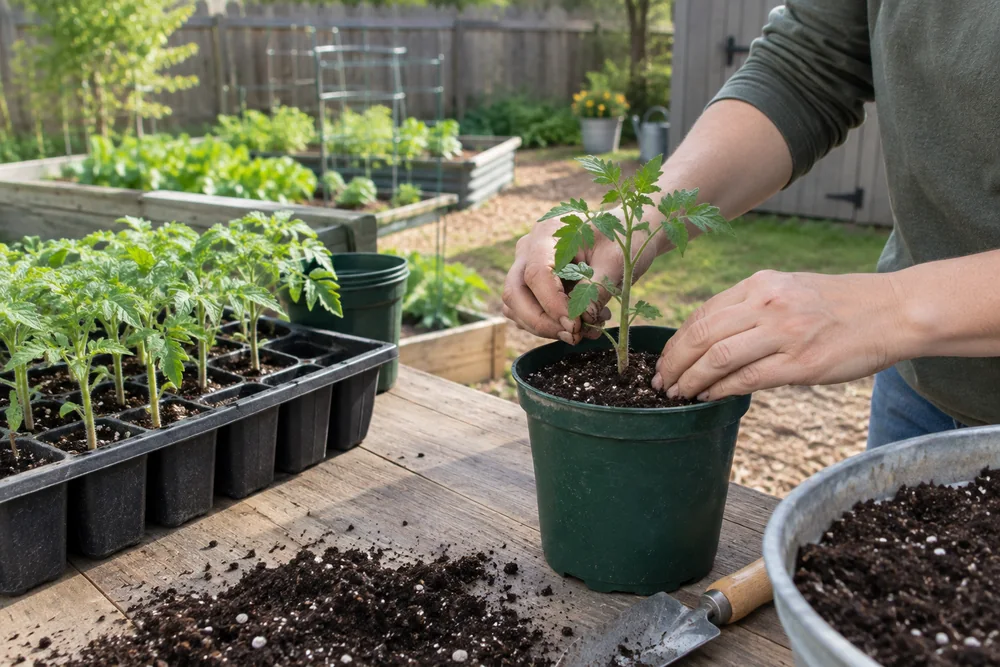
Potting up means moving a seedling from its small cell or seed flat into a larger container before the roots run out of room. University of Maryland Extension advises doing it when the first true leaves appear, while plants are small and recover quickly. Leaving seedlings in crowded flats too long is one of the most common mistakes.
Step-by-step: potting up and burying the stem
- Water the seedlings an hour before. Moist root balls slide out intact.
- Fill 3- to 4-inch pots partway with moist potting mix.
- Hold seedlings by a leaf, never the stem. A torn leaf can be replaced; a crushed stem cannot.
- Ease out the root ball by pushing up from the bottom of the cell or using a plant label as a lever.
- Set the seedling deep, so the mix comes up close to the seed leaves (the first pair of round leaves). Tomatoes grow roots all along buried stem, so this turns a leggy seedling into a sturdier one.
- Firm gently and water in to settle the mix around the roots.
- Keep them out of strong light for a day if they wilt, then return them under the lights.
If seedlings outgrow 4-inch pots before the weather allows planting out, Oregon State University Extension suggests moving them into 1-gallon containers, again setting them deeper and removing the lowest leaves.
Garden hack: Potting up twice, from cell to 4-inch pot to quart or gallon, is the easiest way to rescue seedlings that got tall. Each move buries a few more inches of stem.
Gear that helps
- 4-inch plastic nursery pots: The right size for the first potting up, with room to bury the stem.
As an Amazon Associate we earn from qualifying purchases. Check current prices and reviews on Amazon.
Leggy tomato seedlings: causes and fixes
Leggy seedlings have long, thin, pale stems with widely spaced leaves, and they often flop over. Iowa State and Maryland extension specialists point to the same main cause: not enough light, usually made worse by warm temperatures and crowding.
- Lower the lights to 2 to 4 inches and confirm they run 14 to 16 hours.
- Drop the room temperature a few degrees, especially at night.
- Thin or space out crowded plants so leaves do not shade each other.
- Pot up deeper. Burying the stem is the fix most gardeners overlook.
- Brush the tops daily to encourage thicker stems.
Our full guide to fixing leggy seedlings covers other crops too.
Yellow or purple tomato seedlings: what it means
| Symptom | Likely cause | What to do |
|---|---|---|
| Pale or yellowing lower leaves | Nutrients used up after several weeks in the same mix, or roots sitting in soggy mix | Start light feeding; let the surface dry between waterings; pot up if roots circle the cell |
| Purple undersides or purple stems | Cool temperatures limiting phosphorus uptake; general stress | Keep nights above 55°F; avoid chilly windowsills; plants usually outgrow it once planted in warm soil |
| White or papery patches on leaves | Sunscald from sudden full sun | Harden off more gradually; new leaves will be fine |
| Stem pinched and collapsed at soil line | Damping off | Discard affected plants; use fresh mix; water less often; improve airflow |
| Long, thin stems | Low light, heat, crowding | Lower lights, cool the room, pot up deeper |
An Extension expert answering a question about purple tomato seedlings described the color as a stress response tied to cool conditions and phosphorus uptake, and noted that plants typically grow out of it after transplanting. Clemson’s tomato fact sheet also lists purplish veins as a normal sign during hardening off.
Hardening off tomato seedlings
Seedlings raised indoors have never felt wind, direct sun, or cool nights. Hardening off introduces those conditions gradually over 7 to 14 days. Wisconsin Extension suggests starting with about an hour of morning sun and adding roughly 15 minutes a day, while Clemson HGIC recommends beginning in bright, indirect light under a tree or covered porch.
- Days 1-3: Shade or dappled light, sheltered from wind, for 1 to 3 hours.
- Days 4-6: Add morning sun and a few more hours outside.
- Days 7-10: Full sun most of the day; leave them out on mild nights.
- Days 10-14: Outside day and night, ready to plant.
Ease off on watering slightly during this period, but never let plants wilt hard. Bring them in if nights drop below about 45°F. See our hardening off schedule for a printable day-by-day plan.
When to transplant tomato seedlings outside
Tomatoes are frost-tender, and cold soil stalls them even without frost. Oregon State and Wisconsin extension guidance both point to a soil temperature of about 60°F, and Wisconsin adds that overnight lows should stay above 45-50°F. In practice, that is usually 1 to 3 weeks after your average last frost date. A good transplant is 6 to 8 weeks old, 6 to 10 inches tall, and stocky.
| USDA zone | Typical last frost | Usual window to transplant tomatoes |
|---|---|---|
| 3-4 | Mid-May to early June | Early to mid-June |
| 5 | Early to mid-May | Late May to early June |
| 6 | Late April to early May | Mid- to late May |
| 7 | Early to mid-April | Late April to mid-May |
| 8 | Mid-March to early April | Early to mid-April (fall crop: July-August) |
| 9-10 | Rare frost to late February | February to March, and again August to September for a fall crop |
These dates are averages. Your USDA zone reflects average winter lows, not frost dates, so look up your local frost dates or call your county extension office before planting; microclimates vary a lot. Our when to plant tomatoes guide goes deeper by region.
Garden hack: A cheap soil thermometer pushed 4 inches deep at 8 a.m. tells you more than the calendar. Three mornings in a row at 60°F or higher means go.
Gear that helps
- Soil thermometer: Shows when soil has reached about 60°F so you can transplant with confidence.
As an Amazon Associate we earn from qualifying purchases. Check current prices and reviews on Amazon.
Transplanting tomato seedlings: step by step
- Pick a calm, cloudy day or late afternoon to reduce transplant shock.
- Water the plants in their pots an hour before.
- Strip the lowest leaves and dig a hole deep enough to bury the stem up to the top two or three sets of leaves. Penn State Extension suggests planting 5 to 6 inches deep.
- Trench leggy plants: lay the stem sideways in a shallow trench and gently bend the top upright. The roots stay in warmer soil near the surface.
- Space plants about 2 feet apart for determinate types and 3 feet for indeterminate types, or 18 to 24 inches if staked.
- Set stakes or cages now, before roots spread.
- Water deeply and add mulch once the soil has warmed.
For everything that happens after planting, from staking to harvest, see our complete guide on how to grow tomatoes.
Common mistakes to avoid
- Leaving seedlings on a heat mat after they sprout.
- Relying on a windowsill alone for light in late winter.
- Keeping lights too far above the plants.
- Watering on a schedule instead of checking the mix.
- Waiting too long to pot up, so roots circle and plants stall.
- Starting seeds too early, which leaves oversized plants waiting indoors.
- Skipping hardening off and moving plants straight into full sun.
- Planting into cold soil just because the frost date has passed.
FAQ
How often should I water tomato seedlings?
Water when the surface of the mix is nearly dry, which may be daily or every few days depending on cell size, temperature, and light. Keep the mix moist but never soggy.
When should I pot up tomato seedlings?
Pot up when the first true leaves appear or when roots start to fill the cell. Move them into 3- to 4-inch pots and bury the stem up to the seed leaves.
Can you bury tomato seedlings deep?
Yes. Tomato stems grow roots wherever they are buried, so planting deeper at each potting up and at transplant gives a larger root system and a sturdier plant.
How big should tomato seedlings be before transplanting?
Aim for plants 6 to 8 weeks old and about 6 to 10 inches tall, with a stocky stem roughly the width of a pencil and several sets of true leaves.
Why are my tomato seedlings turning purple?
Purple stems or leaf undersides usually signal cool temperatures that limit phosphorus uptake, or general stress. Keep nights above 55°F; most plants outgrow it once planted in warm soil.
What temperature is too cold for tomato seedlings?
Bring hardening-off seedlings indoors if nights drop below about 45°F. Wait to transplant until soil is near 60°F and night lows stay above 45-50°F.
Keep reading
Sources
- Care of Vegetable Seedlings – University of Maryland Extension
- Growing Tomatoes Handout – University of Wisconsin-Madison Extension, Pierce County
- Transplant Production: Tomato, Pepper, Eggplant – Utah State University Extension
- Tomatoes: From Seedlings to Fruit – Penn State Extension
- Growing Tomatoes – Oregon State University Extension Service
- Tomato Fact Sheet – Clemson Cooperative Extension, Home & Garden Information Center
- Purple Leaves and Stems on Tomato Seedlings – Ask Extension
- Why Are My Indoor-Started Plants Tall and Spindly? – Iowa State University Extension