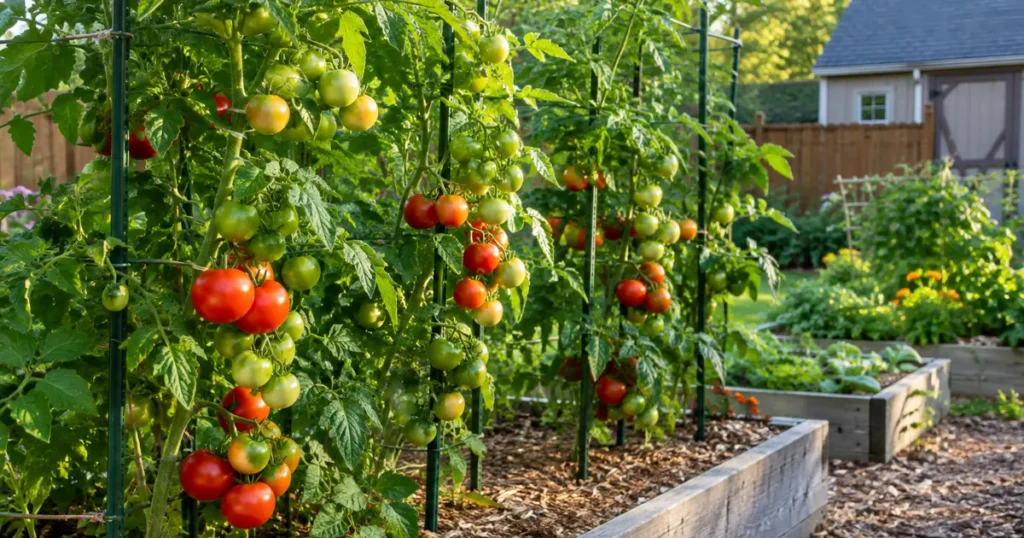
To grow tomatoes, set out sturdy transplants in full sun after your last frost, once the soil is at least 60°F and nights stay above 50°F. Bury the stem deep, give each plant a stake or cage, water about 1 to 2 inches a week on a steady schedule, and feed lightly. Most varieties start ripening 55 to 85 days after transplanting.
This guide follows the season in order, from picking a variety to the last harvest before frost, with timing for every USDA zone. Each section links to a deeper guide when you need more detail.
Quick answer
- Plant transplants 1-2 weeks after your average last frost, when soil is 60°F or warmer and nights hold above 50°F.
- Choose a spot with 6-8 hours or more of direct sun and well-drained soil with a pH around 6.2-6.8.
- Bury the stem up to the first set of leaves, or lay leggy plants sideways in a trench.
- Water deeply and evenly, about 1-2 inches a week, and mulch once the soil has warmed.
- Go easy on nitrogen: too much gives you a big green bush and few tomatoes.
In this guide
- Tomato growing basics at a glance
- Step 1: Choose the right tomato varieties
- Step 2: Time your planting by zone
- Step 3: Start from seed or buy transplants?
- Step 4: Pick the site and prepare the soil
- Step 5: How to plant tomato plants
- Step 6: Support your plants with stakes, cages or a trellis
- Step 7: Watering tomatoes the right way
- Step 8: Mulching tomatoes
- Step 9: Fertilizing tomatoes without overdoing it
- Step 10: Pruning tomatoes and removing suckers
- Common tomato problems (and what causes them)
- Harvesting tomatoes and ripening
- Growing tomatoes in containers
- Common mistakes to avoid
- FAQ
 Grow tomatoes in season for your region, month by month: The Year-Round Vegetable Garden ($27, PDF).
Tomato growing basics at a glance
Tomatoes are warm-season plants. They cannot take frost, they sulk in cold soil, and they stop setting fruit in extreme heat. Everything about growing them well comes back to giving them warmth, sun, steady water and support.
| What tomatoes need | Target |
|---|---|
| Sun | Full sun, at least 6-8 hours a day |
| Soil temperature at planting | 60°F or warmer at a 4-inch depth |
| Night temperatures | Steadily above 50°F at planting; fruit sets best between about 55°F and 75°F |
| Soil pH | About 6.2-6.8 (slightly acidic) |
| Spacing | 18-24 inches staked, 24-36 inches caged, 3-4 feet sprawling |
| Water | About 1-2 inches per week, applied deeply and evenly |
| Seed to transplant | 6-8 weeks indoors |
| Transplant to first ripe fruit | About 55-85 days, depending on variety |
Step 1: Choose the right tomato varieties
Variety choice affects everything that follows: how tall the plant gets, what support it needs, when it ripens and how well it shrugs off disease. Start with three questions.
Determinate or indeterminate?
Determinate (bush) tomatoes grow to a set size, then flower and ripen most of their crop over a few weeks. They suit containers, short seasons and anyone who wants a big batch for canning. Indeterminate tomatoes keep growing and producing until frost, often reaching 6 feet or more, and need tall stakes or sturdy cages. Our guide to determinate vs indeterminate tomatoes explains how to tell them apart on a seed packet.
Which type of fruit?
Cherry, grape, paste (Roma), slicer, beefsteak and heirloom tomatoes all grow the same way, but they differ in size, flavor, days to maturity and heat tolerance. Cherry types ripen first and keep setting fruit in hotter weather than big beefsteaks. See our overview of types of tomatoes for what each one is best at.
Disease resistance and days to maturity
Look for letters after the variety name, such as V, F, N or TSWV. They mean resistance to Verticillium wilt, Fusarium wilt, root-knot nematodes or tomato spotted wilt virus. Resistant hybrids are the easiest path for beginners, especially in the humid South.
In zones 3-4, pick varieties that ripen in about 55-70 days from transplant. In zones 5-7 you can grow almost anything. In zones 8-10, favor heat-tolerant and cherry types that keep setting fruit as summer heats up. Our list of the best tomatoes to grow sorts proven picks by goal and climate.
Garden hack: Grow at least one cherry tomato alongside your main slicers. It ripens first, keeps producing when big tomatoes stall in the heat, and gives you a harvest even in a rough year.
Step 2: Time your planting by zone
Tomatoes go outside after your average last frost, once the soil has warmed. In most of the country that means 1-2 weeks after the frost date. Seeds go under lights 6-8 weeks before that transplant date. In zones 8-10, summer heat matters as much as frost, so many gardeners plant twice: once in late winter or spring, and again in mid to late summer for a fall crop.
| USDA zone | Typical last frost | Start seeds indoors | Transplant outside | Fall crop |
|---|---|---|---|---|
| 3 | Mid-May to early June | Mid to late April | Early to mid-June | No |
| 4 | Early to late May | Early to mid-April | Late May to early June | No |
| 5 | Late April to mid-May | Late March to early April | Mid to late May | No |
| 6 | Mid-April to early May | March (mid to late is typical) | Early to mid-May | Transplants by mid-June for a late crop |
| 7 | Late March to mid-April | Late February to mid-March | Late April to mid-May | Transplant late June to mid-July (7b) |
| 8 | Early March to early April | Mid-January to mid-February | Late March to April (mid to late May in the Pacific Northwest) | Transplant late June to mid-July |
| 9 | Late January to early March | December to January | Mid-February to March | Transplant late July to early September |
| 10 | Rare | December to January; July for fall | Florida: August to February; low desert: February to March; SoCal coast: mid-March to May | Fall is the main season in South Florida |
These are typical windows. Frost dates vary a lot within a zone, so look up yours by ZIP code with our frost dates by zone guide or ask your local extension office. For the full timing rules, including soil temperature and how to protect early plantings, read when to plant tomatoes.
Step 3: Start from seed or buy transplants?
Almost everyone grows tomatoes from transplants, because the plants need a long warm season that most of the country cannot offer from a direct sowing. You can grow your own or buy them.
Growing your own seedlings
Starting seeds indoors gives you access to hundreds of varieties instead of the dozen at the garden center. Sow seeds 1/4 inch deep in a sterile seed-starting mix, keep the mix at about 75-85°F until sprouts appear, then grow them under bright lights at around 65-75°F. Start 6-8 weeks before your transplant date, not earlier: older seedlings get root-bound and leggy and often stall after planting. Our step-by-step guide on how to grow tomatoes from seed covers the whole process.
Buying transplants
Choose stocky, dark green plants about 6-10 inches tall with 5-7 leaves and no flowers or fruit yet. Plants that are already blooming in the pot tend to establish slowly. Skip anything with spotted leaves or yellowing at the base.
Harden them off
Whether you grew them or bought them from a greenhouse, give transplants 7-10 days to adjust to sun, wind and outdoor temperatures before planting. Start with an hour or two in a sheltered, shaded spot and increase the exposure each day. Our hardening off schedule lays out each day.
Step 4: Pick the site and prepare the soil
Tomatoes want full sun, at least 6-8 hours of direct light a day. More sun means more fruit and better flavor. Choose a spot with good air flow, which helps leaves dry quickly after rain and slows disease.
Rotate your planting site. Avoid ground where you grew tomatoes, potatoes, peppers, eggplant or tomatillos in the last 3-4 years, because these crops share many soil-borne diseases. Keep tomatoes well away from black walnut trees, whose roots release juglone, a compound tomatoes are very sensitive to.
Soil and pH
The best tomato soil is deep, loose and well drained, with plenty of organic matter. Work 2-3 inches of compost into the top 6-8 inches before planting. In heavy clay or soggy spots, a raised bed 8-12 inches tall solves most drainage problems.
Aim for a pH around 6.2-6.8. A soil test from your extension office tells you your pH and which nutrients you already have, so you add only what is missing. See how to test soil pH if you have never checked yours. Lime raises pH and elemental sulfur lowers it, but both take months to work, so adjust in fall if you can.
Gear that helps
- Soil test kit: Checks pH before planting so you can target the 6.2-6.8 range.
As an Amazon Associate we earn from qualifying purchases. Check current prices and reviews on Amazon.
Step 5: How to plant tomato plants
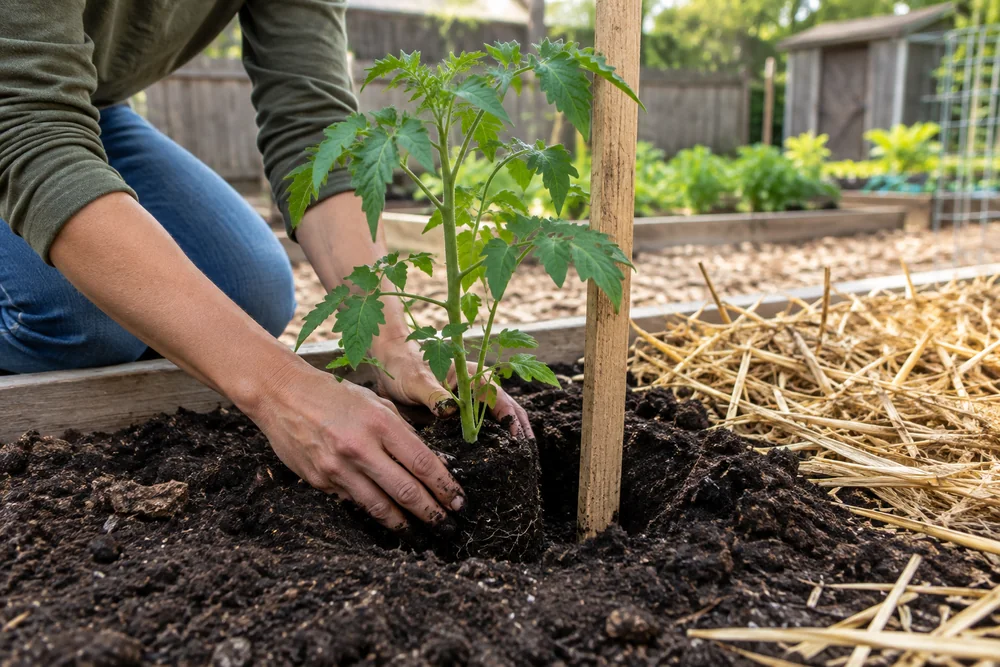
Tomatoes are one of the few vegetables you should plant deeper than they grew in the pot. Hairs along the stem turn into roots when buried, giving you a stronger plant that handles drought better.
- Water the transplants well an hour before planting.
- Set supports first. Drive stakes or place cages now, so you do not spear the roots later.
- Dig deep. Make a hole deep enough to bury the stem up to the first set of true leaves. Pinch off any leaves that would end up below ground.
- Go sideways for tall plants. For leggy transplants, dig a trench 3-4 inches deep, lay the root ball and lower stem on its side, and gently bend the top upright. The buried stem roots along its length, and the roots stay in warmer surface soil.
- Peat pots: tear off the rim or bury it completely, or the exposed edge wicks water away from the roots.
- Backfill and firm the soil, then water slowly until the root zone is soaked.
- Plant on a cloudy day or late afternoon to reduce transplant shock.
Tomato spacing
Small transplants look lonely at first, but crowded tomatoes stay damp, shade each other and spread disease. Space by the support you plan to use.
| Growing method | Between plants | Between rows |
|---|---|---|
| Staked, pruned to 1-2 stems | 18-24 inches | 3-4 feet |
| Caged | 24-36 inches | 4-5 feet |
| Sprawling on the ground (determinate) | 3-4 feet | 4-5 feet |
| Containers | One plant per 5-gallon (or larger) pot | Pots 2-3 feet apart |
Step 6: Support your plants with stakes, cages or a trellis
Supported plants have cleaner fruit, fewer rots, better air flow and easier picking. Install the support on planting day.
Stakes
Use a stake 6-8 feet long for indeterminate varieties, driven 12-18 inches into the ground about 3-4 inches from the stem. Tie the main stem loosely every 12 inches with soft cloth or garden tape in a figure-eight loop. Staking works best when you prune the plant to one or two main stems.
Cages
The small cone cages sold at garden centers suit determinate plants. Indeterminate tomatoes need a stronger, taller cage, such as one made from concrete reinforcing wire about 5 feet tall and 18-24 inches across, with openings large enough to reach through. Caged plants need little pruning and produce more fruit, though it may ripen a bit later. Anchor cages with a stake so a summer storm cannot tip them over.
Trellis and stake-and-weave
For a row of plants, set a sturdy post every 2-3 plants and run garden twine along both sides of the row, adding a new level every 8-12 inches as the plants grow. This “Florida weave” holds plants upright with very little tying. Cattle panels or a string trellis from an overhead beam also work well for indeterminate types.
Gear that helps
- Heavy-duty tall tomato cages: Indeterminate tomatoes outgrow flimsy cone cages; sturdy tall cages keep plants upright all season.
As an Amazon Associate we earn from qualifying purchases. Check current prices and reviews on Amazon.
Step 7: Watering tomatoes the right way
Tomatoes need about 1-2 inches of water a week from rain or irrigation, more in hot, windy weather and sandy soil. Consistency matters more than the exact number. Swings between dry and soaked soil are behind blossom end rot and fruit cracking.
- Water deeply, less often. One or two thorough soakings a week beat a daily sprinkle. Deep water builds deep roots.
- Water the soil, not the leaves. Drip lines or soaker hoses keep foliage dry and reduce leaf diseases. Water in the morning if you must use a sprinkler.
- Check before you water. Push a finger or trowel 2-3 inches into the soil. If it is dry at that depth, water.
- Containers dry fast. Large plants in pots may need water every day in summer, sometimes twice.
Garden hack: Put an empty tuna can or rain gauge under your sprinkler or next to your drip line and time how long it takes to collect 1 inch. Now you know exactly how long to run the water each week.
Gear that helps
- Drip irrigation kit or soaker hose: Delivers deep, even moisture at the base and keeps leaves dry, reducing blossom end rot and leaf disease.
As an Amazon Associate we earn from qualifying purchases. Check current prices and reviews on Amazon.
Step 8: Mulching tomatoes
Mulch keeps soil moisture even, blocks weeds and stops soil from splashing onto lower leaves, which is how many leaf diseases spread. Apply 2-4 inches of weed-free straw, shredded leaves or untreated grass clippings around the plants.
Timing matters. Organic mulch keeps the soil cool, so wait until the soil has warmed and plants are growing well, usually 2-4 weeks after transplanting in the North. In short-season zones, black plastic laid before planting does the opposite: it warms the soil and gives you an earlier start. Cut holes for the plants and keep stems from touching the plastic.
Step 9: Fertilizing tomatoes without overdoing it
Tomatoes are heavy feeders, but too much nitrogen gives you large, leafy plants that flower late and set little fruit. Let a soil test guide you when you can.
- At planting: mix compost and a balanced fertilizer into the bed following your soil test or the product label, often about 2-3 pounds of a 10-10-10 type product per 100 square feet. Many soils already have plenty of phosphorus.
- Side-dress when fruit sets: when the first fruits are about 1 inch across, scatter a small amount of fertilizer around each plant, about 6 inches from the stem, and water it in. Repeat every 3-4 weeks while plants are producing.
- Read the leaves: dark green, bushy plants with few flowers need less nitrogen, not more.
Organic gardeners can use compost, aged manure and organic tomato fertilizers. Follow the label for amounts.
Step 10: Pruning tomatoes and removing suckers
Suckers are the shoots that sprout in the angle between a leaf and the main stem. Each one becomes another stem with its own flowers.
- Indeterminate, staked: remove most suckers while they are small, keeping one or two main stems. You get fewer but larger, earlier tomatoes on a tidy plant.
- Indeterminate, caged: prune lightly or not at all. The extra foliage shades fruit from sunscald.
- Determinate: remove only the suckers below the first flower cluster. Pruning above it cuts your harvest, since these plants do not keep growing.
Snap suckers off by hand when they are 2-4 inches long, on a dry morning. Also remove the lowest leaves that touch the soil once plants are 2-3 feet tall. In late summer in the North, pinch off new flowers and the growing tips about 4-6 weeks before your first fall frost so the plant puts its energy into fruit that can still ripen.
Common tomato problems (and what causes them)
Most tomato trouble comes from weather, watering or a handful of well-known diseases and pests. Here is a quick guide to the big ones.
| Problem | What you see | Main cause and fix |
|---|---|---|
| Blossom end rot | Dark, sunken, leathery patch on the bottom of the fruit | Calcium not reaching the fruit, usually from uneven watering. Keep moisture steady, mulch, and avoid excess nitrogen. |
| Cracking | Splits in rings or lines around the stem end | A sudden flush of water after a dry spell. Water evenly; pick fruit at first color before heavy rain. |
| Early blight and Septoria leaf spot | Brown spots on lower leaves, which yellow and drop | Fungi that splash up from soil. Mulch, water at the base, remove infected leaves, rotate crops. |
| Late blight | Large, greasy gray-green patches on leaves and stems; brown, firm fruit rot | A fast-spreading disease favored by cool, wet weather. Remove and bag infected plants; do not compost them. |
| Tomato hornworms | Stripped leaves, dark droppings, large green caterpillars | Handpick at dusk or dawn. Leave any covered in white cocoons; those carry parasitic wasps. |
| Blossom drop | Flowers fall off without setting fruit | Nights below about 55°F or above about 75°F, or days above 90°F. It usually resolves when weather moderates. |
For any pest or disease product, choose one labeled for tomatoes or vegetables and follow the label. Your extension office can confirm a diagnosis from a photo or sample.
Watch out: Late blight can wipe out tomatoes and potatoes across a whole neighborhood within days. If you see it, pull infected plants, seal them in a bag and put them in the trash, and let your local extension office know.
Harvesting tomatoes and ripening
Pick tomatoes when they are fully colored and still firm, or as soon as they show their first blush of color. A tomato that has started to change color will finish ripening indoors with no loss of flavor, which also protects it from cracking, birds and squirrels.
- Ripening temperature: tomatoes color best between about 68°F and 77°F. Above about 86°F, red pigment stops forming and fruit can stay orange or yellowish. In hot spells, pick at first color and finish ripening indoors.
- Storage: keep ripe tomatoes on the counter, out of direct sun. The refrigerator dulls flavor and turns the texture mealy.
- End of season: before the first frost, pick every mature green tomato (full size, glossy, often with a pale star on the bottom). Small, hard, deep green fruit rarely ripens well.
Our guide to ripening green tomatoes indoors walks you through the paper bag, box and whole-plant methods. If an early cold snap is coming, covering plants for frost can buy you a few more weeks of harvest.
Growing tomatoes in containers
Patio and balcony gardeners can grow excellent tomatoes in pots. The two rules are big containers and steady water.
- Size: use at least a 5-gallon container for one plant; 10-20 gallons is better for indeterminate varieties. Bigger pots dry out more slowly.
- Varieties: compact determinate, dwarf and cherry types do best. Check the tag for “patio” or “container.”
- Mix: fill with a quality potting mix, never garden soil, which packs down and drains poorly in pots. Make sure there are drainage holes.
- Water and food: water whenever the top inch is dry, which can be daily in summer. Frequent watering washes nutrients out, so feed with a diluted liquid fertilizer every 1-2 weeks or mix in a slow-release fertilizer at planting.
- Support: add a cage or stake at planting and place the pot where it gets 6-8 hours of sun.
Garden hack: Dark pots in full sun can cook roots in July. Group containers together, or slide a light-colored pot around a dark one, to keep the root zone cooler in the South and West.
Gear that helps
- Fabric grow bags 10-20 gallon: Large, breathable containers keep roots cooler and dry out more slowly than small pots.
As an Amazon Associate we earn from qualifying purchases. Check current prices and reviews on Amazon.
Common mistakes to avoid
- Planting too early. Cold soil and chilly nights stunt tomatoes. Plants set out 2 weeks later in warm soil often catch up and pass them.
- Crowding plants. Tight spacing traps humidity and spreads leaf diseases.
- Adding support too late. Driving a stake beside a big plant tears roots.
- Watering in fits and starts. Uneven moisture leads to blossom end rot and cracks.
- Too much nitrogen. Lush leaves, few flowers, late fruit.
- Planting in the same spot every year. Rotate on a 3-4 year cycle to keep soil-borne disease down.
- Using a tiny pot. Anything under 5 gallons dries out too fast for a full-size tomato.
FAQ
How long does it take to grow tomatoes?
Most tomatoes need 55-85 days from transplanting to the first ripe fruit, plus 6-8 weeks from seed to transplant. Cherry and early varieties are fastest; large beefsteaks and many heirlooms take the longest.
How often should I water tomato plants?
Give in-ground tomatoes about 1-2 inches of water a week, usually in one or two deep soakings. Water when the soil is dry 2-3 inches down. Containers may need water every day in hot weather.
How deep should I plant tomato plants?
Bury the stem up to the first set of true leaves, removing any leaves that would end up underground. For leggy plants, lay the stem sideways in a trench 3-4 inches deep and bend the tip upright.
How many tomato plants do I need?
Plan on 2-3 plants per person for fresh eating, and add more if you want to can or make sauce. Paste varieties are the most efficient for sauce.
Do tomatoes need full sun?
Yes. Tomatoes need at least 6-8 hours of direct sun a day to produce well. In very hot desert areas, light afternoon shade or 30-50% shade cloth in midsummer can help plants keep setting fruit.
Should I remove tomato suckers?
Remove most suckers on staked indeterminate plants to keep one or two main stems. Prune caged plants lightly. On determinate plants, remove only the suckers below the first flower cluster.
Keep reading
Sources
- Growing tomatoes in home gardens – University of Minnesota Extension
- Growing Tomatoes in the Home Garden – Ohio State University Extension
- How to Grow Tomatoes in Your Garden – Utah State University Extension
- Tomatoes – UF/IFAS Gardening Solutions
- Florida Vegetable Gardening Guide – UF/IFAS Extension
- Easy Gardening: Tomatoes – Texas A&M AgriLife Extension
- Tomato – Clemson Cooperative Extension Home & Garden Information Center