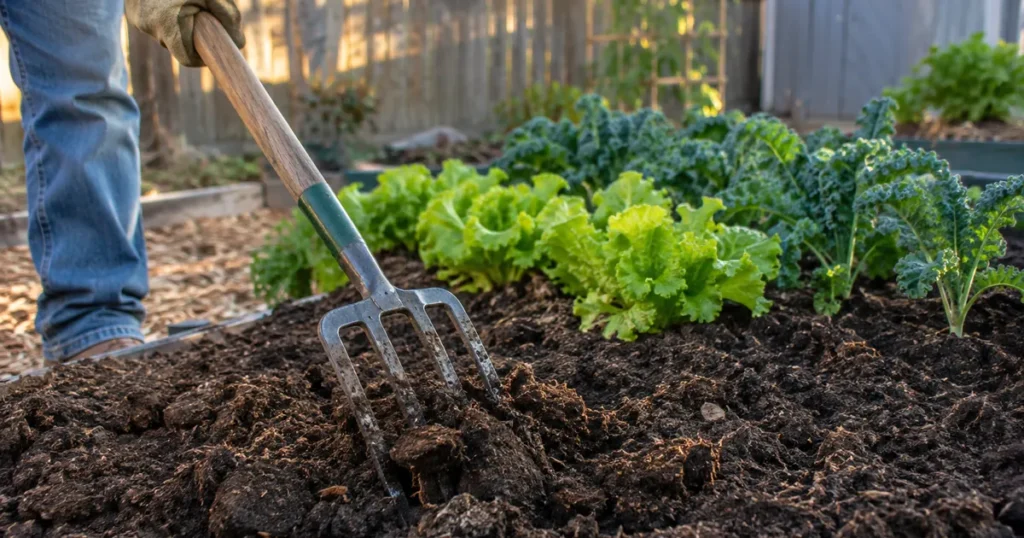
The best garden soil for vegetables is a loose, crumbly loam that drains well, holds moisture, contains about 3-5% organic matter and has a pH between 6.0 and 7.0. Very few yards start out that way. The good news: almost any soil, from sticky clay to fast-draining sand, can get there with compost, mulch, cover crops and less digging.
Quick answer
- Best soil for a vegetable garden: loam or sandy loam, rich in organic matter, pH 6.0-7.0, draining 1-3 inches of water per hour.
- Find out what you have with three free checks (jar test, squeeze test, drainage test) and one cheap lab soil test.
- Fix any soil the same way: add 1-2 inches of compost a year, keep it covered with mulch or cover crops, and stop walking on growing beds.
- Bagged “garden soil” is meant to be mixed into the ground; raised beds need a raised-bed mix and containers need potting mix.
- In older urban neighborhoods, test for lead before growing leafy greens and root crops.
In this guide
- What makes good garden soil?
- Soil texture: sand, silt and clay
- Soil structure: the crumb that roots love
- How much organic matter does garden soil need?
- Soil pH for vegetables: aim for 6.0-7.0
- How to test soil drainage
- Garden soil vs. topsoil vs. potting mix vs. raised-bed mix
- How to improve any garden soil
- When to work on your soil, by USDA zone
- Lead and contamination in urban garden soil
- Common mistakes to avoid
- FAQ
Want every planting date for your region in one place? Get The Year-Round Vegetable Garden (225 pages, $27).
What makes good garden soil?
Healthy garden soil is roughly half solid material and half open pore space. The solids are mostly minerals (sand, silt and clay) plus a small but powerful share of organic matter. The pores hold the air and water roots need. When the balance is right, roots push easily, water soaks in instead of running off, and soil life cycles nutrients for your plants.
Four things decide how a soil behaves:
- Texture: the mix of sand, silt and clay particles. You cannot change it much.
- Structure: how those particles clump into crumbs. You can improve it a lot.
- Organic matter: decomposed plant and animal material that feeds soil life and glues crumbs together.
- Chemistry: pH and nutrient levels, which only a soil test measures reliably.
Soil texture: sand, silt and clay
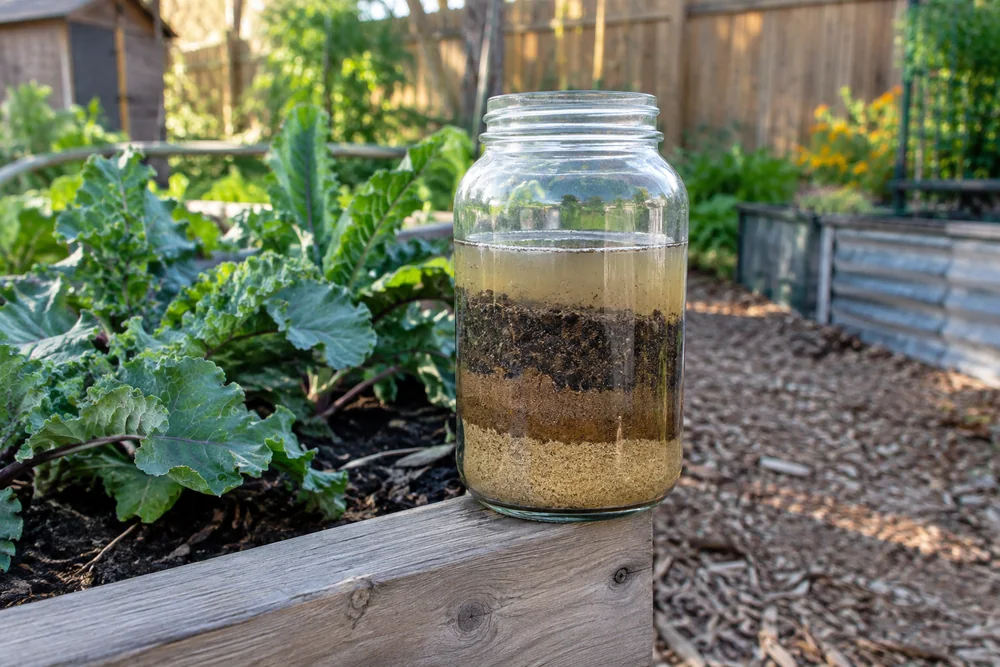
Texture is the ratio of three particle sizes. Sand grains are the largest and feel gritty. Silt feels smooth, like flour. Clay particles are so tiny they feel sticky when wet and turn hard when dry. A soil with a fairly even blend of the three is called loam, the texture gardeners dream about.
| Soil type | How it feels | Strengths | Problems |
|---|---|---|---|
| Sandy | Gritty, falls apart when squeezed | Drains fast, warms early in spring, easy to dig | Dries out quickly, loses nutrients, needs frequent watering |
| Silty | Smooth, slightly slick | Holds moisture and nutrients well | Crusts on the surface, compacts easily |
| Clay | Sticky when wet, rock-hard when dry | Holds nutrients and water, naturally fertile | Drains slowly, cold and late in spring, cracks in summer |
| Loam | Soft, crumbly, holds a loose ball | Balanced drainage, moisture and fertility | Few; still needs organic matter to stay that way |
If you are fighting heavy, sticky ground, our full guide on how to improve clay soil (and sandy soil) goes deeper.
How to do the soil jar test
The jar test gives you a rough texture reading for the price of a canning jar.
- Dig a few trowels of soil from 4-6 inches deep in your garden. Remove stones, roots and debris.
- Fill a straight-sided clear quart jar about one-third full of soil.
- Add water until the jar is nearly full, leaving a little air space. A teaspoon of powdered dishwasher detergent helps the particles separate, though it is optional.
- Cap and shake hard for several minutes until no clumps remain.
- Set the jar on a level surface. After about 1 minute, mark the height of the bottom layer: that is sand.
- After about 2 hours, mark the next layer: silt.
- After 1-2 days, when the water clears, mark the top layer: clay.
- Divide each layer’s height by the total soil height and multiply by 100 to get rough percentages.
A result of roughly 40% sand, 40% silt and 20% clay means loam. More than about 40% clay is a clay soil; mostly sand is sandy soil. Organic matter floats on top and is not counted.
Garden hack: Do the jar test from two or three spots: the old lawn area, the bottom of a slope and near the house foundation. Soil can change within a few yards, especially in new subdivisions where builders spread fill or subsoil.
Soil structure: the crumb that roots love
Structure is how particles stick together into small aggregates, or crumbs. Good structure creates large pores for drainage and air, and small pores that hold water. A clay soil with great structure can grow better vegetables than a loam that has been trampled flat.
Roots, fungi, earthworms and the sticky substances microbes produce build those crumbs. Heavy foot traffic, tilling wet soil and leaving soil bare in hard rain break them down. That is why the improvement methods later in this guide focus on feeding soil life and protecting the surface.
To check structure, dig a spadeful in late spring and break it apart. Rounded, crumbly pieces with visible pores and a few earthworms are a good sign. Hard flat plates, a crust on top or a layer your shovel bounces off point to compaction.
How much organic matter does garden soil need?
Most native soils contain somewhere between 1% and 3% organic matter. Colorado State University Extension suggests building vegetable garden soil toward 3-5% organic matter over a period of years. That small percentage does a huge job. It holds water like a sponge, feeds the microbes that release nutrients, and helps both clay and sand behave more like loam.
A standard lab soil test can report organic matter for little or no extra cost, so you can track progress over time. More is not always better: piling on several inches of manure-based compost every year can raise salts and phosphorus to excessive levels. Plant-based compost at 1-2 inches a year is a safe rhythm for an established garden.
Soil pH for vegetables: aim for 6.0-7.0
Soil pH controls how available nutrients are to roots. Most vegetables grow best in slightly acidic to neutral soil, pH 6.0 to 7.0. Below about 5.5, nutrients such as phosphorus and calcium become less available and some elements can reach toxic levels. Above 7.5, iron, manganese and phosphorus get locked up, which often shows as yellow leaves with green veins.
A few crops break the rule: potatoes tolerate acidic soil (and get less scab in it), while blueberries need pH 4.5-5.5. You cannot guess pH by looking at soil or at your neighbor’s hydrangeas, and you should never add lime “just in case.” Our guide on how to test soil pH walks through lab tests, home kits and a crop-by-crop pH table.
Gear that helps
- Soil sample probe (stainless steel): Takes clean, uniform cores 6-8 inches deep for an accurate lab soil test.
As an Amazon Associate we earn from qualifying purchases. Check current prices and reviews on Amazon.
How to test soil drainage
Vegetable roots need oxygen, and waterlogged soil suffocates them. This simple percolation test, recommended by Iowa State University Extension, tells you whether your garden drains well enough:
- Dig a hole about 12 inches deep and 4-12 inches wide where you plan to grow.
- Fill it with water and let it drain completely. This wets the surrounding soil.
- Refill the hole right away and measure how far the water drops in 15 minutes.
- Multiply that number by 4 to get inches per hour.
| Drainage rate | What it means | What to do |
|---|---|---|
| Less than 1 inch per hour | Poor drainage, typical of heavy clay or compaction | Add organic matter, use cover crops, or build raised beds |
| 1-3 inches per hour | Ideal for most vegetables | Keep it that way with compost and mulch |
| More than 4 inches per hour | Very fast, typical of sand | Add organic matter and mulch to hold water; water more often |
Skip the test right after heavy rain, when the soil is already saturated, and in very wet clay, where digging can smear the hole walls and skew results.
Garden soil vs. topsoil vs. potting mix vs. raised-bed mix
At the garden center, bags labeled “topsoil,” “garden soil,” “raised bed soil” and “potting mix” sit side by side and look alike. They are designed for very different jobs, and using the wrong one is a common reason vegetables struggle.
| Product | What it usually is | Best use | Do not use it for |
|---|---|---|---|
| Native garden soil | The ground in your yard: mineral soil plus whatever organic matter it has | In-ground beds, improved with compost over time | Containers (it compacts and drains poorly in pots) |
| Topsoil (bulk or bagged) | Screened mineral soil, quality varies widely; may come from construction sites | Filling low spots, leveling, as one part of a raised-bed blend | Containers; filling raised beds on its own |
| Bagged “garden soil” | Generally a blend of topsoil or bark fines with compost and other organic materials, sometimes with added fertilizer | Mixing into existing in-ground soil to add organic matter | Containers; filling a raised bed by itself |
| Raised-bed mix | Lighter blend of compost, organic matter and some mineral soil, made to stay loose in a frame | Filling raised beds | Small pots (often too heavy and coarse) |
| Potting mix | Soilless: peat or coir, bark, perlite or vermiculite, little or no actual soil | Containers, grow bags, window boxes | Large in-ground areas (expensive and short-lived) |
Labels are not standardized, so read the ingredient list. University of Maryland Extension notes that many bagged “organic soil” products contain little or no real topsoil and are mostly wood waste, bark fines, compost and peat moss. That is not bad, it just means they act more like an amendment than like soil.
What soil to use in raised beds
A simple, proven fill for a raised bed is about two parts good topsoil to one part compost, or equal parts of each, by volume. For beds built on pavement or for very shallow beds, University of Maryland Extension suggests a 1:1 mix of compost and a soilless growing mix instead. Expect any bed to settle a few inches the first year; top it off with compost each spring or fall. For layout ideas, see how to plan a vegetable garden.
Why potting mix belongs in containers
Garden soil in a pot turns dense, stays soggy at the bottom and suffocates roots. Potting mix is built to keep air spaces open in a small container. Seedlings need something even finer; see our guide to seed-starting mix.
Watch out: Cheap bulk topsoil can carry weed seeds, construction debris, herbicide residue or contaminants. Look at it before you buy: good topsoil is dark, crumbly and smells earthy. Avoid soil that smells sour, looks gray and mottled, or feels sticky or chalky.
Gear that helps
- Organic raised bed soil mix: Ready-made fill for new raised beds, the right product instead of bagged garden soil alone.
As an Amazon Associate we earn from qualifying purchases. Check current prices and reviews on Amazon.
How to improve any garden soil
Whether you start with clay, sand or tired loam, the fix follows the same four soil health principles promoted by the USDA Natural Resources Conservation Service (NRCS): disturb the soil as little as possible, keep it covered, keep living roots in it as much of the year as you can, and grow a diversity of plants.
1. Add compost every year
Compost is the single best soil improver. For a new garden, spread 2-3 inches and mix it into the top 6-8 inches. After that, add 1-2 inches of plant-based compost per year, or about half an inch of manure-based compost, which is richer in salts and nutrients. Make your own with our guide on how to make compost; shredded fall leaves are a free source too.
2. Mulch bare soil
A 2-3 inch layer of straw, shredded leaves or untreated grass clippings around vegetables protects structure from pounding rain, keeps moisture in, moderates soil temperature and feeds worms as it breaks down. Pull mulch back slightly from stems. On paths, wood chips work well.
3. Grow cover crops in the off-season
Cereal rye, oats, crimson clover, hairy vetch and forage radish add roots and organic matter when beds would otherwise sit bare. Legumes add nitrogen; deep-rooted radish and rye help open dense soil. Timing depends on your zone; our cover crops guide has seeding windows and rates.
4. Dig less (no-till or low-till)
Repeated tilling breaks soil crumbs, burns through organic matter and brings buried weed seeds to the surface. Once your beds are established, try spreading compost on top and planting through it. Use a broadfork to loosen compacted spots without flipping the layers. Permanent beds with fixed paths keep feet off the growing area, which prevents most compaction.
5. Fertilize based on a soil test
Compost improves soil but does not always supply enough nitrogen for heavy feeders like corn, tomatoes and squash. A soil test tells you which nutrients you actually need. Many gardens already have plenty of phosphorus, and adding more year after year can cause problems.
Garden hack: Lay cardboard over grass in fall, soak it, and cover it with 4-6 inches of compost and shredded leaves. By spring the grass is dead, worms have pulled organic matter into the soil, and you can plant a new bed without digging up sod.
Gear that helps
- Broadfork: Loosens compacted beds deeply without flipping soil layers, the low-till way to improve structure.
As an Amazon Associate we earn from qualifying purchases. Check current prices and reviews on Amazon.
When to work on your soil, by USDA zone
Fall is the best season for most soil projects in cold and mid zones: there is time for lime and organic matter to settle in before spring. In the South, soil work fits between the summer and fall-winter growing seasons. The table below gives rough windows; check your local frost dates and extension office, because microclimates vary.
| Zone | Fall soil test and amending | Spring: soil usually workable | Notes |
|---|---|---|---|
| 3-4 | Late August to early October, before the ground freezes | Late April to May | Short season; sow cover crops by early September |
| 5 | September to October | Mid to late April | Fall is the main window for lime and compost |
| 6 | September to early November | Late March to April | Clay soils often stay too wet to dig until mid-April |
| 7 | October to November | March | Soil can often be worked in mild winter spells |
| 8 | August to September for fall crops; November to December for spring crops | February to March | Fall and winter are main growing seasons |
| 9-10 | Late summer, before the cool-season garden goes in | Year-round between crops | Heat burns through organic matter fast; add compost with every planting |
Not sure which zone you are in? See USDA hardiness zones explained. Zones are based on average winter low temperatures; frost dates come from local climate data, so look up both.
Lead and contamination in urban garden soil
If you garden in a city, near an older house, along a busy road or on a former industrial lot, test for lead before you plant. Lead from old exterior paint (homes built before the late 1970s), past leaded gasoline and demolition debris can linger in soil for decades. Young children and pregnant people are most at risk, mainly from swallowing or breathing soil dust rather than from eating vegetables.
Many state soil labs offer a lead test as an add-on to a standard soil test. University of Maryland Extension guidance, in short:
- Under about 400 ppm: generally fine for vegetables with good habits (wash produce, keep soil covered, wear gloves).
- About 400-1,000 ppm: grow leafy greens and root crops in raised beds or containers with clean soil and compost at least 8 inches deep; fruiting crops such as tomatoes, peppers and squash take up much less lead.
- Very high levels: contact your extension office; soil replacement or growing only in sealed containers may be needed.
Other good habits: put a barrier such as landscape fabric under raised beds on questionable soil, keep beds well away from old painted walls and the dripline of older homes, rinse produce outdoors, and peel root crops.
The Year-Round Vegetable Garden (2027 Edition)
Plan the whole season in one place: a 225-page month-by-month guide with calendars for six US growing regions, 50 plant profiles (tomatoes included), 5 copy-ready garden plans and 7 printable pages.
Tomato lover? Add Tomato Mastery, our seed-to-harvest tomato blueprint, for just $10 at checkout.
Get the guide ($27)Common mistakes to avoid
- Adding sand to clay. Small amounts make clay harder, not looser. Use organic matter instead.
- Liming without a test. Many Western and Midwestern soils are already alkaline; lime makes them worse.
- Filling raised beds with bagged garden soil alone. It is designed to be blended into the ground and can settle into a dense mass.
- Using garden soil in pots. It drains poorly in containers. Use potting mix.
- Tilling wet soil. If a squeezed handful stays in a sticky ball, wait a few days.
- Leaving beds bare all winter. Mulch or a cover crop protects structure and organic matter.
- Walking on growing beds. Compaction undoes years of soil building.
FAQ
What is the best soil for a vegetable garden?
A loose, crumbly loam or sandy loam with 3-5% organic matter, a pH of 6.0-7.0 and drainage of about 1-3 inches per hour. Most yards are not there yet, but yearly compost, mulch and cover crops move any soil in that direction.
Can I use bagged garden soil in a raised bed?
Bagged garden soil is meant to be mixed into existing ground. For a raised bed, use a product labeled raised-bed mix, or blend topsoil and compost at about 2:1 or 1:1 by volume.
Is topsoil the same as garden soil?
No. Topsoil is mostly screened mineral soil with variable quality. Bagged garden soil is usually topsoil or bark fines blended with compost and other organic materials, sold as an amendment for in-ground beds.
Can I use garden soil in containers?
It is not recommended. Garden soil packs down and drains poorly in pots, starving roots of air. Use a potting mix made from peat or coir, bark and perlite or vermiculite.
How often should I add compost to my garden?
Once a year is enough for most gardens: about 1-2 inches of plant-based compost, or about half an inch of manure-based compost, spread in fall or spring.
How do I know if my soil has lead?
Only a lab test can tell you. Ask your state extension soil lab for a lead test, especially if you live near an older house, a busy road or a former industrial site.
Keep reading
Sources
- Vegetable Gardens: Soil Management and Fertilization – Colorado State University Extension
- Soil Texture Analysis: The Jar Test – Clemson Cooperative Extension HGIC
- Testing and Improving Soil Drainage – Iowa State University Extension and Outreach
- Soil to Fill Raised Beds – University of Maryland Extension
- Lead in Garden Soils – University of Maryland Extension
- Soil Health and Small-Scale Agriculture – USDA Natural Resources Conservation Service
- Garden Soil Preparation – Utah State University Extension