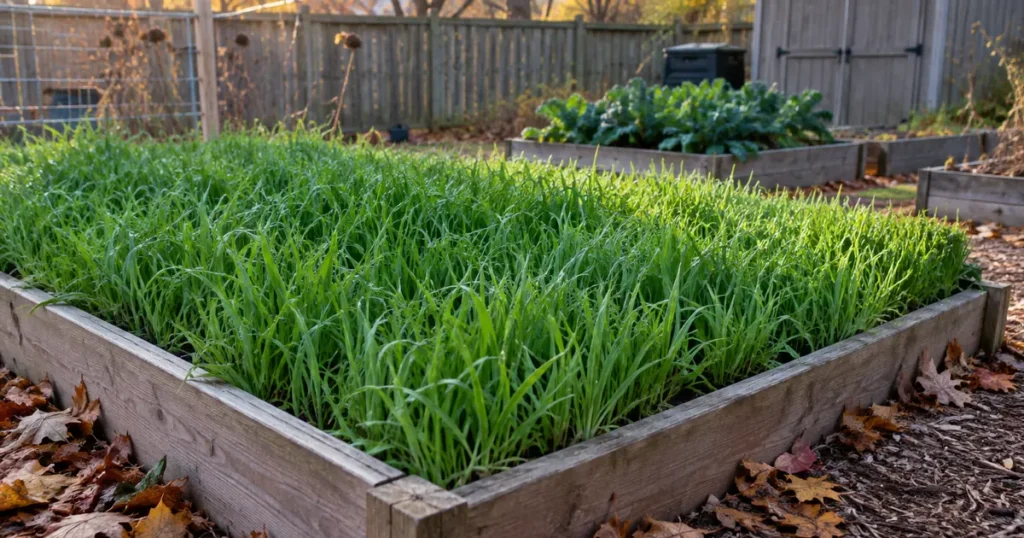
Cover crops are plants you grow to feed and protect the soil instead of your plate. Sow them in late summer or fall on beds you have cleared, let them hold the soil over winter, then cut them down in spring a few weeks before planting. The easiest choices for a home vegetable garden are cereal rye, oats, crimson clover and hairy vetch, plus buckwheat as a quick summer filler.
Quick answer
- Best all-around winter cover crop: cereal (winter) rye, the hardiest and the latest you can sow, at about 2-4 oz of seed per 100 sq ft.
- Want no spring cleanup? Sow oats or spring peas 6-8 weeks before your first frost; in zones 3-6 they die over winter and leave a ready-made mulch.
- For free nitrogen, sow crimson clover or hairy vetch early enough (August to September in most northern zones).
- Kill the cover crop with a mower, string trimmer or tarp, then wait 2-3 weeks before transplanting and 3-4 weeks before sowing small seeds after rye.
- Your latest sowing date depends on your zone; see the table below.
In this guide
- What are cover crops and why grow them in a vegetable garden?
- The best cover crops for home vegetable gardens
- Winter rye cover crop: the complete small-garden method
- Clover cover crop: crimson, white or something else?
- Winter cover crop planting dates by USDA zone
- How to fit cover crops into a small garden
- Common mistakes to avoid
- FAQ
Want every planting date for your region in one place? Get The Year-Round Vegetable Garden (225 pages, $27).
What are cover crops and why grow them in a vegetable garden?
A cover crop is any plant grown mainly for the soil’s benefit. Instead of leaving beds bare from October to April, you keep living roots in the ground, and that buys you:
- Erosion control. Roots keep winter rain and snowmelt from washing topsoil away.
- Nitrogen savings. Grasses like rye “scavenge” leftover nitrogen so it does not leach away, and legumes like clover and vetch pull nitrogen from the air with the help of soil bacteria.
- Organic matter. Every root and stem you cut down in spring becomes food for soil life and, eventually, humus.
- Weed suppression. A thick stand shades out winter annual weeds such as chickweed and henbit.
- Better structure. Fibrous grass roots and deep radish roots open up compacted soil.
Cover crops work alongside compost, not instead of it: spread finished compost in fall, then sow right on top. Pair this guide with our beginner’s method for making compost.
The best cover crops for home vegetable gardens
Seeding rates below are for broadcasting by hand on a small garden. Use the higher number if you sow late or cannot rake the seed in well. Rates are adapted from Purdue Extension’s home-garden cover crop guide; seed companies may list slightly different figures.
| Cover crop | Sowing window | Seed per 100 sq ft | Winter-kills? | Main benefit |
|---|---|---|---|---|
| Cereal (winter) rye | Late summer to late fall; the latest of all | 2-4 oz | No, hardy into zone 3 | Huge root mass, erosion control, nitrogen scavenging, weed suppression |
| Oats | Late summer, 6-8 weeks before first frost (or early spring) | 4-5 oz | Yes, in zones 3-6; may survive in 8-10 | Fast fall cover that dies into a soft mulch, easy spring planting |
| Winter wheat | Late summer to mid-fall | 3-4 oz | No | Less aggressive than rye, slower to bolt in spring |
| Crimson clover | Late summer, 6-8 weeks before first frost | 1-2 oz | Often in zones 5 and colder; overwinters in 6b-8 | Fixes nitrogen, red flowers feed early bees |
| Hairy vetch | Late summer, 30-45 days before a killing frost | 3-4 oz | No, hardy to zone 4 (zone 3 with snow) | Highest nitrogen of the common legumes |
| Field peas (Austrian winter peas) | Late summer to early fall | 3-4 oz | Sometimes; hardy to about 10°F | Nitrogen, breaks down quickly in spring |
| Buckwheat (summer) | Late spring to late summer, after frost danger | 3-4 oz | Yes, the first frost kills it | Smothers weeds in 4-6 weeks, flowers for pollinators |
A simple, reliable mix for beginners is rye plus hairy vetch, or oats plus peas. When you blend species, cut each one to roughly 60% of its solo rate so they do not crowd each other out.
Garden hack: Not sure how much 3 oz of seed looks like? Weigh it once on a kitchen scale, pour it into a measuring cup, and note the level. Cereal rye runs very roughly 1/3 to 2/3 cup per 100 sq ft. Then sow half the seed walking one direction and half walking crosswise for even coverage.
Gear that helps
- Cover crop seed mix for home gardens (rye, vetch, clover): A small bag of pre-mixed seed is the easiest way to start on a few beds.
As an Amazon Associate we earn from qualifying purchases. Check current prices and reviews on Amazon.
Winter rye cover crop: the complete small-garden method
Cereal rye (often sold as “winter rye”) is the go-to winter cover crop for a reason. It germinates in soil as cold as about 34°F, survives zone 3 winters, and grows a dense mat of roots that holds soil like nothing else. It also causes the most trouble when handled badly. Note that cereal rye is not the ryegrass sold for lawns.
Seeding rate for a small garden
Plan on 2-4 oz of seed per 100 sq ft (a 4 x 25 ft bed, or a 10 x 10 ft plot). A 4 x 8 ft raised bed needs only about 1 oz. If you are sowing late in the season or simply scattering seed on top of the soil, go heavier: some extension services recommend up to 4-5 lb per 1,000 sq ft (about 6-8 oz per 100 sq ft) for broadcast rye, because more seed makes up for slower fall growth and seeds that never get covered.
When to plant winter rye
The ideal window is late summer to mid-fall, typically September to late October in zones 5-7. Rye will still sprout later than any other cover crop, but very late plantings give little fall growth, so you get most of the benefit only in spring. In zones 8-10, rye can go in from fall into midwinter.
How to sow it
- Pull or cut down spent crops and remove diseased plants.
- Loosen the surface with a rake so the seed has somewhere to land.
- Broadcast the seed evenly.
- Rake it in so most seed is covered by about 1/2 to 1 inch of soil, then press it down with the back of the rake or by walking on a board.
- Water if the soil is dry. Seedlings usually show within a week in warm fall soil.
How to terminate winter rye in spring without a tractor
Rye’s big weakness for home gardeners: if you cut it too early, it grows right back. Mowing kills rye reliably once it has started flowering, when the heads have emerged and you can see pollen shaking off (often late April in the South and May in the North). You have three hand-scale options:
- Cut and lay down. Mow as low as possible or use a string trimmer at the flowering stage. Leave the cut straw on the bed as mulch and plant transplants through it.
- Cut and dig. For a small bed, chop the stems low, let them dry for a day or two, then turn the roots under with a spade or tiller a few inches deep. This is hard work in a thick stand, so smaller plots are easier.
- Smother with a tarp. Mow first, then cover the stubble with a heavy black or opaque tarp weighed down at the edges. Leave it 2-4 weeks, until the rye is dead and the residue is soft.
Watch out: Do not let rye go to seed, or you will be pulling volunteer rye for years. And do not wait until it is tall and straw-colored to dig it in: mature rye is so high in carbon that it temporarily ties up soil nitrogen, which can stunt the vegetables that follow.
Wait 2-3 weeks before planting (longer for small seeds)
Give the terminated cover crop about 2-3 weeks to start breaking down before you transplant tomatoes, peppers, squash or cabbage. Rye residue releases natural compounds that suppress germination, a process called allelopathy. The effect fades over a few weeks, but it hits small seeds hardest. SARE’s cover crop handbook advises waiting 3-4 weeks before sowing small-seeded crops such as carrots, onions and lettuce. Transplants and large seeds like beans, corn and squash are much more tolerant.
This is also why rye is a poor choice for a bed you want to sow with early peas or spinach in March. Put oats or peas there instead, and save rye for beds that will get warm-season transplants in May or June.
Gear that helps
- Handheld broadcast seed spreader: Spreads rye and clover seed evenly over beds without clumping.
- Heavy-duty black silage tarp: Lets you smother a rye cover crop in spring with no tiller.
As an Amazon Associate we earn from qualifying purchases. Check current prices and reviews on Amazon.
Clover cover crop: crimson, white or something else?
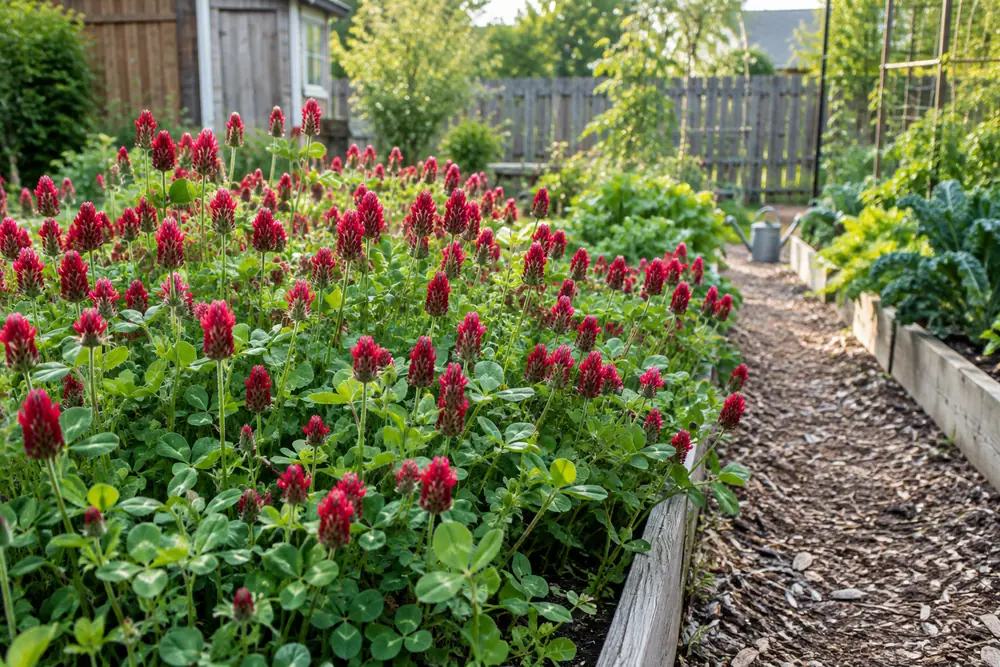
Clovers are legumes: nodules on their roots host bacteria that capture nitrogen from the air. When you cut the clover down, that nitrogen gradually becomes available to the next crop.
- Crimson clover is the classic fall-sown garden clover. Sow it 6-8 weeks before your average first frost at 1-2 oz per 100 sq ft. It reliably overwinters in zone 8, often survives in the warmer parts of zone 6, and usually winter-kills in zone 5 and colder, where it still protects the soil through fall. Mowing it once it reaches the bud or bloom stage kills it, and it delivers the most nitrogen at late bloom.
- White clover (including Dutch white) is a low perennial. It is better as a living mulch in garden paths or under tall crops than as a bed cover crop you want to remove in spring.
- Hairy vetch is not a clover, but it fills the same nitrogen role and is far hardier, surviving zone 4 and even zone 3 under snow. Sow it at least 30-45 days before a killing frost. Plan to cut it at early to mid bloom. About 10-20% of vetch seed is “hard” seed that can sprout a season or more later, so expect a few volunteers.
Small legume seed should be covered only about 1/4 inch deep. Buying seed pre-coated with the right rhizobia inoculant (or coating it yourself) helps the plants start fixing nitrogen, especially in soil that has never grown that legume.
Gear that helps
- Legume inoculant for peas, clover and vetch: Helps legume cover crops fix nitrogen in soil that has never grown them.
As an Amazon Associate we earn from qualifying purchases. Check current prices and reviews on Amazon.
Winter cover crop planting dates by USDA zone
Your USDA zone is based on average winter low temperatures, not frost dates, so use the table as a starting point and then count back from your own average first fall frost. Check your local frost dates and your county extension office, because microclimates vary. Our frost dates by zone guide explains how to find yours.
| USDA zone | Typical first fall frost | Oats, peas, crimson clover: sow by | Hairy vetch: sow by | Cereal rye: latest useful sowing |
|---|---|---|---|---|
| 3-4 | Early to late September | Late July to mid-August | Mid-August | Early October |
| 5 | Late September to mid-October | Mid-August | Early September | Late October |
| 6 | Mid- to late October | Late August to early September | Mid-September | Early to mid-November |
| 7 | Late October to mid-November | Early to mid-September | Late September to early October | Mid- to late November |
| 8 | Mid-November to early December | Late September to October | October | December |
| 9-10 | December or rare | October to November | October to November | December to January |
In zones 8-10, fall and winter are prime vegetable seasons, so many Southern gardeners grow cover crops in summer instead: buckwheat, cowpeas or sunn hemp on beds that would otherwise sit empty in July and August.
Garden hack: Missed every planting date? Cover the bed with 3-6 inches of shredded leaves instead. It is not a living cover, but it still protects the soil and feeds worms over winter. See our guide to composting leaves and using leaf mulch.
How to fit cover crops into a small garden
You do not have to cover the whole garden. Start with the beds that empty first in fall (early potatoes, squash, beans, sweet corn) and skip beds holding garlic or winter greens.
- Beds for early spring crops: Use something that winter-kills (oats, spring peas, oilseed radish) so the soil is ready in March.
- Beds for summer crops: Rye, wheat, crimson clover or vetch keep growing in spring and add more biomass before you plant in May.
Cover crops are one step in putting the garden to bed; our guide to winterizing your vegetable garden covers the rest.
Common mistakes to avoid
- Sowing too late. Legumes and oats need weeks of growth before hard freezes. Past those dates, switch to rye or a leaf mulch.
- Leaving seed on the surface. Birds eat it and it dries out. Rake it in and firm the soil.
- Mowing rye too early. Vegetative rye regrows. Wait for flowering, or plan to tarp or dig.
- Letting cover crops set seed. Buckwheat, vetch and rye can all become weeds if they drop seed.
- Planting right after termination. Give residue 2-3 weeks to break down, and 3-4 weeks after rye before sowing small seeds.
- Using rye before early spring sowings. Choose a winter-killed cover crop for beds you need in March or April.
The Year-Round Vegetable Garden (2027 Edition)
Plan the whole season in one place: a 225-page month-by-month guide with calendars for six US growing regions, 50 plant profiles (tomatoes included), 5 copy-ready garden plans and 7 printable pages.
Tomato lover? Add Tomato Mastery, our seed-to-harvest tomato blueprint, for just $10 at checkout.
Get the guide ($27)FAQ
What is the best winter cover crop for a vegetable garden?
Cereal rye is the most reliable winter cover crop because it is the hardiest and can be sown the latest. If you want nitrogen too, mix it with hairy vetch. If you want no spring cleanup, choose oats, which winter-kill in zones 3-6.
How much winter rye seed do I need for a small garden?
Plan on about 2-4 oz of cereal rye seed per 100 sq ft, or roughly 1 oz for a 4 x 8 ft raised bed. Use the higher rate, or even a little more, if you sow late or just scatter seed on the surface.
When should I plant a cover crop in fall?
Sow oats, peas and crimson clover 6-8 weeks before your average first frost, and hairy vetch at least 30-45 days before a killing frost. Cereal rye can go in last, up to early October in zones 3-4 and into November in zones 6-7.
Can I plant vegetables right after cutting down a cover crop?
Wait about 2-3 weeks before transplanting so the residue can start to break down. After cereal rye, wait 3-4 weeks before sowing small seeds like carrots, lettuce or onions, because rye residue can suppress their germination.
Do I have to till cover crops into the soil?
No. You can mow or string-trim the crop at the right stage and leave it on top as mulch, or cover it with a tarp for 2-4 weeks to smother it. Winter-killed crops like oats need nothing at all.
Keep reading
Sources
- HO-324: Cover Crops in the Home Garden – Purdue Extension
- Cover Crops for Gardens – University of Maryland Extension
- Cereal Rye as a Cover Crop – Penn State Extension
- Cereal Rye/Winter Rye: The Perfect Garden-Reset Cover Crop – University of Illinois Extension
- Managing Cover Crops Profitably: Cereal Rye – USDA SARE
- Managing Cover Crops Profitably: Crimson Clover – USDA SARE
- Managing Cover Crops Profitably: Hairy Vetch – USDA SARE
- Cover Crop Selection for Vegetable Growers – University of Minnesota Extension