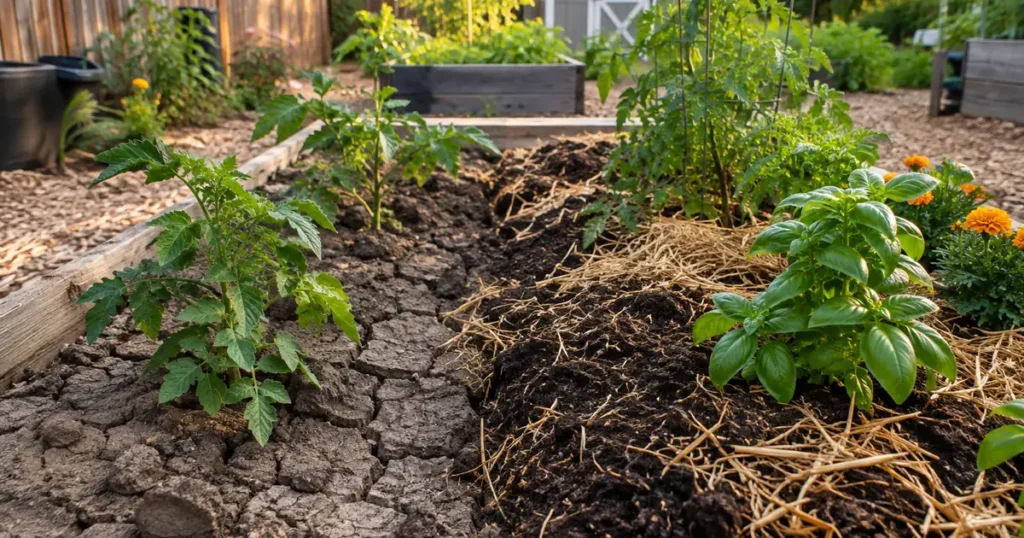
To improve clay soil, add organic matter every year, keep the surface covered with mulch or cover crops, never dig it when it is wet, and keep your feet off the beds. Skip the sand and the gypsum: sand can turn clay into something close to concrete, and gypsum mainly helps a specific type of high-sodium soil. Clay improves slowly, over 2-3 seasons, but it rewards you with fertile, moisture-holding ground.
Quick answer
- Mix 2-4 inches of compost into the top 6-12 inches the first year, then add 1-2 inches every year after.
- Do not add sand. You would need about half the soil volume to change texture; less makes it harder.
- Gypsum is not a clay fix for most home gardens; its main use is sodic (high-sodium) soils.
- Do the squeeze test before digging: if a ball of soil does not crumble, wait.
- Sandy soil has the opposite problem, but the same fix: organic matter and mulch.
In this guide
Want every planting date for your region in one place? Get The Year-Round Vegetable Garden (225 pages, $27).
What is clay soil?
Clay soil contains a high share of clay particles, the smallest of the three soil particle sizes (sand, silt and clay). Those particles are flat and pack tightly, leaving tiny pore spaces. The result is soil that holds water and nutrients very well but drains slowly and lets in little air.
Clay is common across much of the US, from the red clays of the Southeast and Piedmont to the heavy prairie clays of the Midwest and Texas. New-construction yards are often the worst, because grading strips the topsoil and leaves compacted subsoil behind.
How to tell if you have clay soil
- It is sticky and slick when wet and sticks to your shoes and shovel.
- It dries into hard clods and cracks in summer.
- Puddles linger hours after rain.
- A moist handful squeezed between thumb and finger forms a long, smooth ribbon (more than about 2 inches).
- A jar test shows a thick top layer that takes a day or more to settle. Our garden soil guide explains the jar test and a simple drainage test.
Clay is not all bad. It is usually rich in nutrients and holds moisture well into summer. The goal is not to get rid of clay; it is to give it structure, so particles clump into crumbs with pores for air and water.
How to improve clay soil: 7 steps that work
1. Add organic matter, every year
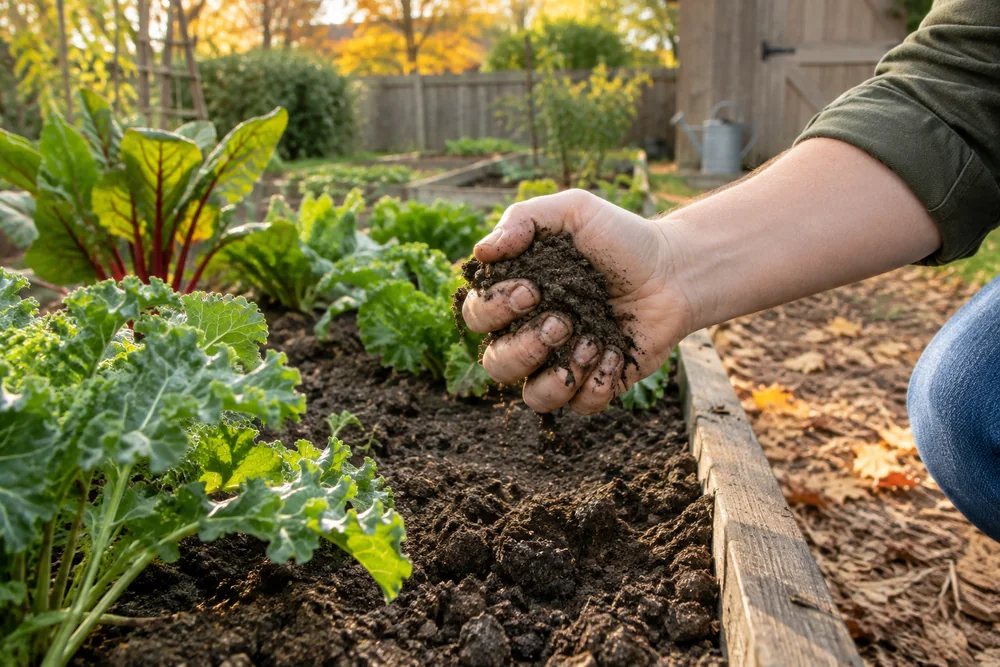
Organic matter is the real clay fixer. As soil life breaks it down, it produces sticky substances that bind clay particles into crumbs, opening up pores for drainage and roots. Iowa State University Extension recommends working 2-4 inches of compost into the top 6-12 inches of soil. Utah State University Extension suggests starting with 2-3 inches mixed 6-8 inches deep, then adding about 2 more inches yearly, and warns heavy clay can take 2-3 years to show a big difference.
Good choices: finished compost, shredded leaves or leaf mold, well-aged manure and composted bark fines. Fresh wood chips and sawdust are best kept on the surface as mulch, because mixing them in ties up nitrogen as they decompose. Our guides on making compost and composting leaves show how to make plenty for free.
2. Do not add sand
Adding sand sounds logical: clay is too fine, sand is coarse, so mix them. In practice, a few bags of sand mixed into clay fill the gaps between particles and create a dense, concrete-like mix. The University of Saskatchewan’s gardening program notes that sand must reach roughly 50% of total soil volume before it meaningfully changes clay texture. For a 10 x 10 ft bed dug 8 inches deep, that means well over a cubic yard of sand, thoroughly mixed in. Organic matter does the job better for far less work and money.
3. Skip the gypsum (unless your soil is sodic)
Gypsum (calcium sulfate) is widely sold as a clay softener. It does help one kind of soil: sodic soil, where excess sodium makes clay disperse and seal. Those soils are mostly found in arid parts of the West, and a soil test can identify them. Iowa State University Extension finds little benefit from gypsum in typical Midwest clay, and Washington State University Extension notes that while it can help some heavily farmed or weathered agricultural soils, it is usually unnecessary in home landscapes, where organic matter and mulch do more. It also does not change pH. If you suspect salt or sodium problems, ask your soil lab for a sodium or soluble-salts test first.
4. Never work clay when it is wet
Digging or tilling wet clay smears and compresses it into hard clods that can last all season. Before you dig, do the squeeze test:
- Take a handful of soil from about 3 inches deep.
- Squeeze it firmly into a ball.
- Drop it from waist height onto a hard surface, or poke it with a finger.
- If the ball shatters or crumbles, the soil is ready. If it holds together or smears, wait a few dry days and test again.
Very dry clay is a problem too: it breaks into rock-hard clods. Aim for the in-between moment, often a few days after a soaking rain.
Garden hack: Clay is easiest to improve from the top down. Instead of digging, spread 2 inches of compost on the surface each fall, cover it with shredded leaves, and let earthworms pull it in over winter. By spring the top few inches will be noticeably darker and looser, with zero tilling.
5. Mulch and keep the soil covered
Bare clay forms a crust after hard rain, which sheds water and smothers seedlings. A 2-3 inch layer of straw, shredded leaves or grass clippings around vegetables protects the surface, keeps moisture even and feeds worms. On paths, use 3-4 inches of wood chips.
6. Grow cover crops with deep roots
Cover crops are living soil builders. University of Maryland Extension highlights forage radish (also sold as tillage or daikon radish), whose thick taproot pushes into dense clay and leaves channels when it rots over winter, and winter rye and winter wheat, whose massive fibrous root systems break up heavy soil. Sow them after your summer crops come out. See our cover crops guide for seeding rates.
| Zone | Forage radish (sow by) | Winter rye | Workable clay in spring (typical) |
|---|---|---|---|
| 3-4 | Early to mid-August | Late August to mid-September | Mid-May |
| 5 | Mid to late August | September to early October | Late April to early May |
| 6 | Late August to early September | Mid-September to late October | Mid to late April |
| 7 | Early to mid-September | Late September to early November | Late March to April |
| 8 | September to early October | October to November | March, or between fall-winter crops |
| 9-10 | October to November | October to December | Year-round, between crops |
These dates are approximate: forage radish needs about 6-8 weeks of growth before a hard freeze to build a big root. Check your local frost dates on our frost dates by zone page or with your extension office, because microclimates vary.
7. Build raised beds and stay off the soil
Raised beds are the fastest way around poor drainage. Even 8-12 inches of improved soil above the clay gives roots a well-drained zone, warms earlier in spring and stays uncompacted because you never step in it. Loosen the clay underneath with a garden fork before filling, so roots and water can move down. Whether you garden in raised beds or in the ground, use permanent paths and keep beds no wider than about 4 feet so you can reach the middle.
Watch out: Rototilling clay every spring feels productive, but it breaks down the crumbs you are trying to build and can create a hard layer (a plow pan) just below tilling depth. Till once if you must, to mix in a big load of compost, then switch to surface additions and a broadfork.
Gear that helps
- Broadfork: Loosens heavy clay without tilling, protecting the soil structure you are building.
- Forage (tillage) radish cover crop seed: Deep taproots open channels in dense clay over winter.
As an Amazon Associate we earn from qualifying purchases. Check current prices and reviews on Amazon.
Best vegetables for clay soil
While you improve the soil, choose crops that cope well with heavier ground:
- Leafy brassicas and greens: cabbage, kale, broccoli, Brussels sprouts, collards, chard. They like clay’s moisture and fertility.
- Beans and peas: shallow-rooted and they add nitrogen.
- Squash, pumpkins and cucumbers: plant them in hills or mounds of compost on top of the clay.
- Tomatoes and peppers: fine in improved clay; mulch well to avoid crusting and uneven watering.
- Lettuce and spinach: good in spring and fall when clay stays cool and moist.
Save long, straight carrots, parsnips and big potato harvests for raised beds or loosened soil. In unimproved clay, they fork, stunt or rot. Short varieties such as round or half-long carrots cope better.
The Year-Round Vegetable Garden (2027 Edition)
Plan the whole season in one place: a 225-page month-by-month guide with calendars for six US growing regions, 50 plant profiles (tomatoes included), 5 copy-ready garden plans and 7 printable pages.
Tomato lover? Add Tomato Mastery, our seed-to-harvest tomato blueprint, for just $10 at checkout.
Get the guide ($27)Sandy soil: the opposite problem
Sandy soil has big particles and big pores. It drains fast, warms early in spring and is easy to dig, but it holds little water or nutrients. Utah State University Extension notes that water can soak into sandy soil at 1-10 inches per hour, and that sandy soils need fertilizing more often because nutrients wash through. Colorado State University Extension points out that organic matter holds over ten times more water and nutrients than sand.
The fix is the same tool used in a different way:
- Add compost generously. Mix 2-3 inches into new beds, then add 1-2 inches every year. In hot Southern zones, organic matter breaks down fast, so add compost with every planting.
- Mulch thickly. 3-4 inches of straw or leaves slows evaporation.
- Water deeply but more often, ideally with drip lines placed right over the root zone, since water in sand moves straight down rather than spreading sideways.
- Feed little and often. Split fertilizer into smaller doses through the season, or use slow-release organic fertilizers.
- Grow cover crops to add roots and organic matter, and test your soil every 2-3 years since sandy soils change faster.
Good crops for sandy soil include carrots, radishes, potatoes, sweet potatoes, watermelon, peanuts and onions, which love a loose, quick-draining bed.
Garden hack: In sandy beds, bury a 1-2 inch layer of compost in a shallow trench under each row of tomatoes, peppers or squash before planting. It acts like a sponge right where roots need water most.
Gear that helps
- Drip irrigation kit for raised beds: Puts water right over the root zone, which matters in fast-draining sandy soil.
As an Amazon Associate we earn from qualifying purchases. Check current prices and reviews on Amazon.
Common mistakes to avoid
- Adding sand to clay. Small amounts create a harder soil.
- Spending on gypsum without a sodium test. It rarely helps typical garden clay.
- Digging wet clay. Do the squeeze test first.
- Tilling every year. It breaks structure and compacts the layer below.
- Stopping after one load of compost. Clay improves over several years of steady additions.
- Leaving clay bare over winter. Use mulch or a cover crop.
- Guessing pH and nutrients. Get a soil test; see how to test soil pH.
FAQ
What is the fastest way to improve clay soil?
Build raised beds filled with a topsoil and compost blend on top of loosened clay. For in-ground beds, mixing 2-4 inches of compost into the top 6-12 inches gives the quickest noticeable change, followed by yearly compost and mulch.
Does gypsum break up clay soil?
Mainly in sodic soils, which have high sodium and are found mostly in arid Western areas. In typical home garden clay, gypsum gives little benefit. A soil test can tell you whether sodium is a problem.
Should I add sand to clay soil?
No. You would need sand equal to about half the soil volume to change the texture. Smaller amounts pack into the clay and make it harder. Add organic matter instead.
How long does it take to improve clay soil?
Expect a noticeable change after one season of compost and mulch, and a big improvement in 2-3 years. Keep adding organic matter every year, because it breaks down over time.
Can vegetables grow in clay soil?
Yes. Cabbage, kale, broccoli, beans, peas, squash, lettuce and tomatoes all grow well in improved clay. Long root crops like carrots and parsnips do better in raised beds or loosened soil.
How do I improve sandy soil?
Add 2-3 inches of compost the first year and 1-2 inches every year after, mulch thickly, water with drip irrigation and fertilize in smaller, more frequent doses.
Keep reading
Sources
- Will an Application of Gypsum Improve a Clay Soil? – Iowa State University Extension and Outreach
- Testing and Improving Soil Drainage – Iowa State University Extension and Outreach
- Garden Soil Preparation – Utah State University Extension
- Gardening in Sandy Soils – Utah State University Extension
- Adding Sand to Clay Soils Is Not Recommended – University of Saskatchewan
- The Myth of Gypsum Magic – Washington State University Extension
- Cover Crops for Gardens – University of Maryland Extension
- Vegetable Gardens: Soil Management and Fertilization – Colorado State University Extension