
Growing tomatoes from seed takes about 6 to 8 weeks indoors: sow seeds 1/4 inch deep in a sterile mix kept at 75-85°F, move the seedlings under bright light as soon as they sprout, pot them up deep, harden them off, and plant them outside 1 to 2 weeks after your last frost. Do that and one seed packet turns into a full row of sturdy transplants, in varieties you will never find at the garden center.
Quick answer
- When: start tomato seeds 6-8 weeks before your average last frost date (early to mid-April in zones 3-4, February in zone 7).
- How deep: 1/4 inch, in moist seed starting mix.
- Germination: keep the mix at 75-85°F; most seeds sprout in 6-12 days.
- Light: 14-16 hours a day, with the lights 2-4 inches above the leaves.
- Transplant: after 7-10 days of hardening off, plant deep once nights stay above 50°F and the soil reaches about 60°F.
In this guide
- Why grow tomatoes from seed?
- Choosing tomato seeds: heirloom, hybrid and open-pollinated
- When to start tomato seeds
- How to start tomato seeds: step by step
- Light: the make-or-break factor
- Potting up tomato seedlings deep
- Feeding and watering seedlings
- Hardening off tomato seedlings
- Transplanting tomatoes into the garden
- Saving tomato seeds for next year
- Common mistakes to avoid
- FAQ
 Grow tomatoes in season for your region, month by month: The Year-Round Vegetable Garden ($27, PDF).
Why grow tomatoes from seed?
Garden centers carry maybe a dozen tomato varieties. Seed catalogs list hundreds: heirloom beefsteaks, disease-resistant hybrids, paste tomatoes for sauce, cherries for snacking, and dark-fruited favorites like the Cherokee Purple tomato. Starting your own also lets you control timing, so your plants hit the garden at the right size instead of root-bound and already flowering in a 4-inch pot.
Tomatoes are one of the easiest crops to start indoors. The seeds are large enough to handle, they sprout fast in warm soil, and the plants forgive a few beginner mistakes. If you have never started anything indoors before, our general guide to how to start seeds indoors covers the equipment basics; this page focuses on what tomatoes specifically need.
Choosing tomato seeds: heirloom, hybrid and open-pollinated
Before you buy tomato seeds, decide what you want from the plant. Three labels matter most on a seed packet.
- Heirloom: an older, open-pollinated variety passed down for generations. Heirlooms are prized for flavor and color, but most carry little or no disease resistance.
- Open-pollinated (OP): the variety breeds true, so seeds you save from the fruit grow into plants like the parent. All heirlooms are open-pollinated; not all open-pollinated tomatoes are heirlooms.
- Hybrid (F1): a cross between two parent lines, bred for traits like disease resistance, earliness or yield. Saved seed from hybrids will not reliably reproduce the same plant, so you buy fresh seed each year.
Also check the growth habit. Determinate tomatoes stop at a set height and ripen their crop over a few weeks, which suits containers and canning. Indeterminate tomatoes keep growing and producing until frost, so they need tall stakes or cages. Our guide to determinate vs indeterminate tomatoes explains which fits your space, and the best tomatoes to grow lists reliable picks by type.
Finally, look at days to maturity. That number is counted from transplanting, not from sowing, so add the 6-8 weeks of indoor growing. In zones 3-4 with short summers, choose varieties listed at 75 days or fewer for at least part of your planting.
Garden hack: Grow at least one disease-resistant hybrid next to your heirlooms. Look for letter codes after the name (V, F, N, TSWV, LB) that show resistance to verticillium wilt, fusarium wilt, nematodes, tomato spotted wilt virus or late blight. If disease hits, you still get a harvest.
Gear that helps
- Heirloom tomato seed variety pack: An easy way to try several open-pollinated tomatoes and save your own seed.
As an Amazon Associate we earn from qualifying purchases. Check current prices and reviews on Amazon.
When to start tomato seeds
Start tomato seeds indoors 6-8 weeks before your average last frost date. Tomatoes go outside 1 to 2 weeks after that date, so this timing gives you transplants with five to seven true leaves, not lanky plants that have outgrown their pots.
Count back from your own frost date, which you can look up in our guide to last and first frost dates by zone. The table below gives typical windows that match our full seed starting calendar.
| USDA zone | Typical last frost | Start tomato seeds indoors | Transplant outside |
|---|---|---|---|
| 3-4 | Early May to early June | Early to mid-April | Late May to mid-June |
| 5 | Late April to mid-May | Mid to late March | Mid to late May |
| 6 | Mid-April to early May | Early to late March | Early to mid-May |
| 7 | Late March to mid-April | Late February to early March | Mid to late April |
| 8 | Early March to early April | Early to mid-February | Late March to mid-April |
| 9-10 | Late January to early March, or rare | December to January; again July to August for fall | February to March; again August to September |
These dates are averages. Your microclimate, elevation and the year’s weather all shift them, so confirm your frost date with your local extension office and watch the 10-day forecast before transplanting.
In zones 9-10 and much of zone 8, summer heat is the real limit. Tomatoes drop their blossoms when days run above 90°F or nights stay above 75°F, so Southern gardeners start seeds early enough to set fruit before summer peaks, then sow again in midsummer for a fall crop.
How to start tomato seeds: step by step
What you need
- A sterile, fine-textured seed starting mix (not garden soil)
- Cell trays or small pots with drainage holes, plus a solid tray underneath
- A clear humidity dome or plastic wrap
- A seedling heat mat (optional but helpful in cool houses)
- Shop lights or grow lights for seedlings on a timer
- Plant labels and a waterproof marker
Sowing the seeds
- Moisten the mix first. Stir water into the dry mix until it feels like a wrung-out sponge, then fill the cells and firm lightly.
- Sow 2 seeds per cell, 1/4 inch deep. Poke a shallow hole with a pencil tip, drop the seeds in, and cover. Sowing two gives you a backup if one fails.
- Label every variety. Tomato seedlings look identical, and the labels are the only way to know which is your paste tomato and which is your beefsteak.
- Cover and warm. Put on the dome and keep the mix at 75-85°F. A heat mat under the tray is the easiest way to hold that temperature; potting mix often runs several degrees cooler than the room air.
- Check daily. Most tomato seeds sprout in 6-12 days in warm mix. Keep the surface evenly moist, never soggy.
The moment they sprout
As soon as you see the first loops of stem breaking the surface, remove the dome, turn off or lower the heat mat, and get the seedlings under lights. After germination, tomatoes grow best around 70-75°F during the day and about 60-65°F at night. Cooler nights keep stems thicker and shorter.
When the first true leaves appear (the jagged ones that look like tomato foliage, above the two smooth seed leaves), snip the weaker seedling in each cell at soil level. Pulling it can damage the roots of the keeper.
Watch out: Seedlings that suddenly collapse at the soil line usually have damping off, a fungal disease favored by cool, wet mix and stagnant air. Use fresh sterile mix and clean trays, water from below, and run a small fan nearby.
Gear that helps
- Seedling heat mat with thermostat: Holds seed starting mix at the 75-85°F tomatoes need to germinate quickly and evenly.
As an Amazon Associate we earn from qualifying purchases. Check current prices and reviews on Amazon.
Light: the make-or-break factor
A sunny windowsill is rarely enough for tomato seedlings, especially in late winter. Weak light makes seedlings stretch toward the glass and turn thin and pale. Give them 14-16 hours of light a day from LED shop lights or grow lights hung 2-4 inches above the leaves, and raise the lights as the plants grow.
If your seedlings are already tall and floppy, you can still save them. Tomatoes are one of the few crops that root along a buried stem, so the fix is to bury that stem when you pot up. Our guide to leggy seedlings walks through the causes and fixes.
Garden hack: Brush your hand lightly across the tops of the seedlings 10-20 times once or twice a day, or set a small fan on low nearby. The movement mimics wind and helps build thicker, sturdier stems before the plants face real breezes outside.
Gear that helps
- LED grow light / shop light for seedlings: Provides 14-16 hours of strong light so tomato seedlings stay short and stocky.
As an Amazon Associate we earn from qualifying purchases. Check current prices and reviews on Amazon.
Potting up tomato seedlings deep
Tomatoes in small cells run out of room in 3-4 weeks. Once seedlings have two or more sets of true leaves, move them into 3- to 4-inch pots filled with a quality potting mix. Each time you pot up, set the seedling deeper than before, burying the stem up to just below the lowest leaves. The buried stem sprouts new roots, giving you a shorter, sturdier plant with a bigger root system.
- Water the seedlings an hour before so the root ball holds together.
- Hold each seedling by a leaf, never by the stem; a torn leaf is fine, a crushed stem is not.
- Fill the new pot one-third full, set the seedling in, and fill up to the lowest leaves.
- Water gently and return the pots to the lights.
Gear that helps
- 4-inch plastic nursery pots: The right size for potting up tomato seedlings deep before transplanting.
As an Amazon Associate we earn from qualifying purchases. Check current prices and reviews on Amazon.
Feeding and watering seedlings
Most seed starting mixes contain few nutrients. Once the first true leaves appear, feed weekly with a water-soluble general-purpose fertilizer mixed at 1/4 strength. After potting up into a mix with added fertilizer, you can feed less often; pale or purplish lower leaves are a sign the plants want more.
Water from below when the top of the mix feels dry: set the pots in a tray with half an inch of water for 20-30 minutes, then pour off what is left. This keeps the stems and soil surface drier, which discourages fungus gnats and damping off.
Hardening off tomato seedlings
Plants raised indoors have never felt direct sun, wind or cool nights. Skip the transition and they can scorch white or wilt hard on day one. Start hardening off seedlings 7-14 days before transplanting:
- Days 1-2: one to two hours outdoors in shade, sheltered from wind.
- Days 3-5: half a day outside with some morning sun.
- Days 6-8: most of the day in full sun; bring them in if nights drop below 50°F.
- Days 9-10: leave them out overnight if nights stay above 50°F.
Cut back slightly on water during this period, but never let the plants wilt badly.
Transplanting tomatoes into the garden
Tomatoes are warm-season plants. Transplant them after all danger of frost has passed, once nights stay above 50°F and the soil 4 inches down reaches about 60°F. Planting into cold soil does not give you a head start; the plants sit and sulk until the ground warms.
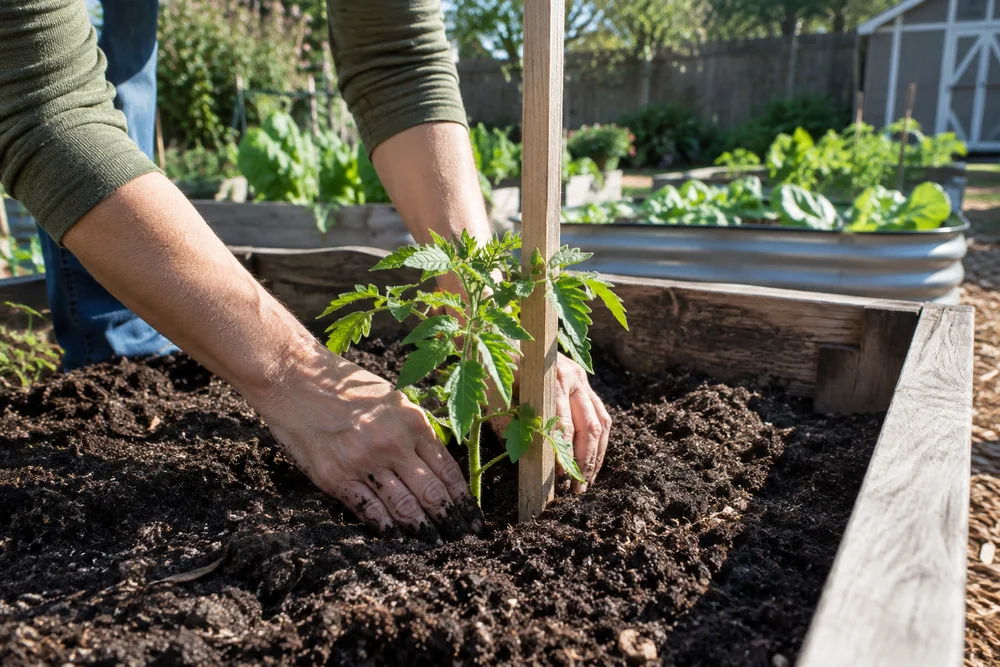
Plant deep. Strip the leaves from the lower half to two-thirds of the stem, then bury the plant so only the top two or three sets of leaves show. For tall or leggy plants, dig a shallow trench and lay the stem on its side, gently bending the top upward; it will straighten within days. Either way, the buried stem roots along its length.
Space indeterminate plants 2-3 feet apart and determinates about 2 feet apart, and put stakes or cages in at planting time so you do not spear the roots later. Water thoroughly, then mulch once the soil is warm. For care from transplant to harvest, head to our complete guide on how to grow tomatoes.
Garden hack: In zones 3-5, lay black plastic over the bed a week or two before planting to warm the soil, then cut X-shaped holes for your transplants. It can add several degrees to the root zone during cool late-spring weeks.
Saving tomato seeds for next year
If you grow open-pollinated or heirloom tomatoes, you can save your own seed. Tomatoes mostly pollinate themselves, so saved seed from a home garden usually comes true, though bees can occasionally cross varieties planted side by side.
- Pick a fully ripe fruit from a healthy, typical plant.
- Squeeze the seeds and gel into a jar, add a little water, and leave it at room temperature for several days until a layer of mold forms on top. This fermentation removes the gel coating, which contains germination inhibitors, and helps reduce some seed-borne diseases.
- Pour off the mold and floating seeds; the good seeds sink. Rinse in a strainer.
- Spread the seeds on a plate or coffee filter to dry completely for a week or more, then store them in a labeled envelope or jar somewhere cool, dark and dry.
Skip saving seed from hybrids (marked F1). The next generation is a genetic mix and will not reliably match the parent.
Common mistakes to avoid
- Starting too early. Ten- or twelve-week-old tomatoes become root-bound and leggy. Stick to 6-8 weeks.
- Using garden soil or old mix. It compacts, drains poorly and can carry damping off pathogens.
- Keeping seedlings on the heat mat. Warmth speeds germination but stretches seedlings afterward. Turn it off once they sprout.
- Lights too far away. A light 12 inches up produces stretched seedlings. Keep it 2-4 inches above the leaves.
- Overwatering. Constantly wet mix starves roots of oxygen. Let the surface dry slightly between waterings.
- Skipping hardening off. Unadjusted seedlings can sunburn badly in a single afternoon.
- Transplanting into cold soil. Wait for nights above 50°F and soil near 60°F.
FAQ
How long does it take to grow tomatoes from seed?
Plan on 6-8 weeks indoors, then about 55-90 days from transplanting to the first ripe fruit depending on the variety. From sowing to harvest, most tomatoes take roughly 3 to 5 months.
How deep do you plant tomato seeds?
Sow tomato seeds 1/4 inch deep in moist seed starting mix. Deeper seeds take longer to emerge, and seeds left on the surface can dry out.
What temperature do tomato seeds need to germinate?
Tomato seeds germinate best when the mix stays between 75 and 85°F. They will still sprout in cooler mix, but more slowly and less evenly.
Can you plant tomato seeds directly in the garden?
Yes, in long-season areas like zones 9-10, once the soil is warm. In most of the US, direct-sown tomatoes start fruiting too late in summer, so starting indoors or buying transplants works better.
Do tomato seedlings need light to germinate?
No. Tomato seeds sprout in the dark under 1/4 inch of mix. They need strong light the moment they emerge, or they stretch within a day or two.
Keep reading
Sources
- Growing tomatoes in home gardens – University of Minnesota Extension
- Starting seeds indoors – University of Minnesota Extension
- Tomato, pepper and eggplant transplant production – Utah State University Extension
- Tomato – Clemson Cooperative Extension Home & Garden Information Center
- Blossom drop – NC State Extension
- Seed saving for beginners – University of Idaho Extension
- USDA Plant Hardiness Zone Map – USDA Agricultural Research Service