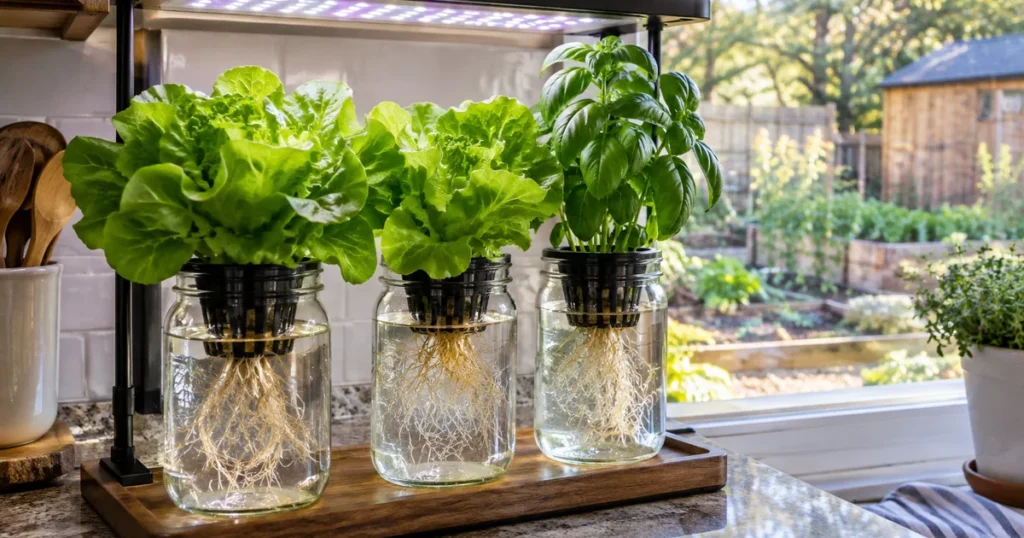
A hydroponic garden grows plants in water mixed with nutrients instead of soil, with the roots fed directly and the plants held in a small cup of inert growing medium. For beginners, the simplest place to start is the Kratky method: a jar of nutrient solution, a net cup and a lettuce seedling, with no pump and no electricity. Leafy greens and herbs are the easiest crops, and with a grow light you can harvest lettuce indoors all winter.
Quick answer
- Easiest system: Kratky (passive, no pump). Next step up: deep water culture with an air pump.
- Best beginner crops: loose-leaf lettuce, butterhead, basil, mint, parsley, bok choy and other greens.
- Lettuce targets: pH about 5.5-6.5 (sweet spot 5.8-6.0), EC about 1.2-1.8 mS/cm, solution around 65-70°F.
- Indoors, plan on a grow light for 14-16 hours a day. A winter window alone gives slow, leggy plants.
- Loose-leaf lettuce is ready to cut in about 4 to 6 weeks from seeding.
In this guide
 Every planting date for your region in one place: The Year-Round Vegetable Garden ($27, PDF).
How does a hydroponic garden work?
In soil, roots search for water, nutrients and air. In hydroponics, you hand them all three. The plant sits in a net cup filled with an inert medium such as rockwool, coco coir plugs or clay pebbles, and its roots reach into a nutrient solution made from water and a fertilizer formulated for hydroponics.
Three things decide whether a system works: the roots must get oxygen, the solution must have the right nutrient strength (EC), and it must stay in the right pH range so plants can absorb those nutrients. Each system below solves the oxygen problem in a different way.
Types of hydroponic systems
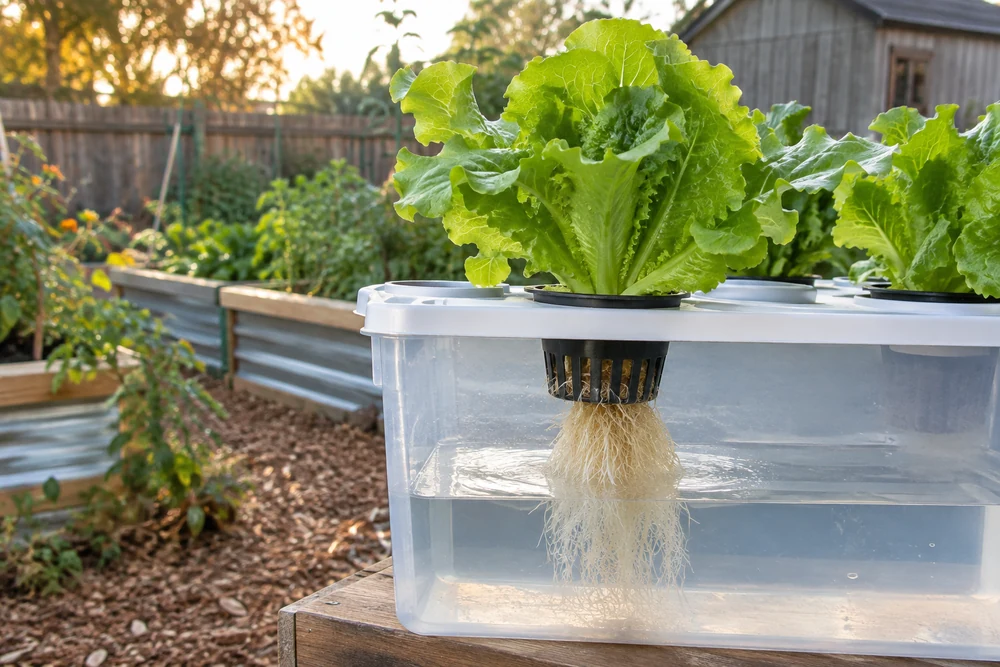
Kratky method (passive, no pump)
Developed by Dr. Bernard Kratky at the University of Hawaii, this method needs no pump, timer or electricity. You fill a container with nutrient solution so the bottom of the net cup just touches it. As the plant drinks, the level drops and leaves an air gap. Upper roots breathe in the moist air while lower roots stay in the solution. Kratky’s work found that a lettuce plant can finish its whole life cycle on the solution it started with.
Best for: lettuce, herbs and other quick leafy crops. Larger fruiting plants such as tomatoes need much larger containers like 5-gallon buckets.
Deep water culture (DWC)
Plants sit in a lid over a tub of solution, and an aquarium air pump with an air stone bubbles oxygen through the water. UF/IFAS Extension describes it as easy to set up and ideal for beginners. The catch: if the pump stops or the water gets warm, roots can run short of oxygen quickly.
Nutrient film technique (NFT)
A thin stream of solution flows down slightly sloped channels, and the roots sit in that film. It is water-efficient and great for lettuce and herbs, which is why many commercial greens are grown this way. If the pump fails, roots dry out within hours, so it suits gardeners ready to watch their equipment.
Ebb and flow (flood and drain)
A tray of plants floods with solution on a timer, then drains back to a reservoir, pulling fresh air into the root zone. It handles a wider range of crops, including fruiting plants in larger media beds, but needs a reliable timer and pump.
Countertop smart gardens
Countertop units are compact, all-in-one hydroponic gardens with a built-in reservoir, LED light and usually a small pump, sold with seed pods. They take the guesswork out of light and nutrients and are a tidy way to grow herbs and salad greens in a kitchen. The tradeoffs are a small growing area, limited plant height and, with many models, reliance on the maker’s pods. Look at reservoir size, adjustable light height, and whether you can use your own seeds and nutrients.
| System | Pump needed? | Difficulty | Best crops | Main risk |
|---|---|---|---|---|
| Kratky | No | Very easy | Lettuce, herbs, greens | Running out of solution with large plants |
| Deep water culture | Air pump | Easy | Lettuce, basil, greens | Root rot if water warms or pump stops |
| NFT | Water pump | Moderate | Lettuce, herbs, strawberries | Roots dry fast if pump fails |
| Ebb and flow | Pump + timer | Moderate | Greens, herbs, some fruiting crops | Timer failure, salt buildup |
| Countertop unit | Built in | Very easy | Herbs, salad greens | Small space, limited plant size |
Kratky lettuce in a jar: step-by-step project
This is the best first project for growing lettuce indoors. It takes about 15 minutes to set up.
What you need
- A wide-mouth quart or half-gallon mason jar (a half-gallon gives a full head more room)
- A 3-inch net cup that sits in the jar mouth
- Rockwool cubes or coco coir plugs, plus clay pebbles to fill the cup (optional)
- Hydroponic nutrient made for leafy greens (one-part or two-part)
- A pH test kit or pen, and pH down (pH up if your water is low)
- An EC/TDS meter (optional but useful)
- Aluminum foil, a paper bag or a jar sleeve to block light
- Loose-leaf or butterhead lettuce seeds
Steps
- Start the seed. Soak a rockwool cube, set 2 or 3 lettuce seeds in it and keep it moist and bright at 65 to 70°F. Seeds usually sprout in a few days. Thin to the strongest seedling. For more on germination, see how to start seeds indoors.
- Wrap the jar. Cover the outside with foil or a sleeve. Light hitting the solution grows algae, which competes with roots for oxygen.
- Mix the solution. Fill the jar with water, add hydroponic nutrient at the label rate for leafy greens and stir. Mix two-part nutrients separately into the water, never directly into each other.
- Check EC. For lettuce, aim for about 1.2 to 1.8 mS/cm (roughly 600 to 900 ppm on a 500-scale TDS meter). UF/IFAS Extension uses about 1.25 mS/cm for its Kratky bucket lettuce; Cornell’s leafy greens research uses about 1.5.
- Adjust pH. Bring the solution into the 5.5 to 6.5 range; 5.8 to 6.0 is a safe target. Add pH down a few drops at a time and retest.
- Set the seedling. When roots poke out of the cube (usually 1 to 3 weeks), place it in the net cup, fill around it with clay pebbles if you like, and set the cup in the jar. The bottom of the cup should touch the solution.
- Add light. Put the jar under a grow light for 14 to 16 hours a day.
- Leave it alone. Do not top up to the original level. As the plant drinks, the solution drops and the air gap forms. If the jar gets very low before harvest, add a little half-strength solution, but keep the upper roots in the air.
- Harvest. Pick outer leaves of loose-leaf lettuce starting around 4 weeks from seeding, or cut the whole head at about 5 to 6 weeks.
Garden hack: Mark the starting water level on the foil with a marker. If the level barely drops in a week, your plant is not growing: check light and temperature first. If it drops fast, your plant is thriving and a quart jar may be too small for a full head.
Watch out: Use fertilizer made for hydroponics. Regular garden fertilizers often rely on soil microbes to release nutrients and may lack trace elements, so plants yellow and stall in plain water. Store nutrients and pH adjusters out of reach of kids and pets, and follow the label.
Gear that helps
- 3-inch net cups and rockwool starter cubes: Fits wide-mouth mason jars for a simple Kratky setup.
- pH test kit or pH pen: Keeping lettuce solution at pH 5.5-6.5 is essential.
As an Amazon Associate we earn from qualifying purchases. Check current prices and reviews on Amazon.
What grows well in a hydroponic garden?
- Easiest: loose-leaf and butterhead lettuce, arugula, spinach (likes it cool), bok choy, kale harvested young, Swiss chard.
- Herbs: basil, mint, parsley, cilantro, chives, oregano and thyme. Basil is the fastest-growing herb in most setups.
- Possible with more space and light: cherry tomatoes, peppers, cucumbers and strawberries. They need bigger containers, stronger light, more nutrient solution and hand pollination indoors.
- Poor fits: root crops such as carrots and potatoes, and large sprawling plants such as squash and corn.
If you mostly want fast greens, you may also enjoy growing microgreens, which need only a tray and a light.
Light needs for growing lettuce indoors
Light is the most common limiting factor indoors. Lettuce needs much more light than a winter window provides, especially in northern states where winter days are short and the sun is low.
- Hours: 14 to 16 hours a day on a timer. Plants need a dark period, so do not leave lights on 24 hours.
- Type: Full-spectrum white LEDs are efficient and run cool. Hang them close, usually 6 to 12 inches above the leaves, and follow the maker’s guidance.
- Signs of too little light: long, pale, stretched stems and floppy leaves.
- Signs of too much heat: bitter leaves and early bolting. Lettuce likes air around 60 to 70°F.
Cornell University research on commercial leafy greens targets a daily light integral of about 17 moles per square meter per day for full-speed lettuce. Home growers do not need to hit that, but it explains why stronger light means faster, denser heads. Our grow lights guide covers fixture types and setup.
Gear that helps
- Full-spectrum LED grow light: Lettuce needs 14-16 hours of strong light indoors.
As an Amazon Associate we earn from qualifying purchases. Check current prices and reviews on Amazon.
Hydroponic garden troubleshooting
| Problem | Likely cause | Fix |
|---|---|---|
| Pale or yellow leaves | Nutrient solution too weak, or pH out of range | Check EC and pH; aim for pH 5.8-6.0 and EC 1.2-1.8 |
| Brown, slimy roots with a bad smell | Root rot from warm, low-oxygen water | Keep solution below about 72°F, add an air stone, start fresh with clean equipment |
| Green film or slime in the jar | Algae from light reaching the solution | Block all light from the container |
| Long, stretched seedlings | Not enough light, light too far away | Lower the light, add hours, use a stronger fixture |
| Brown, crispy leaf edges (tipburn) | Fast growth outpacing calcium delivery, low airflow, high heat | Add a small fan, lower temperature, avoid very high EC |
| Plant bolts (shoots up a flower stalk) | Heat or very long days | Keep air near 60-70°F and lights at 16 hours or less; grow bolt-resistant varieties |
| Solution level not dropping | Plant barely growing | Check light, temperature and nutrient strength |
Gear that helps
- EC/TDS meter: Checks nutrient strength to diagnose pale or burned leaves.
As an Amazon Associate we earn from qualifying purchases. Check current prices and reviews on Amazon.
What does a hydroponic garden cost to start?
Costs vary widely with size and equipment, but the spending falls into a few predictable buckets:
- Lowest cost: a Kratky jar or bucket uses mostly household items plus net cups, a growing medium and a bottle of nutrient. One bottle of concentrate goes a long way for a few jars.
- Moderate: a homemade DWC tote adds an aquarium air pump, tubing and air stones.
- The real recurring cost: a grow light and the electricity to run it 14 to 16 hours a day.
- All-in-one: countertop smart gardens cost more up front and often use proprietary seed pods, but they bundle the light, reservoir and pump.
- Worth buying early: a pH test kit or pen. An EC meter is optional for Kratky but very helpful for DWC and NFT.
Start small: a couple of Kratky jars under one light tells you whether you enjoy it.
Common mistakes to avoid
- Skipping pH. Out-of-range pH locks up nutrients even when the solution is strong enough.
- Topping up a Kratky jar to the brim. It drowns the air roots. Let the level drop.
- Letting light hit the solution. Clear containers grow algae.
- Using garden fertilizer. Use a complete hydroponic nutrient.
- Relying on a winter window. Add a grow light for real growth.
- Warm solution. Above about 75°F, water holds less oxygen and root rot sets in.
- Starting with tomatoes. Begin with lettuce and herbs, then scale up.
FAQ
What is the Kratky method?
A passive hydroponic method developed at the University of Hawaii. Plants sit over a container of nutrient solution with no pump. As the level drops, an air gap forms so upper roots get oxygen while lower roots keep drinking.
What pH is best for hydroponic lettuce?
About 5.5 to 6.5, with 5.8 to 6.0 a reliable target. Check pH when you mix the solution and adjust with pH down or pH up a few drops at a time.
How long does hydroponic lettuce take to grow?
Loose-leaf lettuce is usually ready for first leaf harvests about 4 weeks from seeding and full heads in about 5 to 6 weeks, with good light and temperatures around 60 to 70°F.
Can I use tap water for hydroponics?
Usually yes. Let chlorinated water sit out overnight if you like, then test pH after adding nutrients. Very hard water or softened water can throw off EC and pH, so filtered or rainwater may work better in those cases.
Do hydroponic plants need a grow light?
Indoors, yes in most of the US, especially in winter. Plan on 14 to 16 hours of light a day for lettuce and herbs.
Are countertop hydroponic gardens worth it?
They are a convenient way to grow herbs and salad greens in a small kitchen with almost no setup. They are limited in size, so a DIY jar or tote system gives more harvest per dollar if you are willing to tinker.
Keep reading
Sources
- Set it and forget it hydroponics – UF/IFAS Extension Orange County
- Hydroponic production methods, part 1 – UF/IFAS Extension Collier County
- A suspended pot, non-circulating hydroponic method – University of Hawaii CTAHR
- Dakota Gardener: Water you growing? – NDSU Extension
- Growing hydroponic leafy greens – Cornell University CEA