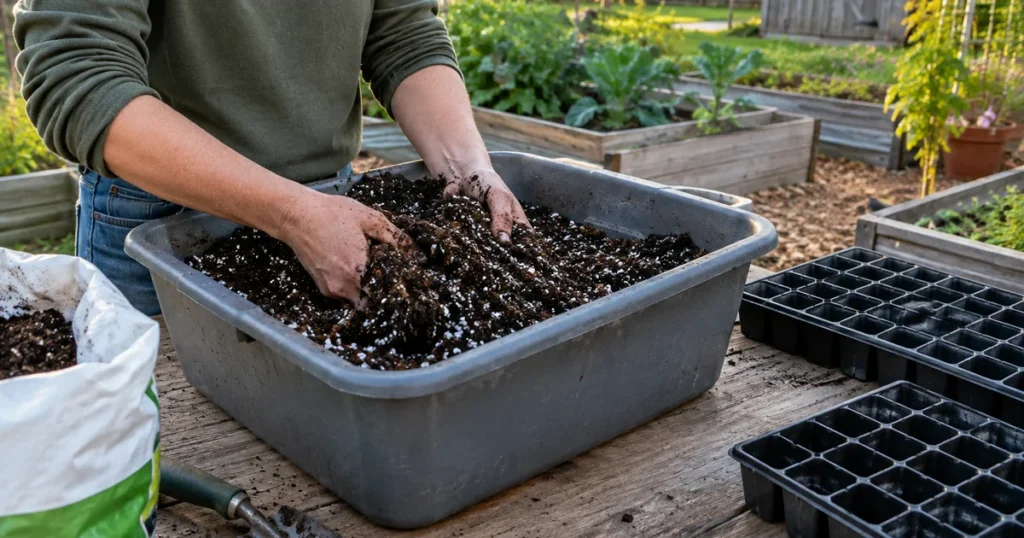
A seed starting mix is a fine, light, soilless blend, usually peat moss or coconut coir with vermiculite or perlite, that holds moisture and air around tiny roots without crusting or carrying disease. It contains little or no fertilizer, so seeds sprout cleanly and you feed the seedlings later. You can buy it by the bag or mix your own from equal parts of two ingredients.
Quick answer
- Never start seeds in garden soil: it compacts, drains poorly and carries weed seeds and disease organisms.
- Good seed starting mix is sterile, fine-textured and soilless, with a pH around 5.5-6.5.
- Simple DIY recipe: 1 part peat moss or coir + 1 part vermiculite or perlite, moistened before use.
- Moisten the mix until it feels like a wrung-out sponge before filling trays.
- Use seed starting mix for sowing, potting mix for potting up and containers, and raised bed mix only outdoors.
In this guide
- What is seed starting mix?
- Why not use garden soil for seeds?
- Seed starting mix ingredients
- DIY seed starting mix recipe
- How to moisten seed starting mix
- Store-bought seed starting mix: what to look for
- Seed starting mix vs potting mix vs raised bed mix
- What is the best potting mix for vegetables?
- Is potting soil the same as seed starting mix?
- Common mistakes to avoid
- FAQ
Want every planting date for your region in one place? Get The Year-Round Vegetable Garden (225 pages, $27).
What is seed starting mix?
Seed starting mix is a growing medium made for germination. Most bagged mixes contain sphagnum peat moss or coir as the base, plus vermiculite and sometimes perlite for air and moisture balance. Many add a little lime to raise the pH and a wetting agent so the dry mix absorbs water more easily.
What it lacks matters just as much. A true seed starting mix has no garden soil, no coarse bark chunks and little or no fertilizer. Penn State Extension notes that compost-heavy mixes can be high in soluble salts, which can inhibit germination, so seed mixes lean on peat and vermiculite instead.
Why not use garden soil for seeds?
Garden soil works outdoors because it is part of a living system with worms, roots and freeze-thaw cycles that keep it loose. Packed into a 2-inch cell, it behaves very differently.
- It compacts. Watering turns it dense and airless, and roots need oxygen as much as water.
- It crusts. The surface dries into a hard skin that delicate sprouts struggle to push through.
- It carries weed seeds and pathogens, including the fungi and water molds that cause damping-off.
- It drains poorly in a container, leaving roots sitting wet.
Oregon State University Extension sums it up: backyard soil is too compacted, full of weed seeds and not pasteurized. Keep your garden soil for the garden.
Seed starting mix ingredients
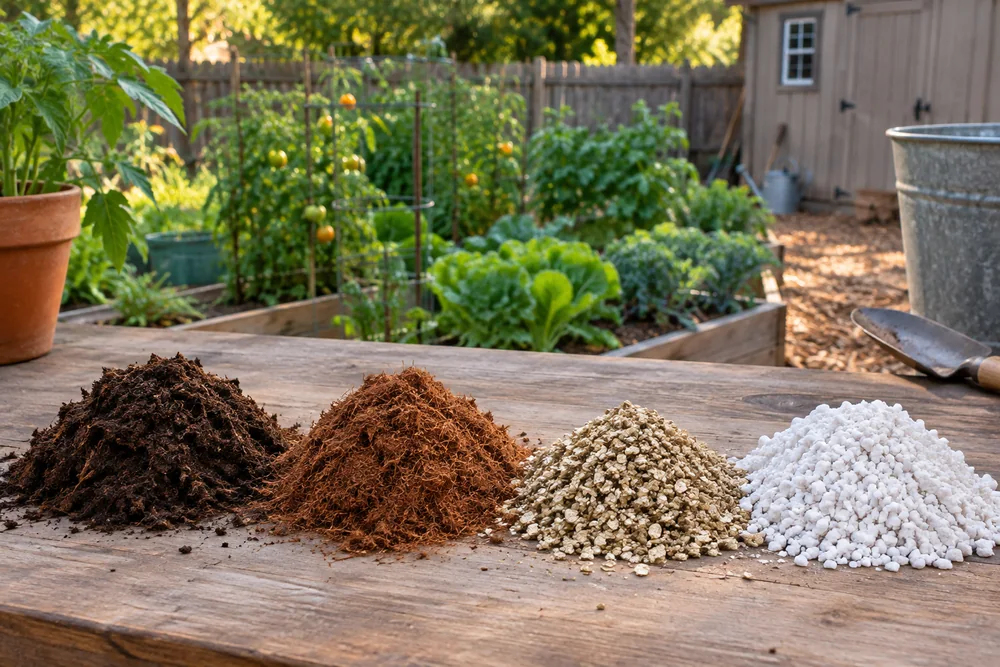
Sphagnum peat moss
Peat is the classic base. It holds a lot of water while staying light and airy, and it is naturally low in nutrients and disease organisms. It is also very acidic, which is why commercial mixes add lime. Dry peat repels water at first, so always moisten it thoroughly before sowing.
Coconut coir
Coir is made from coconut husk fiber and is the main alternative to peat. It holds water well, rewets more easily than peat once dry, and its pH is closer to neutral. Many gardeners choose it as a renewable byproduct, since peat is harvested from slow-growing bogs. Quality varies, so buy coir sold for horticulture, which is rinsed to remove excess salts.
Vermiculite
Vermiculite is a mineral heated until it puffs into light, spongy flakes. It holds water and some nutrients, improves aeration, and makes a clean covering for seeds that will not crust over. Fine grade is best for seed starting.
Perlite
Perlite is volcanic glass expanded into white, popcorn-like bits. It holds very little water and mainly adds drainage and air. It is useful in mixes that tend to stay soggy. Our perlite vs vermiculite guide explains when to use each.
Compost
Compost adds nutrients and helpful microbes but can bring weed seeds, salts and disease if it is not fully finished. It belongs in potting mix for older seedlings rather than in the germination mix. If you use homemade compost, screen it fine and keep it to a small share of the blend.
Gear that helps
- Compressed coconut coir bricks: Economical, renewable base for a DIY mix
As an Amazon Associate we earn from qualifying purchases. Check current prices and reviews on Amazon.
DIY seed starting mix recipe
Making your own mix is cheap and lets you buy ingredients in bulk. Several extension services offer recipes; these three cover most needs:
- Basic seed mix. 1 part peat moss or coir + 1 part vermiculite or perlite (or half of each). Oregon State and Utah State extensions both describe this simple blend.
- Classic peat-lite mix from University of Missouri Extension: 4 quarts vermiculite + 4 quarts peat moss + 1 tablespoon superphosphate + 2 tablespoons pulverized limestone. The lime offsets the peat’s acidity.
- Potting-up mix for older seedlings. University of Maryland Extension suggests blending compost 1:2 with soilless mix, which adds some nutrition once seedlings move to bigger pots.
Measure by volume with a bucket or coffee can, combine in a tub, and moisten before use. Store leftover dry mix in a closed bin so it stays clean.
Garden hack: Not sure a homemade or new bagged mix is any good? Sow a pinch of lettuce or cress seed in a cup of it. Penn State Extension recommends this quick test: if the seeds sprout evenly in a few days and look healthy, the mix is ready for your peppers and tomatoes.
Watch out: Wear a dust mask when mixing dry peat, perlite or vermiculite, and dampen the ingredients first to keep dust down. If you choose to pasteurize compost or soil for a mix, Oregon State Extension advises heating it to 180°F for 30 minutes, checked with a thermometer, and not hotter, which can damage its structure.
Gear that helps
- Fine vermiculite: Key ingredient for a homemade mix and for covering small seeds
As an Amazon Associate we earn from qualifying purchases. Check current prices and reviews on Amazon.
How to moisten seed starting mix
Dry mix sheds water, so a common mistake is filling cells with dry mix and pouring water on top. The water runs straight through and the seeds sit in dust.
- Pour the mix into a tub or bucket.
- Add warm water a little at a time, about 1 cup per few quarts of mix to start.
- Stir and squeeze with your hands until it is evenly damp.
- Squeeze a handful: it should hold together and drip no more than a drop or two. If water streams out, add more dry mix.
- Let it sit for 30 minutes so peat or coir fully absorbs the water, then fill your trays.
Store-bought seed starting mix: what to look for
Bags are labeled many ways, so read the ingredients rather than the front panel. The main types are:
- Peat-based seed starting mix: peat, vermiculite and/or perlite, lime and a wetting agent. The standard choice.
- Coir-based seed starting mix: same idea with coir as the base. Rewets easily, good if you tend to let trays dry out.
- Organic seed starting mix: uses ingredients allowed in organic growing, sometimes with a small organic fertilizer charge. Look for an OMRI Listed or similar label if that matters to you.
- Compressed coir bricks: lightweight blocks that expand in water. Economical, but add some vermiculite or perlite for air.
- Peat or coir pellets: pre-formed discs in netting that swell when soaked. Convenient for a few seeds, but they dry out fast and the netting can restrict roots if not removed at planting.
- Fine all-purpose potting mix: University of Maryland Extension notes that a standard all-purpose transplanting mix works for seed starting too. Screen out bark chunks for tiny seeds.
Pass on bags labeled garden soil, topsoil or raised bed mix for starting seeds. Mixes with a large dose of fertilizer are better for potting up than for sowing.
The Year-Round Vegetable Garden (2027 Edition)
Plan the whole season in one place: a 225-page month-by-month guide with calendars for six US growing regions, 50 plant profiles (tomatoes included), 5 copy-ready garden plans and 7 printable pages.
Tomato lover? Add Tomato Mastery, our seed-to-harvest tomato blueprint, for just $10 at checkout.
Get the guide ($27)Gear that helps
- Organic seed starting mix: Ready-made fine, soilless mix for readers who prefer not to blend their own
As an Amazon Associate we earn from qualifying purchases. Check current prices and reviews on Amazon.
Seed starting mix vs potting mix vs raised bed mix
| Seed starting mix | Potting mix | Raised bed mix | Garden soil / topsoil | |
|---|---|---|---|---|
| Main ingredients | Fine peat or coir, vermiculite, perlite | Peat or coir, perlite, bark, often compost and fertilizer | Compost, topsoil, bark or other organic matter | Mineral soil (sand, silt, clay) |
| Texture | Very fine and light | Medium, some chunks | Coarse and heavier | Heavy, variable |
| Nutrients | Little or none | Moderate, often with slow-release fertilizer | Moderate to high | Variable |
| Best use | Sowing seeds in cells and flats | Potting up seedlings, containers, pots | Filling raised beds outdoors | In-ground beds and topping up beds |
| Use for seed starting? | Yes | Fine grades work; screen out bark | No, too coarse and dense | No |
What is the best potting mix for vegetables?
Once seedlings move into 3-4 inch pots, or when you grow vegetables in containers on a patio, they need more than a seed mix. A good potting mix for vegetables is light enough to drain freely but holds water between waterings, and it feeds the plant.
Look for a mix based on peat or coir with perlite or fine bark for drainage, plus compost or a slow-release fertilizer. For containers, plan to keep feeding through the season, since frequent watering flushes nutrients out. Adding a little screened compost or worm castings to a bagged mix is a common way to give it more staying power. Avoid filling containers with garden soil: even good loam turns dense in a pot.
Is potting soil the same as seed starting mix?
Not quite. “Potting soil” and “potting mix” are often used for the same bagged product, and most contain no actual soil at all. They are usually coarser and richer than a seed starting mix. That makes them a good choice for potting up and containers, and a workable choice for larger seeds like squash and beans, but small seeds such as lettuce, onions and peppers germinate more evenly in a fine seed mix.
Common mistakes to avoid
- Reusing old mix from last year’s trays or containers. It can harbor disease and has lost structure.
- Sowing into dry mix. Always pre-moisten, then fill.
- Packing it down. Firm gently by tapping the tray; pressing hard squeezes out air.
- Adding unscreened compost or garden soil to a germination mix.
- Forgetting to feed. Seed mixes carry little fertilizer, and any starter charge lasts only a few weeks. Start quarter-strength feeding at the first true leaves.
Ready to sow? Our step-by-step guide on how to start seeds indoors takes you from filling trays to transplanting.
FAQ
Can I use potting soil instead of seed starting mix?
Yes, a fine all-purpose potting mix works, especially for larger seeds. Screen out bark chunks and avoid heavily fertilized mixes for small seeds, which germinate better in a fine seed mix.
What is the best seed starting mix?
The best mix is fine, sterile and soilless, based on peat or coir with vermiculite or perlite and a pH around 5.5-6.5. Bagged or homemade, those qualities matter more than the brand.
Can I make my own seed starting mix?
Yes. Mix 1 part peat moss or coir with 1 part vermiculite or perlite by volume, and moisten it before filling trays. Add a little lime if you use peat.
Is coir better than peat for seed starting?
Both work well. Coir rewets more easily and has a pH closer to neutral; peat is widely available and very consistent. Choose based on availability and preference.
Do seed starting mixes have fertilizer?
Most have little or none, and some include a small starter charge that lasts only a few weeks. Feed seedlings at quarter strength once true leaves appear.
Can I reuse seed starting mix?
It is best not to reuse it for germination, since it may carry disease. Add old mix to the compost pile or work it into garden beds instead.
Keep reading
Sources
- Make your own seed-starting mix – Oregon State University Extension
- Potting Media and Plant Propagation – Penn State Extension
- Starting Plants Indoors From Seeds – University of Missouri Extension
- Containers and Potting Soil for Indoor Seed Starting – University of Maryland Extension
- Starting Vegetable Seeds Indoors: II. Materials – Utah State University Extension
- Starting seeds indoors – University of Minnesota Extension