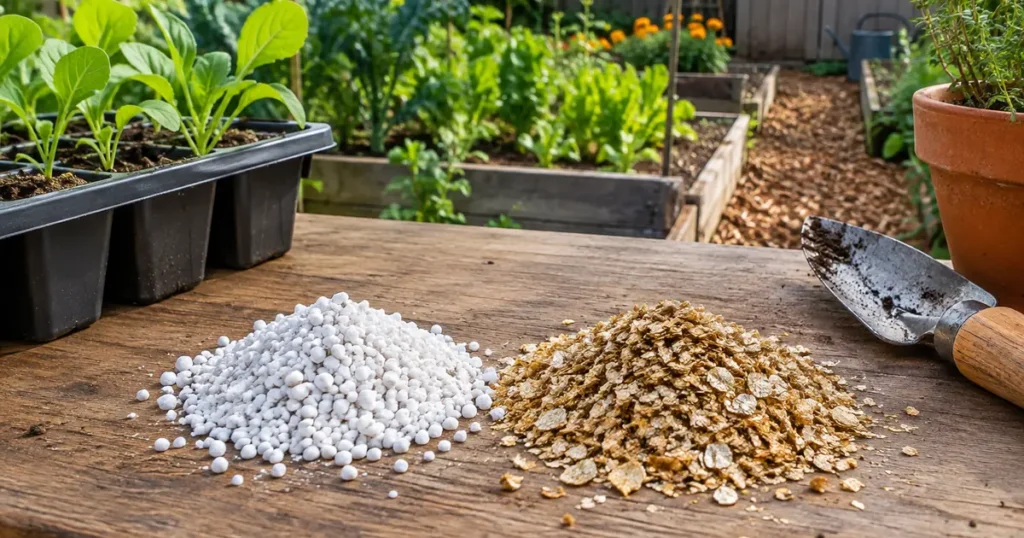
Perlite and vermiculite both lighten potting mixes, but they do opposite jobs. Perlite is puffed volcanic glass that drains fast and adds air, while vermiculite is expanded mica-like mineral that soaks up water and holds nutrients. Use perlite when roots need oxygen and quick drainage, and vermiculite when seeds and young roots need steady moisture.
Quick answer
- Perlite = drainage and air. It is white, gritty, pH neutral and holds water only on its surface.
- Vermiculite = moisture and nutrients. It is tan-gold, flaky, neutral to slightly alkaline and holds a lot of water plus potassium, calcium and magnesium.
- For seed starting, a fine grade of vermiculite is the classic seed cover; perlite keeps the mix from staying soggy.
- For containers of vegetables, perlite is usually the better choice; for rooting cuttings, both work, alone or mixed with peat or coir.
- Both are dusty when dry. Dampen them first and wear a dust mask.
In this guide
- What is perlite?
- What is vermiculite?
- Perlite vs vermiculite: properties compared
- Which is better for seed starting?
- Perlite vs vermiculite for containers
- Rooting cuttings: perlite or vermiculite?
- Should you add perlite or vermiculite to raised beds?
- Is vermiculite safe? Dust and the asbestos question
- Coco coir vs peat moss: the other half of your mix
- Common mistakes to avoid
- FAQ
Want every planting date for your region in one place? Get The Year-Round Vegetable Garden (225 pages, $27).
What is perlite?
Perlite is a volcanic glass that contains a little trapped water. Miners crush it and flash-heat it in a furnace (University of Arkansas Extension puts the range at 1,100-1,600°F). The water turns to steam, and each grain pops like popcorn into a lightweight white pebble full of sealed air cells.
Because those cells are closed, perlite does not soak up water the way a sponge does. Moisture clings to its rough outer surface and crevices, and the rest drains away. That is exactly why gardeners add it: it opens up air pockets and keeps a mix from compacting.
- pH: neutral, and chemically inert, so it won’t change your mix.
- Nutrients: none.
- Weight: very light, about 6-8 pounds per cubic foot.
- Quirk: it floats, so it tends to rise to the top of pots after heavy watering.
What is vermiculite?
Vermiculite is a mined mineral related to mica. When it is heated, water between its thin layers turns to steam and pushes them apart, so each flake expands into an accordion-shaped particle. Those layers trap water and dissolved nutrients.
Oklahoma State Extension describes vermiculite as having excellent water-holding capacity and a relatively high cation exchange capacity (CEC), which means it grabs positively charged nutrients such as potassium, calcium and magnesium and releases them to roots over time. Texas A&M adds that it also supplies some potassium and magnesium of its own.
- pH: neutral to slightly alkaline for U.S. sources, according to University of Arkansas Extension; some imported material runs higher.
- Nutrients: holds and buffers them.
- Weak spot: it is soft. Squeezing or packing it, especially when wet, crushes the layers and ruins its structure.
Perlite vs vermiculite: properties compared
| Property | Perlite | Vermiculite |
|---|---|---|
| Made from | Volcanic glass, heat-expanded | Mica-like mineral, heat-expanded |
| Looks like | White, round, gritty pebbles | Gold-brown, shiny, flaky bits |
| Water retention | Low (surface only) | High |
| Aeration and drainage | Excellent | Moderate |
| pH | Neutral | Neutral to slightly alkaline |
| Holds nutrients (CEC) | No | Yes |
| Durability | Holds its shape for years | Compresses and breaks down faster |
| Best uses | Container mixes, plants that hate wet feet, cuttings, opening up heavy mixes | Covering seeds, seed-starting mixes, moisture-loving cuttings, mixes that dry out too fast |
Garden hack: Can’t remember which is which? “Perlite” and “pebble” both start with P: perlite is the white, crunchy pebble that adds air. Vermiculite is the soft, shiny flake that holds water. Rub a pinch between your fingers and you’ll feel the difference right away.
Which is better for seed starting?
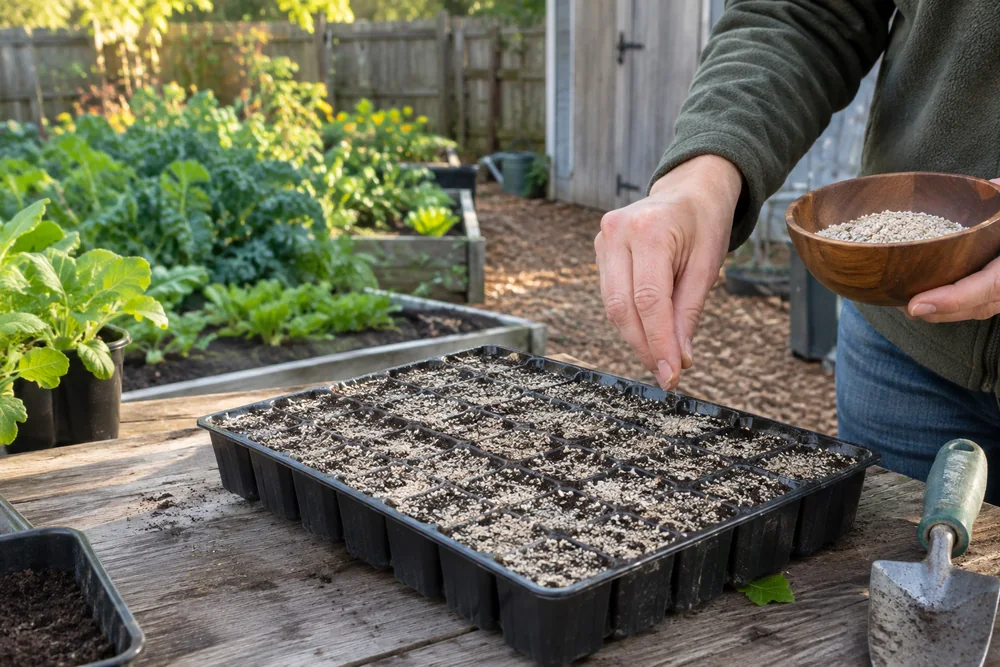
Both show up in good seed starting mix, usually blended with peat moss or coco coir. The classic Cornell “peat-lite” recipe for greenhouses is simply equal parts peat moss and vermiculite, which tells you how well vermiculite suits young seedlings.
Vermiculite as a seed cover
A thin layer of fine vermiculite over sown seeds is a long-standing trick. It keeps the seed zone evenly moist, lets light through for seeds that need a little of it, and does not crust over. University of Minnesota Extension suggests covering seeds that need darkness with vermiculite, and the University of Saskatchewan recommends a sterile vermiculite cover to help prevent damping off.
Perlite for drainage
If your seed mix stays soggy for days after watering, mix in 10-25 percent perlite. Waterlogged mix is one of the main reasons seeds rot before they sprout. Fine grades work best in small cells.
A simple homemade seed mix: 1 part peat moss or coir, 1 part fine vermiculite, 1 part fine perlite. Moisten it before filling cells. For the full process, see our guide to starting seeds indoors.
Gear that helps
- Fine-grade horticultural vermiculite: Classic seed cover that keeps the seed zone evenly moist
As an Amazon Associate we earn from qualifying purchases. Check current prices and reviews on Amazon.
Perlite vs vermiculite for containers
For vegetables in pots, grow bags and window boxes, perlite is usually the better pick. Container soil stays wetter than garden soil because water perches at the bottom of the pot, and perlite keeps air in the root zone. Tomatoes, peppers, herbs like rosemary and thyme, and anything prone to root rot benefit.
Vermiculite earns a spot in containers that dry out too fast: hanging baskets, small pots on a hot patio, or mixes heavy in bark. A blend of both gives you some of each property.
- Most vegetables in containers: quality potting mix with 10-20 percent extra perlite if it seems dense.
- Thirsty crops in small pots (lettuce, celery): add a few handfuls of vermiculite.
- Mediterranean herbs: up to one-third perlite for sharp drainage.
Gear that helps
- Organic horticultural perlite: Improves drainage and aeration in container mixes
As an Amazon Associate we earn from qualifying purchases. Check current prices and reviews on Amazon.
Rooting cuttings: perlite or vermiculite?
Both make clean, sterile rooting media, and the University of Arkansas notes vermiculite is used extensively in propagation. The choice comes down to moisture.
- Perlite (alone or 50/50 with peat or coir): lower rot risk, good for cuttings that rot easily and for setups with a humidity dome.
- Vermiculite (alone or mixed): stays moist longer, useful if you can’t check cuttings daily.
Tomato suckers, basil and mint root easily in either. Keep the medium moist, not dripping, and give cuttings bright indirect light.
Should you add perlite or vermiculite to raised beds?
Usually not. In a raised bed, the volume is too large for either to be cost-effective, and perlite tends to work its way to the surface and blow around. For better drainage and water holding in beds, compost and good topsoil do the job for far less money. Our garden soil guide covers bed mixes in detail.
The exception is small raised planters and elevated “table” beds, which behave like big containers. There, a potting-mix-style blend with some perlite makes sense.
The Year-Round Vegetable Garden (2027 Edition)
Plan the whole season in one place: a 225-page month-by-month guide with calendars for six US growing regions, 50 plant profiles (tomatoes included), 5 copy-ready garden plans and 7 printable pages.
Tomato lover? Add Tomato Mastery, our seed-to-harvest tomato blueprint, for just $10 at checkout.
Get the guide ($27)Is vermiculite safe? Dust and the asbestos question
Both products are dusty when dry. Oklahoma State Extension notes perlite dust can irritate the eyes and lungs, and fine vermiculite is no different. Moisten the bag contents before you scoop, work outdoors or in a ventilated space, and wear a dust mask.
Vermiculite carries a second, historical concern. EPA notes that a mine near Libby, Montana, supplied over 70 percent of all vermiculite sold in the U.S. from 1919 to 1990, and that ore was contaminated with asbestos. The mine closed in 1990, and the most serious problems were with vermiculite attic insulation, often sold as Zonolite.
For garden products, EPA tested 54 vermiculite garden products bought in stores in 2000. Most had no measurable asbestos, a handful had trace amounts, and EPA concluded that consumer exposure posed a minimal health risk. Its advice for gardeners still stands as good practice:
- Use vermiculite outdoors or in a well-ventilated area.
- Keep it damp to cut down on dust.
- Don’t track dusty clothing through the house.
- If you’d rather avoid it, use a premixed potting soil or substitute perlite, peat or coir.
Watch out: Old vermiculite insulation in an attic or wall is a different material. Do not scoop it out for the garden or disturb it; EPA advises leaving it alone and hiring a trained professional if it must be removed.
Gear that helps
- Reusable dust mask / N95 respirator: Protects lungs when mixing dry perlite or vermiculite
As an Amazon Associate we earn from qualifying purchases. Check current prices and reviews on Amazon.
Coco coir vs peat moss: the other half of your mix
Perlite and vermiculite are usually mixed with an organic base. The two common choices:
| Feature | Peat moss | Coco coir |
|---|---|---|
| Source | Partly decayed sphagnum from bogs | Shredded coconut husks |
| pH | Very acidic, about 3.8-4.5; mixes add lime | About 5.5-6.8 |
| Water holding | Very high, up to about 10 times its weight | High, up to about 9 times its weight |
| Rewetting when dry | Hard; repels water at first | Easier |
| Watch for | Slow-renewing resource harvested from bogs | Salt (sodium, chloride) if not well washed; buy rinsed, buffered coir |
Either works well with perlite and vermiculite. Coir’s easier rewetting makes it forgiving for beginners who sometimes let trays dry out.
Garden hack: Compressed coir bricks expand several times their size. Soak one in warm water in a bucket for 15-20 minutes, fluff it with your hands, then stir in perlite or vermiculite while it is still moist so nothing dusts up.
Gear that helps
- Compressed coco coir bricks: Peat alternative that rewets easily for homemade mixes
As an Amazon Associate we earn from qualifying purchases. Check current prices and reviews on Amazon.
Common mistakes to avoid
- Using vermiculite in pots that already stay wet, which leaves roots short of oxygen.
- Packing vermiculite down firmly, which crushes its structure.
- Pouring either product dry and indoors without a mask.
- Filling a whole raised bed with perlite or vermiculite instead of compost and soil.
- Buying coarse perlite for tiny seed cells; choose fine grades for seed starting.
- Assuming you need either one: many bagged potting and seed-starting mixes already contain them.
FAQ
Can I use perlite instead of vermiculite?
Yes, but expect a mix that drains faster and needs watering more often. Perlite adds air, while vermiculite holds water and nutrients, so they are not interchangeable one for one.
Is perlite or vermiculite better for seed starting?
Fine vermiculite is the better seed cover because it holds even moisture. Perlite is useful inside the mix to keep it from staying soggy. Many good seed mixes contain both.
Does vermiculite contain asbestos today?
The asbestos-contaminated Libby, Montana mine closed in 1990. When EPA tested 54 garden vermiculite products in 2000, it found minimal risk to consumers, though a few had trace amounts. EPA still advises keeping vermiculite damp and using it in ventilated areas.
Can you reuse perlite?
Yes. Perlite doesn’t break down, so you can sift it out of old mix, rinse it, and reuse it. Discard it if the plants that grew in it were diseased.
Why is perlite floating on top of my pot?
Perlite is lighter than water, so heavy watering lifts it to the surface. It is harmless. Bottom watering or a thin layer of mix on top reduces it.
Is coco coir better than peat moss?
Coir rewets more easily and comes from a renewable byproduct, but it can carry salts if not washed. Peat holds more water and is very acidic, so mixes add lime. Both grow good seedlings.
Keep reading
Sources
- Soilless Growing Mediums – Oklahoma State University Extension
- Growing Media for Container Production in a Greenhouse or Nursery – University of Arkansas Cooperative Extension
- Growing Media – Texas A&M AgriLife Extension
- Asbestos-Contaminated Vermiculite: Garden Products Fact Sheet – U.S. EPA
- Protect Your Family from Asbestos-Contaminated Vermiculite Insulation – U.S. EPA
- Starting Seeds Indoors – University of Minnesota Extension