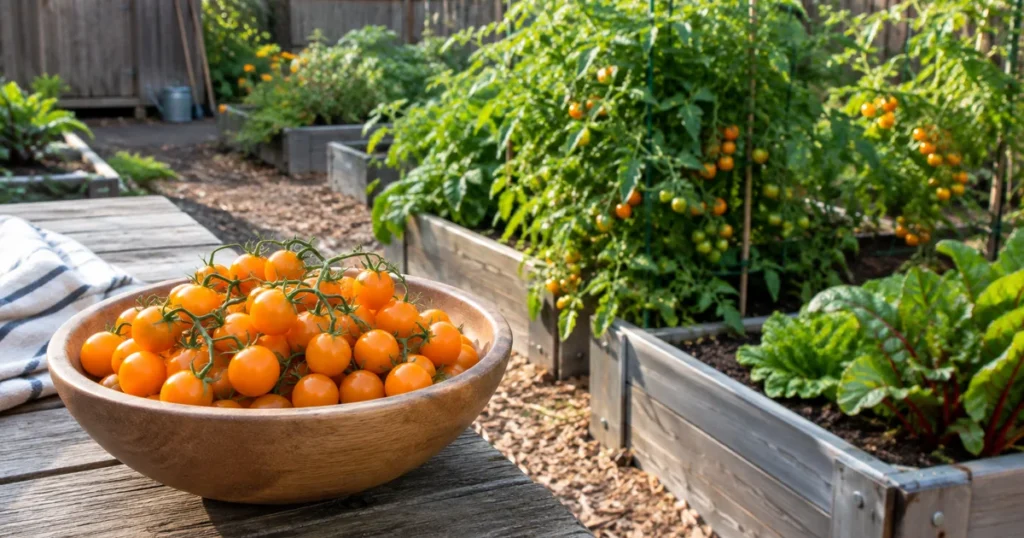
Sungold (also written Sun Gold) is an F1 hybrid cherry tomato with tangerine-orange fruit and a very sweet, fruity flavor. It is indeterminate, vigorous, and early: extension variety lists put it at about 57 to 60 days from transplant to first ripe fruit. Its one well-known weakness is splitting after heavy rain or uneven watering.
Quick answer
- Type: F1 hybrid, indeterminate cherry tomato bred in Japan by Tokita Seed.
- Days to maturity: about 57-60 days from transplanting.
- Plants get big: often 6 feet or more, so use a tall stake, sturdy cage, or trellis.
- Prone to cracking: water evenly, mulch, and pick fruit as soon as it turns fully orange.
- Seeds saved from the fruit will not grow true; buy fresh seed each year.
In this guide
- What is a Sungold tomato?
- Sungold tomato plant at a glance
- Sungold tomato days to maturity
- When and how to plant Sungold tomatoes
- Supporting and pruning a Sungold tomato plant
- Why Sungold tomatoes split, and how to reduce it
- Watering and feeding Sungold tomatoes
- Growing Sungold in containers
- Harvesting Sungold cherry tomatoes
- Can you save Sungold tomato seeds?
- Common mistakes to avoid
- FAQ
 Grow tomatoes in season for your region, month by month: The Year-Round Vegetable Garden ($27, PDF).
What is a Sungold tomato?
Sungold is a cherry tomato that bears long clusters of round, roughly 1-inch fruits. They ripen from green to a deep golden orange, and the flavor is consistently described as sweet with tangy, tropical, or citrus notes. North Dakota State University horticulturist Tom Kalb, writing about variety trials, described the fruit as tangerine-orange with sweet citrus and tropical flavors.
The variety was developed by Tokita Seed Co. in Japan and reached gardeners in the United Kingdom and the United States in the early 1990s. Because it is an F1 hybrid, every seed comes from a controlled cross of two parent lines, which is why the plants are uniform but seeds saved from the fruit are not.
Sungold or Sun Gold?
Both spellings refer to the same variety. Seed catalogs and extension lists use “Sungold,” “SunGold,” and “Sun Gold” interchangeably. Clemson’s Home & Garden Information Center, for example, lists it as Sun Gold, while Cornell’s citizen-science variety database uses Sungold.
Sungold tomato plant at a glance
| Trait | Sungold |
|---|---|
| Type | Cherry tomato, F1 hybrid |
| Growth habit | Indeterminate (vining, keeps producing until frost) |
| Days to maturity | About 57-60 days from transplant |
| Fruit | Round, about 1 inch, golden orange, in long clusters |
| Plant height | Often 5-6 feet or more with good support |
| Disease resistance | Listed with resistance to Fusarium wilt and tobacco mosaic virus (Clemson HGIC) |
| Main weakness | Fruit cracking after rain or uneven watering |
New to vining types? Our guide to determinate vs indeterminate tomatoes explains why indeterminate plants need more support and pruning.
Sungold tomato days to maturity
Clemson HGIC and University of Delaware Cooperative Extension both list Sun Gold at 57 days, and Cornell’s variety database gives 57 to 60 days. That count starts on the day you set transplants in the garden, not the day you sow. Add roughly 6 to 8 weeks of indoor growing before that.
In practice, the first clusters ripen noticeably earlier than most full-size tomatoes, and an indeterminate plant keeps setting new trusses until cold weather shuts it down. NDSU’s trial notes describe fruit setting from early summer until the first frost.
Garden hack: Because Sungold ripens so early, it is a smart pick for short-season zones 3-5. Pair it with a later slicer so you have fruit in July while the big tomatoes catch up.
When and how to plant Sungold tomatoes
Start seeds indoors 6 to 8 weeks before you plan to transplant, then follow normal tomato timing: plant out after your last frost once the soil reaches about 60°F and nights stay above 50°F. Our guide to tomato seedling care covers light, potting up, and hardening off.
| USDA zone | Start seeds indoors | Transplant outside | First ripe fruit (about) |
|---|---|---|---|
| 3-4 | Early to mid-April | Early to mid-June | Early to mid-August |
| 5 | Late March to early April | Late May to early June | Late July to early August |
| 6 | Mid- to late March | Mid- to late May | Mid- to late July |
| 7 | Early to mid-March | Late April to mid-May | Early July |
| 8 | Late January to February | Early to mid-April | Early June |
| 9-10 | December to January (and June for fall) | February to March, or August for fall | April to May, or October to November |
These are averages based on typical frost dates. USDA zones describe winter lows, not frost dates, so check your local frost dates or ask your county extension office before planting. Our guide to when to plant tomatoes has more regional detail.
Planting tips
- Sun: At least 6 to 8 hours of direct sun.
- Soil: Well-drained, rich in organic matter, pH around 6.2 to 6.8.
- Depth: Remove the lower leaves and bury the stem so only the top two or three sets of leaves show.
- Spacing: About 2 to 3 feet between plants; 18 to 24 inches is workable if you stake and prune to one or two stems.
Supporting and pruning a Sungold tomato plant

Sungold is a large plant. NDSU’s trial reported vines around 6 feet tall, and gardeners in Cornell’s database repeatedly mention vigorous plants that need staking or caging and pruning. A short store-bought cone cage will not hold it.
- Tall stake: Use a 7- to 8-foot stake driven 1 foot or more into the ground, and tie the main stem every 8 inches or so. Prune to one or two main stems.
- Heavy cage: University of Georgia Extension recommends cages at least 3 feet in diameter made from livestock fencing or concrete reinforcing wire, anchored so they do not tip.
- Trellis or cattle panel: An arch or vertical panel handles several plants and keeps clusters easy to reach.
Pinch suckers (the shoots that form between a leaf and the main stem) while they are small if you are training to a stake. In cages, Clemson HGIC suggests pruning once to three or four main stems and letting the plant fill the cage. Remove lower leaves that touch the soil to cut down on splash-borne disease.
Gear that helps
- Heavy-duty tomato cage: Holds a vigorous 6-foot indeterminate vine that would flatten a light cone cage.
As an Amazon Associate we earn from qualifying purchases. Check current prices and reviews on Amazon.
Why Sungold tomatoes split, and how to reduce it
Cracking is the most common complaint about Sungold. Variety descriptions sometimes call it crack-free, but many gardeners in Cornell’s database report splitting, especially after rain or a deep watering, and NDSU noted that a competing orange cherry was much less prone to cracking.
The University of Massachusetts Amherst vegetable program identifies swings from dry to wet soil as a major cause of tomato cracking, along with high temperatures, high humidity, and fruit left to ripen fully on the plant. Sugar content and genetics are also thought to play a role, which helps explain why some varieties crack more than others.
- Water evenly. Aim for about 1 inch of water per week, soaking the root zone, rather than letting soil dry out and then flooding it.
- Mulch. A 2- to 3-inch layer of straw or shredded leaves keeps soil moisture steadier.
- Pick early. Harvest when fruit is fully orange, and pick ahead of forecast heavy rain.
- Use drip or soaker hoses so water goes to the soil, not onto the fruit.
Watch out: Split fruit is safe to eat right away if the crack is fresh and clean, but cracks open the door to mold and fruit flies. Use split tomatoes the same day and compost any that are moldy or leaking.
Gear that helps
- Soaker hose or drip kit: Delivers even moisture to the soil, which helps reduce fruit cracking.
As an Amazon Associate we earn from qualifying purchases. Check current prices and reviews on Amazon.
Watering and feeding Sungold tomatoes
Tomatoes need at least an inch of water per week, more in hot, windy weather, and South Dakota State University Extension recommends soaking the soil 8 to 10 inches deep rather than sprinkling lightly. Frequent shallow watering encourages shallow roots and makes cracking worse.
Base fertilizer on a soil test when you can. Too much nitrogen gives a jungle of leaves with fewer flowers. A common extension approach is to work in a balanced fertilizer before planting and side-dress lightly once the first fruits form, following the product label.
Garden hack: Push a finger 2 inches into the soil every morning in midsummer. If it is dry at that depth, water deeply. That one habit prevents most splitting and blossom drop on cherry tomatoes.
Growing Sungold in containers
Sungold can grow in a pot, but its size calls for a big one: think 15 to 20 gallons or more, with a strong stake or a cage anchored into the container. Containers dry out fast, so expect to water daily in summer, which also means more risk of the dry-wet swings that cause cracking. Use a quality potting mix rather than garden soil. See our guide to growing tomatoes in pots for setup details.
Harvesting Sungold cherry tomatoes
Pick when the fruit turns from yellow to a deep golden orange and gives slightly under your fingers. Fruit left on the vine past that point gets no sweeter and is more likely to split. Snip or pinch individual fruits, or cut whole clusters when most of the truss is ripe.
Harvest every day or two at peak season. At the end of the season, pull remaining green fruit before frost and ripen it indoors; our guide on ripening green tomatoes explains how.
Can you save Sungold tomato seeds?
You can, but the plants will not match the parent. Wisconsin Extension notes that only open-pollinated, non-hybrid varieties produce seed that grows true. Seeds from a Sungold fruit give a mix of plants that may differ in color, size, flavor, and vigor. If you want true Sungold every year, buy fresh hybrid seed or transplants.
For the full growing season, from soil prep to harvest, see our guide on how to grow tomatoes.
Common mistakes to avoid
- Using a small cone cage that collapses under a 6-foot vine.
- Letting soil swing from bone-dry to soaked, which splits fruit.
- Leaving ripe fruit on the plant for days.
- Overfeeding with nitrogen, which grows leaves instead of fruit.
- Planting into cold soil and losing the early-harvest advantage.
- Saving seed from hybrid fruit and expecting identical plants.
FAQ
Is Sungold tomato determinate or indeterminate?
Sungold is indeterminate. The vines keep growing and setting fruit until frost, often reaching 6 feet or more, so they need a tall stake, a sturdy cage, or a trellis.
How many days does it take for Sungold tomatoes to ripen?
Extension variety lists give about 57 to 60 days from transplanting to the first ripe fruit. Add 6 to 8 weeks of indoor growing if you start from seed.
Why do my Sungold tomatoes keep splitting?
Splitting is usually caused by uneven soil moisture, especially heavy rain or watering after a dry spell. Water evenly, mulch, and pick fruit as soon as it is fully orange.
Is Sungold a hybrid or heirloom?
Sungold is an F1 hybrid developed by Tokita Seed in Japan. Seeds saved from its fruit will not grow true to type.
Can you grow Sungold tomatoes in a pot?
Yes, in a large container of about 15 to 20 gallons or more with strong support. Expect to water daily in hot weather to keep moisture steady.
When are Sungold tomatoes ripe?
They are ripe when they turn a deep golden orange and feel slightly soft. Pick promptly; fruit left on the vine is more likely to crack.
Keep reading
Sources
- Tomato Fact Sheet (cultivar table) – Clemson Cooperative Extension, Home & Garden Information Center
- Cherry Tomatoes – University of Delaware Cooperative Extension
- Dakota Gardener: You Have to Try This Tomato – NDSU Extension
- Vegetable Varieties for Gardeners: Sungold Tomato – Cornell Cooperative Extension
- Tomato Fruit Cracking – UMass Amherst Extension Vegetable Program
- Staking and Pruning Tomatoes in the Home Garden – University of Georgia Extension
- Tomato: How to Grow It – South Dakota State University Extension
- Tomatoes: From Seedlings to Fruit – Penn State Extension
- Growing Tomatoes Handout – University of Wisconsin-Madison Extension