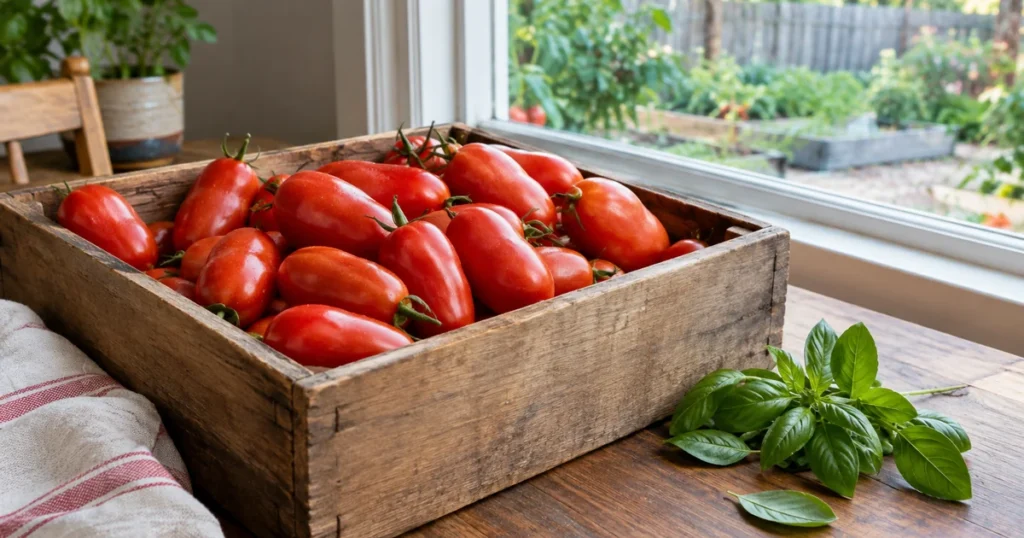
San Marzano tomatoes are an Italian open-pollinated paste variety with long, pointed, meaty fruit and few seeds, prized for sauce. In the garden they behave as indeterminate vines that need tall support, take about 78 to 80 days from transplant to harvest, and are more prone to blossom end rot than most tomatoes, so steady watering matters.
Quick answer
- San Marzano is an open-pollinated heirloom paste tomato, listed by extension services as indeterminate.
- Expect about 78-80 days from transplanting to first ripe fruit.
- Stake or cage tall; plants keep growing and producing until frost.
- It is one of the more blossom end rot-prone varieties: water deeply and evenly, and mulch.
- “San Marzano DOP” is an Italian label for tomatoes grown and canned in a defined area near Naples; home-grown fruit is the same variety, not DOP.
In this guide
- What are San Marzano tomatoes?
- San Marzano vs Roma: what is the difference?
- What does DOP San Marzano mean?
- When to plant San Marzano tomatoes
- How to grow San Marzano tomatoes
- San Marzano and blossom end rot
- Harvesting San Marzano tomatoes
- Using San Marzano tomatoes: sauce and canning
- Common mistakes to avoid
- FAQ
 Grow tomatoes in season for your region, month by month: The Year-Round Vegetable Garden ($27, PDF).
What are San Marzano tomatoes?
San Marzano is a plum-type tomato named for San Marzano sul Sarno, a town in the Campania region of southern Italy. The fruits are long and slender, often 3 inches or more, with a tapered or slightly pointed tip, thick walls, and a small seed cavity. University of Delaware Cooperative Extension sums it up as a traditional sauce tomato with long fruit and a small seed cavity.
That shape and flesh make it a classic paste tomato: less juice to cook off, fewer seeds to strain, and a rich, sweet-tart flavor when cooked down. It is also open-pollinated, so you can save seeds from your best fruit and grow the same variety next year.
San Marzano tomato plant at a glance
| Trait | San Marzano |
|---|---|
| Type | Paste (plum) tomato, open-pollinated heirloom |
| Growth habit | Indeterminate (vining) |
| Days to maturity | About 78-80 days from transplant |
| Fruit | Elongated, tapered, deep red, meaty, few seeds |
| Disease resistance | None listed in Clemson HGIC’s cultivar table |
| Main weakness | Blossom end rot |
San Marzano vs Roma: what is the difference?
Both are paste tomatoes, and both make good sauce, but they grow differently in the garden.
| San Marzano | Roma | |
|---|---|---|
| Growth habit | Indeterminate (climbing) | Determinate (bush) |
| Days to maturity | About 78 days | About 76 days |
| Fruit shape | Longer, slimmer, tapered tip | Shorter, egg- or plum-shaped, blunt end |
| Harvest pattern | Steady picking until frost | Most fruit ripens over a few weeks |
| Support | Tall stake, heavy cage, or trellis | Short cage or stake |
Day counts are from University of Delaware’s paste tomato fact sheet. Pick Roma if you want a big batch at once for a single canning weekend; pick San Marzano if you want a longer harvest and do not mind a taller plant. Our guide to determinate vs indeterminate tomatoes explains the trade-offs in more detail.
What does DOP San Marzano mean?
DOP stands for Denominazione d’Origine Protetta, the Italian form of the European Union’s Protected Designation of Origin. The registered name is Pomodoro S. Marzano dell’Agro Sarnese-Nocerino. According to the specification filed with the EU, it covers:
- A defined area: municipalities in the provinces of Salerno, Naples, and Avellino, on the volcanic plain of the Sarno River.
- A defined plant: the San Marzano ecotype or improved lines derived from it.
- Defined methods: plants trained upright on posts and wires, fruit hand-picked when fully ripe in several passes.
- A defined product: mainly whole peeled tomatoes packed in cans or jars.
Because the label is tied to that place, tomatoes grown in the United States, including in your backyard, can be the San Marzano variety but cannot be DOP San Marzano. When shopping for canned tomatoes, a can labeled simply “San Marzano style” or “San Marzano variety” does not carry the DOP certification.
When to plant San Marzano tomatoes
Start seeds indoors 6 to 8 weeks before your planned transplant date, and move plants outside after the last frost once the soil reaches about 60°F and nights stay above 50°F. With a longer season than cherry types, San Marzano benefits from getting into the ground on time. Our tomato seedlings guide covers indoor care and hardening off.
| USDA zone | Start seeds indoors | Transplant outside | First ripe fruit (about) |
|---|---|---|---|
| 3-4 | Early to mid-April | Early to mid-June | Late August to early September |
| 5 | Late March to early April | Late May to early June | Mid- to late August |
| 6 | Mid- to late March | Mid- to late May | Early to mid-August |
| 7 | Early to mid-March | Late April to mid-May | Late July |
| 8 | Late January to February | Early to mid-April | Late June to early July |
| 9-10 | December to January (June for fall) | February to March, or August for fall | May, or late October to November |
These dates follow typical frost dates for each zone. Your USDA zone is based on average winter lows, not frost dates, so confirm your local frost dates or check with your county extension office. In zones 3-4, choose a warm, sheltered spot and consider covering young plants on cool nights. See when to plant tomatoes for more on timing.
How to grow San Marzano tomatoes
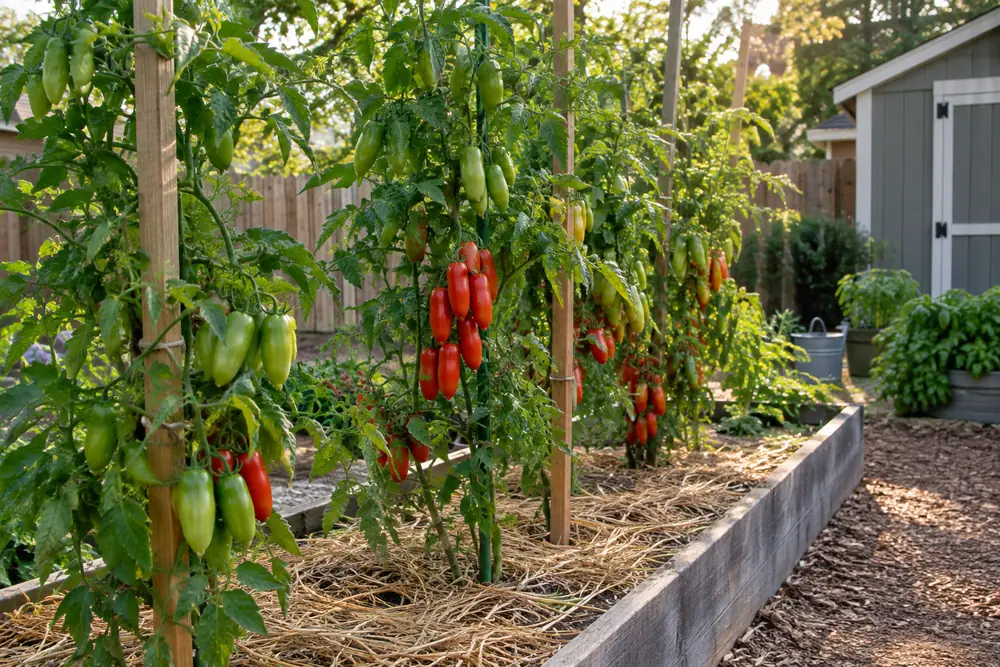
Site and soil
Give plants at least 6 to 8 hours of direct sun in well-drained soil rich in organic matter. Penn State Extension recommends a slightly acidic soil pH of 6.2 to 6.8. A soil test tells you whether you need lime or fertilizer; Clemson HGIC advises basing fertilizer on test results. Raised beds warm faster in spring and drain well, which suits a long-season variety; see our guide to raised garden beds.
Planting
- Harden off transplants for 7 to 14 days.
- Remove the lower leaves and plant deep, burying the stem up to the top two or three sets of leaves. Roots form all along the buried stem.
- Space plants about 2 to 3 feet apart in rows 3 to 4 feet apart.
- Install stakes or cages at planting time to avoid damaging roots later.
- Water deeply, then mulch once the soil has warmed.
Support and pruning
Because San Marzano is indeterminate, it can easily pass 6 feet. Use a 7- to 8-foot stake, a heavy wire cage at least 3 feet wide, or a trellis. The DOP growers near Naples train plants upright on posts and wires for the same reason: it keeps the long fruit clean and off the ground.
If you stake, prune to one or two main stems and pinch suckers weekly. In a large cage, Clemson HGIC suggests a single pruning to three or four main stems. Remove lower leaves that touch the soil.
Garden hack: Tie stems to stakes with strips of old T-shirt instead of string. The soft, wide fabric holds a heavy, fruit-loaded stem without cutting into it.
Gear that helps
- Tall tomato stakes: Indeterminate San Marzano vines easily pass 6 feet and need tall, sturdy support.
As an Amazon Associate we earn from qualifying purchases. Check current prices and reviews on Amazon.
San Marzano and blossom end rot
Blossom end rot shows up as a sunken, leathery, tan to black patch on the bottom of the fruit. It is not a disease; it is a calcium shortage in the developing fruit, usually triggered by uneven watering rather than a lack of calcium in the soil. Long paste tomatoes are known for it, and an Extension expert answering a gardener’s question described San Marzano as one of the more susceptible varieties.
- Keep moisture steady. Give at least 1 inch of water per week, soaking the root zone 8 to 10 inches deep, and more in heat.
- Mulch with 2 to 3 inches of straw or shredded leaves to slow evaporation.
- Go easy on nitrogen. UC Master Gardeners note that heavy high-nitrogen feeding pulls calcium toward leaves instead of fruit.
- Keep pH near 6.5, where calcium is most available, and add calcium only if a soil test shows a shortage.
- Be extra careful in containers, which dry out fast and make even moisture harder.
Watch out: No spray or soil amendment will repair fruit that already shows blossom end rot. Pick off affected tomatoes so the plant puts energy into new fruit, and correct the watering. Early-season fruit is often hit hardest; later clusters frequently come in clean.
Gear that helps
- Straw mulch: A 2- to 3-inch layer keeps soil moisture steady, the key to preventing blossom end rot.
As an Amazon Associate we earn from qualifying purchases. Check current prices and reviews on Amazon.
Harvesting San Marzano tomatoes
Pick when the fruit is fully red with no green at the shoulders and gives slightly when squeezed. Paste tomatoes are firmer than slicers even when ripe, so color is the best guide. Harvest every few days at peak season. At the end of the season, bring in mature green fruit before frost and finish it indoors; our guide to ripening green tomatoes shows how.
Saving San Marzano seeds
Since San Marzano is open-pollinated, seeds from your best fruit should grow true if the plants did not cross with a nearby variety. Pick a fully ripe fruit from a healthy plant, scoop the seeds, let them ferment in a little water for a few days, rinse, and dry them on a plate before storing in a cool, dry spot.
Using San Marzano tomatoes: sauce and canning
San Marzanos shine in cooked dishes. Their dense flesh breaks down into a thick sauce with less simmering, and the slim fruit peels easily after a quick blanch. They also work roasted, oven-dried, or packed whole.
If you can them at home, follow tested USDA recipes from the National Center for Home Food Preservation. Tomatoes sit close to the line between acid and low-acid foods, so every jar needs added acid, even if you use a pressure canner:
- Per quart: 2 tablespoons bottled lemon juice or 1/2 teaspoon citric acid.
- Per pint: 1 tablespoon bottled lemon juice or 1/4 teaspoon citric acid.
Add the acid straight to each jar, use the processing time and pressure or water-bath method given in the tested recipe for your altitude, and never reduce the acid to suit taste. A little sugar can offset any sourness.
Watch out: Do not invent your own canning times or skip acid because San Marzanos “taste acidic.” Flavor is not a reliable measure of acidity, and untested methods can allow botulism.
For the whole season from soil prep to harvest, see our complete guide on how to grow tomatoes.
Gear that helps
- Water bath canner with rack: Needed to process acidified tomatoes using tested USDA recipes.
As an Amazon Associate we earn from qualifying purchases. Check current prices and reviews on Amazon.
Common mistakes to avoid
- Using a short cage for an indeterminate vine.
- Letting soil dry out between deep waterings, which invites blossom end rot.
- Heavy nitrogen feeding that produces leaves instead of fruit.
- Planting late in short-season zones, leaving too few weeks for an 80-day tomato.
- Assuming garden-grown fruit or “San Marzano style” cans are DOP.
- Canning tomatoes without added acid or with an untested recipe.
FAQ
Are San Marzano tomatoes determinate or indeterminate?
Extension cultivar lists from Clemson and the University of Delaware classify San Marzano as indeterminate. Plants keep growing and producing until frost, so give them tall support.
Can I grow DOP San Marzano tomatoes in the US?
You can grow the San Marzano variety anywhere, but the DOP label applies only to tomatoes grown and processed under the rules of the protected area near Naples, Italy.
Why do my San Marzano tomatoes have black bottoms?
That is blossom end rot, a calcium shortage in the fruit usually caused by uneven watering. Water deeply and consistently, mulch, and avoid heavy nitrogen.
How long do San Marzano tomatoes take to grow?
About 78 to 80 days from transplanting to first ripe fruit, plus 6 to 8 weeks of indoor growing if you start from seed.
Is San Marzano better than Roma for sauce?
Both make good sauce. San Marzano is slimmer with fewer seeds and produces over a longer season; Roma is a compact bush that ripens most of its fruit at once.
Keep reading
Sources
- Paste Tomatoes – University of Delaware Cooperative Extension
- Tomato Fact Sheet (cultivar table) – Clemson Cooperative Extension, Home & Garden Information Center
- Blossom End Rot on San Marzano Tomatoes – Ask Extension
- Fighting Blossom End Rot – UC Master Gardeners, University of California ANR
- Tomato: How to Grow It – South Dakota State University Extension
- Tomatoes: From Seedlings to Fruit – Penn State Extension
- Since You Can’t Have Too Many Tomatoes – National Center for Home Food Preservation
- Pomodoro S. Marzano dell’Agro Sarnese-Nocerino PDO Specification – European Commission eAmbrosia Register