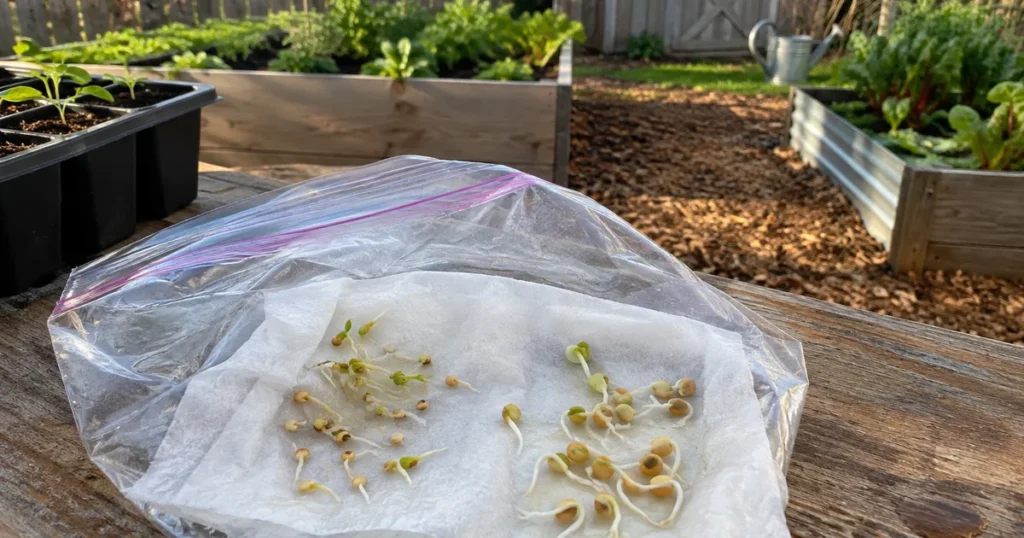
To germinate seeds, give them four things: steady moisture, air in the soil, the right temperature for that crop, and light or darkness if the seed requires it. Sow at about two to three times the seed’s width, keep the mix as damp as a wrung-out sponge, and hold it in the crop’s ideal temperature range. Most vegetable seeds then sprout in 3-14 days.
Quick answer
- Moisture and oxygen go together: damp mix, never soggy.
- Temperature is the biggest lever. Most vegetables germinate best at 65-75°F in the mix; peppers, squash and cucumbers want it warmer.
- A few seeds, such as lettuce, need light, so press them onto the surface instead of burying them.
- Old seed? Run a 10-seed paper-towel test and adjust how thickly you sow.
- Store leftover seed cool, dry and sealed, ideally in a jar in the fridge.
In this guide
Want every planting date for your region in one place? Get The Year-Round Vegetable Garden (225 pages, $27).
What seeds need to germinate
A seed is a dormant plant with a packed lunch. Seed germination starts when the right conditions wake it up: it absorbs water, swells, burns stored food, and pushes out a root and then a shoot.
Water
Seeds must take up water to start growing, and once that process starts, letting them dry out can kill the embryo. Utah State University Extension describes the right moisture as “a wrung-out sponge” and warns against letting dry spots form before seeds sprout.
Oxygen
Germinating seeds breathe. In waterlogged mix, the air spaces fill with water and seeds can suffocate or rot, and the fungi that cause damping off thrive. This is why a light, airy seed starting mix beats heavy garden soil indoors.
Temperature
Every crop has a minimum, an optimum and a maximum. Below the minimum, seeds sit and often rot. Near the optimum, they sprout fastest. Much above it, germination drops again, especially for lettuce and spinach.
Light (for some seeds)
Most vegetable seeds don’t care about light while germinating; they just need to be covered at the right depth. A few need light to break dormancy, and a few flowers prefer darkness. More on that below.
Soil temperature for seed germination
This table, based on Oregon State University Extension data, shows soil temperatures for common vegetables and how fast they emerge. Note how slowly tomatoes and peppers come up in cool soil.
| Crop | Minimum (°F) | Optimum range (°F) | Days to emerge at 59°F | Days to emerge at 77°F |
|---|---|---|---|---|
| Lettuce | 35 | 40-80 | 4 | 2 |
| Spinach | 35 | 45-75 | 7 | 5 |
| Onion | 35 | 50-95 | 7 | 4 |
| Pea | 40 | 40-75 | 9 | 6 |
| Carrot | 40 | 45-85 | 10 | 6 |
| Beet | 40 | 50-85 | 10 | 5 |
| Cabbage | 40 | 45-85 | 9 | 4 |
| Tomato | 50 | 60-85 | 14 | 6 |
| Sweet corn | 50 | 60-95 | 12 | 4 |
| Bean | 60 | 60-85 | 16 | 8 |
| Cucumber | 60 | 60-95 | 13 | 4 |
| Pepper | 60 | 65-95 | 25 | 8 |
| Squash | 60 | 70-95 | n/a | n/a |
Indoors, a seedling heat mat makes the biggest difference for peppers, eggplant and tomatoes. University of Minnesota Extension notes that potting mix can run up to 5°F cooler than room air, and it recommends 80-90°F in the flat for pepper seeds until they emerge. Use a thermostat with the mat so the mix doesn’t cook.
Outdoors, the same numbers tell you when to direct sow. A spring that is “warm enough” for you may still mean 50°F soil, which is fine for peas but too cold for beans. Your timing depends on your zone and frost dates; see frost dates by zone and when to start seeds indoors, and check with your local extension office, since microclimates vary.
Garden hack: A $10 soil thermometer pushed 2-4 inches deep in the morning tells you more than any calendar. Sow beans, corn and squash only when it reads at least 60°F a few mornings in a row.
Gear that helps
- Seedling heat mat with thermostat: Holds the mix at the ideal germination temperature for peppers and tomatoes
- Soil thermometer: Tells you when soil is warm enough to direct sow
As an Amazon Associate we earn from qualifying purchases. Check current prices and reviews on Amazon.
Seeds that need light vs darkness
Seeds that need light should sit on the surface of the mix, pressed in so they touch moisture. Seeds that need darkness should be fully covered. Everything else: follow the packet depth.
| Need light (press onto surface) | Prefer darkness (cover fully) | Indifferent (cover to packet depth) |
|---|---|---|
| Lettuce | Calendula | Tomato, pepper, eggplant |
| Celery and celeriac (commonly listed; cover very lightly at most) | Annual phlox | Cabbage family |
| Petunia, snapdragon, impatiens, begonia, ageratum | Verbena, vinca, centaurea (bachelor’s button) | Beans, peas, squash, cucumbers, corn |
Lists come from University of Kentucky and Utah State University Extension. Always check the packet: if it says “do not cover” or “needs light to germinate,” follow it.
Watch out: Lettuce can go dormant when the soil is too warm, often above about 80°F. In midsummer, sow it in a cool spot, in the evening, or start it indoors where it stays below that.
How to germinate seeds indoors, step by step
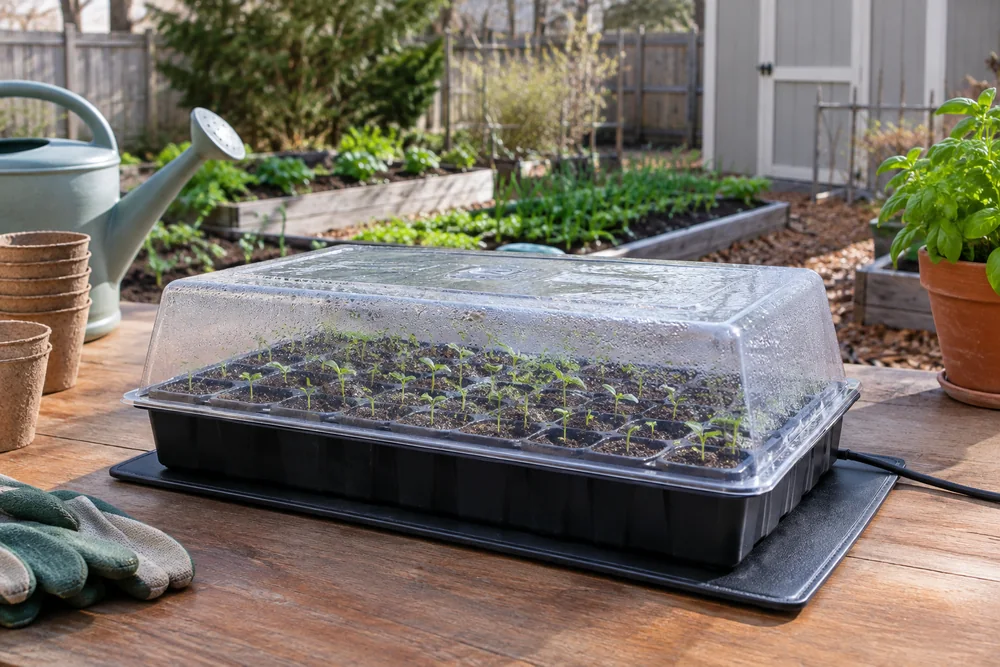
- Fill clean cells with pre-moistened seed starting mix and firm it gently.
- Sow two or three seeds per cell at a depth of two to three times the seed’s width. Press light-needing seeds onto the surface.
- Mist or bottom-water, then cover with a clear dome or plastic wrap to hold humidity.
- Set the tray on a heat mat or in a warm spot that matches the crop’s range.
- Check daily. As soon as about half the seeds sprout, remove the dome and move the tray under bright light. Utah State suggests 12-14+ hours a day; see our grow lights guide.
- Thin to the strongest seedling per cell by snipping the others at soil level.
For the full process, from containers to potting up, read how to start seeds indoors.
Seed viability: how to test old seeds with a paper towel
Seed viability is the share of seeds that are still alive and able to sprout. It drops every year, faster in warm, humid storage. Before you sow last year’s packets, run this simple test, recommended by University of Illinois Extension.
- Count out 10 seeds (or 20 for better accuracy).
- Lay them on a damp, not dripping, paper towel, roll or fold it, and slip it into a plastic bag or container.
- Label it with the crop and date, and keep it somewhere warm, around 70-80°F for most vegetables.
- Check every day or two and keep the towel moist.
- After the normal germination time on the packet (add a few days for slow crops like peppers and parsley), count the seeds with a root.
How to calculate germination rate and adjust sowing
Germination rate (%) = seeds that sprouted ÷ seeds tested × 100. If 7 out of 10 sprout, your rate is 70 percent.
- 9-10 sprouted (90-100%): sow normally.
- 7-8 sprouted (70-80%): sow a little more thickly. A quick rule: divide the number of plants you want by the rate. For 20 plants at 70%, sow about 29 seeds.
- 6 or fewer: Illinois Extension suggests buying fresh seed. If the variety is hard to replace, sow heavily and save new seed.
The sprouted seeds aren’t wasted: carefully plant the ones with short roots into cells.
The Year-Round Vegetable Garden (2027 Edition)
Plan the whole season in one place: a 225-page month-by-month guide with calendars for six US growing regions, 50 plant profiles (tomatoes included), 5 copy-ready garden plans and 7 printable pages.
Tomato lover? Add Tomato Mastery, our seed-to-harvest tomato blueprint, for just $10 at checkout.
Get the guide ($27)How long do vegetable seeds last?
With good storage, these are typical lifespans from University of Illinois Extension. Treat them as averages: seeds stored in a hot garage can fail sooner, and cold, dry seeds often outlast them.
| Approximate years | Vegetables |
|---|---|
| 1 | Onion, parsley, parsnip |
| 2 | Sweet corn, leek, okra, pepper |
| 3 | Asparagus, bean, broccoli, carrot, celery, Chinese cabbage, kohlrabi, pea, spinach |
| 4 | Beet, Brussels sprouts, cabbage, cauliflower, eggplant, kale, pumpkin, squash, tomato, turnip, watermelon |
| 5 | Collards, cucumber, endive, muskmelon, radish |
| 6 | Lettuce |
How to store seeds
- Keep them cool and dry. A sealed glass jar in the refrigerator works well.
- Add a packet of silica gel or a spoonful of dry rice wrapped in tissue to absorb moisture.
- Let a cold jar warm to room temperature before opening, so moisture doesn’t condense on the seeds.
- Write the year on every packet.
Garden hack: Sort packets by the year they expire, not by crop. Onions, parsnips and parsley go in front so you use them first; lettuce and cucumbers can wait.
Gear that helps
- Seed storage box or jars with silica gel: Keeps seed packets dry, sorted and labeled by year
As an Amazon Associate we earn from qualifying purchases. Check current prices and reviews on Amazon.
Why seeds fail to germinate
- Too cold. Warm-season seeds sit and rot in cold mix. Peppers below about 60°F barely move.
- Too wet. Saturated mix drowns seeds and invites rot and damping off.
- Too dry. A seed that swells and then dries out dies.
- Too deep. Small seeds run out of stored food before they reach the surface.
- Too hot. Lettuce and spinach stall in hot soil.
- Old or poorly stored seed. Test it before trusting it.
- Light-needing seed buried. Lettuce and celery covered too thickly may not sprout.
- Crusted soil outdoors. A hard crust after rain can trap seedlings; cover rows with a thin layer of vermiculite, compost or a board until they emerge.
Even with good conditions, not every seed comes up. University of Kentucky Extension cautions gardeners not to expect more than 65-80 percent of seeds to germinate in typical home conditions, so sow a few extra.
Common mistakes to avoid
- Leaving the humidity dome on after sprouting, which encourages mold and damping off.
- Running a heat mat with no thermostat, or leaving it under seedlings after they emerge.
- Watering from above with a strong stream that washes tiny seeds out of place.
- Giving up too soon on slow crops: peppers, parsley and celery can take two to three weeks.
- Direct sowing warm-season crops by the calendar instead of by soil temperature.
- Storing seeds in a hot shed or a humid basement.
FAQ
How long does it take seeds to germinate?
Most vegetable seeds sprout in 3-14 days at their ideal temperature. Lettuce and radishes can appear in 2-4 days, while peppers, parsley and celery may take two to three weeks, longer in cool soil.
Do seeds need light to germinate?
Most vegetable seeds do not; they germinate covered at the right depth. Lettuce and celery are common exceptions and should be pressed onto the surface or covered very lightly.
Is it better to germinate seeds in a paper towel or in soil?
Soil or seed mix is best for planting, since you avoid handling fragile roots. The paper-towel method is ideal for testing old seed or pre-sprouting large seeds like beans and squash.
Should I soak seeds before planting?
Soaking large, hard seeds such as peas, beans, beets and squash for a few hours, up to overnight, can speed germination. Don’t soak for more than about 24 hours, and plant them right away.
How do you know if seeds are still good?
Do a germination test: place 10 seeds on a damp paper towel in a bag, keep it warm, and count the sprouts after the packet’s germination time. Seven or more out of 10 is usable.
What temperature do seeds germinate at?
Most vegetables germinate best at 65-75°F. Cool-season crops like lettuce and spinach sprout in cooler soil, while peppers, squash and cucumbers do best at 80°F or more.
Keep reading
Sources
- Soil Temperature Conditions for Vegetable Seed Germination – Oregon State University Extension
- Will My Seeds Still Grow? Seed Viability – University of Illinois Extension
- Starting Vegetable Seeds Indoors: Germination – Utah State University Extension
- Starting Plants from Seeds (HO-98) – University of Kentucky Cooperative Extension
- Starting Seeds Indoors – University of Minnesota Extension
- Growing Peppers – University of Minnesota Extension