
Growing cherry tomatoes is the easiest way to get a big, steady tomato harvest from a small space. Plant them in full sun after your last frost, once nights stay above about 50°F, give the vines a tall support, water deeply and evenly, and pick the fruit as soon as it is fully colored. Most cherry types start bearing about two months after transplanting and keep going until frost.
Quick answer
- Transplant after the last frost when soil is at least 55-60°F and nights stay above 50-55°F.
- Most cherry tomatoes are indeterminate: set a 5-foot cage or a sturdy stake at planting.
- Give about 1 to 2 inches of water per week, delivered evenly, and mulch to limit cracking and blossom end rot.
- Pick when the fruit is fully colored but still firm, and pick before heavy rain if fruit is ripe.
- In pots, use at least a 5-gallon container for compact types and 10 gallons or more for big vines.
In this guide
- Why grow cherry tomatoes?
- Cherry tomato varieties: what to look for
- When to plant cherry tomatoes by USDA zone
- How to plant cherry tomatoes
- Supporting cherry tomato plants
- Cherry tomato plant care: watering, mulch and feeding
- Why do cherry tomatoes crack, and how do you stop it?
- When to pick cherry tomatoes
- Growing cherry tomatoes in pots
- Common mistakes to avoid
- FAQ
 Grow tomatoes in season for your region, month by month: The Year-Round Vegetable Garden ($27, PDF).
Why grow cherry tomatoes?
Cherry and grape tomatoes ripen earlier than most slicers, produce over a long season, and forgive more mistakes. UC Master Gardeners in Sonoma County point out that a single standard cherry plant is usually plenty for a family of four, because the clusters keep coming for months.
They also handle heat better than many large-fruited tomatoes. The University of Florida’s vegetable gardening guide describes cherry types as heat resistant, which is why they are a common choice for zones 9 and 10 and for long Southern summers. If you are new to tomatoes in general, our main guide on how to grow tomatoes covers soil, planting depth and pests in more depth.
Cherry tomato varieties: what to look for
The biggest decision is growth habit. Indeterminate varieties keep growing and fruiting until frost and can easily reach 6 to 8 feet. Determinate and dwarf types stop at a set height and fit pots and small beds better. Check the plant tag or seed packet for “indeterminate” or “determinate” before you buy.
| Variety | Habit | Notes |
|---|---|---|
| Sungold | Indeterminate | Orange, very sweet; about 57-60 days from transplant; listed by Penn State as late blight tolerant |
| Sweet 100 | Indeterminate | Long clusters of small red fruit; vines can top 7 feet |
| Juliet | Indeterminate | Small grape-type fruit; on UF/IFAS’s list of small-fruited picks |
| Matt’s Wild Cherry | Indeterminate | Tiny fruit on sprawling vines; another late blight tolerant pick from Penn State |
| Yellow Pear | Indeterminate | Heirloom, pear-shaped yellow fruit |
| Small Fry, Patio types | Determinate or dwarf | Compact plants for pots and hanging baskets |
| Tumbling Tom, Tumbler | Trailing determinate | Made for baskets and window boxes |
For a closer look at the orange favorite, see our profile of the Sungold tomato. Disease codes on seed packets (such as V and F for Verticillium and Fusarium wilt) are worth checking if tomato diseases have hit your garden before; heirlooms rarely carry them.
When to plant cherry tomatoes by USDA zone
Tomatoes are killed by even a light frost, and cold nights stall them. Colorado State University Extension recommends waiting for nights above 52°F, days above 60°F and soil above 55°F; Utah State suggests soil warmer than 60°F. Start seeds indoors 6 to 8 weeks before your planned transplant date.
| USDA zone | Start seeds indoors | Transplant outdoors | Notes |
|---|---|---|---|
| 3-4 | Early to mid-April | Early to mid-June | Choose early, compact varieties; black plastic or row cover helps |
| 5 | Late March to early April | Late May to early June | Wait 1-2 weeks after the last frost for warm soil |
| 6 | Mid to late March | Mid to late May | Long season lets indeterminate cherries shine |
| 7 | Early to mid-March | Late April to mid-May | A second planting in June extends the harvest |
| 8 | February | Late March to mid-April; fall crop in July | Fruit set slows in midsummer heat |
| 9-10 | December to January; June to July for fall | February to March, and August to September | In South Florida, UF/IFAS lists August through February |
These dates are approximate. Your hardiness zone describes winter cold, not frost dates, so look up your own average last frost in our frost dates by zone guide or ask your county extension office, because microclimates vary. Our article on when to plant tomatoes goes deeper into timing.
Garden hack: In hot regions, Texas A&M AgriLife suggests setting out fall tomatoes about 100 days before your first expected frost. Fast-maturing cherry types are the safest bet for that late window.
How to plant cherry tomatoes
- Pick a sunny spot. Aim for at least 6 hours of direct sun; 8 or more is better. Avoid beds where tomatoes, potatoes, peppers, eggplant or tomatillos grew in the last 3 to 4 years, as University of Minnesota Extension recommends.
- Prepare the soil. Work in compost and follow a soil test. UMN suggests a pH of 5.5 to 7.
- Plant deep. Bury the stem so only the top 2 or 3 sets of leaves show. Roots form along the buried stem.
- Space them. Give staked or caged indeterminate plants about 2 feet in the row with 2 to 3 feet between rows. Crowding raises disease without raising yield, according to Colorado State.
- Install support right away. Pushing a stake in later damages roots.
- Water in well and keep the soil evenly moist for the first few weeks while roots settle.
Supporting cherry tomato plants
Indeterminate cherry vines get heavy and long. Colorado State Extension notes that many store-bought cages are too small for vigorous varieties and cites a cage about 2 feet across and 4 to 5 feet tall as a better size. Determinate types can get by with cages around 3 feet tall.
- Tall cages made of concrete-reinforcing wire or livestock panel need almost no pruning.
- A single 6- to 8-foot stake works if you prune to one or two main stems and tie the vine every 8 to 12 inches.
- A trellis or cattle-panel arch handles several plants spaced about 2 feet apart.
Light pruning of suckers keeps staked vines manageable, but avoid stripping leaves. Fruit that loses its leaf cover heats up in the sun, and the University of Delaware links higher fruit temperature and light exposure to more cracking.
Gear that helps
- Tall heavy-duty tomato cages: Indeterminate cherry vines outgrow short cages by midsummer; a 4-5 foot cage holds the weight.
As an Amazon Associate we earn from qualifying purchases. Check current prices and reviews on Amazon.
Cherry tomato plant care: watering, mulch and feeding
Steady moisture is the single most important care task. Utah State Extension recommends deep, infrequent watering totaling about 1 to 2 inches per week, with drip irrigation preferred. Water the soil, not the leaves, and do it in the morning so foliage dries quickly.
Mulch helps hold that moisture steady. Colorado State notes that a surface mulch also reduces early blight spores splashing from soil onto the lower leaves. In cool northern soils, wait until the ground has warmed before spreading straw; Utah State suggests waiting until soil passes about 75°F.
Feed lightly. Too much nitrogen gives you a jungle of leaves and few flowers. A common extension approach is a balanced or starter fertilizer at planting, then a light feeding once the first fruits start to swell, repeated every 2 to 4 weeks with a water-soluble fertilizer, as Colorado State suggests. Follow your soil test and the label.
Watch out: Blossom end rot (a dark, sunken patch on the bottom of the fruit) comes from calcium not reaching developing fruit, usually because watering swings between wet and dry. Clemson HGIC notes that calcium sprays do not fix it; even watering and mulch do.
Gear that helps
- Drip irrigation kit with timer: Even, deep watering is the best defense against cracking and blossom end rot.
As an Amazon Associate we earn from qualifying purchases. Check current prices and reviews on Amazon.
Why do cherry tomatoes crack, and how do you stop it?
Cherry tomatoes split more than most types. The University of Delaware’s fact sheet on fruit cracking lists cherry tomatoes and large fruit as the most prone, possibly because of their high sugar content. Cracks happen when the inside of the fruit expands faster than the skin can stretch, typically after a heavy rain or a big watering following a dry spell.
- Keep soil moisture even with drip lines, a soaker hose, or a regular deep-watering schedule.
- Mulch 2 to 3 inches deep once soil is warm.
- Do not over-prune; leaves shade the fruit and reduce heat stress.
- Pick ripe and nearly ripe fruit before a forecast downpour.
- If splitting is a yearly problem, try a variety described as crack resistant. Many newer hybrids are, according to Utah State.
Split fruit is still edible if you use it quickly, but deep cracks invite rot and fruit flies, so do not leave it on the vine.
When to pick cherry tomatoes
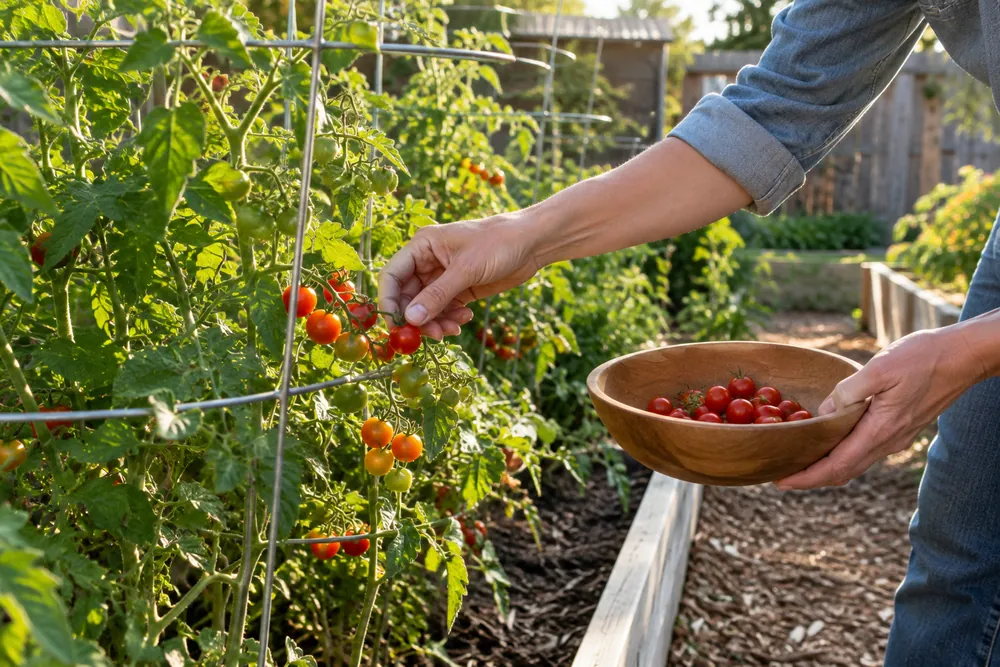
Fruit typically ripens 25 to 35 days after the flower is pollinated, depending on temperature and variety, according to Utah State Extension. Pick when the fruit has reached its full mature color (red, orange, yellow, purple or black, depending on the variety) and still feels firm. Many cherry types come off easily with a light tug when ripe.
- Pick often. Every day or two at peak season keeps plants producing and limits splitting.
- Snip whole trusses for varieties that ripen evenly along the cluster.
- Store at room temperature. Refrigeration dulls flavor and can cause chilling injury; Utah State suggests 50-55°F as the cool limit for ripe fruit.
- At the end of the season, harvest fruit that is pink or has a light streak at the blossom end before frost. UMN notes that fruit showing some color usually ripens well indoors, while hard green fruit often does not.
Garden hack: When fruit stops setting in a heat wave, it is usually the temperature, not your care. Colorado State notes that blossoms abort when days hit 90°F by mid-morning or nights drop below 55°F. Cherry types tend to keep going, and 30% shade cloth over the hottest weeks can help hold flowers.
Growing cherry tomatoes in pots
Cherry tomatoes are the easiest tomatoes for containers. Iowa State Extension gives 2 gallons (about 10 inches across) as the bare minimum for a cherry plant, but bigger pots dry out more slowly and are far easier to keep evenly moist. A 5-gallon pot suits compact and patio varieties; full-size indeterminate cherries like Sungold do best in 10 to 20 gallons with a cage anchored in the pot.
Use a soilless potting mix, never garden soil, and expect to water daily in summer, sometimes twice. For pot sizes, mixes and feeding schedules, see our full guide to growing tomatoes in pots.
Common mistakes to avoid
- Planting too early. Cold soil and nights below 50°F stall growth for weeks.
- Using a short cage. Indeterminate cherries will flop over a 3-foot cage by midsummer.
- Watering on and off. Dry-then-soaked cycles cause cracking and blossom end rot.
- Overfeeding with nitrogen. Lush leaves, few flowers.
- Leaving ripe fruit on the vine before a storm. That is when most splitting happens.
- Planting in the same bed every year. Soilborne diseases build up; rotate tomato-family crops.
FAQ
How long do cherry tomatoes take to grow?
Most cherry varieties start ripening about 55 to 70 days after transplanting. Sungold, for example, is listed at about 57 to 60 days. Add 6 to 8 weeks if you start from seed indoors.
How many cherry tomato plants do I need?
One or two indeterminate plants usually supply a household with fresh snacking and salad tomatoes all summer. UC Master Gardeners note that one standard plant is often enough for a family of four.
Do cherry tomatoes need full sun?
Yes. Give them at least 6 hours of direct sun a day, and 8 or more for the best yields and flavor.
Should I prune cherry tomato plants?
Pruning is optional. Caged plants can grow with little pruning. Staked plants need suckers removed to keep one or two main stems. Avoid heavy leaf removal, which exposes fruit to sunscald and cracking.
Why are my cherry tomatoes splitting?
Splitting happens when fruit takes up water faster than the skin can stretch, usually after heavy rain or uneven watering. Keep moisture steady, mulch, and pick ripe fruit before storms.
Can cherry tomatoes grow in a 5-gallon bucket?
Yes, especially compact or patio types. Drill drainage holes, use potting mix, and plan to water daily in hot weather. Large indeterminate vines do better in bigger containers.
Keep reading
Sources
- Growing Tomatoes – Colorado State University Extension
- How to Grow Tomatoes in Your Garden – Utah State University Extension
- Growing Tomatoes in Home Gardens – University of Minnesota Extension
- Fruit Cracking in Tomato – University of Delaware Cooperative Extension
- Cherry Tomatoes – UC Master Gardener Program of Sonoma County
- Florida Vegetable Gardening Guide – UF/IFAS Extension
- Sungold – Vegetable Varieties for Gardeners, Cornell University
- Tomato-Potato Late Blight in the Home Garden – Penn State Extension
- Growing Tomatoes in Containers – Iowa State University Extension
- Gardening Myths: Fix Blossom End Rot with Calcium Sprays – Clemson HGIC
- Easy Gardening: Tomatoes – Texas A&M AgriLife Extension