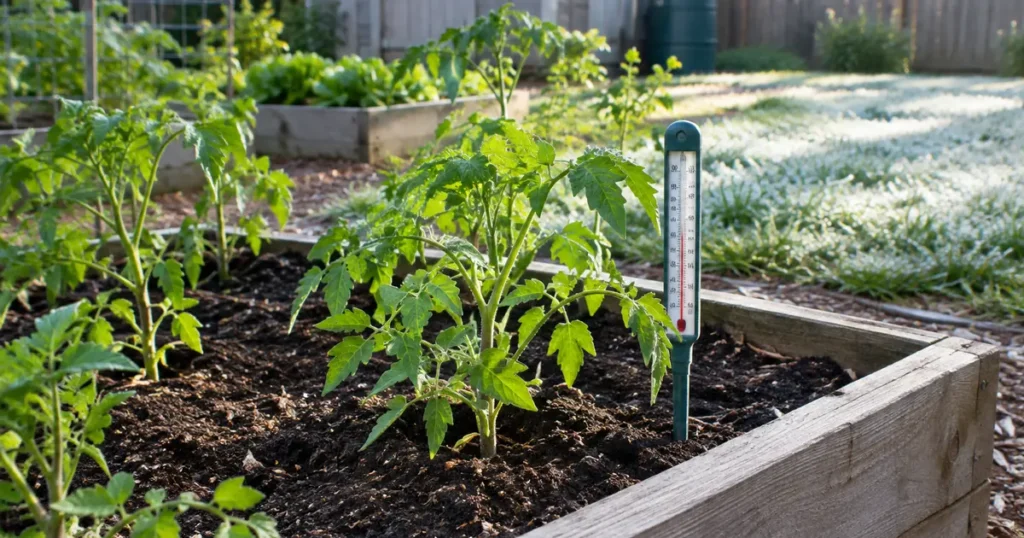
Your last frost date is the average date of the final 32°F night in spring, and your first frost date is the average date of the first 32°F night in fall. They are calculated from NOAA climate records for weather stations near you, not from your USDA hardiness zone. Zones give you a rough idea, though: in zone 5 the last spring frost usually falls in late April to mid-May, while in zone 8 it is often mid-March to early April.
Quick answer
- Hardiness zones measure the coldest winter night, not frost dates. Two towns in the same zone can have last frost dates weeks apart.
- Frost dates come from NOAA’s 1991-2020 climate normals and are probabilities: a “50%” date means a frost after it still happens in about half of years.
- Find your dates by ZIP through NOAA climate maps, your local National Weather Service office or your state extension service.
- Count backward from the last frost to start seeds indoors, and from the first frost to schedule fall crops.
- Planting tender crops one to two weeks after your average last frost cuts the risk considerably.
In this guide
Want every planting date for your region in one place? Get The Year-Round Vegetable Garden (225 pages, $27).
Hardiness zones are not frost dates
The 2023 USDA Plant Hardiness Zone Map divides the country by average annual extreme minimum winter temperature, based on 1991-2020 data. Each zone covers a 10°F range, split into “a” and “b” half zones of 5°F. Zone 6, for example, means the coldest night of a typical winter falls between -10°F and 0°F.
That number tells you which perennials, fruit trees and overwintering crops will survive. It does not tell you when spring’s last frost arrives. Frost timing depends on latitude, elevation, distance from large bodies of water and local terrain. A coastal town and an inland valley can share a zone and still have last frost dates three or four weeks apart.
So use the zone table below as a starting point, then look up the actual dates for your location.
How frost dates are calculated
NOAA’s National Centers for Environmental Information publishes U.S. Climate Normals, 30-year averages currently based on 1991-2020. For thousands of weather stations, the normals include the probability of reaching 36°F, 32°F, 28°F and lower on each day of the year.
From those records come the frost dates gardeners use:
- Last spring frost (50%): the date after which there is a 50% chance of another 32°F night. NOAA’s Climate.gov describes it as the point when the chance of freezing temperatures for the rest of spring drops below 50%.
- Last spring frost (10%): a later, safer date. Only about 1 year in 10 brings a frost after it.
- First fall frost (50% and 10%): the same idea in reverse. The 10% date for fall is earlier, the date before which a frost happens only about 1 year in 10.
Some sources also list a 28°F date, sometimes called the killing freeze, which matters for hardy crops like kale and cabbage. Light frost and hard freeze are different events, and our guide to how to cover plants for frost explains what each one does to your garden.
Watch out: An “average last frost date” is a coin flip, not a guarantee. If you plant tomatoes on that exact day, you face roughly a 50% chance of at least one more frosty night. For tender crops, plan around the 10% date, or keep covers on hand.
How to find your frost dates by ZIP code
There is no single official “frost dates by ZIP code” list, because the data come from weather stations, not postal codes. The good news is that free public tools make it easy to find the nearest station.
- Start with NOAA. Climate.gov has an interactive map of the average date of the last spring freeze, built on the 1991-2020 normals. Zoom to your area and click the station closest to you.
- Check your National Weather Service office. Many local NWS offices post frost and freeze tables for the cities they cover, often with median, early and late dates. Search “frost freeze dates” plus your NWS office or city.
- Ask your state extension service. Land-grant universities and county extension offices publish planting calendars with local frost dates. Some state climate offices offer lookup tools too.
- Pick the right station. Choose one with a similar elevation and setting to your garden. A station on a hilltop or at a downtown airport may run warmer than a rural valley a few miles away.
- Write both numbers down. Note the 50% and 10% dates for spring and fall, and keep them with your garden notes.
Garden hack: Put both spring frost dates in your phone calendar as recurring yearly events, with reminders set 10 weeks, 6 weeks and 2 weeks ahead. Those three alerts line up with starting peppers, starting tomatoes and hardening off transplants.
Average last frost and first frost dates by zone
The table below shows typical, approximate ranges for each zone across the continental U.S. Because zones and frost dates measure different things, the real dates for your town may fall outside these ranges. Always confirm with local data or your extension office, because microclimates vary.
| USDA zone | Typical last spring frost | Typical first fall frost | Approximate frost-free season |
|---|---|---|---|
| 3 | Mid-May to early June | Early to mid-September | 90-120 days |
| 4 | Early to late May | Mid to late September | 110-140 days |
| 5 | Late April to mid-May | Late September to mid-October | 140-170 days |
| 6 | Mid-April to early May | Early to late October | 160-190 days |
| 7 | Late March to mid-April | Late October to mid-November | 190-220 days |
| 8 | Early March to early April | Early November to early December | 220-260 days |
| 9 | Late January to early March | Late November to late December | 260-330 days |
| 10 | Frost rare; occasional in January | Frost rare; occasional in December-January | Nearly year-round |
In zones 8-10, the calendar flips. Summer heat, not frost, is often the main limit, and fall through spring is prime time for lettuce, broccoli, carrots and other cool-season crops.
When is the first frost?
For most of the northern half of the country (zones 3-5), the first fall frost arrives sometime in September or early October. In zones 6-7, which cover much of the Mid-Atlantic, Ohio Valley and lower Midwest, expect it in October or early November. The Deep South, Gulf Coast and Southwest deserts (zones 8-9) typically see their first frost from November into December, and parts of zone 10 may go years without one.
Weather forecasts beat averages once the season arrives. When a frost advisory or freeze warning appears in your 7-day forecast, act on it, even if it comes two weeks ahead of your average date.
Gear that helps
- Wireless indoor/outdoor min-max thermometer: Records the actual lows in the garden to compare with forecasts and averages
As an Amazon Associate we earn from qualifying purchases. Check current prices and reviews on Amazon.
How to use frost dates to plan your garden
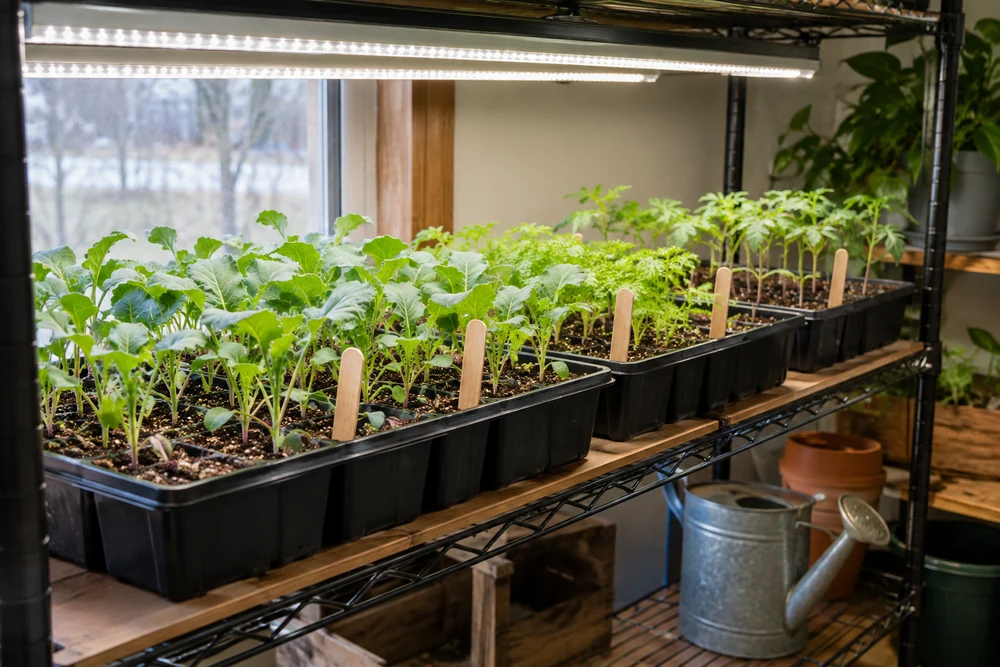
Frost dates work as anchor points. Almost every seed packet and planting guide gives timing in “weeks before” or “weeks after” the last frost, so once you know your date, the rest is simple counting.
Starting seeds indoors
Count backward from the date you plan to transplant. University of Minnesota Extension suggests keeping tomatoes indoors about 5-6 weeks and peppers and eggplant about 9 weeks before they move outside, while onions and leeks need 14-15 weeks. Cabbage-family crops are hardy enough to set out a couple of weeks before the last frost.
Example (zone 6, last frost around April 20):
- Plan to transplant tomatoes and peppers around May 1-10, once nights stay above 50°F.
- Start peppers and eggplant indoors in early March.
- Start tomatoes indoors in late March.
- Start onions from seed in mid to late January.
- Harden off all transplants for 7-14 days before planting out.
Planting tender crops outdoors
Beans, squash, cucumbers and corn go in after the last frost, once the soil warms. Waiting one to two weeks past your 50% date, or until your 10% date, lowers the frost risk a lot and gives seeds warmer soil to sprout in.
Scheduling fall crops
For fall planting, count backward from your first frost. A method shared by Virginia Cooperative Extension master gardeners adds two buffers to the days to maturity on the seed packet: about 14 days as a “fall factor” for slower growth in shorter, cooler days, plus another 14 days for frost-tender crops so they finish before the cold.
Example (zone 6, first frost around October 20):
- Bush beans, 55 days: 55 + 14 + 14 = 83 days. Count back 83 days from October 20 and you get about July 29 as your last sowing date.
- Spinach, 45 days: spinach handles frost, so skip the frost-tender buffer. 45 + 14 = 59 days, or a sowing date around August 22.
Hardy crops such as kale, spinach and carrots can keep growing past the first frost, especially under row cover or in a cold frame. For full planting lists, see our fall vegetable garden guide and what to plant in October.
The Year-Round Vegetable Garden (2027 Edition)
Plan the whole season in one place: a 225-page month-by-month guide with calendars for six US growing regions, 50 plant profiles (tomatoes included), 5 copy-ready garden plans and 7 printable pages.
Tomato lover? Add Tomato Mastery, our seed-to-harvest tomato blueprint, for just $10 at checkout.
Get the guide ($27)Gear that helps
- Seed starting kit with heat mat and grow light: Lets readers start tomatoes and peppers indoors on the schedule counted back from their last frost
As an Amazon Associate we earn from qualifying purchases. Check current prices and reviews on Amazon.
Frost dates are shifting
NOAA updates the normals every ten years, and the 1991-2020 set replaced the 1981-2010 averages, so an old frost-date chart in a garden book may be out of date. The 2023 hardiness map, built on the same 30-year period, moved about half of the country into a warmer half zone compared with the 2012 map. Even so, late frosts still happen in warm springs, and one cold night can undo weeks of work. Use the averages to plan, then follow the forecast.
Garden hack: Keep a simple log of the actual last and first frosts in your own yard each year. After three or four seasons you will know whether your garden runs earlier or later than the nearest station, and you can shift your calendar with confidence.
Gear that helps
- Garden planner journal: A place to log yearly frost dates and planting dates
As an Amazon Associate we earn from qualifying purchases. Check current prices and reviews on Amazon.
Common mistakes to avoid
- Using your hardiness zone as if it were a frost date.
- Treating the 50% last frost date as a safe planting date for tomatoes and peppers.
- Picking a weather station at a very different elevation from your garden.
- Starting tomatoes indoors too early, which leaves leggy, root-bound plants by planting time.
- Forgetting the fall factor, so fall crops are still maturing when cold weather stalls them.
- Ignoring the forecast because “it’s too early for frost.”
FAQ
What is the average last frost date?
It is the date after which there is about a 50% chance of another 32°F night in spring, based on NOAA’s 1991-2020 climate normals for a nearby weather station. It ranges from late winter in the Deep South to early June in the coldest northern areas.
Is my last frost date the same as my hardiness zone?
No. Your zone reflects the average coldest winter temperature. Frost dates depend on local climate records, so two places in the same zone can have last frost dates weeks apart.
How do I find frost dates by ZIP code?
Use NOAA’s Climate.gov frost map, your local National Weather Service frost and freeze tables, or your state extension service, and pick the nearest station with a similar elevation.
How soon after the last frost can I plant tomatoes?
Wait until after your last frost date and until nights stay above about 50°F, often one to two weeks later. Keep covers ready in case of a late cold snap.
What does a 10% frost date mean?
It means only about 1 year in 10 has a frost later than that date in spring, or earlier than that date in fall. It is the safer date for frost-tender crops.
When is the first frost in zone 6?
Typically sometime in October, though it varies with elevation and location. Check your local NOAA or extension data for your exact average.
Keep reading
Sources
- Interactive Map: Average Date of Last Spring Freeze – NOAA Climate.gov
- U.S. Climate Normals – NOAA National Centers for Environmental Information
- USDA Plant Hardiness Zone Map (2023) – USDA Agricultural Research Service
- Frost and Freeze Maps – NOAA National Weather Service Raleigh
- Starting Seeds Indoors – University of Minnesota Extension
- Planning the Fall Vegetable Garden – Piedmont Master Gardeners, Virginia Cooperative Extension