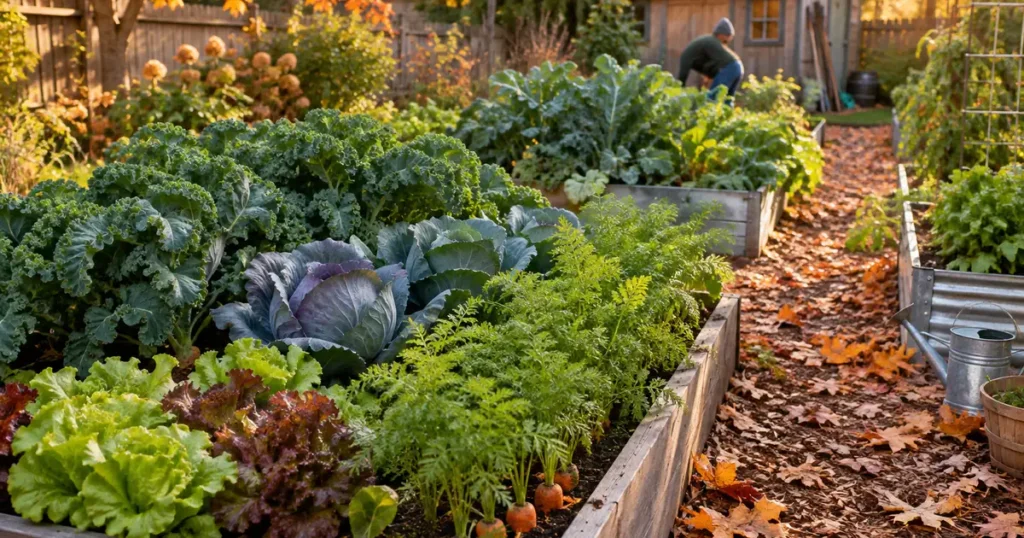
A fall vegetable garden is a second planting of cool-season crops timed to mature as temperatures drop, so you harvest sweet greens, roots and cabbages well past the first frost. The trick is timing: count back from your average first fall frost date using each crop’s days to maturity, then add about two weeks for slower fall growth and two weeks of harvest.
Quick answer
- Best fall garden vegetables: spinach, kale, collards, lettuce, radishes, turnips, beets, carrots, broccoli, cabbage, Brussels sprouts, peas and garlic.
- Timing formula: days to maturity + 14 days (fall factor) + 14 days (harvest window), counted back from your first frost date.
- When to plant: mid-summer in zones 3-6, late summer in zone 7, and September through November (or later) in zones 8-10.
- Frost tolerance matters: kale, collards and spinach handle hard freezes; lettuce, broccoli and beets prefer light frosts only.
- Season extension: row covers and cold frames add weeks of harvest in every zone.
In this guide
- Why plant a fall garden?
- How to time your fall vegetable garden
- Best vegetables for a fall garden
- When to plant a fall garden by zone
- How to plant a fall garden step by step
- Succession planting and interplanting in fall
- Fall gardening in raised beds and containers
- Season extension: row covers and cold frames
- What can you still plant in October?
- Common mistakes to avoid
- FAQ
Want every planting date for your region in one place? Get The Year-Round Vegetable Garden (225 pages, $27).
Why plant a fall garden?
Many vegetables grow better in fall than in spring. Soil is already warm, so seeds germinate fast, while days get cooler as crops mature. That combination is ideal for greens and brassicas, which tend to bolt (go to seed) or turn bitter in summer heat.
Frost also changes flavor. Iowa State University Extension notes that parsnips and Brussels sprouts get sweeter after exposure to freezing temperatures, and the same is widely observed with kale, collards and carrots as plants convert starches to sugars. Add fewer flea beetles and cabbage worms late in the season, and fall can be the easiest garden of the year.
In zones 8-10, the fall garden is not a bonus; it is the main event. Texas, Florida, the Gulf Coast, the low deserts and coastal California often get their best lettuce, broccoli and carrots between October and March.
How to time your fall vegetable garden
The single most important number for a fall garden is your average first fall frost date. Your USDA hardiness zone (from the 2023 map) only describes the average coldest winter temperature, so use it as a rough guide and look up the actual frost date for your town. Microclimates vary, so your local extension office is the best source for planting dates in your county.
The fall planting formula
Seed packets list days to maturity for spring conditions, when days are getting longer and warmer. In fall, days shorten and growth slows, so you need extra time. The Garden Professors, a group of university horticulture faculty, describe a simple formula:
- Days to maturity from the seed packet (use days from transplant if you set out transplants).
- Add 14 days as a “fall factor” for slower growth in shortening days.
- Add 14 days for the harvest window, so you are not picking everything the day before frost.
- Count that total back from your average first fall frost date. That is your last safe planting date.
Example: a 50-day kale variety needs 50 + 14 + 14 = 78 days. If your first frost averages October 15, plant by about July 29. Because kale tolerates frost well, you can push that a week or two later and still harvest; for frost-tender crops like bush beans, stick to the formula or plant earlier.
Worked example: first frost October 15
Here is the formula applied to a garden with an average first fall frost around October 15, typical of many zone 6 locations. Swap in your own frost date and your seed packets’ numbers.
| Crop | Days to maturity | + 28 days | Plant by about |
|---|---|---|---|
| Carrots | 70 | 98 | July 9 |
| Broccoli (transplant) | 60 | 88 | July 19 |
| Kale | 55 | 83 | July 24 |
| Spinach | 40 | 68 | August 8 |
| Radishes | 25 | 53 | August 23 |
Notice how early the slow crops need to go in. That is why many northern gardeners start fall broccoli and cabbage indoors in June, while the spring garden is still producing.
Garden hack: Write your planting deadlines on your calendar in late spring, right when you set out tomatoes. By July, the summer garden is so busy that most missed fall gardens are simply forgotten seed-sowing dates.
Light frost vs. hard freeze
Not all cold is equal. University of Nebraska-Lincoln Extension defines a light frost as 28-32°F and a hard freeze as below 28°F. Here is roughly how common fall crops sort into those groups, based on its lists (varieties differ):
- Very hardy (survive hard freezes below 28°F): collards, kale, kohlrabi, mustard, spinach, turnips, rutabagas, pea plants, salsify.
- Frost tolerant (survive light frosts, 28-32°F): beets, broccoli, Brussels sprouts, cabbage, carrots, cauliflower, celery, chard, Chinese cabbage, lettuce, onions, parsnips, radishes.
- Tender (damaged by any frost): beans, cucumbers, eggplant, melons, okra, peppers, squash, sweet corn, tomatoes, sweet potatoes.
Many “frost tolerant” crops survive a few degrees lower once mature and hardened by gradually falling temperatures, so the lists are a starting point, not hard limits.
Gear that helps
- Vegetable garden planner or seed-starting calendar: Writing planting deadlines down is the easiest way not to miss the fall window.
As an Amazon Associate we earn from qualifying purchases. Check current prices and reviews on Amazon.
Best vegetables for a fall garden
These are the fall garden vegetables that give the most reliable results. Days to maturity are typical ranges from seed unless noted; your variety may differ.
| Crop | Days to maturity | Frost tolerance | Notes |
|---|---|---|---|
| Radishes | 22-30 | Light frost | Fastest crop; sow every 2 weeks |
| Arugula | 30-40 | Light frost (some to low 20s°F) | Milder flavor in cool weather |
| Spinach | 35-50 | Hard freeze | Germinates poorly in hot soil; can overwinter |
| Leaf lettuce | 40-55 | Light frost | Cover below about 28°F |
| Turnips | 40-55 | Hard freeze | Greens and roots both edible |
| Bok choy | 45-55 | Light frost | Bolts if planted too early in heat |
| Kale | 50-65 | Hard freeze | Sweeter after frost; harvest all winter in many zones |
| Beets | 50-65 | Light frost | Mulch roots to extend harvest |
| Broccoli | 55-70 from transplant | Light frost | Fall heads are often tighter than spring ones |
| Peas | 55-70 | Light frost (pods and flowers) | Plants tolerate cold; pods damaged by hard freeze |
| Collards | 60-80 | Hard freeze | The South’s classic winter green |
| Carrots | 60-80 | Light frost (roots protected by soil) | Leave in ground under mulch; flavor improves |
| Cabbage | 60-90 from transplant | Light frost; many varieties tolerate low 20s°F | Choose early varieties for fall |
| Brussels sprouts | 90-110 from transplant | Light frost; mature plants handle low 20s°F | Needs an early start; best after frost |
| Garlic | Overwinters; harvest next summer | Survives zone 3 winters with mulch | Plant cloves weeks before ground freezes |
If you want to grow onions over winter, short-day and some intermediate-day types can be planted in fall in the South, while northern gardeners plant shallots and hardy multiplier onions. Our guide to planting onions in fall covers which types work where.
When to plant a fall garden by zone
The table below gives typical planting windows for fall crops, based on extension planting charts from the Upper Midwest to Florida. Treat them as averages and adjust to your own first frost date.
| Zone | Typical first fall frost | Sow or transplant fall crops | Plant garlic |
|---|---|---|---|
| 3-4 | Early to late September | Mid-June to late July (brassica transplants by early July) | Late September to mid-October |
| 5 | Early October | July to early August | Early to late October |
| 6 | Mid to late October | Mid-July to mid-August | Mid-October to early November |
| 7 | Late October to mid-November | Late July to early September | Late October to mid-November |
| 8 | Mid-November to early December | August to October | October to November |
| 9-10 | December, rare or none | September to December (many crops through February) | October to December |
For a deeper look at how frost dates are calculated and how to find yours, see frost dates by zone.
The South and West: fall is the main season
UF/IFAS lists lettuce, broccoli, kale, carrots and cabbage as September-to-February crops across most of Florida. The University of Arizona’s Maricopa County calendar includes peas, carrots, onions and garlic in October and November, and UC planting guides show lettuce and spinach planted from August into early spring along the South Coast. In these regions, plant succession crops every 2-4 weeks through winter rather than one big fall sowing.
The Pacific Northwest: plant early, harvest late
Oregon State University Extension’s guide to winter vegetables west of the Cascades notes that most winter crops there are planted between June and August, then hold in the garden through the mild, wet winter. Kale, leeks, cabbage, Brussels sprouts and carrots are reliable; nighttime lows below 15-20°F can still damage winter brassicas, so variety choice matters.
How to plant a fall garden step by step
- Clear and refresh the bed. Pull spent summer crops and work in 1-2 inches of finished compost. Summer crops used a lot of nutrients.
- Use transplants for slow crops. Broccoli, cabbage, cauliflower and Brussels sprouts do best from 4-6 week old transplants, which skip the hottest germination period.
- Sow seeds a bit deeper. Summer soil dries fast, so sow about 1.5 times the spring depth and keep the surface moist.
- Cool the soil for germination. Spinach and lettuce germinate poorly when soil is hot. Water the bed, then shade it with a board, burlap or shade cloth until seedlings emerge.
- Water consistently. Young fall crops need about 1 inch of water per week, more in late summer heat.
- Cover against pests. Lightweight insect netting or row cover keeps cabbage worms and flea beetles off brassicas.
- Mulch once soil cools. A layer of straw or shredded leaves keeps roots even-tempered when frosts begin.
Gear that helps
- Insect netting for brassicas: Keeps cabbage worms and flea beetles off fall brassicas.
As an Amazon Associate we earn from qualifying purchases. Check current prices and reviews on Amazon.
Succession planting and interplanting in fall
A fall garden does not need its own empty bed. Most fall crops go into space freed up by summer crops, and a little planning lets one bed produce twice.
Follow early summer crops
Beds that held garlic, early potatoes, spring peas or bush beans are usually empty by mid to late summer, right when northern fall crops need to go in. Pull the old crop, add compost and plant the same week. Try to follow one plant family with a different one: brassicas after beans or garlic, for example, rather than kale after spring cabbage.
Plant in waves
Instead of sowing all your lettuce or radishes on one day, sow a short row every 1-2 weeks until about four weeks before your first frost. You get a steady harvest instead of one glut, and if one sowing fails in a heat wave, the next one picks up the slack.
Tuck crops under fading summer plants
Spinach, lettuce and kale seedlings appreciate a little afternoon shade in late summer. Sow or transplant them under the edge of tomato or squash plants that are winding down, then remove the summer plants once the frost hits. The fall crop is already established when the space opens up.
Fall gardening in raised beds and containers
Raised beds are ideal for fall crops. They drain well during wet autumn weather, and a 4-by-8-foot bed is easy to cover with a single piece of row cover or turn into a low tunnel with a few hoops. Refresh the top 2 inches with compost before planting, since summer crops will have used up nutrients.
Containers work too, with a few limits. Choose greens, radishes, bok choy and compact kale, which root shallowly; a pot 8-12 inches deep is enough for most leafy crops. Containers freeze faster than garden soil, so move them against a south-facing wall or into an unheated garage on the coldest nights. Water when the top inch of mix is dry; cool weather means less watering than in summer, but pots still dry out on sunny, windy days.
Watch out: Lettuce and spinach seed can go dormant in soil above roughly 80°F. If your August or September beds are hot, start lettuce indoors in a cool spot and transplant it, or wait for a cooler stretch to direct-sow.
Season extension: row covers and cold frames
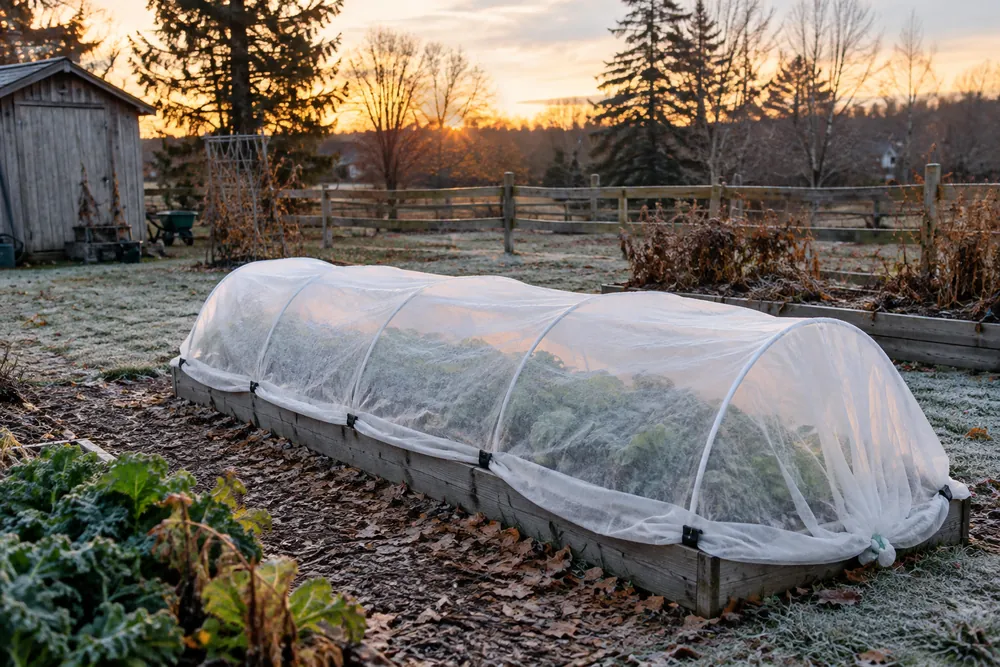
A little protection can stretch your fall garden by weeks, and in zones 5-7 it can keep greens alive all winter.
Floating row covers
Spunbonded polyester or polypropylene fabric laid over crops or on wire hoops traps soil warmth overnight. NC State Extension says row covers provide about 4-5°F of frost protection, and University of Wisconsin Extension notes they can protect crops to about 28°F. Heavier fabrics give more protection but let through less light, so many gardeners double up only on the coldest nights. Our guide to protecting plants from frost explains how to set them up.
Cold frames
A cold frame is a bottomless box with a clear lid. It captures daytime sun and holds it overnight, letting you grow spinach, lettuce, mâche and radishes weeks after outdoor crops stop. The catch is ventilation: on sunny days, even in late fall, temperatures inside can climb high enough to cook plants. Prop the lid open on bright days and close it in mid-afternoon to trap heat.
Low tunnels
Plastic sheeting over hoops (a low tunnel) works like a long cold frame. Pair it with row cover underneath for extra protection in zones 5-6, and vent the ends when days are warm.
Garden hack: Water beds the afternoon before a frost. Moist soil holds and releases more heat overnight than dry soil, giving covered crops a few extra degrees of buffer.
The Year-Round Vegetable Garden (2027 Edition)
Plan the whole season in one place: a 225-page month-by-month guide with calendars for six US growing regions, 50 plant profiles (tomatoes included), 5 copy-ready garden plans and 7 printable pages.
Tomato lover? Add Tomato Mastery, our seed-to-harvest tomato blueprint, for just $10 at checkout.
Get the guide ($27)Gear that helps
- Cold frame kit: Extends fall harvests of greens by weeks.
- Floating row cover: Adds a few degrees of frost protection overnight.
As an Amazon Associate we earn from qualifying purchases. Check current prices and reviews on Amazon.
What can you still plant in October?
If you are reading this in October and your summer garden is just winding down, you have not missed fall entirely.
- Zones 3-6: plant garlic and shallots, sow spinach to overwinter for spring (early October), and sow cereal rye on empty beds.
- Zone 7: plant garlic and onion sets; sow spinach, radishes, mâche and arugula early in the month, ideally under a row cover.
- Zone 8: set out brassica transplants and sow carrots, beets, turnips, lettuce and spinach.
- Zones 9-10: plant almost any cool-season vegetable now.
For a full zone-by-zone list, see what to plant in October. If a bed will sit empty, cover it with a cover crop or leaf mulch rather than leaving it bare.
Common mistakes to avoid
- Starting too late. This is the number one fall garden failure. In the North, most fall crops must be sown in July or early August.
- Using spring days to maturity. Without the fall factor, crops are still half-grown when growth stalls.
- Letting seedlings dry out. Late-summer heat kills young seedlings fast; check moisture daily for the first two weeks.
- Ignoring pests. Cabbage worms and aphids are still active in early fall. Cover brassicas from day one.
- Choosing the wrong varieties. Pick fast-maturing, cold-tolerant varieties for fall, such as savoy spinach and winter kales, not long-season or heat-bred types.
- Harvesting frozen leaves. Wait until leaves thaw naturally before picking, or they turn limp.
FAQ
What vegetables can you plant in the fall?
The best vegetables to plant in fall are cool-season crops: spinach, kale, collards, lettuce, arugula, radishes, turnips, beets, carrots, broccoli, cabbage, Brussels sprouts, peas and garlic. Garlic and shallots are planted in fall for a harvest the following summer.
When should I start my fall garden?
Count back from your average first fall frost date using days to maturity plus about 28 days (14 for slower fall growth and 14 for harvest). In zones 3-6 that usually means July to mid-August; in zones 8-10, September through November.
Is it too late to plant a fall garden?
Not necessarily. Fast crops like radishes, arugula and spinach can still be sown about 4-6 weeks before your first frost, and garlic can be planted until a few weeks before the ground freezes. In zones 8-10, fall planting continues into winter.
Can you plant tomatoes in the fall?
Only in zones 9-10, and only early enough to ripen before cool nights slow them, usually by late summer. Elsewhere, tomatoes are frost tender and will not ripen before the first freeze.
What is the easiest fall vegetable to grow?
Radishes and kale are the easiest. Radishes are ready in about a month, and kale tolerates hard freezes and keeps producing for months with little care.
Keep reading
Sources
- Counting the Days to Maturity: Calculating Planting Dates for Fall Vegetables – The Garden Professors
- Frost and Cold Temperatures Bring End to Gardening Season – Nebraska Extension in Lancaster County
- Late Season Harvest in the Vegetable Garden – Iowa State University Extension
- Season Extenders and Greenhouses – NC State Extension Gardener Handbook
- Extending the Gardening Season – University of Wisconsin Extension
- Fall Vegetable Gardening Guide – Texas A&M AgriLife Extension
- Florida Vegetable Gardening Guide – UF/IFAS Extension
- Winter Vegetable Production on Small Farms and Gardens West of the Cascades – Oregon State University Extension
- Vegetable Planting Calendar for Maricopa County – University of Arizona Cooperative Extension