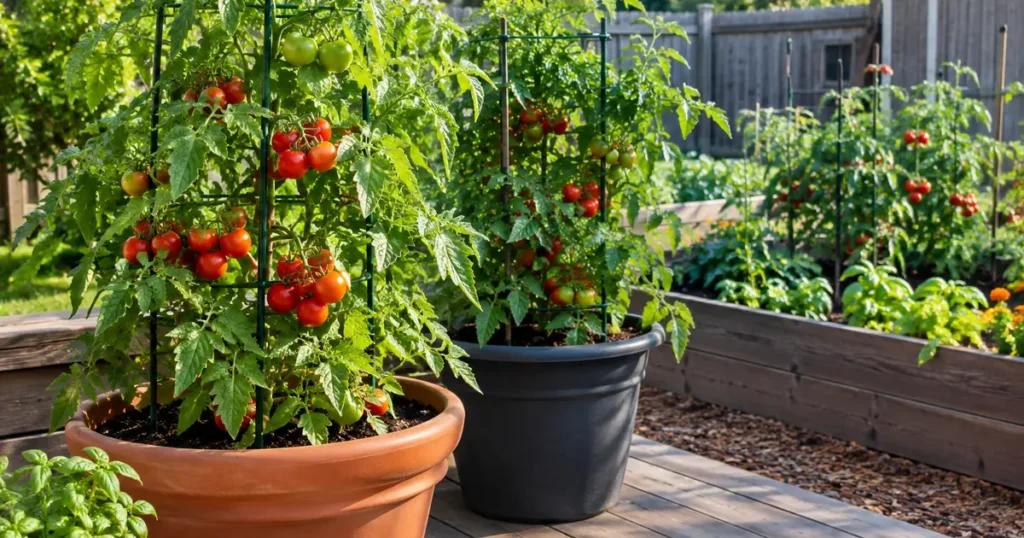
Growing tomatoes in pots works well as long as you get three things right: a big enough container, a quality potting mix, and steady watering. Choose a compact or patio variety for anything under 10 gallons, put the pot where it gets at least 6 hours of direct sun, and plan on checking moisture every day in summer. Container tomatoes need regular feeding too, because frequent watering washes nutrients out of the mix.
Quick answer
- Pot size: 5 gallons is a practical minimum for one standard plant; 10 to 20 gallons suits large indeterminate vines.
- Use soilless potting mix, never garden soil, in a container with drainage holes.
- Water until it drains from the bottom, then water again when the top inch feels dry; that is often daily in summer.
- Feed with a water-soluble fertilizer every 1 to 2 weeks, or use slow-release granules at planting.
- Even watering prevents most blossom end rot and fruit cracking in pots.
In this guide
- What is the best pot size for tomatoes?
- Container tomato varieties
- Best potting mix for tomatoes in pots
- How to plant tomatoes in containers
- How often to water tomatoes in pots
- Blossom end rot and cracking in containers
- Fertilizing tomatoes in pots
- Supporting and placing container tomatoes
- Common mistakes to avoid
- FAQ
 Grow tomatoes in season for your region, month by month: The Year-Round Vegetable Garden ($27, PDF).
What is the best pot size for tomatoes?
Bigger is almost always better. Extension sources give different minimums: University of Illinois Extension lists 3 gallons for a standard tomato and 1 gallon for cherry or patio types, Iowa State says at least 4 gallons for standard varieties and 2 gallons for cherries, and Texas A&M AgriLife recommends 5-gallon containers with one plant each. Those are survival minimums. More soil holds more water, which means fewer wilted afternoons and fewer fruit disorders.
| Tomato type | Minimum pot | Better choice | Example pot |
|---|---|---|---|
| Dwarf or micro (Tiny Tim, Pixie) | 1-2 gallons | 3 gallons | 10-12 inch pot, window box, hanging basket |
| Patio and trailing cherry (Patio, Tumbling Tom) | 2-3 gallons | 5 gallons | 12-14 inch pot or basket |
| Determinate bush (Bush Early Girl, Celebrity) | 4-5 gallons | 7-10 gallons | 5-gallon bucket or 16-18 inch pot |
| Indeterminate cherry (Sungold, Sweet 100) | 5 gallons | 10-15 gallons | Half whiskey barrel size or large grow bag |
| Indeterminate slicer or heirloom | 10 gallons | 15-20+ gallons | 20-gallon grow bag, at least 24 inches deep |
The University of Wisconsin’s Marinette County extension office notes that determinate varieties can grow in a 5-gallon bucket, while indeterminate types need something larger. A UC Master Gardener fact sheet for San Francisco goes further and recommends 15 to 20 gallons or more, at least 24 inches deep, for all tomatoes in that cool, foggy climate. Whatever you choose, it must have drainage holes.
Garden hack: Fabric grow bags are a cheap way to get 10 to 20 gallons of root space. They are light enough to move when empty and fold flat for winter. Expect them to dry out faster than plastic, so check them twice a day in a heat wave.
Gear that helps
- Fabric grow bags (10-20 gallon): An affordable way to give tomato roots enough soil volume to stay evenly moist.
As an Amazon Associate we earn from qualifying purchases. Check current prices and reviews on Amazon.
Container tomato varieties
Determinate and dwarf varieties usually do better in containers because they are less likely to outgrow the pot, according to Iowa State Extension. Clemson’s Home & Garden Information Center suggests looking for names that include “patio,” “balcony,” or “bush.” If you are not sure about the difference between habits, our guide to determinate vs indeterminate tomatoes explains it.
- Dwarf and micro types: Tiny Tim, Pixie, Small Fry. Small plants for 1- to 3-gallon pots and windowsills.
- Patio types: Patio, Patio Princess, Patio Choice Yellow (about 18 inches tall, per Clemson), Better Bush.
- Trailing types: Tumbling Tom and Tumbler, bred for hanging baskets.
- Determinate standard types: Bush Early Girl, Celebrity, Jetstar and Super Bush, listed by Iowa State and Illinois Extension for containers.
- Indeterminate cherries in big pots: Sungold, Sweet 100 and Juliet produce heavily in 10+ gallon containers with a tall cage.
Clemson lists Better Boy, Early Girl, Brandywine and Cherokee Purple among the indeterminate tomatoes to avoid in small pots, because they keep growing until frost. For more picks by goal, see the best tomatoes to grow, and for snacking types, our guide to growing cherry tomatoes.
Best potting mix for tomatoes in pots
Use a soilless potting mix, not garden soil. Iowa State Extension explains that soilless mixes are free of disease organisms and weed seeds, resist compaction, hold water and nutrients well, and are lightweight. Garden soil packs down in a pot, drains poorly and starves roots of air.
- Bagged potting mix made from peat or coir with perlite or bark is the simplest choice. Check the label to see whether it already contains fertilizer.
- Add compost for structure and slow nutrients. UW-Extension notes that compost can make up a large share of the mix; a mix with more than about 25% compost may need little extra fertilizer.
- Do not reuse last year’s tomato mix for tomatoes again if plants had disease.
Some older guides suggest a layer of gravel in the bottom of the pot for drainage. University of Missouri horticulturist David Trinklein explains that gravel actually slows drainage: it creates a “perched water table” that pushes the soggy zone higher into the root area. Drainage holes and a well-draining mix do the job.
How to plant tomatoes in containers
- Wait for warm weather. Set plants out after your last frost when nights stay above about 50-55°F. Our when to plant tomatoes guide gives dates by zone.
- Pick the sunniest spot. Iowa State and Clemson both call for at least 6 hours of direct sun daily.
- Fill the pot with moistened mix to about 1 inch below the rim, leaving room to water.
- Plant deep. Bury the stem up to the top few sets of leaves; roots form along the buried part.
- Add the cage or stake now. For tall varieties, a cage that sits inside the pot plus a stake driven through the drainage area or tied to a railing keeps the whole setup from tipping.
- Water thoroughly until it runs out the bottom.
How often to water tomatoes in pots
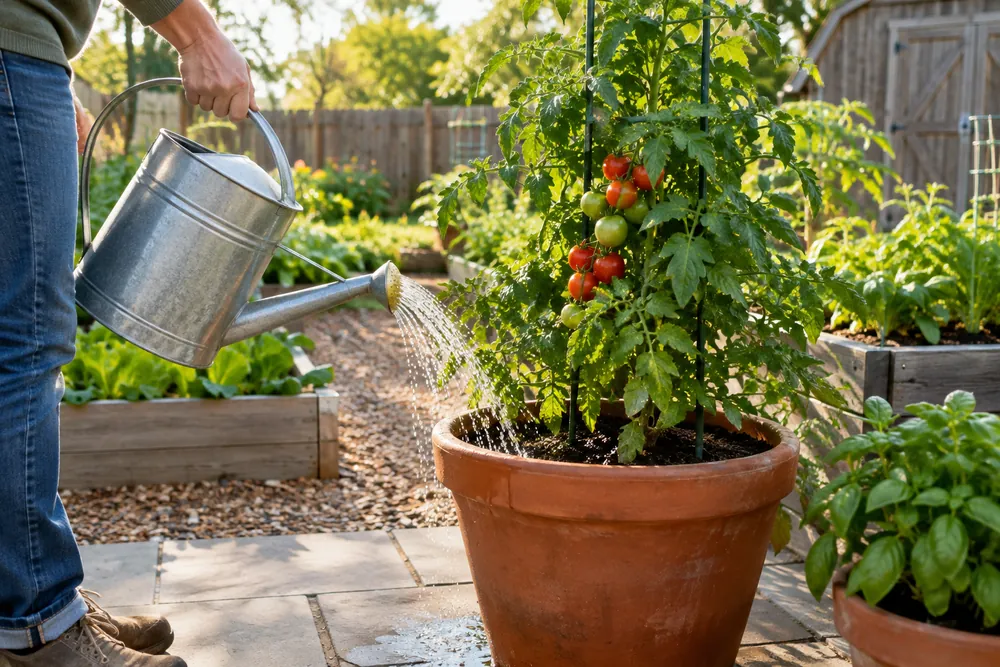
Container plants dry out fast, and some need water every day, according to Iowa State Extension. Clemson HGIC notes that daily watering is typical at the height of summer, and Texas A&M says large, leafy plants may need water twice a day. The pot size, weather, mix and plant size all change the schedule, so check rather than follow a calendar.
- The finger test: push a finger into the mix. If the top inch is dry, water. UC Master Gardeners use the same rule.
- Water deeply: keep going until water runs from the drainage holes, so the whole root ball is wet.
- Water the soil, not the leaves, ideally in the morning, to reduce leaf diseases.
- Do not let the pot dry out completely. Iowa State notes plants may drop flowers and fruit if it does.
- Do not keep it soggy either. Waterlogged mix deprives roots of oxygen.
Garden hack: Self-watering containers with a built-in reservoir, or a simple drip line on a timer, keep moisture far more even than hand watering. UW-Extension specifically mentions reservoir containers as a way to prevent blossom end rot.
Gear that helps
- Self-watering tomato planter: A reservoir keeps moisture steady between waterings, which helps prevent blossom end rot.
As an Amazon Associate we earn from qualifying purchases. Check current prices and reviews on Amazon.
Blossom end rot and cracking in containers
Blossom end rot shows up as a sunken, dark leathery patch on the bottom of the fruit. It is a calcium shortage inside the fruit, but Clemson HGIC explains that it usually happens even when the soil has enough calcium. Calcium moves to the fruit with water, so when watering is interrupted, so is the calcium supply. Pots, with their small soil volume, swing from wet to dry fastest, which is why container tomatoes are so prone to it.
Iowa State names blossom end rot and fruit cracking as common problems when watering is inconsistent. To prevent both:
- Use the largest pot you can manage.
- Water on a steady routine, or use drip irrigation or a reservoir pot.
- Add 1 to 2 inches of mulch (shredded leaves or straw) on top of the mix.
- Avoid heavy nitrogen feeding, which Utah State links to blossom end rot.
UW-Extension suggests adding about 1 cup of garden lime per 5-gallon container of soilless mix to supply calcium. Clemson notes that calcium sprays on leaves do not help, because foliar calcium cannot move into the fruit. Roma-type tomatoes are more prone to blossom end rot than small round types, so cherry varieties are a safer bet in small pots. Affected fruit is still edible once the damaged spot is cut away.
Watch out: The first fruits of the season often get blossom end rot, then later fruit is fine. Do not rush to dose the pot with calcium products; fix the watering routine first.
Fertilizing tomatoes in pots
Because water runs through the pot every day, nutrients leach out much faster than in the ground. Container tomatoes need regular feeding.
- Liquid feeding: Iowa State suggests a soluble fertilizer such as 20-20-20 or 15-30-15 every one to two weeks. Clemson suggests a water-soluble fertilizer once a week.
- Slow-release granules: mixed into the potting mix at planting and re-applied at the interval on the label. If your mix already has slow-release fertilizer, Iowa State notes you can usually wait until midsummer to start liquid feeding.
- Organic options: UC Master Gardeners suggest topping up with compost or a liquid organic fertilizer every 4 weeks, favoring products lower in nitrogen and higher in phosphorus and potassium.
Texas A&M’s container guide also recommends flushing the pot with plain water about once a week to leach out built-up fertilizer salts. Too much nitrogen gives big leafy plants with few fruit, so stick to label rates.
Gear that helps
- Water-soluble tomato fertilizer: Frequent watering leaches nutrients from pots, so regular liquid feeding keeps plants productive.
As an Amazon Associate we earn from qualifying purchases. Check current prices and reviews on Amazon.
Supporting and placing container tomatoes
Even compact varieties benefit from a small cage once they carry fruit. Indeterminate plants in pots need a tall cage or stake and regular ties. Place pots where they get full morning sun; in hot climates (zones 8 to 10), a spot with light afternoon shade or a light-colored pot helps keep the root zone from overheating. On a windy balcony, group pots together and secure tall cages to a railing.
At the end of the season, empty the pot, compost healthy plant material, and store the container dry. For the full growing picture, from planting to harvest, see our main guide on how to grow tomatoes.
Common mistakes to avoid
- Choosing a pot that is too small for the variety; indeterminate vines in 3-gallon pots wilt daily.
- Filling pots with garden soil instead of potting mix.
- Using containers without drainage holes.
- Watering by the calendar instead of checking the mix every day.
- Skipping fertilizer after the starter nutrients in the bag run out.
- Adding support too late, after the plant has sprawled or tipped the pot.
FAQ
Can you grow tomatoes in a 5-gallon bucket?
Yes. A 5-gallon bucket suits one determinate, patio or cherry tomato. Drill several drainage holes in the bottom, fill it with potting mix, and expect to water daily in summer. Large indeterminate vines do better in 10 gallons or more.
How many tomato plants per pot?
One. Extension guides recommend a single tomato plant per container so roots do not compete for limited water and nutrients.
How often should I water tomatoes in pots?
Check daily and water whenever the top inch of mix is dry. In hot summer weather that usually means once a day, and sometimes twice for large plants in small pots.
What is the best soil for tomatoes in pots?
A soilless potting mix based on peat or coir with perlite or bark, optionally blended with some compost. Avoid garden soil, which compacts and drains poorly in containers.
Why are my potted tomatoes getting black bottoms?
That is blossom end rot, caused by calcium not reaching the fruit, usually because watering swings between wet and dry. Water evenly, mulch the pot, and use a bigger container next season.
Do container tomatoes need fertilizer?
Yes. Frequent watering washes nutrients out, so feed every 1 to 2 weeks with a water-soluble fertilizer or use slow-release granules at planting, following the label.
Keep reading
Sources
- Growing Tomatoes in Containers – Iowa State University Extension and Outreach
- Tomatoes in Containers – Clemson Cooperative Extension, Home & Garden Information Center
- Vegetable Gardening in Containers (E-545) – Texas A&M AgriLife Extension
- Growing Vegetables in Containers – University of Illinois Extension
- Growing a Tomato Plant in a Container – University of Wisconsin-Madison Extension
- Growing Container Tomatoes in San Francisco – UC Master Gardener Program, UC ANR
- Gardening Myths: Fix Blossom End Rot with Calcium Sprays – Clemson HGIC
- How to Grow Tomatoes in Your Garden – Utah State University Extension
- Gardening Advice: Fact or Fiction – University of Missouri IPM