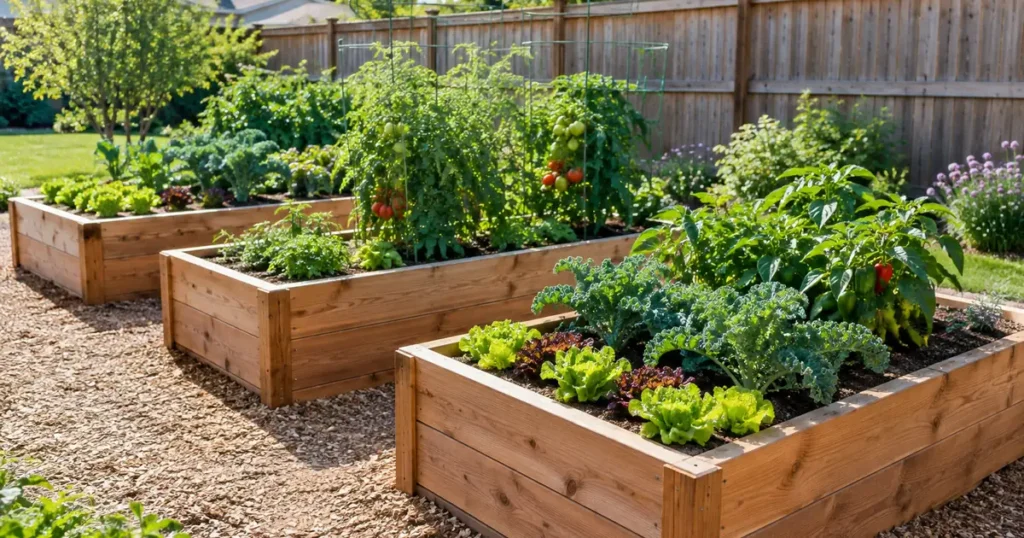
Raised garden beds are framed boxes of loose, improved soil that sit above the ground, usually 4 feet wide and 10 to 12 inches deep. They drain better, warm up earlier in spring and keep your feet off the growing area, which is why so many beginners start with one. The trade-offs are cost and soil that dries out faster in summer, so placement, depth and watering matter more than the box itself.
Quick answer
- Size: no wider than 4 feet (3 feet if you can reach from one side only); 4 x 8 feet is the classic starter bed.
- Depth: about 10 to 12 inches of soil suits most vegetables over loosened ground; go deeper on pavement or for root crops and tomatoes.
- Sun: at least 6 hours of direct sun, ideally 6 to 8 for tomatoes, peppers and squash.
- Wood: cedar, redwood or cypress last longest untreated; modern copper-based pressure-treated lumber (ACQ or CA) rated for ground contact is considered safe, old CCA lumber and railroad ties are not.
- Timing: build in fall so the soil settles over winter, then plant in spring by your local frost date.
In this guide
- What is a raised garden bed?
- Raised bed vs in-ground: benefits and drawbacks
- What size should a raised garden bed be?
- How deep should a raised bed be?
- Best wood for raised beds (and other materials compared)
- Where to put a raised bed
- How to build a raised garden bed (in brief)
- How to fill a raised garden bed (in brief)
- What to grow in raised beds
- When to set up and plant raised beds by zone
- Watering and caring for raised beds
- Common mistakes to avoid
- FAQ
 Every planting date for your region in one place: The Year-Round Vegetable Garden ($27, PDF).
What is a raised garden bed?
A raised bed is any planting area where the soil sits higher than the surrounding ground. Most are enclosed by a frame of wood, metal, stone or block, but extension services also describe unframed “mounded” beds, where soil is simply heaped 4 to 8 inches high with sloped sides. Framed beds hold their shape for years; mounded beds are cheaper but flatten and need rebuilding.
Either way, you create a block of loose, fertile soil that you never step on, so it stays fluffy and roots spread easily. That is the core of raised bed gardening, whether you build one 4 x 4 box or a dozen beds.
Raised bed vs in-ground: benefits and drawbacks
Raised beds are not automatically better than a well-prepared in-ground garden; they solve specific problems. Here is how the two compare, based on Minnesota, Missouri and Alabama extension guidance.
Benefits
- Better drainage. Heavy clay or soggy sites are the classic reason to build up. Water moves through the loose mix instead of pooling around roots.
- Earlier planting. Raised soil warms and dries faster in spring, so you can often sow cool-season crops sooner than in a cold, wet in-ground plot.
- No compaction. You never walk on the growing area, which keeps the soil open for air and water.
- Soil you control. On poor, rocky, shallow or contaminated urban soil, you bring in a clean mix rather than fighting what you have.
- Less bending. Taller beds are easier on backs and knees, and beds 2 feet or higher can be worked from a seat or wheelchair.
Drawbacks
- Raised beds dry out faster. The same drainage that helps in spring means more watering in July. Taller beds dry fastest.
- Cost and labor. Lumber, metal or block plus several cubic yards of soil add up, and you have to build before you plant.
- Limited rotation. Fewer, smaller beds make it harder to rotate crop families, which can build up soilborne diseases.
- Sprawling crops. Watermelon, pumpkins and winter squash quickly outgrow a 4 x 8 box unless you train them over the edge or onto a trellis.
Garden hack: If your native soil is already good, you do not need a tall box. A low frame or a mounded bed 6 to 8 inches high over loosened ground gives you most of the drainage and no-compaction benefits for a fraction of the soil.
What size should a raised garden bed be?
The single most important dimension is width. You should be able to reach the center without stepping in, and for most adults that means a reach of about 2 feet from each side.
- Width: 3 to 4 feet if you can reach from both sides. Make it 3 feet or less if the bed sits against a fence or wall and you can only reach from one side. University of Georgia guidance suggests 4 feet for adults, 3 feet for children, and 3 feet for adults gardening from a wheelchair.
- Length: anything that fits your space. Lumber comes in 8-, 10- and 12-foot lengths, so 4 x 8 and 4 x 12 beds waste the least wood. Very long beds are better split into shorter ones with walkways between them.
- Paths: at least 12 inches, ideally 18 to 24 inches between beds. Plan 30 inches or more where a wheelbarrow or garden cart has to pass, and about 4 feet for wheelchair access.
A 4 x 8 bed gives you 32 square feet, room for a few tomatoes, peppers, herbs and salad greens. For layouts and spacing, see how to plan a vegetable garden.
How deep should a raised bed be?
Most vegetables do well with 10 to 12 inches of good soil, as long as the bed sits on loosened native ground that roots can grow into. The University of Georgia notes that most garden crops need at least 10 inches of soil, and Missouri Extension describes a rooting zone of 6 to 12 inches, with deeper being better.
Depth matters most on a hard surface such as a patio, driveway or compacted fill, where roots cannot go further. There, build taller.
| Bed depth (soil) | Best for | Notes |
|---|---|---|
| 6-8 in | Lettuce, spinach, radishes, green onions, most herbs | Only over loosened native soil; the classic mounded-bed height |
| 10-12 in | Most vegetables: beans, peppers, bush cucumbers, kale, beets, onions | The standard depth; a single 2×12 board or two stacked 2x6s |
| 12-18 in | Tomatoes, squash, potatoes, carrots, parsnips | Extra room for deep-rooted crops and long roots |
| 18-24 in or more | Beds on pavement, rooftops or poor fill; accessible gardens | Extension guidance suggests 1 to 2 feet over pavement; about 24 to 27 inches tall for wheelchair users |
University of California rooting-depth data puts lettuce, onions, radishes and potatoes among the shallow-rooted crops (main roots in the top 1 to 2 feet), and tomatoes, pumpkins and melons among the deep-rooted ones. Roots keep going below the frame if you loosen the ground before filling.
Watch out: Beds taller than about 18 to 24 inches hold a lot of wet, heavy soil that pushes outward. Tall beds need stronger walls and bracing, and Missouri Extension notes that walls above that height move into retaining-wall territory.
Best wood for raised beds (and other materials compared)
Wood is the most common choice because it is easy to cut and costs less than masonry. The real questions are how long you want the bed to last and how you feel about treated lumber.
| Material | Pros | Cons | Good to know |
|---|---|---|---|
| Cedar, redwood, cypress | Naturally rot- and insect-resistant, no chemicals, easy to work | Costs more than pine or fir | The usual pick for organic gardeners; lasts many seasons |
| Untreated pine, fir, hemlock | Cheapest, widely available | Rots fastest in soil contact | Oregon State found advanced decay in untreated Douglas-fir beds after about six years |
| Pressure-treated (ACQ, CA) | Long-lasting, inexpensive | Copper preservatives; not accepted by some organic programs | Choose lumber rated for ground contact; see the safety section below |
| Galvanized steel | Very durable, thin walls, modern look | Metal kits vary in quality; walls heat up in sun | Minnesota Extension notes zinc leaching is a concern mainly in soils below pH 5 |
| Composite / recycled plastic lumber | Will not rot, low maintenance | Can flex on long spans; needs bracing | Good for beds you never want to rebuild |
| Fabric grow bags and beds | Light, portable, inexpensive to start | Dry out quickly; wear out after a few seasons | Manage like large containers |
| Stone, brick, concrete block | Permanent, fireproof, no rot | Heavy, needs a level base, labor-intensive | Masonry can raise soil pH over time; test your soil |
For a ready-made option instead of a DIY box, compare kits in our best raised garden beds guide.
Is pressure-treated wood safe for raised beds?
Short answer: modern pressure-treated lumber is considered safe for vegetable beds by several extension services, while old treated wood is not. The difference is the chemistry.
- CCA (chromated copper arsenate) contained arsenic. It was phased out for residential uses, including garden beds, at the end of 2003. Do not use lumber bought before 2004, salvaged decks or fences of unknown age, or railroad ties, which carry creosote.
- ACQ (alkaline copper quaternary) and CA (copper azole) replaced CCA. They rely on copper and contain no arsenic or chromium. Missouri Extension cites a 2007 study concluding ACQ exposure is not expected to harm adults or children.
- Recent research: Oregon State University grew vegetables for several seasons in beds made of copper azole-treated Douglas-fir. Soil copper rose only within about 1 inch of the boards, and the vegetables and herbs showed no increase in copper.
If you go with treated wood, buy lumber labeled for ground contact (Clemson cites the AWPA UC4A category or higher), seal freshly cut ends with a cut-end preservative, and wear gloves and a mask when cutting. If you still prefer extra caution, line the inside walls (not the bottom) with heavy plastic, or simply choose cedar, stone or block.
Gear that helps
- Galvanized metal raised garden bed kit: A long-lasting, rot-free frame if you would rather not build from lumber.
- Cedar raised garden bed kit: Untreated, rot-resistant wood with pre-cut boards for a quick setup.
As an Amazon Associate we earn from qualifying purchases. Check current prices and reviews on Amazon.
Where to put a raised bed
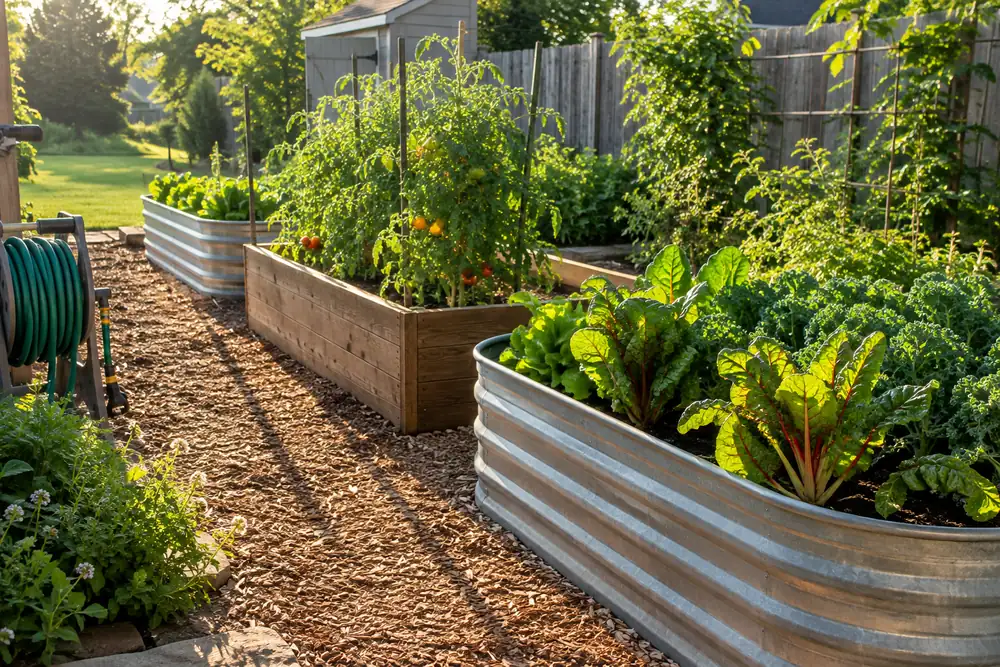
Placement decides more of your harvest than the frame material does. Run through this checklist before you build.
- Sun: at least 6 hours of direct sun per day; 6 to 8 hours for fruiting crops like tomatoes, peppers, eggplant and squash. In part shade (4 to 6 hours), stick to lettuce, kale, scallions, radishes and other leafy crops.
- Water: close to a hose bib, because raised beds need more frequent watering than in-ground beds.
- Level ground: a flat, well-drained spot is easiest. On a slope, plan to dig in the uphill side or terrace the beds like stairs.
- Orientation: extension services suggest running beds north to south so both sides get even light. Put tall crops on the north end so they do not shade shorter ones.
- Away from trouble: keep beds out of tree root zones, away from black walnut trees, and off spots where the soil may hold lead, such as next to old painted houses.
Garden hack: Map your sun before you buy lumber. Check the spot at 9 a.m., noon and 3 p.m. on a clear day and note when it is shaded. A bed in the wrong place is the hardest mistake to fix once it is full of soil.
How to build a raised garden bed (in brief)
A basic wooden bed is a weekend project with a saw, a drill and a level. The short version:
- Clear the site of sod or weeds and loosen the ground underneath.
- Cut boards to size: for a 4 x 8 bed, two 8-foot sides and two end pieces.
- Screw the boards to corner posts with exterior-rated screws, drilling pilot holes near board ends.
- Set the frame in place, level it side to side and end to end, and stake it if needed.
- Add hardware cloth on the bottom if gophers or voles are a problem in your area.
Our step-by-step guide on how to build a raised garden bed includes a full cut list for a 4 x 8 bed, tools, leveling on a slope, and ideas for cinder block, metal, tiered and elevated beds.
How to fill a raised garden bed (in brief)
Fill your bed with a blend of good topsoil and compost, not straight potting mix and not plain dirt from a construction site. Extension recipes vary, but most land between two parts topsoil to one part compost and roughly equal parts of each. Mix the ingredients together rather than leaving them in separate layers, which can block water and roots.
Plan on more soil than you think. A 4 x 8 bed that is 1 foot deep holds 32 cubic feet, or about 1.2 cubic yards, and the mix will settle an inch or two in the first season. Get a soil test so you can adjust pH and nutrients; our guide on how to test soil pH walks you through it.
For soil recipes, a volume table for common bed sizes, cheaper fill options like hugelkultur, and what to keep out, read how to fill a raised garden bed. For the basics of what makes soil fertile in the first place, see Garden Soil 101.
What to grow in raised beds
Almost any vegetable will grow in a raised bed. Some crops make better use of the space than others.
- Top choices: lettuce and salad greens, spinach, kale, chard, radishes, carrots, beets, onions, garlic, bush beans, peppers, herbs and compact or staked tomatoes. Loose soil makes root crops especially happy.
- With support: pole beans, peas, cucumbers and indeterminate tomatoes grow up instead of out if you add a trellis or cage on the north side.
- Space hogs: sweet corn needs a block of plants to pollinate well, and pumpkins, watermelons and winter squash sprawl 10 feet or more. Grow them in-ground or let vines spill over the edge onto the path.
Planting in blocks rather than single rows fits more into a small bed. For low-risk first-year crops, see our list of the easiest vegetables to grow.
When to set up and plant raised beds by zone
The best time to build a raised bed is fall or early winter. The soil settles over winter, weeds smothered under it die back, and the bed is ready to plant in spring. Spring builds work too; just top off the soil as it settles. Avoid digging when the ground is soggy, which compacts it.
Because raised beds warm faster, you can often plant cool-season crops a little earlier than in the ground. Warm-season crops still wait until after your last frost. Your zone describes winter low temperatures, not frost dates, so look up your own dates on our frost dates by zone page.
| USDA zone | Typical last spring frost (rough) | Build / prep beds | Plant cool-season crops | Plant warm-season crops |
|---|---|---|---|---|
| 3-4 | Mid-May to early June | Late summer to early fall, before the ground freezes | Late April to May | Early to mid-June |
| 5 | Early to mid-May | September to October | April | Mid to late May |
| 6 | Late April to early May | October to November | Late March to April | Early to mid-May |
| 7 | Early to mid-April | October to December | March | Mid-April to early May |
| 8 | Late March to early April | Summer for fall crops, or November to January | February to early March, again in September to October | April |
| 9-10 | February or rare frost | Late summer for the main fall/winter season | September to February | February to March, again in late summer where heat allows |
These dates are broad averages. Microclimates, elevation and the year’s weather all shift them, so confirm with your local extension office before you plant. In zones 8 to 10, fall and winter are prime raised-bed seasons for greens, roots, onions and brassicas, while midsummer heat favors heat-loving crops like okra and southern peas. For crop-by-crop dates, see the vegetable planting calendar.
Watering and caring for raised beds
A simple routine keeps raised-bed plants from stalling in summer.
- Water at the soil, not the leaves. Soaker hoses or drip lines put water where roots are and keep foliage dry, which helps limit leaf diseases. A timer makes this nearly effortless.
- Mulch. Two inches of straw, shredded leaves or compost slows evaporation and moderates soil temperature.
- Top off every year. Organic matter breaks down, so the soil level drops. Add an inch or two of compost each season.
- Test every 2 to 3 years. Heavy compost use can build up phosphorus and salts. A soil test tells you what to add and what to skip.
- Rotate. Avoid growing the same plant family (tomatoes, peppers, eggplant and potatoes are all one family) in the same bed for 3 to 4 years when you can.
- Put beds to bed. Cover empty beds in fall with leaves, compost or a cover crop. Our fall checklist for beds and raised beds covers the details.
Gear that helps
- Raised bed drip irrigation kit: Waters at the soil line and offsets the faster drying of raised beds.
- Soaker hose: A low-cost way to keep water off leaves and on the roots.
As an Amazon Associate we earn from qualifying purchases. Check current prices and reviews on Amazon.
Common mistakes to avoid
- Building too wide. A 5- or 6-foot bed forces you to step in, which defeats the purpose.
- Too little sun. Fewer than 6 hours of direct light means weak tomatoes and peppers, no matter how good the soil is.
- Filling with potting mix alone. It dries out too fast and gets expensive at bed scale. Use a topsoil-compost blend.
- Using old treated wood or railroad ties. Pre-2004 CCA lumber and creosote-soaked ties have no place around food crops.
- Lining the bottom with plastic. It blocks drainage and turns the bed into a bathtub. Use hardware cloth for pests and leave the bottom open.
- Paths too narrow. If you cannot kneel or roll a wheelbarrow between beds, every chore gets harder.
FAQ
How deep should a raised garden bed be for vegetables?
About 10 to 12 inches of soil is enough for most vegetables when the bed sits on loosened native soil. Go 12 to 18 inches for tomatoes, squash, potatoes and carrots, and 18 to 24 inches or more if the bed sits on pavement or compacted fill.
What is the best size for a raised garden bed?
A 4 x 8 foot bed is the most popular starting size. Keep the width at 4 feet or less (3 feet against a wall) so you can reach the middle without stepping in, and choose any length that fits your space.
Is cedar or pressure-treated wood better for raised beds?
Both work. Cedar resists rot naturally and needs no chemicals but costs more. Modern ACQ or copper azole lumber rated for ground contact is considered safe by several extension services; avoid pre-2004 CCA lumber and railroad ties.
Do raised beds need a bottom?
No. An open bottom lets roots grow into the ground and lets water drain. Add galvanized hardware cloth only if burrowing animals such as gophers are a problem, and never line the bottom with plastic.
Are raised beds better than an in-ground garden?
They are better on poor, wet, rocky or contaminated soil and for gardeners who want less bending. On good native soil, an in-ground garden costs less and needs less watering.
When is the best time to build a raised bed?
Fall or early winter is ideal because the soil settles before spring planting. You can also build in early spring; just top off the soil as it sinks over the first season.
Sources
- Raised bed gardens – University of Minnesota Extension
- Raised-Bed Gardening (G6985) – University of Missouri Extension
- Gardening in Raised Beds (ENH1211) – UF/IFAS Extension
- Raised Bed Gardening (ANR-1345) – Alabama Cooperative Extension System
- Pressure-treated wood for raised bed construction in Oregon (EM 9879) – Oregon State University Extension
- Raised Beds (HGIC 1257) – Clemson Cooperative Extension
- Raised Garden Bed Dimensions (C1027-4) – University of Georgia Extension
- Raised Bed Gardening – University of Delaware Cooperative Extension
- Vegetable Garden Irrigation (rooting depths) – UC Master Gardeners of Placer County, UC ANR