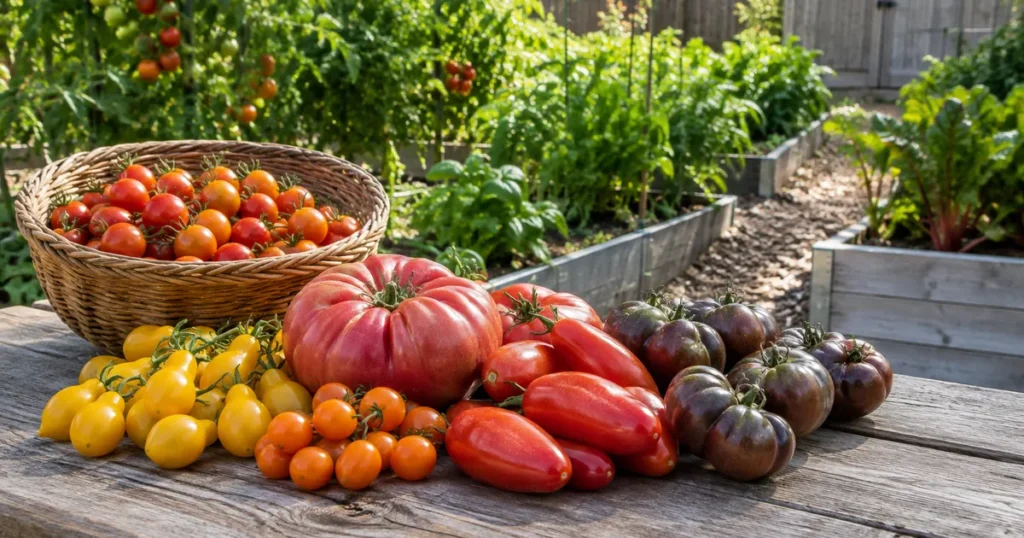
There are thousands of tomato varieties, but almost all of them fit into a handful of types: cherry, grape, pear and currant (the small ones), paste or plum, round slicers and big beefsteaks. On top of fruit type, every variety also has a growth habit (determinate or indeterminate) and a seed type (heirloom, hybrid or open-pollinated). Learn those three layers and any seed packet suddenly makes sense.
Quick answer
- The main types of tomatoes by fruit are cherry, grape, pear/currant, paste (Roma, San Marzano), globe slicers and beefsteaks.
- Small-fruited types ripen first, often 55-70 days after transplanting; big beefsteaks can take 80-95 days.
- Growth habit matters as much as fruit type: determinate plants stay bushy and ripen in a burst, indeterminate vines keep producing until frost.
- Heirlooms are open-pollinated varieties with a long history; hybrids (F1) are crosses bred for traits like disease resistance.
- Letters after a name (V, F, N, T, A, TSWV, LB) tell you which diseases the variety resists.
In this guide
- Tomato types at a glance
- Small-fruited tomato types
- Paste and plum tomatoes (Roma, San Marzano)
- Slicing tomatoes: globe and beefsteak
- Heirloom vs hybrid vs open-pollinated tomatoes
- Determinate vs indeterminate tomato types
- Tomato varieties by color
- Specialty types: dwarf, patio and hanging-basket tomatoes
- Which tomato type fits your zone?
- Tomato disease resistance codes explained
- Common mistakes to avoid
- FAQ
 Grow tomatoes in season for your region, month by month: The Year-Round Vegetable Garden ($27, PDF).
Before choosing, it helps to know how a tomato plant grows and what it needs overall; our complete guide to growing tomatoes covers soil, spacing, watering and support from start to finish.
Tomato types at a glance
Use this table as a cheat sheet. Days to maturity on seed packets are counted from transplanting a 6- to 8-week-old seedling into the garden, not from sowing the seed. Ranges below come from seed company and extension variety listings and will shift with your weather.
| Type | Example varieties | Typical fruit size | Days to maturity | Best uses |
|---|---|---|---|---|
| Currant | Sweet Pea Currant, Yellow Currant, Matt’s Wild Cherry | 1/3 to 1/2 inch | 60-75 | Snacking, salads, garnish |
| Cherry | Sun Gold, Super Sweet 100, Black Cherry | About 1 inch, under 1 oz | 57-70 | Snacking, salads, roasting |
| Grape | Juliet, Jolly Elf, Sweet Olive | Oval, about 1 oz | 60-75 | Snacking, salads, quick sauces |
| Pear and plum (mini) | Yellow Pear, Red Pear | 1 3/4 to 2 inches | 70-80 | Salads, pickling, color |
| Paste / plum | Roma, San Marzano, Amish Paste | 2-6 oz, elongated | 72-85 | Sauce, paste, canning, drying |
| Globe / slicer | Early Girl, Celebrity, Better Boy | 4-12 oz, round | 52-75 | Sandwiches, salads, all-purpose |
| Beefsteak | Big Beef, Brandywine, Mortgage Lifter | 10 oz to 2 lbs or more | 73-95 | Slicing, burgers, BLTs |
| Dwarf / patio | Tiny Tim, Tumbling Tom, Bush Early Girl | Cherry to 7 oz | 45-70 | Pots, balconies, hanging baskets |
Small-fruited tomato types
Cherry tomatoes
Cherry tomatoes are round, about an inch across and usually under an ounce. They are the most forgiving type for beginners: plants set fruit in big clusters, ripen early and keep going when larger types stall in summer heat. Extension offices in the South often call them the most reliable tomatoes for their region.
Most cherries are indeterminate and vigorous, so give them a tall cage or stake. Sun Gold, an orange hybrid, is listed around 57-65 days; Super Sweet 100 is a red hybrid with Verticillium and Fusarium resistance.
Grape tomatoes
Grape tomatoes are oblong rather than round, with thicker skin and firmer flesh than most cherries. That firmness means they crack less after heavy rain and hold up longer on the counter. Juliet, an All-America Selections winner, is a crack-resistant grape type listed at about 60 days.
Pear and currant tomatoes
Pear tomatoes are small, waisted fruits, usually yellow or red, that make a salad look like a farmers market display. Yellow Pear is a classic indeterminate heirloom at roughly 70-78 days.
Currant tomatoes are even smaller, often half an inch or less, and many belong to a wild relative species from South America (Solanum pimpinellifolium). A single plant can carry hundreds of fruits on long sprays. Expect sprawling, rambling vines that need room.
Garden hack: If you only have space for one plant and want tomatoes as early as possible, grow a cherry or grape type. Small fruits need fewer days to size up and ripen, so you usually pick the first ones two to three weeks before a beefsteak planted the same day.
Gear that helps
- Tall heavy-duty tomato cages: Most cherry and grape tomatoes are vigorous indeterminate vines that outgrow small cone cages.
As an Amazon Associate we earn from qualifying purchases. Check current prices and reviews on Amazon.
Paste and plum tomatoes (Roma, San Marzano)
Paste tomatoes, also called plum or sauce tomatoes, are elongated fruits with thick walls, a small seed cavity and less juice. Less water means sauce cooks down faster and canned tomatoes are meatier. They are also good for drying and roasting.
- Roma: the classic bush-type paste tomato, determinate, around 75-78 days. Many packets list VF resistance.
- San Marzano: long, pointed Italian heirloom, indeterminate, around 78-80 days.
- Amish Paste: a large, plum-shaped heirloom with excellent flavor, indeterminate, about 80-85 days.
Determinate paste varieties such as Roma are popular with canners because a big share of the crop ripens over a few weeks, which makes it easy to fill a batch of jars at once. Paste tomatoes are prone to blossom end rot when watering is uneven, so keep soil moisture steady.
Gear that helps
- Food mill / tomato strainer: Removes skins and seeds fast when turning a paste tomato harvest into sauce.
As an Amazon Associate we earn from qualifying purchases. Check current prices and reviews on Amazon.
Slicing tomatoes: globe and beefsteak
Globe or round slicers
Globe tomatoes are the medium, round, red fruits most people picture, typically 4 to 12 ounces. Many popular hybrids sit here: Early Girl (about 52 days, indeterminate), Celebrity (about 70 days, sold as determinate or semi-determinate) and Better Boy (about 75 days, indeterminate). Medium fruit sets and ripens more reliably than giant fruit in hot climates.
Beefsteak tomatoes
Beefsteaks are the big ones: 10 ounces to 2 pounds or more, often flattened, ribbed and packed with several seed cavities. Big Beef is a hybrid beefsteak around 73 days with a long disease-resistance code. Heirloom beefsteaks such as Brandywine and Mortgage Lifter take about 80-90 days and can yield less, but many gardeners grow them for flavor.
Watch out: Large-fruited tomatoes are the first to quit in extreme heat. Pollination and fruit set can fail when days run above about 90°F and nights stay above about 70°F, and flowers also drop when nights fall below 55°F. In hot zones, choose cherries, medium slicers or heat-set varieties for midsummer.
Heirloom vs hybrid vs open-pollinated tomatoes
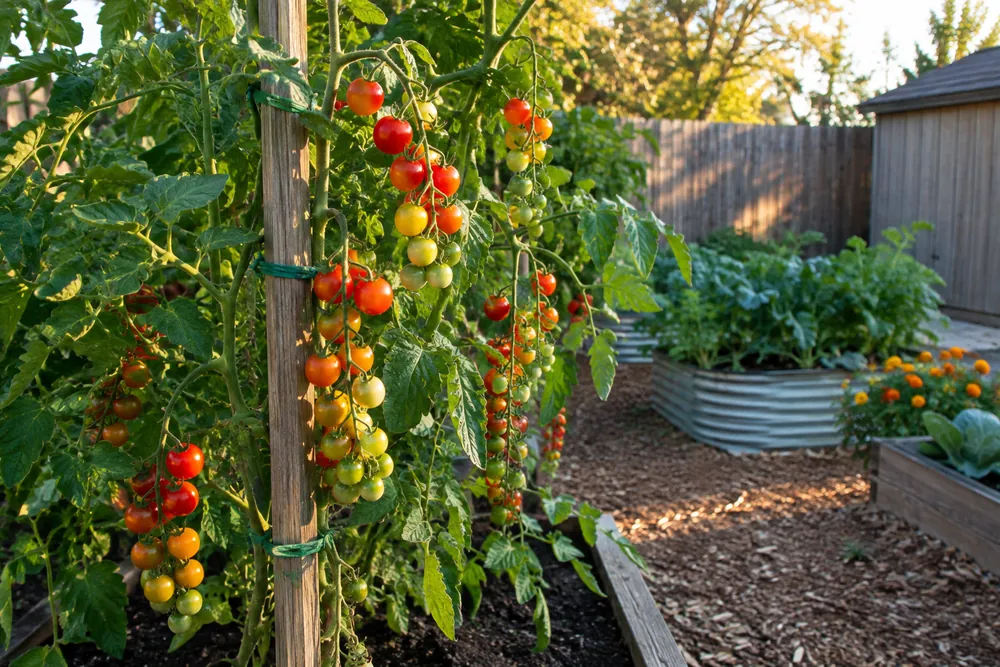
This layer describes how the seed was bred, not what the fruit looks like. A beefsteak can be heirloom or hybrid; so can a cherry.
- Open-pollinated (OP): varieties that breed true. Save seed from an OP tomato and, as long as it did not cross with a neighbor, the next generation looks and tastes like the parent.
- Heirloom: an open-pollinated variety with a history, typically passed down for decades in a family, region or community. Brandywine, Cherokee Purple and San Marzano are heirlooms. Read our close-up on the Cherokee Purple tomato for a typical example.
- Hybrid (F1): a deliberate cross of two parent lines, bred for traits such as vigor, earliness, uniform fruit or disease resistance. Seed saved from a hybrid does not breed true, so you buy new seed each year.
Neither group is automatically better. Heirlooms are prized for flavor and diversity but usually carry little disease resistance. Hybrids are often more productive and reliable in disease-prone gardens. Newer crosses, such as Cornell’s late-blight-resistant BrandyWise, try to combine heirloom eating quality with modern resistance.
Determinate vs indeterminate tomato types
Every variety has a growth habit printed somewhere on the packet or catalog page:
- Determinate (bush): stems end in a flower cluster, so plants stop growing at roughly 2 to 4 feet. Most fruit ripens within a few weeks. Good for containers and canning.
- Indeterminate (vining): stems keep growing and flowering until frost, often reaching 6 to 8 feet. Harvest is spread over the whole season. Needs tall stakes, cages or a trellis.
- Semi-determinate: an in-between habit, larger than a bush type but more compact than a full vine.
We explain support, pruning and yield differences in detail in determinate vs indeterminate tomatoes.
Tomato varieties by color
Color is mostly about looks and flavor nuance; growing needs are the same.
- Red: the classic, from Early Girl to San Marzano.
- Pink: red flesh with clear skin, often described as milder; Brandywine is the best-known pink.
- Orange and yellow: often lower in perceived acidity and sweet-tasting; Sun Gold, Yellow Pear, Carolina Gold.
- Black or purple: dusky red-brown fruit with a rich, smoky reputation; Cherokee Purple, Black Krim, Paul Robeson, Black Cherry.
- Green-when-ripe: stays green or yellow-green at maturity, such as Green Zebra or Green Grape. Judge ripeness by a slight softness and a yellow blush, not color.
- White: pale cream to yellow-white fruit, like Snow White cherry.
- Bicolor: yellow flesh marbled with red, often large beefsteaks.
Specialty types: dwarf, patio and hanging-basket tomatoes
Compact tomatoes are bred for small spaces, but they are not all the same:
- Micro and patio bush types: Tiny Tim, developed at the University of New Hampshire in the 1940s, grows only 10-18 inches tall and is listed around 45-55 days. Patio Choice Yellow stays near 18 inches.
- Trailing types: Tumbling Tom and Tumbler cascade over the edge of a hanging basket or window box.
- Dwarf tomatoes: a separate group with thick central stems and crinkled (rugose) foliage that stays about 2 to 4.5 feet tall but carries full-size heirloom-style fruit. The volunteer Dwarf Tomato Project has released dozens of open-pollinated dwarfs since 2006. UC Master Gardeners suggest a 10- to 15-gallon container for them.
- Bush versions of classics: Bush Early Girl and Better Bush offer slicer-size fruit on shorter plants.
Gear that helps
- 10-15 gallon fabric grow bags: Gives dwarf and patio tomatoes enough root room on a balcony or patio.
As an Amazon Associate we earn from qualifying purchases. Check current prices and reviews on Amazon.
Which tomato type fits your zone?
The fruit type you pick should match your season length. Zones describe winter lows, not frost dates, but colder zones usually have shorter frost-free summers. The ranges below are rough; check your own last and first frost dates and your local extension office, because elevation and microclimates vary a lot.
| USDA zone | Typical frost-free season | Best tomato types | Notes |
|---|---|---|---|
| 3-4 | Short (often under 130 days) | Cherry, early slicers, early paste, compact determinates | Choose varieties under about 70 days; add 10-14 days to packet days in cool summers. |
| 5 | Moderate | All small types, slicers, paste; beefsteaks if transplanted promptly | Plant 1-2 weeks after the last frost date once soil warms. |
| 6-7 | Long | Every type, including late heirloom beefsteaks | Indeterminate vines can produce for three months or more. |
| 8 | Long, with hot midsummer | Cherries, medium slicers, heat-set hybrids | Plant early in spring and again for a fall crop. |
| 9-10 | Very long; summer heat limits fruit set | Cherries, heat-set and disease-resistant hybrids | Main seasons are late winter to spring and fall; midsummer set is poor. |
For month-by-month timing, see when to plant tomatoes.
Tomato disease resistance codes explained
The capital letters after a variety name (for example, Big Beef VFFNTA) are a shorthand for diseases the plant resists or tolerates. Resistance lowers the risk; it does not make a plant immune. Common codes on US seed packets and in extension variety lists:
| Code | Disease | What it means for you |
|---|---|---|
| V | Verticillium wilt | Soilborne fungus; yellowing and wilting from the bottom up, worse in cool regions. |
| F, FF, FFF (or F1, F2, F3) | Fusarium wilt, races 1, 2, 3 | Soilborne fungus; each F covers one race. Important in warm Southern soils. |
| N | Root-knot nematodes | Microscopic soil worms that cause root galls; common in sandy Southern soils. |
| T (TMV, ToMV) | Tobacco or tomato mosaic virus | Mottled, distorted leaves; spread by hands and tools. |
| A or ASC | Alternaria stem canker | Dark cankers on stems; not the same as early blight. |
| St | Stemphylium (gray leaf spot) | Leaf spotting in warm, humid areas. Also written GLS. |
| TSWV | Tomato spotted wilt virus | Spread by thrips; a serious problem in the Southeast. |
| TYLCV | Tomato yellow leaf curl virus | Spread by whiteflies; mostly Florida, the Gulf Coast and the Southwest. |
| EB | Early blight | Target-ring leaf spots starting low on the plant; usually tolerance, not full resistance. |
| LB | Late blight | Fast, destructive disease in cool, wet weather; Mountain Magic, Defiant PhR and Plum Regal carry resistance. |
Some catalogs now use international codes instead, such as Fol for Fusarium, Va/Vd for Verticillium, Ma/Mi/Mj for nematodes and Pi for late blight. If a code puzzles you, the catalog’s legend will translate it.
Garden hack: Ask your county extension office which tomato diseases show up most in your area, then shop by code. A Southeastern gardener fighting TSWV and a New England gardener facing late blight need completely different letters on the packet.
Common mistakes to avoid
- Choosing by fruit type alone and ignoring growth habit, then planting an 8-foot indeterminate vine in a 5-gallon pot.
- Picking 90-day heirloom beefsteaks in a short-season zone with no early varieties as backup.
- Saving seed from a hybrid and expecting the same tomato next year.
- Reading resistance codes as a guarantee; good spacing, mulch and crop rotation still matter.
- Growing only giant slicers in a hot Southern summer, when cherries and medium fruits set far more reliably.
- Counting days to maturity from the sowing date instead of from transplanting.
FAQ
How many types of tomatoes are there?
There are thousands of named varieties, but most fall into about six fruit types: currant, cherry, grape, pear/plum, paste and slicers (globe and beefsteak). Each variety is also determinate or indeterminate and heirloom, hybrid or open-pollinated.
What is the easiest type of tomato to grow?
Cherry tomatoes are the easiest for most gardeners. They ripen early, set fruit in heat better than large types and usually produce heavily even when the season is short or hot.
What type of tomato is best for sauce?
Paste tomatoes such as Roma, San Marzano and Amish Paste are best for sauce. Their thick walls and low water content cook down faster and give a thicker result than juicy slicers.
Is a Roma tomato determinate or indeterminate?
Roma is a determinate, bush-type paste tomato. San Marzano and Amish Paste, two other popular paste varieties, are indeterminate.
Are heirloom tomatoes better than hybrids?
Not automatically. Heirlooms are valued for flavor and variety and you can save their seed, while hybrids usually offer more disease resistance and more consistent yields. Many gardeners grow some of each.
What does VFN mean on a tomato plant?
VFN means the variety resists Verticillium wilt (V), Fusarium wilt (F) and root-knot nematodes (N). Extra letters such as T, A or TSWV add resistance to other diseases.
Keep reading
Sources
- Tomato Variety Information – Colorado State University Extension
- Tomato Variety Selection – Alabama Cooperative Extension System
- Grow Your Own Tomatoes and Tomatillos (EC 1333) – Oregon State University Extension
- Growing Home Garden Tomatoes (G6461) – University of Missouri Extension
- Paste Tomatoes – University of Delaware Cooperative Extension
- Growing Tomatoes in Home Gardens (FS145E) – Washington State University Extension
- Dwarf Tomatoes – UC Master Gardener Program, UC ANR
- Heat-Tolerant Tomato Varieties – University of Maryland Extension