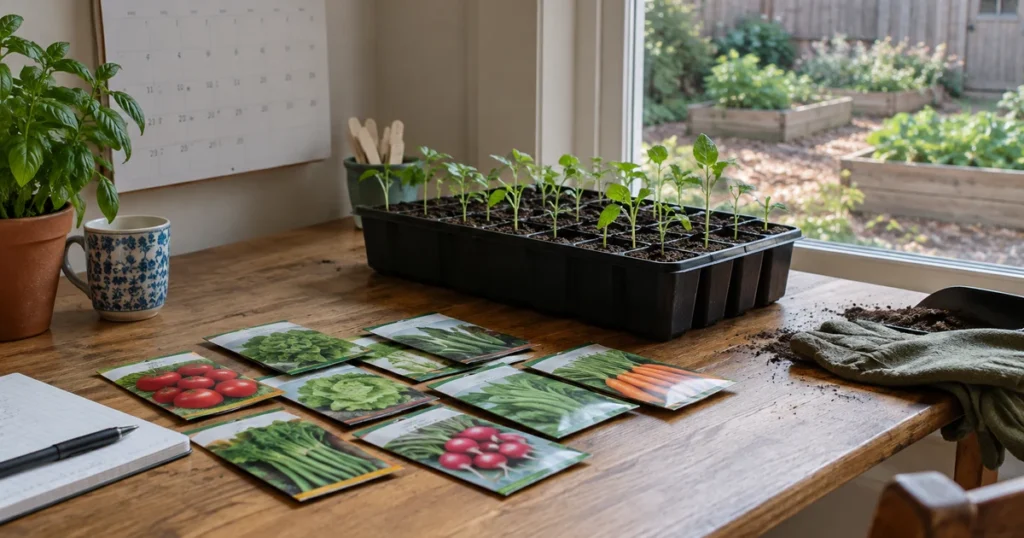
Start seeds indoors by counting backward from the date you plan to set each crop outside, which is tied to your average last spring frost. Peppers, eggplant, onions and celery need 8-12 weeks indoors, tomatoes 6-8 weeks, broccoli and cabbage 5-7 weeks, and cucumbers and squash only 3-4 weeks. For most of the country, that puts the busiest seed-starting weeks between late January and early April.
Quick answer
- Find your average last frost date, then decide when each crop goes outside: hardy crops 2-4 weeks before it, tender crops 1-2 weeks after it.
- Subtract the crop’s weeks indoors from that transplant date. That is your sowing date.
- Tomatoes: 6-8 weeks indoors. Peppers and eggplant: 8-10. Onions, leeks and celery: 10-12. Squash, cucumbers and melons: 3-4.
- In zones 8-10, add a second seed-starting season in late summer for fall and winter crops.
- Starting too early is as harmful as starting too late: overgrown, root-bound transplants stall in the garden.
In this guide
- How to figure out when to start seeds indoors
- Seed starting chart: weeks indoors, germination temperature and days to sprout
- Worked example: building a seed starting schedule
- Seed starting calendar by USDA zone
- Starting seeds for a fall garden
- What happens if you start seeds too early or too late?
- Common mistakes to avoid
- FAQ
Want every planting date for your region in one place? Get The Year-Round Vegetable Garden (225 pages, $27).
How to figure out when to start seeds indoors
Every seed packet says something like “start indoors 6-8 weeks before last frost.” That number only works once you know two things: your average last frost date and when each crop can safely go outside.
- Find your average last spring frost date. Use our frost dates by zone page as a starting point, then confirm with your local extension office or a NOAA-based frost date lookup for your ZIP code. Your USDA hardiness zone is based on winter low temperatures, not frost dates, so two towns in the same zone can have last frosts weeks apart.
- Set a transplant date for each crop. Hardy crops such as onions, broccoli and cabbage can go out 2-4 weeks before your last frost. Tender crops such as tomatoes, peppers and squash go out 1-2 weeks after it, once nights stay above about 50°F.
- Count back the weeks indoors. Subtract the number of weeks each crop needs under lights from its transplant date.
- Write it down. A simple seed starting schedule on a calendar or spreadsheet keeps you from sowing everything the first warm weekend of February.
Gear that helps
- Garden planner journal: Keeps a written seed starting schedule and records of sowing dates
As an Amazon Associate we earn from qualifying purchases. Check current prices and reviews on Amazon.
Seed starting chart: weeks indoors, germination temperature and days to sprout
The chart below combines guidance from several extension services. Weeks indoors are counted to your transplant date, not to the frost date. Germination temperatures refer to the seed-starting mix, which a heat mat can raise above room temperature. Days to sprout assume the mix is in the ideal range; expect slower germination in a cool room.
| Crop | Weeks indoors | Plant outside | Ideal mix temperature | Days to sprout |
|---|---|---|---|---|
| Onions (from seed) | 10-12 | 2-4 weeks before last frost | 65-80°F | 7-10 |
| Leeks | 10-12 | 2-4 weeks before last frost | 65-80°F | 7-14 |
| Celery | 10-12 | 1-2 weeks after last frost | 65-75°F | 9-21 |
| Parsley | 8-10 | 2-3 weeks before last frost | 70-75°F | 14-28 |
| Peppers | 8-10 | 1-2 weeks after last frost | 75-85°F | 9-14 |
| Eggplant | 8-10 | 1-2 weeks after last frost | 75-85°F | 7-14 |
| Tomatoes | 6-8 | 1-2 weeks after last frost | 75-85°F | 6-12 |
| Tomatillos | 6-8 | 1-2 weeks after last frost | 75-85°F | 7-14 |
| Basil | 6 | 1-2 weeks after last frost | 70-80°F | 5-10 |
| Broccoli | 5-7 | 2-4 weeks before last frost | 70-80°F | 5-10 |
| Cabbage | 5-7 | 2-4 weeks before last frost | 70-80°F | 4-10 |
| Cauliflower | 5-6 | About 2 weeks before last frost | 70-80°F | 5-10 |
| Brussels sprouts | 5-7 | 2-4 weeks before last frost | 70-80°F | 5-10 |
| Kale | 5-7 | 3-4 weeks before last frost | 70-80°F | 5-10 |
| Collards | 5-7 | 3-4 weeks before last frost | 70-80°F | 5-10 |
| Kohlrabi | 4-6 | 2-4 weeks before last frost | 70-80°F | 5-10 |
| Head lettuce | 4-6 | 2-4 weeks before last frost | 60-70°F | 3-8 |
| Swiss chard | 4-6 | 1-3 weeks before last frost | 70-85°F | 5-10 |
| Bok choy and Asian greens | 3-5 | 2-4 weeks before last frost | 65-80°F | 4-7 |
| Okra | 4-6 | 2-3 weeks after last frost | 75-90°F | 7-14 |
| Cucumbers | 3-4 | 1-2 weeks after last frost | 75-90°F | 4-10 |
| Summer squash and zucchini | 3-4 | 1-2 weeks after last frost | 75-90°F | 4-7 |
| Winter squash and pumpkins | 3-4 | 1-2 weeks after last frost | 75-90°F | 5-8 |
| Cantaloupe | 3-4 | About 2 weeks after last frost | 75-90°F | 4-8 |
| Watermelon | 3-4 | About 2 weeks after last frost | 75-90°F | 5-10 |
Extension recommendations vary by a week or two depending on climate and how big a transplant you want. University of Minnesota Extension, for example, suggests 14-15 weeks for onions and leeks in Minnesota, while New England guidance uses 8-10. If you pot up into larger containers, you can start tomatoes and peppers a little earlier; if you keep them in small cells, stay on the short end.
Garden hack: Lettuce germination drops sharply when the mix gets too warm, so do not put lettuce on the heat mat with your peppers. Start it on a cool shelf, and sow a few cells every two weeks for a steady supply of transplants.
Gear that helps
- Soil thermometer: Checks that the mix is warm enough for each crop to germinate
As an Amazon Associate we earn from qualifying purchases. Check current prices and reviews on Amazon.
Worked example: building a seed starting schedule
Say your average last frost is April 20, which is typical of many zone 6 locations. Here is how the math works:
- Transplant dates. Broccoli and cabbage go out around March 30 to April 6, 2-3 weeks before the frost date. Tomatoes and peppers go out around May 1-4, about 10-14 days after it, once nights reliably stay above 50°F.
- Onions and leeks (10-12 weeks before a late March transplant): sow in early to mid-January.
- Peppers and eggplant (8-10 weeks before May 1-4): sow between about February 20 and March 6.
- Broccoli and cabbage (about 6 weeks before March 30 to April 6): sow around February 16-23.
- Tomatoes (6-8 weeks before May 1-4): sow between about March 6 and March 20.
- Cucumbers and squash (3-4 weeks before May 1-4): sow in individual pots around April 6-13.
- Hardening off starts 1-2 weeks before each transplant date.
Swap in your own frost date and the same math gives you your seed starting calendar. If spring arrives late, hold tender crops indoors a little longer, potting them up so roots have room.
Gear that helps
- Plant labels and marker: Label every sowing with crop, variety and date
As an Amazon Associate we earn from qualifying purchases. Check current prices and reviews on Amazon.
Seed starting calendar by USDA zone
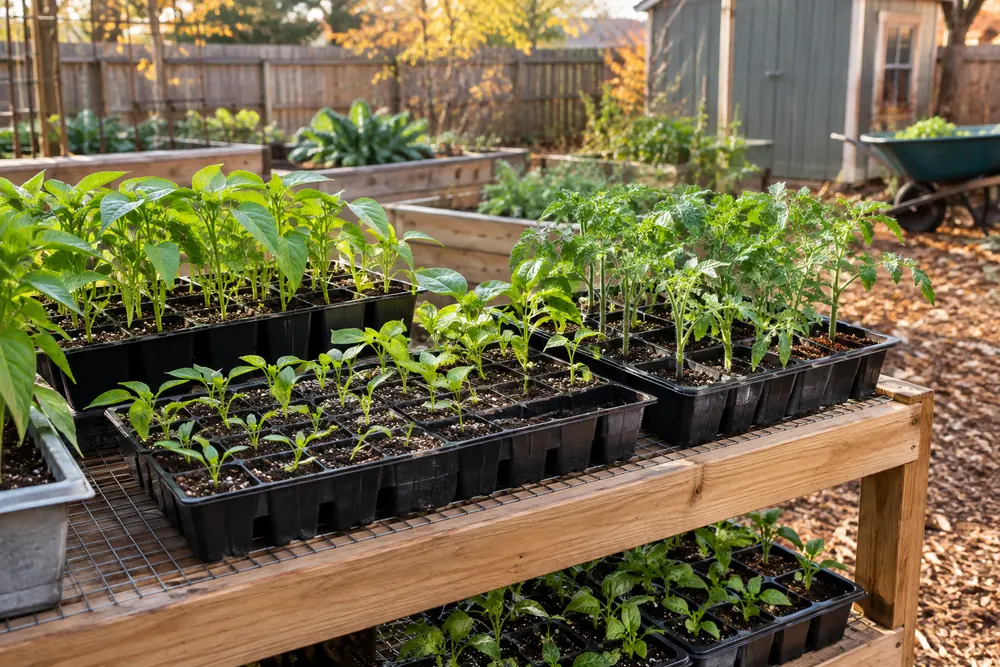
This quick-reference table turns the chart into typical sowing months. It is approximate: frost dates within a zone can vary by several weeks, so treat it as a starting point and confirm your local date with your extension office.
| Zone | Typical last frost | Onions, leeks | Peppers, eggplant | Tomatoes | Broccoli, cabbage (spring) | Cucumbers, squash, melons |
|---|---|---|---|---|---|---|
| 3-4 | Early May to early June | February | Late March to early April | Early to mid-April | Mid to late March | Early to mid-May |
| 5 | Late April to mid-May | Late January to early February | Early to mid-March | Mid to late March | Late February to early March | Mid to late April |
| 6 | Mid-April to early May | January | Late February to early March | Early to late March | Mid to late February | Early to mid-April |
| 7 | Late March to mid-April | December to early January | February | Late February to early March | Late January to early February | Late March to early April |
| 8 | Early March to early April | October to November, for transplanting in winter | Mid to late January | Early to mid-February | Early January; main crop in fall | Early to mid-March |
| 9-10 | Late January to early March, or rare | Fall (September to November) | November to December; again in summer for fall | December to January; again July to August for fall | August to October for fall and winter | January to February; again in late summer |
Zones 8-10 work differently. Summer heat, not frost, is the main limit on many crops, so fall through spring is the prime growing season for broccoli, cabbage, lettuce and onions. Onions in the South are usually short-day types sown in fall and harvested in late spring. Tomatoes often get two seasons: one started in winter for a spring crop and one started in mid-summer for fall.
Starting seeds for a fall garden
You can start a second round of seeds indoors in summer for fall broccoli, cabbage, cauliflower, kale and lettuce. Indoors is often easier than direct sowing in July and August, because the seeds avoid hot, dry soil and early pests.
The math runs from your first fall frost instead. Add the crop’s days to maturity from transplant, 2 extra weeks for slower growth as days shorten, and its weeks indoors, then count back that many weeks from your first fall frost. For a broccoli variety listed at 60 days from transplant, that is about 8-9 weeks plus 2 plus 6 indoors, or roughly 16-17 weeks before your first frost. Our fall vegetable garden guide covers what to plant and when.
The Year-Round Vegetable Garden (2027 Edition)
Plan the whole season in one place: a 225-page month-by-month guide with calendars for six US growing regions, 50 plant profiles (tomatoes included), 5 copy-ready garden plans and 7 printable pages.
Tomato lover? Add Tomato Mastery, our seed-to-harvest tomato blueprint, for just $10 at checkout.
Get the guide ($27)What happens if you start seeds too early or too late?
Too early: seedlings outgrow their containers, become root-bound, stretch under limited indoor light and may even flower before planting. Tomatoes and peppers held too long in small cells often stall for weeks after transplant. If you must hold them, pot up into 4-inch containers and keep them a little cooler.
Too late: transplants are small at planting time, and long-season crops like peppers may not reach full production before fall. A small transplant is still better than none, and fast crops like squash and cucumbers catch up easily. You can also buy nursery transplants for anything you missed.
Watch out: The frost date is an average, which means there is still a real chance of frost after it. Tender crops should go out only when the forecast is frost-free and nights hold above about 50°F. Keep frost cloth handy for the first few weeks; our guide to protecting plants from frost shows how.
Common mistakes to avoid
- Using the zone as a frost date. Hardiness zones describe winter lows. Always look up your actual frost dates.
- Counting weeks to the frost date instead of the transplant date. Tomatoes go out after the frost date, so the clock should run to that later day.
- Sowing everything at once. Peppers and squash need very different lead times. Stagger your sowing.
- Ignoring seed packet notes. Days to maturity and recommended weeks vary by variety, especially for peppers and onions.
- Skipping hardening off time in your schedule. Budget 1-2 weeks before each transplant date; see our hardening off seedlings guide.
FAQ
When should I start tomato seeds indoors?
Start tomatoes 6-8 weeks before you plan to transplant them, which is usually 1-2 weeks after your last frost. In zone 5 that means mid to late March; in zone 7, late February to early March.
Is it too late to start seeds indoors in April?
Not in zones 3-6. April is a good time for tomatoes in the North, and for cucumbers, squash and melons almost everywhere. In zones 8-10 it is late for spring tomatoes, so buy transplants or wait for the fall season.
What seeds should I start first?
Onions, leeks and celery come first, 10-12 weeks before transplant, followed by peppers, eggplant and parsley. Tomatoes and cabbage-family crops come next, and cucurbits come last.
Can I start seeds indoors in January?
Yes, onions and leeks in zones 5-7, and peppers or tomatoes in zones 8-10. In colder zones, January is too early for most vegetables.
How many weeks before the last frost should I start peppers?
Peppers need 8-10 weeks indoors and go outside 1-2 weeks after the last frost, so sow them roughly 6-9 weeks before your frost date.
Keep reading
Sources
- Starting seeds indoors – University of Minnesota Extension
- Seeding and Transplanting, New England Vegetable Management Guide – UMass Amherst and New England land-grant universities
- Bulletin #2751, Starting Seeds at Home – University of Maine Cooperative Extension
- Starting Plants Indoors From Seeds – University of Missouri Extension
- Starting Seeds Indoors – Clemson Cooperative Extension, Home & Garden Information Center
- Soil temperature conditions for vegetable seed germination – Oregon State University Extension
- Starting Vegetable Seeds Indoors: I. Planning – Utah State University Extension