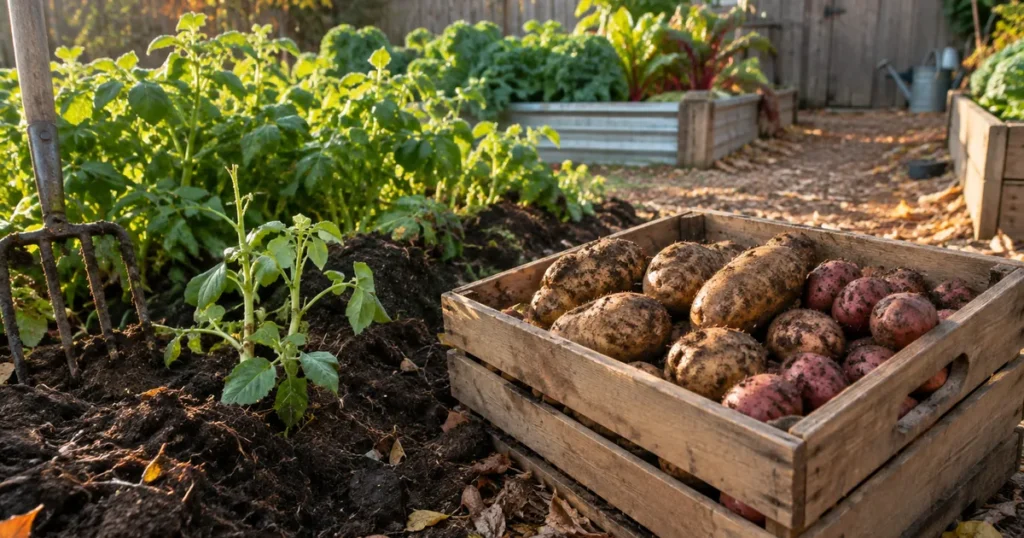
To store potatoes for months, cure them first for about 10-14 days at 50-60°F in high humidity and darkness, then keep them at roughly 40-45°F with about 90% humidity, in the dark, with some air movement. Under those conditions, late-season homegrown potatoes can last 6-8 months. Store-bought potatoes skip the curing step and keep best in a cool, dark pantry for a few weeks.
Quick answer
- Don’t wash potatoes before storing. Brush off loose soil and let them cure 10-14 days at 50-60°F, dark and humid.
- Long-term storage: about 40-45°F, around 90% humidity, total darkness, ventilated crates or bags.
- Below 38°F, starch turns to sugar; the FDA notes refrigerated potatoes can form more acrylamide when fried or roasted.
- Keep potatoes away from onions and apples: both speed sprouting and spoilage.
- Check every week or two and remove soft, rotting, or sprouting tubers.
In this guide
- Storing homegrown vs. store-bought potatoes
- How to harvest potatoes for storage
- How to cure potatoes
- Best conditions for long-term potato storage
- Root cellar and DIY alternatives
- Green potatoes and solanine: are they safe?
- What to do with sprouting potatoes
- Can you store potatoes with onions?
- How long do potatoes last by variety type?
- Check stored potatoes often
- Common mistakes to avoid
- FAQ
Want every planting date for your region in one place? Get The Year-Round Vegetable Garden (225 pages, $27).
Storing homegrown vs. store-bought potatoes
Homegrown storage potatoes and grocery-store potatoes need different handling. Garden potatoes come out of the ground with fresh skins and small nicks that need time to heal. Store-bought potatoes have usually been cured and held in commercial storage already, so they’re further along in their storage life.
- Homegrown: cure, then store cold and humid in a root cellar, basement, or similar spot. Expect months of storage from late varieties.
- Store-bought: skip curing. Keep them in a cool, dark, ventilated place like a pantry or closet, away from the stove, and use them within 2-5 weeks depending on temperature. Remove them from sealed plastic bags.
How to harvest potatoes for storage
Storage starts at harvest. For potatoes you want to keep all winter, wait until the vines die back, then leave the tubers in the ground about two more weeks so the skins thicken. Dig one and rub the skin with your thumb: if it rubs off easily, wait another week.
- Dig on a dry day when the soil is not soggy.
- Use a garden fork and start 12-18 inches from the plant to avoid spearing tubers.
- Handle them gently. Bruises and cuts let in rot organisms.
- Keep freshly dug potatoes out of the sun; even a few hours of light can start greening.
- Brush off loose soil, but don’t wash them.
- Sort as you go. Set aside cut, bruised, or small tubers to eat first.
Gear that helps
- garden digging fork: Lifts tubers with less spearing and bruising than a spade.
As an Amazon Associate we earn from qualifying purchases. Check current prices and reviews on Amazon.
How to cure potatoes
Curing heals small wounds and toughens the skin, which is what lets potatoes last for months. University of Maryland Extension recommends 10-14 days at 50-60°F with high humidity; Iowa State suggests about two weeks at 85-90% relative humidity.
Spread the potatoes in a single layer, or no more than two deep, in shallow boxes or on newspaper in a dark spot: a basement, a garage, or a closet in a cool room. Cover them loosely with burlap or newspaper to block light and hold some moisture. Avoid hot, dry spaces; potatoes cured above 70°F tend to shrivel and rot.
Garden hack: No humid spot? Cure potatoes in cardboard boxes with a damp (not wet) towel draped over the top, out of direct contact with the tubers. It raises humidity around them without making them soggy.
Best conditions for long-term potato storage
After curing, move potatoes to their winter home. The target is cool, humid, dark, and ventilated.
| Condition | Curing (10-14 days) | Long-term storage | Why it matters |
|---|---|---|---|
| Temperature | 50-60°F | About 40-45°F (never below 38°F or freezing) | Warmer = sprouting and rot; colder = sugary taste and darker frying |
| Humidity | 85-95% | About 90% | Tubers are about 80% water and shrivel in dry air |
| Light | Dark | Total darkness | Light causes greening and solanine |
| Air | Gentle ventilation | Gentle ventilation | Potatoes breathe; stale, damp air invites rot |
| Containers | Shallow boxes, single layer | Crates, bins, burlap or paper bags, perforated plastic | Air moves while moisture stays near the tubers |
| Expected life | n/a | Late varieties 6-8 months; early varieties 2-4 months | Thick skins and natural dormancy keep longer |
Oregon State University Extension notes that late-season potatoes can keep 7-8 months at proper temperatures but only 2-3 months above about 46°F. Iowa State adds that above 50°F, tubers usually begin sprouting after 2-3 months.
Why the refrigerator isn’t ideal
A standard kitchen refrigerator runs around 35-38°F, colder than potatoes like. Below about 38°F, potatoes convert starch to sugar (called cold-induced sweetening). They taste oddly sweet, and they brown or darken when fried. The FDA also states that storing potatoes in the refrigerator can increase acrylamide formation during high-heat cooking like frying and roasting, and recommends a cool, dark place like a pantry or closet instead.
If a refrigerator is your only cold storage, a spare fridge set to its warmest setting (around 40-45°F) is a workable option, as Iowa State notes. Potatoes that have turned sweet often improve after a few days at room temperature before cooking.
Gear that helps
- wooden or ventilated storage crates: Lets air circulate around stored tubers while keeping them in the dark when covered.
- burlap sacks: Breathable, dark storage that holds some humidity.
As an Amazon Associate we earn from qualifying purchases. Check current prices and reviews on Amazon.
Root cellar and DIY alternatives
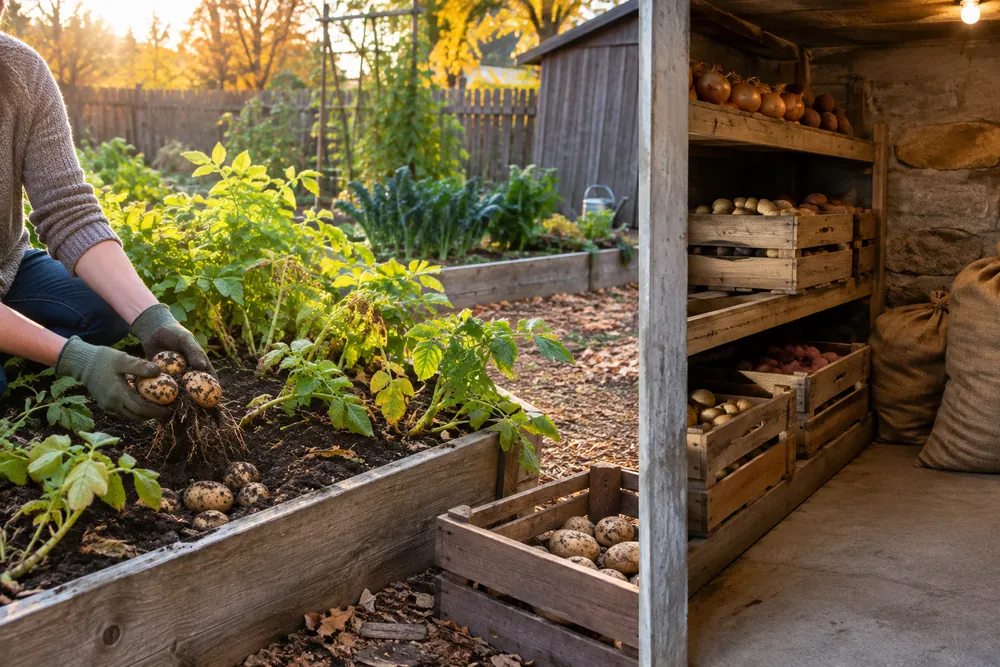
A root cellar is the classic answer to how to store potatoes, because soil keeps temperatures cool and stable and an earth or gravel floor keeps humidity high. If you don’t have one, several spots can work.
- Basement corner: the coolest corner of an unheated basement, ideally on an outside wall away from the furnace. Partition it with insulated walls and add a screened vent to the outdoors if you’re serious about it.
- Attached garage: often stays in the 35-50°F range in late fall in many zones. Keep potatoes in an insulated cooler or a box packed with straw, off the concrete, and move them indoors if temperatures will drop below freezing.
- Buried bin or trash can: bury a clean metal or plastic bin at an angle with the rim a few inches above ground, layer potatoes with clean straw, close the lid, and cover with a thick mound of straw or leaves. Best in zones 4-7.
- In-ground storage (cold zones): in zones 3-5, some gardeners leave part of the crop in the ground under a deep layer of straw or leaves until the soil threatens to freeze, then dig. This is short-term only; voles and wet soil can take a toll.
- Unheated spare room or enclosed porch: fine in late fall as long as it stays dark and above freezing.
Whatever you choose, screen vents and openings against mice, and use only clean insulation like straw, hay, or wood shavings. The University of Alaska Fairbanks Cooperative Extension notes that a full, compact storage space holds humidity better than a big, mostly empty one.
Garden hack: Put an inexpensive digital thermometer with a humidity readout in your storage spot a week before harvest. You’ll know right away whether your garage or basement corner holds 40-45°F and high humidity, or whether you need a backup plan.
Storage by zone
Where you live affects which storage spot works. In zones 3-6, a garage or basement often hits the ideal temperature naturally from October through March, but you must guard against freezing. In zones 7-8, basements and garages often run warmer, so plan to eat your potatoes by mid-winter. In zones 9-10, cool storage is hard to find without a dedicated refrigerator, and many gardeners plant potatoes in fall or late winter and use them within a few weeks of harvest. Microclimates vary, so check your local extension office for regional storage advice.
The Year-Round Vegetable Garden (2027 Edition)
Plan the whole season in one place: a 225-page month-by-month guide with calendars for six US growing regions, 50 plant profiles (tomatoes included), 5 copy-ready garden plans and 7 printable pages.
Tomato lover? Add Tomato Mastery, our seed-to-harvest tomato blueprint, for just $10 at checkout.
Get the guide ($27)Gear that helps
- digital thermometer hygrometer: Confirms a garage or basement corner holds 40-45°F and high humidity.
As an Amazon Associate we earn from qualifying purchases. Check current prices and reviews on Amazon.
Green potatoes and solanine: are they safe?
When potatoes are exposed to light, they produce chlorophyll (the green color) and, alongside it, a bitter natural toxin called solanine. Green itself isn’t the toxin, but it’s a warning sign that solanine has built up. Eating large amounts can cause stomach upset, and cooking does not destroy it.
- Small green patches: peel the potato and cut away all green flesh generously. Iowa State University Extension notes this removes most of the toxin.
- Extensive or deep greening: discard the potato.
- Bitter taste: if a cooked potato tastes bitter, don’t eat it.
Watch out: Prevent greening by storing potatoes in complete darkness, including during curing. A garage with a window or a basement with a bare bulb that stays on can turn a whole bin green in a couple of weeks.
What to do with sprouting potatoes
Sprouting means potatoes are too warm or have come out of dormancy. Sprouts contain higher levels of glycoalkaloids than the rest of the tuber.
- Firm potato with small sprouts: snap or cut the sprouts off, plus a bit of flesh around the eyes, and use the potato soon.
- Long sprouts (over about 1 inch) with shriveled, soft flesh: discard it.
- To slow sprouting: keep storage at 40-45°F, in the dark, and away from apples, onions, and other fruit that release ethylene.
Can you store potatoes with onions?
No. Onions release ethylene gas that speeds potato sprouting and spoilage, and the moisture potatoes give off makes onions rot. The two also like opposite conditions: potatoes want cool and humid, onions want cool and dry. Store them in separate rooms if you can, or at least several feet apart. Keep apples away from potatoes for the same reason.
How long do potatoes last by variety type?
Thick-skinned, late-maturing potatoes store longest, while thin-skinned early potatoes are meant for eating soon after harvest.
| Potato type | Examples | Storage life at 40-45°F |
|---|---|---|
| Late-season russets | Russet Burbank, Butte, Canela Russet | About 6-8 months |
| Late whites and yellows | Kennebec, German Butterball, Katahdin | About 5-7 months |
| Mid-season yellows and reds | Yukon Gold, Red Pontiac | About 3-5 months |
| Early and thin-skinned | Red Norland, Irish Cobbler | About 2-3 months |
| Fingerlings | Russian Banana, French Fingerling | About 3-4 months |
| New potatoes (harvested immature) | Any variety dug early | 1-2 weeks; refrigerate and use quickly |
These are typical ranges; actual storage life depends on how well the potatoes were cured and how steady your storage temperature stays.
Check stored potatoes often
Look through your potatoes every week or two. Pull out any that are soft, wet, smelly, shriveled, or sprouting heavily. A single rotting potato can spread decay to everything around it, and the smell is usually your first warning. Use bruised and small tubers first, and save the best-looking ones for late winter.
Once your harvest is stored, turn your attention to the beds: our guides to cover crops for vegetable gardens and winterizing your vegetable garden will get them ready for next spring.
Common mistakes to avoid
- Washing before storage: moisture on the skin promotes rot. Brush off soil and wash just before cooking.
- Skipping curing: uncured homegrown potatoes bruise easily and rot sooner.
- Storing in the light: even indirect light causes greening.
- Keeping them too warm: a kitchen cabinet near the stove or a heated basement leads to sprouting within weeks.
- Letting them freeze: frozen potatoes turn mushy and spoil once thawed.
- Sealing them in airtight plastic: trapped moisture and no airflow lead to rot.
- Storing with onions or apples: ethylene triggers sprouting.
- Mixing damaged and sound tubers: one cut or bruised potato can start rot in the bin.
FAQ
What is the best way to store potatoes long term?
Cure homegrown potatoes for 10-14 days at 50-60°F in a dark, humid spot, then store them at about 40-45°F with around 90% humidity, in complete darkness, in ventilated crates, burlap, or paper bags.
Should potatoes be stored in the refrigerator?
Not in a standard kitchen refrigerator. Temperatures below about 38°F turn starch to sugar, and the FDA notes refrigerated potatoes can form more acrylamide when fried or roasted. A cool, dark pantry or basement is better.
Can you store potatoes and onions together?
No. Onions give off ethylene that makes potatoes sprout and spoil, and moisture from potatoes makes onions rot. Store them separately.
How long do homegrown potatoes last?
Well-cured late-season varieties like russets can last 6-8 months at 40-45°F. Early and thin-skinned types like red potatoes usually keep 2-3 months.
Is it safe to eat potatoes that have turned green?
Cut away all green parts and peel the potato; a small green patch removed this way is generally fine. Discard potatoes that are green throughout or taste bitter, because cooking does not destroy solanine.
Do I need a root cellar to store potatoes?
No. A cool basement corner, an attached garage that stays above freezing, a buried bin, or a spare refrigerator set to its warmest setting can all hold potatoes for months.
Keep reading
Sources
- Growing Potatoes in a Home Garden – University of Maryland Extension
- Growing Potatoes in the Home Garden – Iowa State University Extension and Outreach
- Sprouting or Greening Potatoes: Keep or Toss? – Iowa State University Extension AnswerLine
- Best Practices for Harvesting and Storing Homegrown Potatoes – Oregon State University Extension
- Harvesting and Storing Home Garden Vegetables – University of Minnesota Extension
- Vegetable Storage in Root Cellars – University of Alaska Fairbanks Cooperative Extension
- Acrylamide and Diet, Food Storage, and Food Preparation – U.S. Food and Drug Administration