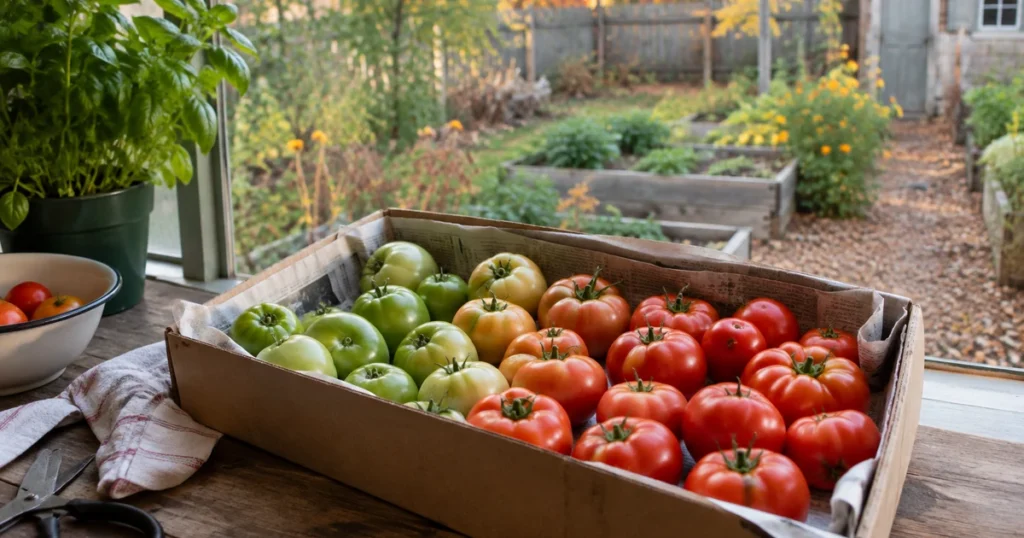
To ripen green tomatoes, pick the full-size, glossy, pale green ones before frost, bring them indoors, and keep them at about 65-70°F in a box, a paper bag, or on the counter. Most mature green tomatoes turn red in about two weeks without any sunlight at all. Small, hard, dark green fruit usually won’t ripen, so turn those into fried green tomatoes or relish instead.
Quick answer
- Harvest every mature green tomato before the first frost, or as soon as nights drop into the low 40s°F.
- Mature green = full size, glossy, with a whitish or light green blush at the blossom end. Immature fruit rarely ripens well.
- Ripen at 65-70°F: about 14 days. At 55-60°F it takes longer but the harvest lasts into late fall.
- Light is not needed. Darkness, steady warmth, and a little ethylene from a ripe banana, apple, or tomato do the work.
- Never ripen green tomatoes in the refrigerator: 40°F shuts down the ripening process.
In this guide
- When should you pick green tomatoes before frost?
- When does first frost usually arrive in your zone?
- How to ripen green tomatoes: 5 methods compared
- What temperature is best for ripening green tomatoes?
- How cold can tomatoes tolerate in the garden?
- Top your plants a few weeks before frost
- What to do with green tomatoes that won’t ripen
- Common mistakes to avoid
- FAQ
Want your best tomato season yet? Our guides cover every step, from seed to harvest. See The Year-Round Vegetable Garden + Tomato Mastery
When should you pick green tomatoes before frost?
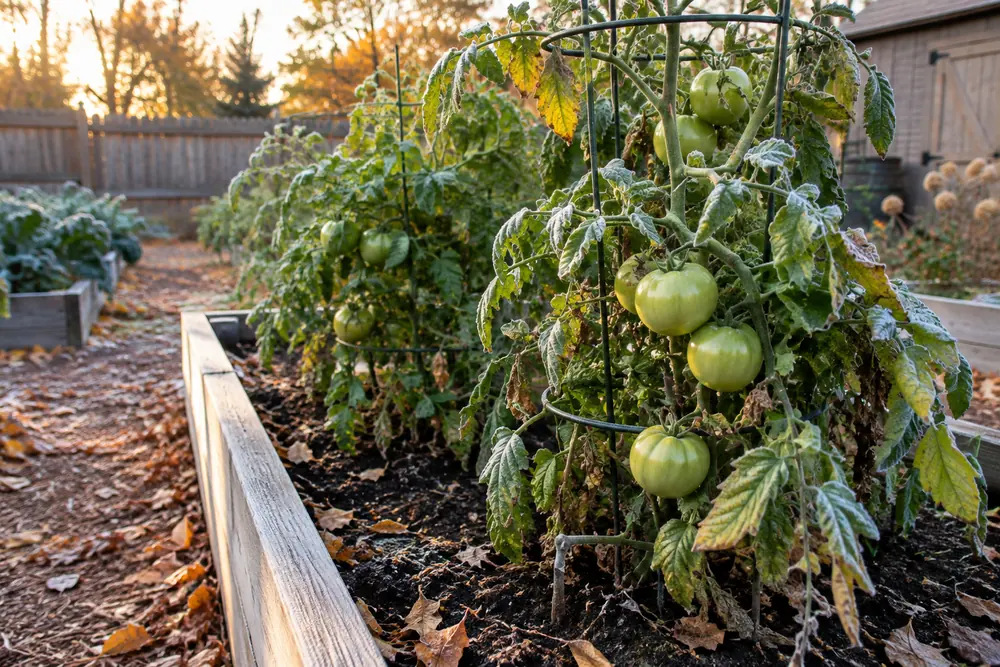
Tomatoes are warm-season plants, and they start suffering long before the first frost. Fruit held below about 50°F for extended periods can develop chilling injury: blotchy color, soft spots, poor flavor, or no ripening at all. A frost at 32°F kills the leaves and damages exposed fruit outright.
Use these triggers to decide when to bring the harvest in:
- Nights in the mid-40s°F or below for several days: ripening on the vine slows to a crawl. Start picking mature green fruit.
- Frost in the forecast (36°F or lower): pick everything worth saving that day. Frost often forms on plants when the official reading is a few degrees above freezing.
- A hard freeze (28°F or colder): anything left outside is lost. Frozen tomatoes turn mushy and won’t ripen.
If a light frost is expected and you want a few more days on the vine, cover the plants overnight with a frost blanket or old sheets. Our guide on how to protect plants from frost shows how to drape covers so they trap ground heat. That buys time, but once nights stay cold, picking is the better move.
Mature green vs. immature green tomatoes
This is the single most important step. A tomato that has reached its “mature green” stage already has developed seeds and the internal chemistry it needs to ripen off the vine. An immature tomato does not, and it will shrivel or rot before it turns red.
| Sign | Mature green (will ripen) | Immature green (unlikely to ripen) |
|---|---|---|
| Size | Full size for the variety | Noticeably smaller |
| Skin | Glossy, smooth | Dull, sometimes fuzzy |
| Color | Light green turning whitish or yellowish, especially at the blossom end | Uniform dark green |
| Inside (cut a test fruit) | Seeds fully formed, gel around them; a knife slides past seeds without cutting them | Firm white flesh, soft seeds that slice easily |
| Best use | Ripen indoors | Fried green tomatoes, relish, salsa |
Fruit already showing a hint of pink (the “breaker” stage) ripens fastest and tastes closest to vine-ripened. Sort your harvest into groups (green, breaking, pink) so you can track each batch.
Gear that helps
- frost cloth / plant cover: Buys a few extra days of vine ripening during an early light frost.
As an Amazon Associate we earn from qualifying purchases. Check current prices and reviews on Amazon.
When does first frost usually arrive in your zone?
Your USDA hardiness zone is based on the average coldest winter temperature, not on frost dates, so treat this table as a rough guide. Frost dates come from NOAA climate normals and vary a lot with elevation, valleys, and proximity to water.
| USDA zone | Typical first fall frost | Green tomato game plan |
|---|---|---|
| 3-4 | Early to late September | Top plants in August; expect to ripen a large share of the crop indoors. |
| 5 | Late September to mid-October | Top plants in late August or early September; watch forecasts closely from mid-September. |
| 6 | Early to late October | Top plants in early to mid-September; harvest mature green fruit in October. |
| 7 | Late October to mid-November | Long ripening season; pick before the first cold snap in late fall. |
| 8 | Mid-November to early December | Fall tomatoes are common; protect plants on cold nights and pick ahead of freezes. |
| 9-10 | Rare frost, or none; late December to January where it occurs | Cool winter nights slow ripening more than frost; bring fruit in when nights stay below about 50°F. |
Check your local average first frost date with your county extension office or our frost dates by zone guide, because microclimates can shift the date by two weeks or more.
How to ripen green tomatoes: 5 methods compared
Every method works on the same principle: tomatoes produce ethylene, a natural ripening gas, and they respond to it best when they’re warm (but not hot) and not crushed. Choose based on how many tomatoes you have and how much space you can spare.
| Method | Best for | Speed at 65-70°F | Pros | Cons |
|---|---|---|---|---|
| Kitchen counter | A handful of breakers or pink fruit | About 1-2 weeks | Easy to watch; no setup | Uses counter space; uneven if the room is drafty |
| Paper bag with a banana or apple | Small batches you want fast | Often several days faster than the counter | Traps ethylene; quickest method | Check daily; mold can spread in a closed bag |
| Cardboard box, 1-2 layers | Big end-of-season harvests | About 2 weeks; longer in a cool room | Holds dozens of pounds; staggers ripening for weeks | Needs sorting and regular checks |
| Hanging the whole plant upside down | Plants loaded with many small and medium fruit | Variable, 2-4 weeks | No picking; plant keeps feeding fruit for a while | Messy; needs garage or shed space; soil and leaves drop |
| Windowsill | A few tomatoes you want to see daily | Similar to the counter | Convenient | Direct sun can overheat fruit and cause sunscald; light adds nothing |
1. On the kitchen counter
Set tomatoes shoulder-side down on a plate or tray, not touching each other, away from the stove and any heat vent.
2. In a paper bag with a banana or apple
Put 3-6 mature green tomatoes in a paper bag with one ripe banana or apple, fold the top loosely, and keep it at room temperature. The fruit gives off ethylene that builds up in the bag and speeds ripening. A ripe tomato does the same job. Open the bag every day or two, pull out ripe fruit, and remove anything soft.
Garden hack: Paper, not plastic. A paper bag holds ethylene but lets moisture escape. A sealed plastic bag traps humidity and invites mold. If you only have plastic, punch several holes in it.
3. In a cardboard box, one or two layers deep
This is the go-to method for a big frost-eve harvest. Line a shallow box with newspaper, set tomatoes in one or two layers with a little space between them, and slide a sheet of newspaper between layers. You can also wrap each tomato in a single sheet of newspaper, which limits contact and slows rot from spreading. Store the box somewhere dark and steady: a spare room, basement, or closet.
Clip stems short before packing so they don’t puncture neighboring fruit. Unwrap tomatoes as they start to change color, and move those to the counter to finish.
4. Hang the whole plant upside down
When a plant is covered in fruit, pull it up by the roots, shake off loose soil, and hang it upside down from a rafter in a garage, shed, or basement that stays above freezing. Iowa State University Extension lists this as a valid option. The fruit continues to draw on the stems for a while and ripens gradually; pick each one as it colors.
Put a tarp underneath to catch falling soil and leaves.
5. On a windowsill (and why sunlight isn’t needed)
Many gardeners line up tomatoes on a sunny sill, but light plays no role in ripening once the fruit is picked. Color change comes from the fruit’s own ethylene breaking down chlorophyll and building lycopene, and that chemistry runs on temperature, not sunshine. University extension sources specifically say fruit can ripen in the dark.
In fact, a hot, sunny windowsill can work against you. Red pigment doesn’t form well above about 85°F, and direct sun through glass can cause sunscald or soften fruit unevenly. If you like the windowsill for convenience, choose a bright spot out of direct sun.
Gear that helps
- stackable produce storage trays or ventilated crates: Holds tomatoes 1-2 layers deep with airflow for the box method.
As an Amazon Associate we earn from qualifying purchases. Check current prices and reviews on Amazon.
What temperature is best for ripening green tomatoes?
Aim for 65-70°F. At 70°F, Colorado State University Extension notes mature green tomatoes ripen in about 14 days. UC Davis postharvest research identifies about 68°F as the best temperature for color, flavor, and vitamin C.
- 65-70°F: fastest ripening with good flavor. Most of the crop turns red in 2-3 weeks.
- 55-60°F: slower, roughly 3-4 weeks or more. Useful when you want ripe tomatoes spread over late fall rather than all at once. Flavor can be a little flatter.
- Above 85°F: fruit softens but colors poorly, often staying orange or yellow.
- Below 50°F for long periods (including the refrigerator): chilling injury. Ripening enzymes stop working, and fruit may never color properly.
Garden hack: Want fresh tomatoes into Thanksgiving? Split your harvest. Keep one box in a warm room for tomatoes now, and a second box in a cool basement around 55-60°F. Move a few at a time to the warm room as you need them.
Check your tomatoes regularly
Look through your boxes and bags every 2-3 days. Remove ripe fruit, and throw out anything with soft spots, mold, cracks that ooze, or a sour smell. One rotting tomato can spoil the ones touching it within a day or two.
Watch out: Only ripen sound fruit. Tomatoes that were frosted, split, bruised, or show disease spots will rot before they ripen and can spread decay to the rest of the box. Use frost-touched fruit right away for cooking, or compost it.
Gear that helps
- digital indoor thermometer hygrometer: Helps readers find a room that holds 65-70°F or a cool 55-60°F spot.
As an Amazon Associate we earn from qualifying purchases. Check current prices and reviews on Amazon.
How cold can tomatoes tolerate in the garden?
Tomatoes tolerate cool nights in the 50s°F without trouble. In the 40s°F, growth and vine ripening slow sharply, and repeated nights below 50°F start to cause chilling injury to fruit. At 32°F, unprotected leaves are killed by frost, and fruit exposed to frost develops water-soaked patches that rot quickly. A covered plant can survive a light frost of 30-32°F, but no cover saves tomatoes from a hard freeze in the 20s°F.
So what temperature is too cold for tomatoes? For ripening purposes, anything below 50°F for more than a few nights. For plant survival, 32°F. Plan your harvest around the first number, not the second.
Top your plants a few weeks before frost
Late in the season, new flowers and marble-size fruit have no chance to mature before frost, but the plant still spends energy on them. About 3-4 weeks before your average first frost date, cut off the growing tips of each main stem and pinch off any new flower clusters and very small fruit. This “topping” sends the plant’s remaining energy into the larger fruit already on the vine.
Colorado State University Extension also suggests removing some mature green fruit early so the rest ripen faster. You can start ripening those indoors right away.
In zones 8-10, where fall tomatoes are grown as a second crop, top plants a month before your average first frost or before nights settle into the 40s°F, whichever comes first.
The Year-Round Vegetable Garden + Tomato Mastery
Plan the whole season with our 225-page month-by-month guide (calendars for six US regions, 50 plant profiles, garden plans, printable pages), and add Tomato Mastery, our seed-to-harvest tomato blueprint, at checkout.
Both for $37 instead of $44: the guide is $27 and Tomato Mastery is just $10 when you add it to your order.
Get both guidesOnly growing tomatoes? Get Tomato Mastery on its own ($17)
What to do with green tomatoes that won’t ripen
Immature fruit and tomatoes that stay hard and green after 3-4 weeks indoors still have uses in the kitchen.
- Fried green tomatoes: slice thick, coat in cornmeal, and pan-fry. Firm, fully green fruit works best.
- Green tomato relish or chow-chow: a classic way to use a big batch. If you plan to can it, follow a tested recipe from the USDA or the National Center for Home Food Preservation for safe acidity and processing times.
- Green tomato salsa: a tangy, salsa verde-style alternative to tomatillos. Again, use a tested recipe if canning.
Once the plants are cleared, see our guide to winterizing your vegetable garden.
Common mistakes to avoid
- Waiting until after the frost: frosted fruit rots fast. Harvest the day frost is forecast.
- Picking immature fruit for ripening: small, dark green tomatoes won’t turn red. Use them for cooking.
- Putting green tomatoes in the fridge: 40°F stops ripening. Refrigerate only fully ripe tomatoes you can’t eat in time, and only for a few days.
- Using sealed plastic bags: trapped moisture leads to mold.
- Stacking tomatoes deep: more than two layers bruises fruit and hides rot.
- Baking them on a sunny windowsill: heat above 85°F blocks red color and can scald fruit.
- Forgetting to check: one bad tomato can spoil the box. Look every 2-3 days.
FAQ
How long does it take green tomatoes to ripen indoors?
Mature green tomatoes take about two weeks at 65-70°F. In a cooler room around 55-60°F, expect three to four weeks or more. Fruit that already shows some pink can ripen in under a week.
Do green tomatoes need sunlight to ripen?
No. Ripening after harvest is driven by ethylene and temperature, not light. Tomatoes ripen well in a dark box or bag, and direct sun on a windowsill can overheat them.
Does a banana really help ripen tomatoes?
Yes. A ripe banana or apple releases ethylene gas, which speeds ripening when it builds up in a closed paper bag or box with green tomatoes. A ripe tomato has the same effect.
Can I pick tomatoes after a frost?
After a light frost, fruit that was protected by leaves may still be usable, so pick it right away and use or ripen only firm, undamaged tomatoes. Fruit with water-soaked or mushy patches will rot and should be composted.
What temperature is too cold for tomatoes?
Repeated nights below 50°F slow ripening and can cause chilling injury to fruit, and 32°F frost kills unprotected leaves. Harvest mature green fruit once nights fall into the mid-40s°F or frost is in the forecast.
Keep reading
Sources
- Ripen Green Tomatoes – Colorado State University Extension (PlantTalk Colorado)
- Can I ripen green tomatoes indoors before frost? – Iowa State University Extension and Outreach
- Tips for Using Green Tomatoes – Iowa State University Extension AnswerLine
- Tomato: Recommendations for Maintaining Postharvest Quality – UC Davis Postharvest Center
- Harvesting and Storing Home Garden Vegetables – University of Minnesota Extension
- USDA Plant Hardiness Zone Map – USDA Agricultural Research Service
- National Center for Home Food Preservation – University of Georgia