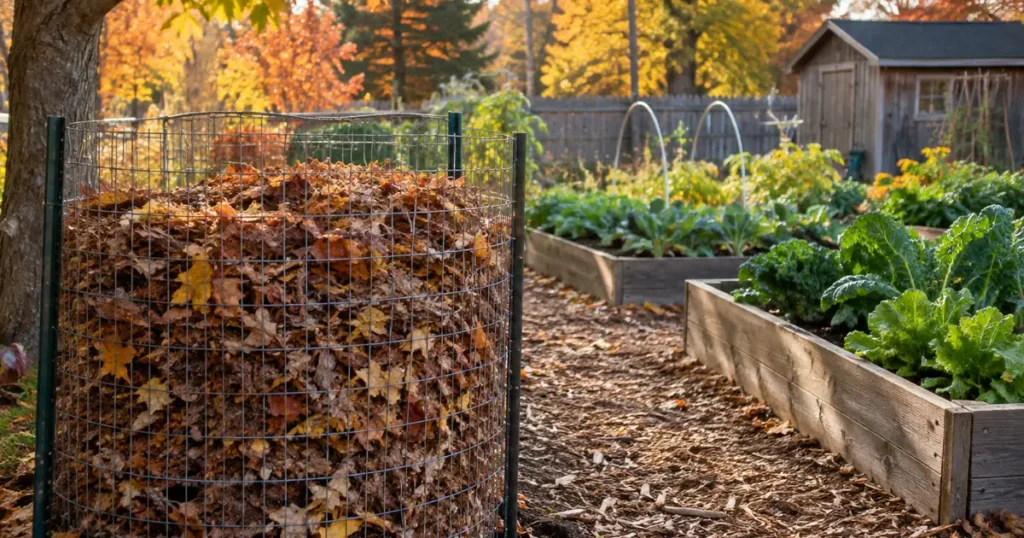
Fall leaves are the best free soil builder most yards produce. Shred them, then compost them with a nitrogen source, pile them up to rot into leaf mold, or spread them as mulch on your vegetable beds. Whole, wet leaves mat down and take years to break down; shredded leaves mixed with “greens” can become usable compost in a few months.
Quick answer
- Shred first. Run a lawn mower over the leaves; shredded leaves break down far faster and do not mat.
- For compost, mix roughly 3 parts shredded leaves to 1 part greens (grass clippings, kitchen scraps, coffee grounds) by volume and keep the pile as damp as a wrung-out sponge.
- For leaf mold, pile or bag moist leaves on their own: about 6-12 months if shredded and tended, 2 years or more if left whole.
- For mulch, spread 3-6 inches of shredded leaves on empty beds for winter and pull them back in spring.
- Use black walnut leaves sparingly and only well composted, and keep badly diseased leaves out of a cool pile.
In this guide
- Why use leaves for compost?
- How to shred leaves with a lawn mower
- How to compost leaves: the brown and green balance
- Leaf mold: what it is and how to make it
- Shredded leaves as mulch: leaf mulch for vegetable beds
- Leaves by USDA zone: when to do what
- Which leaves to avoid or use sparingly
- Mowing leaves into the lawn
- Common mistakes to avoid
- FAQ
Want every planting date for your region in one place? Get The Year-Round Vegetable Garden (225 pages, $27).
Why use leaves for compost?
Leaves are mostly carbon, the “brown” half of every compost recipe. Trees pull minerals from deep in the soil, so the leaves they drop also carry calcium, magnesium and trace nutrients back to the surface. Composted or left to rot, they add organic matter that helps sandy soil hold water and clay soil drain.
The problem is that leaves alone break down slowly. Their carbon-to-nitrogen (C:N) ratio is high: about 30:1 for maple leaves and around 60:1 for oak, compared with the 25-30:1 a fast compost pile wants. That is why the two most useful tricks with leaves are shredding them and pairing them with nitrogen-rich material. If you are new to composting, our step-by-step guide to making compost covers the basics in more depth.
How to shred leaves with a lawn mower
A leaf shredder is nice to have, but your lawn mower does the job for free.
- Rake leaves into a low windrow on the lawn or a driveway edge, no more than several inches deep.
- Set the mower deck high and walk slowly so the blades have time to chop.
- Make two passes in different directions for finer pieces.
- Use the bagger to collect the shredded leaves, or mow them into a pile and rake them up.
Slightly damp (not soaking) leaves shred more cleanly and blow around less.
Garden hack: Mow leaves with the bagger on, and you collect shredded leaves plus a little grass, already pre-mixed browns and greens. That blend heats up faster in a compost pile than leaves alone.
Gear that helps
- Electric leaf mulcher / leaf shredder: Shreds large volumes of leaves quickly if you have many trees or no bagging mower.
As an Amazon Associate we earn from qualifying purchases. Check current prices and reviews on Amazon.
How to compost leaves: the brown and green balance
To turn leaves into regular compost, you need to give the microbes enough nitrogen to work quickly. A good starting point is about 3 parts shredded leaves to 1 part greens by volume. Adjust from there: if the pile stays cold, add greens; if it smells like ammonia or turns slimy, add more leaves.
Good greens to pair with leaves:
- Fresh grass clippings (from untreated lawns)
- Fruit and vegetable scraps
- Coffee grounds and tea leaves
- Spent garden plants that are not diseased
- Manure from herbivores such as chickens, rabbits or horses
Step by step
- Build the pile at least 3 x 3 x 3 ft, the minimum size that holds heat.
- Alternate layers: about 6 inches of shredded leaves, then about 2 inches of greens, then a sprinkle of garden soil or finished compost to add microbes.
- Water each leaf layer until it feels like a wrung-out sponge. Dry leaves shed water, so wet them thoroughly.
- Turn the pile every 1-2 weeks for the first month, then every few weeks.
- Keep stockpiled leaves in bags or a separate bin so you can add browns all year, every time you add kitchen scraps.
A well-tended pile of shredded leaves and greens can turn into usable compost in roughly 3-6 months in warm weather. Left alone, it will still get there, just more slowly.
Gear that helps
- Pop-up yard waste leaf bags: Stores shredded leaves so you have browns to add to compost all year.
As an Amazon Associate we earn from qualifying purchases. Check current prices and reviews on Amazon.
Leaf mold: what it is and how to make it
Leaf mold is what you get when leaves rot on their own, without added greens. It is broken down mainly by fungi rather than the heat-loving bacteria of a hot pile, so it stays cool and takes longer. The result is a dark, crumbly, earthy material that is low in nutrients but excellent at holding moisture and improving soil structure. Gardeners use it as a mulch, as a soil amendment and as a peat substitute in homemade potting mixes.
Three easy leaf mold methods
- Wire bin. Form a 3-4 ft circle of welded wire or hardware cloth, fill it with leaves, pack them down and soak them. A bin keeps leaves from blowing away.
- Plastic bags. Stuff moist leaves into large black trash bags, poke a dozen small holes for air, tie them shut and stack them out of the way. Check moisture once or twice and add water if the leaves feel dry.
- Open pile. In a corner of the yard, simply heap leaves 3-4 ft high, wet them and leave them.
How long does leaf mold take?
Whole leaves left in a pile need about 2 years, sometimes more for oak. You can cut that to roughly 6-12 months by shredding the leaves, keeping them moist, turning the pile occasionally and covering it with a tarp to hold moisture in. Half-finished leaf mold after one season is still a fine mulch.
| Method | What you add | Time to finish | Effort | Best use |
|---|---|---|---|---|
| Leaf compost (hot pile) | Shredded leaves + greens, water, turning | About 3-6 months | Medium to high | Mixing into beds, top-dressing |
| Leaf mold, shredded | Shredded leaves + water, occasional turning | About 6-12 months | Low | Mulch, soil conditioner, potting mix |
| Leaf mold, whole leaves | Leaves + water | 2 years or more | Very low | Same as above, if you are patient |
| Shredded leaf mulch | Nothing; spread directly | Breaks down over 1-2 seasons | Very low | Winter bed cover, summer mulch |
| Mowed into lawn | Nothing | Weeks | Very low | Feeding the lawn, saving raking time |
Gear that helps
- Welded wire fencing roll, 36 inches tall: Makes a simple, cheap leaf mold bin in minutes.
As an Amazon Associate we earn from qualifying purchases. Check current prices and reviews on Amazon.
Shredded leaves as mulch: leaf mulch for vegetable beds
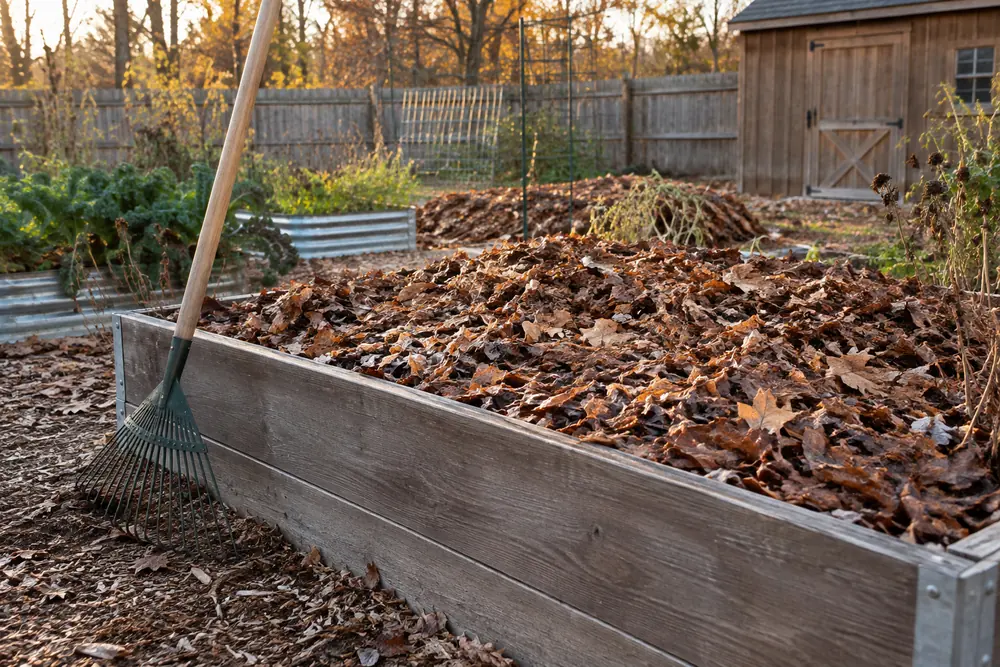
You do not have to compost leaves at all to get the benefit. Shredded leaves make one of the best mulches for a vegetable garden, and fall is the perfect time to use them.
- Winter cover for empty beds. After you pull the last crops, spread 3-6 inches of shredded leaves over the soil. They protect it from erosion and pounding rain, and worms will pull a surprising amount into the soil by spring. In spring, rake the layer aside to let the soil warm, or plant transplants right through it.
- Mulch on fall-planted crops. A few inches of shredded leaves over newly planted garlic and overwintering onions moderates soil temperature and reduces frost heaving. See our guide on how to plant garlic for timing.
- Perennial beds and around shrubs. A 2-4 inch layer is plenty.
- Summer mulch. Stockpiled leaves are ideal around tomatoes, peppers and squash once the soil has warmed, keeping moisture in and weeds down.
Shredded matters. Whole leaves, especially big maple leaves, can flatten into a wet, airless mat that sheds water and smothers soil life. If you have only whole leaves, use them in leaf mold or a compost pile instead.
Leaf mulch and a cover crop are both great ways to avoid bare winter soil; if you have time to sow, compare the options in our guide to cover crops for vegetable gardens.
Leaves by USDA zone: when to do what
Leaf drop and winter weather vary a lot across the country. Use this as a rough calendar, and check your local frost dates and extension office, because microclimates vary.
| USDA zone | Main leaf drop | What to expect |
|---|---|---|
| 3-4 | Mid-September to late October | Piles freeze solid for months. Shred and stockpile now; composting restarts in spring. Mulch garlic once the soil starts to freeze. |
| 5-6 | October to mid-November | Build leaf piles and mulch beds before the ground freezes. Large, insulated compost piles may keep working into early winter. |
| 7 | Late October to early December | Leaf piles break down slowly but steadily through winter. Good time to start a shredded-leaf compost pile. |
| 8-10 | November to January (some trees drop in spring) | Fall and winter are growing seasons. Use leaves as mulch around cool-season crops and keep piles moist during dry spells. |
Which leaves to avoid or use sparingly
Almost any deciduous tree leaf is fine for compost and mulch. A few deserve care:
- Black walnut. Walnut leaves contain juglone, a compound toxic to some plants, and tomatoes and peppers are among the most sensitive vegetables. Juglone breaks down in a well-managed compost pile, and fall leaves contain less of it than spring foliage, but never use fresh walnut leaves as mulch in the vegetable garden. Compost them thoroughly, mix them with plenty of other materials, or skip them.
- Diseased leaves. Leaves with heavy disease, such as badly spotted or blighted foliage, can carry spores. A cool leaf pile does not get hot enough to kill most pathogens; a hot pile that reaches at least 131°F helps but is hard to guarantee at the edges. If in doubt, send them to municipal yard waste collection.
- Oak and beech. Perfectly usable, just slow because of their high carbon content and tough texture. Shred them.
- Pine needles. Fine in moderation. They break down slowly, so they work better as mulch than in compost.
- Leaves from treated areas. Skip leaves raked from lawns or roadsides that were recently sprayed with herbicides.
Watch out: Whole leaves piled thickly on a lawn or around plants can smother them and hold moisture against stems, inviting rot. Keep mulch an inch or two away from plant stems and tree trunks, and always shred leaves before spreading them thickly.
Mowing leaves into the lawn
If raking every leaf sounds like too much work, mow them into the grass instead. Michigan State University research, summarized by Penn State Extension, found no harm from mulching leaves into turf; lawns showed better quality and fewer broadleaf weeds over time.
- Mow when leaves are dry or just slightly damp, ideally before they pile up too deep.
- Virginia Tech notes that up to about 6 inches of leaves can be mulched at once with a good mower.
- Make at least two passes to chop leaves into small pieces.
- The test: after mowing, you should be able to see grass through the leaf bits. If not, rake up the extra for your compost or leaf mold.
Garden hack: Ask neighbors for their bagged leaves in fall. Shredded leaves stored in bags or a covered bin become your supply of browns for next summer, when grass clippings and kitchen scraps pile up and dry carbon is hard to find.
Common mistakes to avoid
- Piling whole, dry leaves and walking away. They stay dry and barely change. Wet them and, ideally, shred them.
- Composting leaves with no nitrogen. Leaves alone make leaf mold, not fast compost. Add greens if you want compost in months.
- Matting beds with whole leaves. Shred them first, especially large leaves.
- Using fresh black walnut leaves around tomatoes and peppers. Compost them fully first or leave them out.
- Letting the pile dry out. Check moisture during dry falls and in spring.
- Forgetting to stockpile. Keep a few bags of leaves for next year’s compost.
The Year-Round Vegetable Garden (2027 Edition)
Plan the whole season in one place: a 225-page month-by-month guide with calendars for six US growing regions, 50 plant profiles (tomatoes included), 5 copy-ready garden plans and 7 printable pages.
Tomato lover? Add Tomato Mastery, our seed-to-harvest tomato blueprint, for just $10 at checkout.
Get the guide ($27)FAQ
How long does it take to compost leaves?
Shredded leaves mixed with greens and turned regularly can become usable compost in about 3-6 months. Leaves left on their own as leaf mold take about 6-12 months if shredded and kept moist, and 2 years or more if whole.
Do I need to shred leaves before composting?
It is not required, but it helps a lot. Shredded leaves break down much faster, hold moisture better and do not mat. A lawn mower with a bagger is the easiest way to shred them.
Can I put leaves directly on my vegetable garden?
Yes. Spread 3-6 inches of shredded leaves over empty beds in fall as winter mulch, then rake them aside or plant through them in spring. Avoid thick layers of whole leaves, which can mat down.
Are black walnut leaves safe to compost?
They can be composted in a well-managed pile, where the juglone breaks down, but use them sparingly and mix them with other materials. Never use fresh black walnut leaves as mulch near tomatoes, peppers or other sensitive plants.
What is the difference between leaf mold and compost?
Leaf mold is made from leaves alone, broken down slowly and mostly by fungi. It is low in nutrients but great for soil structure and moisture. Compost mixes browns and greens, breaks down faster and is richer in nutrients.
Keep reading
Sources
- Leaves Are Treasure, Not Trash – Penn State Extension
- Using Leaves in the Landscape – Colorado State University Extension
- “Leave” Them Alone: Lawn Leaf Management – Virginia Cooperative Extension
- Backyard Composting of Yard, Garden, and Food Discards – NC State Extension
- Walnut Leaves: Safe for Composting? – Oregon State University Extension
- Gardening Near Black Walnuts – Ohio State University Extension