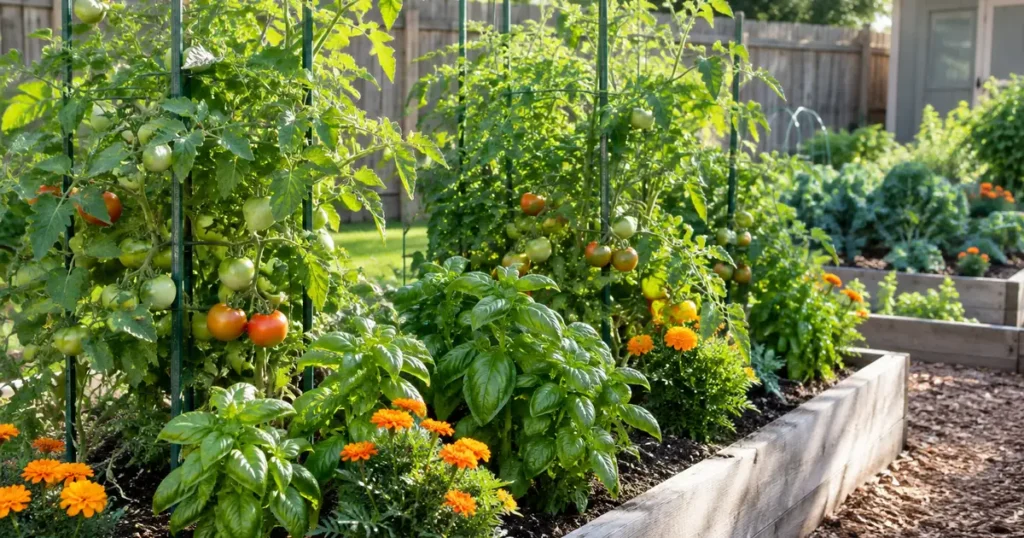
The best companion plants for tomatoes are the ones that bring in beneficial insects or fill unused space without competing: flowering herbs like basil, dill and cilantro, low crops like lettuce under the vines, and pollinator flowers nearby. What not to plant with tomatoes matters just as much: keep them away from black walnut trees, avoid planting them where potatoes, peppers or eggplant grew recently, and do not crowd them next to corn that shares a key pest. Much of the rest of the popular companion chart is folklore, so this guide separates the claims with research behind them from the ones that are only tradition.
Quick answer
- Best-supported benefit: flowering plants (dill, cilantro, basil, alyssum) that feed predators and parasitic wasps.
- Basil next to tomatoes: one field study found fewer whiteflies; the “better flavor” claim has no research behind it.
- Marigolds suppress root-knot nematodes only when grown densely as a cover crop before tomatoes, not as a border.
- Never plant near: black walnut (juglone kills tomatoes within 50-60 feet of the trunk).
- Do not follow tomatoes with potatoes, peppers or eggplant: they share diseases, so rotate.
In this guide
 Grow tomatoes in season for your region, month by month: The Year-Round Vegetable Garden ($27, PDF).
Does companion planting with tomatoes work?
Partly. Washington State University horticulturist Linda Chalker-Scott, who has written extensively on garden myths, concludes in her 2023 WSU Extension publication Gardening with Companion Plants that well-planned plant combinations can reduce pest and disease damage, but many popular pairings have little or no scientific support. A University of Arizona Extension fact sheet she reviewed goes further and says traditional companion charts have more entertainment value than scientific value.
UMass Extension makes the same point: rigorous companion planting studies are few compared with the number of charts and lists in circulation. The mechanisms with the most evidence are:
- Habitat for beneficial insects. Flowering plants provide nectar and pollen for lady beetles, lacewings, hoverflies and parasitic wasps that eat or parasitize pests.
- Plant diversity. Chalker-Scott notes that a mix of non-host plants around a crop seems to disrupt how pests find their host, more through visual cues than scent.
- Allelopathy. Some plants release compounds that harm neighbors. Black walnut is the best-documented example for tomatoes.
- Shared pests and diseases. Planting closely related crops together, or in sequence in the same bed, helps pests and pathogens build up.
Claims that a plant “repels” pests with its scent are much weaker. Chalker-Scott reports that field research has not confirmed lab results for aromatic plants, because the scent disperses quickly outdoors.
Companion plants for tomatoes: claims vs evidence
| Plant | Claimed benefit | What the evidence says |
|---|---|---|
| Basil | Repels pests, improves tomato flavor | Partly supported. A 2016 field study in Kenya found basil rows between tomatoes reduced whitefly infestation. No research found supports a flavor effect. |
| Marigolds (French, African) | Repel nematodes and insects | Supported only as a dense cover crop grown before tomatoes, with specific cultivars. UF/IFAS found interplanting does not appear effective. |
| Dill, cilantro, fennel, parsley | Attract beneficial insects | Reasonably supported. Their flat flower clusters feed lady beetles, lacewings, hoverflies and parasitic wasps. |
| Borage, sweet alyssum | Attract pollinators and predators | Plausible for beneficial insects. Tomatoes self-pollinate, so extra pollinators matter little for tomato yield. |
| Nasturtium | Trap crop for aphids | Weak. Chalker-Scott notes trap crops lose effect with distance and work better as intercropped rows than borders. |
| Lettuce, spinach | Use space under tomatoes | Practical intercropping, mentioned by UMass. A space and timing benefit, not a pest one. |
| Carrots, onions, garlic, chives | Repel pests, “carrots love tomatoes” | Anecdotal. They can share a bed if spaced well, but no strong evidence of pest control. |
| Fennel | Should never be near tomatoes (allelopathic) | Unproven. An Extension Foundation expert found too little research to call fennel allelopathic; competition for light and water is the likelier issue. |
| Black walnut | Kills tomatoes | Well supported. Tomatoes are very sensitive to juglone. |
| Potatoes, peppers, eggplant | Bad neighbors | Supported in terms of rotation: same family, shared diseases such as late blight. |
| Corn | Bad neighbor | Supported: corn earworm and tomato fruitworm are the same insect. |
Basil and tomatoes
Basil is the classic tomato companion, and it does have some research behind it, just not for the reason most people cite. A 2016 study published in the journal Agronomy (Mutisya and colleagues) tested basil rows between open-field tomato rows in Kenya. Basil alone lowered whitefly nymph infestation by roughly 15 to 18%, and basil combined with insect netting cut it by more than 60%, with higher marketable yields. The authors note it was tested at a single site and needs confirmation elsewhere.
Penn State Extension Master Gardeners also report that basil may help mask tomatoes from thrips and from hornworm moths looking to lay eggs, and that basil flowers draw pollinating bees. The widely repeated claim that basil improves the taste of nearby tomatoes, however, rests on gardening tradition. We found no controlled research supporting it.
The practical takeaway: basil and tomatoes need the same full sun, warm soil and steady water, so they are easy partners. Plant basil 12 to 18 inches from the tomato stem so the tomato does not shade it out, and let a few basil plants flower for the insects.
Gear that helps
- Genovese basil seeds: Basil shares the tomato's sun and water needs and is easy to tuck between plants.
As an Amazon Associate we earn from qualifying purchases. Check current prices and reviews on Amazon.
Marigolds and tomatoes
Marigolds are on almost every tomato companion chart, usually for nematode control. The research is more specific than the chart. UF/IFAS Extension’s publication Marigolds for Nematode Management reports that certain French and African marigold cultivars (resistant ones it lists include ‘Single Gold’, ‘Crackerjack’, ‘Toreador’ and ‘Goldie’) can suppress root-knot nematodes, but only when:
- they are grown as a dense cover crop (spacing under 7 inches) in the same spot,
- for at least about two months before the tomatoes go in,
- and the practice is repeated each season, since nematodes rebound.
UF/IFAS states that interplanting marigolds among vegetables does not appear to be effective, and that some signet marigolds can actually increase nematode populations. UMass Extension agrees that there is very little evidence for marigolds’ broader pest-repelling reputation. Chalker-Scott adds that French marigolds can reduce some pests but also reduce beneficial insects.
Root-knot nematodes are mainly a problem in warm, sandy soils, especially in the South. If you garden in zones 8 to 10 and have had knotty, swollen tomato roots, a marigold cover crop before spring tomatoes is a reasonable, research-backed step. Elsewhere, grow marigolds as cheerful flowers and do not count on them for pest control.
Herbs and flowers that attract beneficial insects
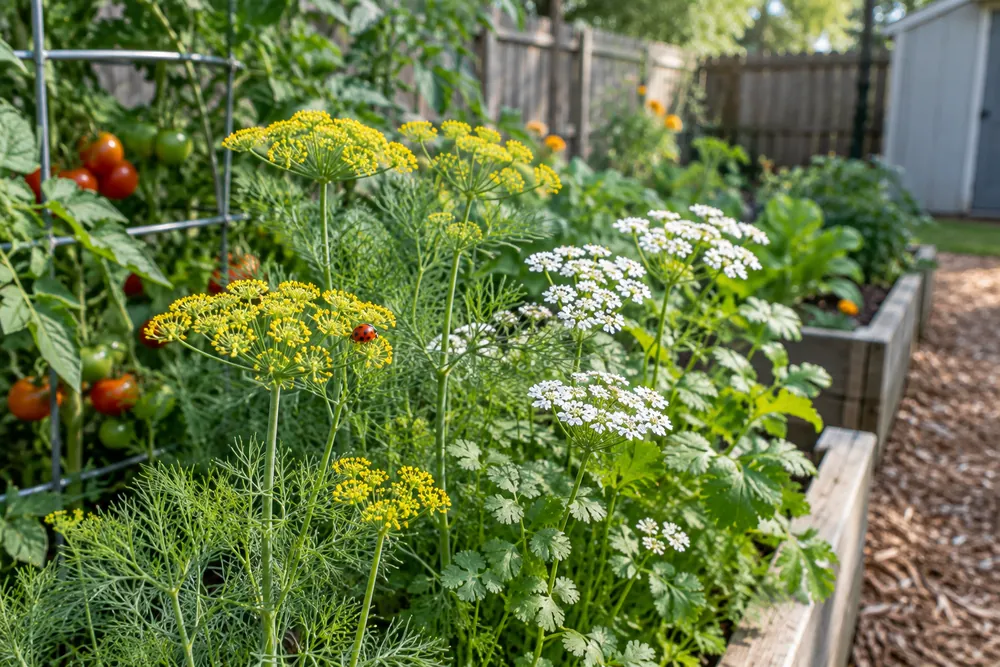
This is where companion planting has its strongest footing. UMass Extension lists basil, cilantro, dill, fennel and parsley among plants that shelter and feed predators such as lady beetles, lacewings and predatory mites. Penn State Extension adds that cilantro, dill and fennel attract lacewings, ladybugs, parasitic wasps and syrphid flies, all of which help keep aphids in check.
Penn State also lists anise, caraway and oregano among herbs that attract parasitic wasps, which target caterpillar pests. Small-flowered plants that bloom through summer help keep those wasps around your tomatoes.
Garden hack: Plant a short row of dill and cilantro at each end of your tomato bed and sow a little more every 3 to 4 weeks. Both bolt fast in heat, and successive sowings keep flowers available for beneficial insects all season.
Chalker-Scott offers one caution: more diversity is not automatically better. Some studies found lady beetles ate fewer aphids when other food was abundant. Aim for a few dependable flowering herbs rather than a crowded jumble that competes with the tomatoes.
Gear that helps
- Beneficial insect flower seed mix: Small-flowered annuals and herbs feed lady beetles, lacewings and parasitic wasps near your tomatoes.
As an Amazon Associate we earn from qualifying purchases. Check current prices and reviews on Amazon.
What not to plant with tomatoes
Black walnut trees
This is the clearest “never” on the list. University of Wisconsin Extension classifies tomatoes as very vulnerable to juglone, a compound produced by black walnut roots. The toxic zone around a mature tree can extend 50 to 60 feet from the trunk. Affected tomatoes wilt suddenly even in moist soil, and their leaves yellow, twist and pucker. Juglone can persist until the roots decay, which can take five or more years after the tree is cut down. If you have a walnut nearby, grow tomatoes in containers or raised beds with a root barrier, well outside the root zone. Hot-composted walnut leaves are considered safe.
Potatoes, peppers and eggplant (in the same bed, year after year)
Tomatoes, potatoes, peppers, eggplant and tomatillos are all in the nightshade family and share diseases. Penn State Extension notes that the late blight pathogen Phytophthora infestans infects both tomatoes and potatoes, and that infected potato tubers left in the ground are a key early-season source of the disease. University of Minnesota Extension recommends not planting tomatoes where any of these crops grew in the past three to four years. Pull volunteer potatoes and tomatoes that sprout in spring.
Growing potatoes and tomatoes in the same garden is fine; just keep them in different beds and rotate. Our guide on how to plant potatoes covers spacing and timing for that side of the garden.
Corn
The corn earworm and the tomato fruitworm are the same insect, Helicoverpa zea. Utah State University Extension notes that when corn silks turn brown, the moths move to other nearby hosts to lay eggs, and recommends keeping tomatoes, peppers and eggplant away from corn that has already silked. In a small garden, put some distance between the two.
Fennel, cabbage family and the rest
Fennel and cabbage-family crops often appear on “never plant” lists. The fennel claim rests on allelopathy that has not been demonstrated in vegetable gardens; an Extension Foundation expert found too little research to confirm it. Fennel does grow tall and thirsty, so give it its own corner. For brassicas, the main conflict is practical: cabbage and broccoli are cool-season crops, while tomatoes need summer heat, so they rarely share a bed at the same time anyway.
Watch out: Sunflowers have documented allelopathic effects according to University of Arizona Extension, and big plants also shade tomatoes. Keep sunflowers on the north side of the garden, away from tomato beds.
A simple tomato companion planting layout
- Space the tomatoes properly first. About 2 feet apart for staked or caged plants, 2 to 3 feet for sprawling vines.
- Add basil between plants or along the sunny edge, 12 to 18 inches from each stem.
- Tuck in lettuce or spinach early in spring under young tomatoes; harvest it before the canopy closes.
- Plant flowering herbs (dill, cilantro, parsley) and sweet alyssum at bed ends.
- Keep potatoes, peppers and eggplant in a different bed and rotate each year.
In raised beds this layout fits neatly in a 4-by-8-foot bed with two or three tomatoes along the north side; see raised garden beds for bed sizing. For everything else about soil, planting and pruning, go to our complete guide on how to grow tomatoes, and our vegetable garden planning guide for rotation layouts.
Common mistakes to avoid
- Crowding tomatoes with companions. Competition for light, water and nutrients outweighs any benefit, and poor airflow raises leaf disease.
- Counting on a marigold border to stop nematodes. It takes a dense cover crop grown ahead of time.
- Planting near a black walnut or in soil where one was recently removed.
- Following potatoes or peppers with tomatoes in the same bed.
- Treating companion charts as rules. Watch what happens in your own beds over several seasons.
FAQ
What is the best companion plant for tomatoes?
Basil is the best-supported choice: it shares the same growing needs, one field study linked it to fewer whiteflies, and its flowers attract bees. Dill, cilantro and sweet alyssum are also useful for attracting beneficial insects.
Does basil make tomatoes taste better?
There is no research showing that basil changes the flavor of nearby tomatoes. The claim is gardening tradition. Basil is still a good neighbor for other reasons.
Do marigolds keep pests away from tomatoes?
Not as a simple border. Specific marigold cultivars can suppress root-knot nematodes when grown densely as a cover crop for about two months before planting tomatoes. Evidence for repelling insects is weak.
What should you not plant near tomatoes?
Avoid black walnut trees, do not plant tomatoes where potatoes, peppers, eggplant or tomatillos grew in the last 3 to 4 years, and keep tomatoes away from corn that has silked, since both host the same fruitworm.
Can tomatoes and potatoes be planted together?
They can grow in the same garden, but not in the same bed in back-to-back years. Both host late blight and other shared diseases, so rotate them and remove volunteer potatoes.
Can you plant lettuce under tomatoes?
Yes. UMass Extension mentions lettuce under tomatoes as a practical intercrop. Plant it in early spring while the tomatoes are small and harvest it before the tomato canopy shades it out.
Keep reading
Sources
- Gardening with Companion Plants (EM128E), Linda Chalker-Scott – Washington State University Extension
- Companion Planting – University of Arizona Cooperative Extension
- Companion Planting in the Vegetable Garden – UMass Extension
- Marigolds (Tagetes spp.) for Nematode Management – UF/IFAS Extension
- Landscaping in Spite of Black Walnut – University of Wisconsin-Madison Extension
- Tomato-Potato Late Blight in the Home Garden – Penn State Extension
- Herbs Make Good Plant Partners and Companions – Penn State Extension
- Growing Tomatoes in Home Gardens – University of Minnesota Extension
- Corn Earworm / Tomato Fruitworm – Utah State University Extension
- Synergistic Effects of Agronet Covers and Companion Cropping on Reducing Whitefly Infestation and Improving Yield of Open Field-Grown Tomatoes – Agronomy (MDPI), 2016
- Fennel and vegetable garden question – Ask Extension (Extension Foundation)