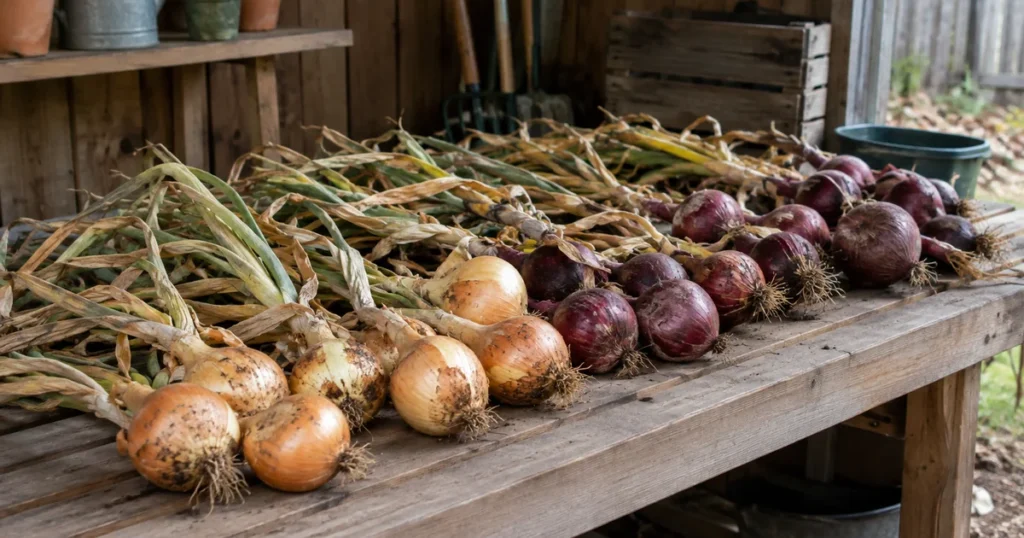
To store onions for months, cure them first: dry the bulbs in a warm, airy, shaded spot for 2-3 weeks until the necks are tight and the skins rustle. Then keep them cool (32-40°F), dry (65-70% relative humidity) and well ventilated in mesh bags, crates or braids. Pungent storage onions can last 6 months or more this way; sweet onions only a few weeks.
Quick answer
- Harvest when most tops have fallen over and started to brown.
- Cure 2-3 weeks somewhere warm, dry, shaded and airy, until necks are completely dry.
- Store at 32-40°F and 65-70% humidity, with air moving around every bulb.
- Pungent onions keep for months; sweet onions keep for weeks, so eat them first.
- Keep onions away from potatoes, and pull out any soft or sprouting bulbs.
In this guide
- When to harvest onions for storage
- How to cure onions
- Best conditions for storing onions
- How long do onions last? Pungent vs sweet
- Why you should not store onions with potatoes
- Sprouting, soft spots and mold: what to do
- Storing green onions and shallots
- Freezing and dehydrating onions
- Common mistakes to avoid
- FAQ
 Every planting date for your region in one place: The Year-Round Vegetable Garden ($27, PDF).
When to harvest onions for storage
Onions tell you when they are ready. As bulbs mature, the necks soften and the tops flop over. Iowa State University Extension advises harvesting dry onions once the tops have fallen over and started to turn brown; most varieties reach that point 90-120 days after planting.
Commercial growers often lift onions a little earlier. UMass Extension notes that harvesting while 30-40% of the foliage is still upright can improve storage life, even if bulbs give up a bit of size. For home gardeners, waiting until most tops are down works well, as long as you do not leave bulbs sitting in wet soil for weeks afterward.
Pick a dry spell. Pull or gently lift bulbs with a garden fork, shake off loose soil and handle them like eggs. Bruises and cuts are where rot starts.
Onion harvest timing by zone
Where you garden decides which onions you grow, and that sets the harvest date. Southern gardeners grow short-day onions planted in fall or winter; northern gardeners grow long-day onions planted in spring.
| Zone | Onion type usually grown | Typical harvest |
|---|---|---|
| 3-5 | Long-day, spring planted | Late July to early September |
| 6-7 | Long-day or intermediate-day | July to August |
| 8 | Short-day or intermediate-day | May to July |
| 9-10 | Short-day, fall or winter planted | April to June |
Dates shift with your planting date and variety, so check your local extension office and our vegetable planting calendar for your area.
Watch out: Onions that send up a flower stalk (bolting) develop a thick, hollow neck that never dries properly. Use those bulbs first instead of storing them.
How to cure onions
Curing dries the outer skins and seals the neck, which is the main entry point for neck rot and other storage diseases. Skip it, and even the best storage variety will rot in a few weeks.
- Leave the tops on. The leaves keep feeding the bulb as they dry and protect the neck.
- Spread them out. Lay bulbs in a single layer on a screen, slatted bench, pallet or newspaper. They should not touch in piles.
- Pick a warm, dry, airy, shaded spot. A garage, covered porch, barn or shed works. Avoid direct sun, which can scald the bulbs. A fan helps in humid regions.
- Wait 2-3 weeks. Iowa State recommends 2-3 weeks; in damp weather it can take up to 4 weeks.
- Check the neck. The onion is cured when the neck is tight and completely dry, with no green or slippery tissue, and the outer skins crackle.
- Trim. Cut tops to about 1 inch above the bulb and trim roots, or leave the tops long if you plan to braid.
Garden hack: Squeeze the neck between your thumb and finger before you trim. If it feels soft or slick, give that onion another week. A neck that is not fully dry is the first place mold shows up in storage.
Gear that helps
- Hanging mesh drying rack: Gives onions a single-layer, airy spot to cure for 2-3 weeks.
As an Amazon Associate we earn from qualifying purchases. Check current prices and reviews on Amazon.
Best conditions for storing onions
Cured onions want three things: cold, dry and air. UC Davis postharvest research and Iowa State Extension both point to the same range:
- Temperature: 32-40°F is ideal. Between about 41°F and 75°F onions break dormancy faster and start to sprout, so a warm kitchen shortens storage life.
- Humidity: 65-70% relative humidity. That is drier than a root cellar for potatoes or carrots; damp air causes mold and rooting.
- Air flow: Every bulb needs air around it. Never store onions in sealed plastic bags or bins.
- Darkness: Light encourages sprouting and greening.
If you do not have a cold room, an unheated garage that stays above freezing, a cool basement or a closet on an outside wall is the next best thing. Expect a shorter storage life above 50°F.
Mesh bags, crates and braids
Mesh produce bags, slatted crates, wire baskets and shallow cardboard boxes with holes all work. Keep layers shallow so air can reach the bottom bulbs. Some gardeners store onions in clean pantyhose with a knot between each bulb, then cut one off at a time.
Braiding works best while the tops are still a little pliable, so braid partway through curing, then hang the braids in a cool, airy spot to finish drying.
Gear that helps
- Reusable mesh produce bags: Lets air circulate around stored onions and keeps them off the floor.
- Digital thermometer hygrometer: Checks that the storage spot stays near 32-40°F and 65-70% humidity.
As an Amazon Associate we earn from qualifying purchases. Check current prices and reviews on Amazon.
How long do onions last? Pungent vs sweet
Storage life depends more on the type of onion than on anything you do. Pungent, high-sulfur onions have more dry matter and thick skins, so they store for months. Sweet onions are juicy and thin-skinned; UC Davis puts their storage life at only about 2-4 weeks, even at 32°F.
| Onion type | Examples | Storage life (32-40°F, 65-70% RH) |
|---|---|---|
| Pungent storage onions (yellow, red or white) | ‘Copra’, ‘Stuttgarter’, ‘Redwing’, ‘Big Daddy’ | 4-9 months, depending on variety |
| Sweet or mild onions | ‘Walla Walla’, ‘Candy’, ‘Texas Grano’, ‘Sierra Blanca’ | 2-4 weeks |
| Shallots, cured | French gray, ‘Ambition’ | 4-6 months or more |
| Green onions (scallions) | Bunching onions | About 1 week in the fridge |
Ranges are typical; storage life varies by variety, growing season and how well bulbs were cured.
Use the sweet onions first and save the pungent ones for winter. If you want to keep sweet onions longer, some gardeners wrap them individually in paper towels or newspaper and keep them in the refrigerator crisper.
Why you should not store onions with potatoes
Onions and potatoes like opposite conditions. Potatoes want high humidity (around 90%) and about 40-45°F, while onions want dry air. Kept side by side, the potatoes’ moisture makes onions soften and mold, and both tend to sprout sooner. UW-Madison Extension advises storing onions away from potatoes. See how to store potatoes all winter for the conditions potatoes need.
Keep onions away from apples and other ripening fruit, too, since the ethylene they release can encourage sprouting.
Sprouting, soft spots and mold: what to do
Check stored onions every week or two. One rotting bulb can spoil its neighbors.
- Sprouting: A green shoot means the onion has broken dormancy, usually because it is too warm. Sprouted onions are safe to eat; use them soon, and plant the green shoot in a pot for scallions if you like.
- Soft necks or soft spots: Usually neck rot or bacterial rot. Toss these right away; do not try to save them.
- Gray or black mold at the neck: A sign of neck rot or black mold, often from bulbs that were not fully cured. Remove affected onions.
- Roots growing from the base: Storage is too humid. Move them somewhere drier.
Storing green onions and shallots
Green onions are not cured. Iowa State suggests storing them in a plastic bag in the refrigerator, where they keep about a week; a slightly damp paper towel in the bag helps.
Shallots are harvested and cured like bulb onions, once the tops yellow and fall. After curing, separate the clusters and store them in mesh bags in the same cool, dry spot. Well-cured shallots often outlast onions. For fall planting tips, see planting onions and shallots in fall.
Freezing and dehydrating onions
For bulbs that will not last, or for extra onions you want to keep past spring, the National Center for Home Food Preservation (NCHFP) gives two easy options.
Freezing
Peel, wash and chop onions into 1/4- to 1/2-inch pieces. NCHFP notes they can be frozen without blanching. Spread pieces in a single layer on a baking sheet, freeze until hard, then transfer to freezer bags and press out the air. Frozen onions lose their crunch, so use them in cooked dishes such as soups, sauces and casseroles. Double-bag them; their odor can transfer to other foods.
Dehydrating
Slice peeled onions about 1/8 to 1/4 inch thick, or chop them. Onions do not need blanching before drying. Dry in a dehydrator until brittle, then store in airtight jars in a cool, dark place. Grind some into homemade onion powder. Follow your dehydrator’s directions and NCHFP drying guidance for temperature and time.
Garden hack: Run the dehydrator in a garage or on a porch. Drying onions gives off a strong smell for hours.
Gear that helps
- Food dehydrator: Dries surplus onions for long-term storage and homemade onion powder.
As an Amazon Associate we earn from qualifying purchases. Check current prices and reviews on Amazon.
Common mistakes to avoid
- Skipping or rushing the cure. Onions with damp necks rot within weeks.
- Curing in full sun. Sunscald damages the skins and opens the door to decay.
- Washing bulbs before storage. Brush off soil instead; moisture invites mold.
- Using plastic bags. They trap humidity and cause rot and rooting.
- Storing sweet onions like storage onions. Plan to eat sweet types within a few weeks.
- Keeping onions in a warm kitchen. Room temperature triggers sprouting.
FAQ
Should you store onions in the refrigerator?
Whole cured onions keep better in a cool, dry, airy spot than in a humid fridge. Sweet onions, green onions and cut onions are the exceptions; keep those refrigerated.
How long do homegrown onions last?
Well-cured pungent storage onions can last 6-9 months at 32-40°F. Sweet onions usually last only a few weeks.
Can you store onions in a garage?
Yes, if it stays cool, dry and above freezing. Hang mesh bags or braids off the floor where air can circulate.
Why are my stored onions sprouting?
They are too warm or too humid, or the variety is not a good keeper. Move them somewhere colder and drier, and use sprouted onions first.
Do you need to blanch onions before freezing?
No. NCHFP says chopped onions can be frozen without blanching.
Keep reading
Sources
- All About Onions – Iowa State University Extension and Outreach
- Harvesting and Curing Onions – UMass Amherst Extension Vegetable Program
- Onions (Dry): Recommendations for Maintaining Postharvest Quality – UC Davis Postharvest Center
- Vidalia Onions Are In – National Center for Home Food Preservation
- Veggie Bites: Onion – University of Wisconsin-Madison Extension