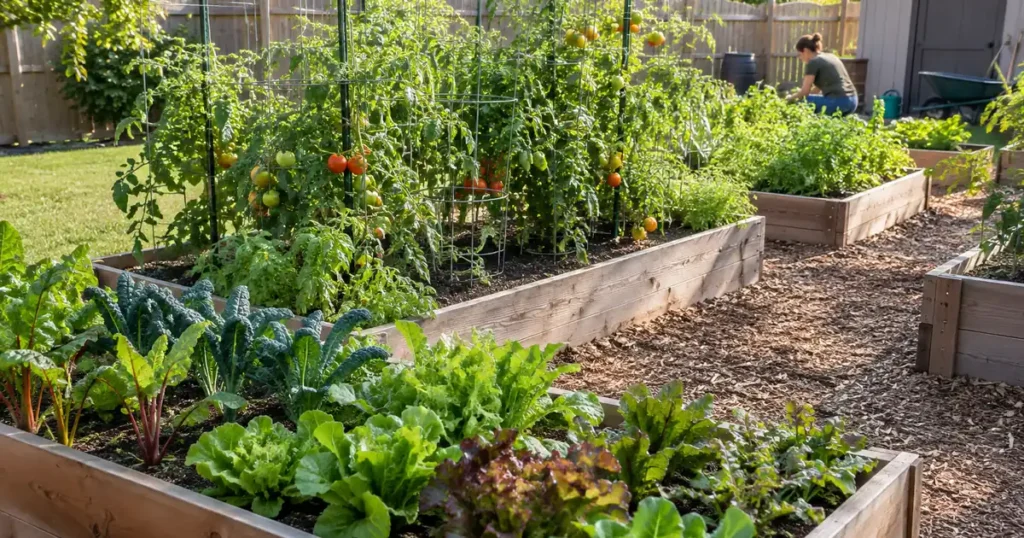
Good garden planning comes down to five decisions: where the garden goes, how big it is, how the beds are laid out, how much of each crop you plant, and when each crop goes in. Pick a spot with at least 6-8 hours of direct sun, start small (one or two 4×8-foot beds is plenty for a first year), plant only what your household will eat, and schedule everything from your local frost dates.
Quick answer
- Sun: at least 6 hours of direct sun a day, ideally 8 or more for tomatoes, peppers and squash.
- Size: beginners do best with 25-100 square feet, such as one to three 4×8-foot beds.
- Layout: beds no wider than 4 feet so you can reach the middle, with paths of at least 18 inches.
- Quantities: about 3-5 tomato plants, 3-5 pepper plants and 1-2 zucchini plants per person for fresh eating.
- Timing: build the plan in winter, then schedule every crop from your last spring frost date.
In this guide
- Step 1: Choose the right spot
- Step 2: Decide how big your garden should be
- Step 3: Lay out beds and paths
- How many plants per person?
- Three sample vegetable garden plans
- Plan for succession planting
- Plan your crop rotation
- A garden planning timeline, from winter to spring
- Keep simple garden records
- Common mistakes to avoid
- FAQ
Want every planting date for your region in one place? Get The Year-Round Vegetable Garden (225 pages, $27).
Step 1: Choose the right spot
Sunlight is the one thing you cannot add later. University of Maryland Extension calls for at least 6 hours of full sun a day, ideally more, and University of Kentucky Extension recommends 8 hours for a full vegetable garden. Fruiting crops like tomatoes, peppers, squash and melons need the most sun. Leafy greens, herbs and root crops can get by with about 6 hours, or with afternoon shade in hot climates.
Watch the spot on a sunny day in late spring or summer before you commit. Note when shade from trees, fences and the house arrives, and remember that deciduous trees leaf out after early spring.
Beyond sun, look for:
- Good drainage. Avoid low spots where water stands after rain. If drainage is poor, raised beds solve most of the problem.
- A nearby water source. If you have to drag a hose 150 feet, watering gets skipped.
- Level or gently sloping ground. Kentucky Extension favors a southern or southeastern exposure for an earlier, warmer garden.
- Distance from tree roots. Large trees compete for water and nutrients well beyond their canopy.
- Visibility. A garden you walk past every day gets weeded, picked and watered on time.
Before you build, a soil test gives you pH and nutrient levels for a modest fee through your state extension service. Our guide to garden soil explains how to read and improve the results.
Gear that helps
- Soil test kit: Testing soil is part of choosing and preparing the site.
As an Amazon Associate we earn from qualifying purchases. Check current prices and reviews on Amazon.
Step 2: Decide how big your garden should be
The most common beginner mistake is planting more than you can maintain. University of Kentucky Extension notes that new gardeners often overplant and then fall behind on the work. University of Maryland Extension suggests 25-50 square feet as a good starter size, and Iowa State Extension points to 100 square feet (10×10 feet) as manageable, with a single 4×8-foot bed as an even easier start.
A practical rule: one 4×8-foot raised bed (32 square feet) is a good first garden for one or two people. Three beds (about 100 square feet of growing space) feed a small family fresh vegetables through the season. A 200-square-foot in-ground plot is enough to add storage crops like potatoes and onions.
Step 3: Lay out beds and paths
Whether you build raised beds or plant in the ground, the same layout rules apply.
- Keep beds 3-4 feet wide. Iowa State Extension recommends no more than 4 feet so you can reach the center from both sides without stepping on the soil. Against a fence or wall, where you can reach from one side only, keep beds to about 2-3 feet.
- Make paths at least 18 inches wide. Go to 24-36 inches if you use a wheelbarrow or garden cart.
- Put tall crops on the north side. Trellised peas, pole beans, cucumbers, staked tomatoes and corn cast shade. Placed on the north edge, they keep shorter crops in full sun.
- Run beds north-south when you can. Both sides of the bed then get roughly equal sun during the day.
- Never walk on the beds. Compacted soil drains poorly and slows root growth. Permanent beds with permanent paths keep the growing soil loose year after year.
Wide-row and bed planting also produce more food per square foot. Kentucky Extension recommends beds 3-4 feet wide with permanent paths and notes that a well-planned garden can yield 600-700 pounds of produce per 1,000 square feet.
Garden hack: Before you build anything, lay out your beds with a garden hose or string and leave the outline in place for a week. Walk the paths, roll the wheelbarrow through and watch the shade. Moving a hose is free; moving a raised bed is not.
Gear that helps
- 4×8 raised garden bed kit: The 4×8 bed is the building block of every sample plan.
As an Amazon Associate we earn from qualifying purchases. Check current prices and reviews on Amazon.
How many plants per person?
The right amount depends on what your household eats and whether you plan to can, freeze or store the extra. This table combines University of Kentucky Extension figures for fresh use and for canning or storage, per person. Row lengths refer to a single row; in a raised bed, two or three short rows add up to the same length.
| Crop | Per person, fresh eating | Per person, canning or storage |
|---|---|---|
| Asparagus | 10-15 plants | 10-15 plants |
| Beans, bush snap | 15-16 ft of row | 15-20 ft of row |
| Beans, pole snap | 5-6 ft of row | 8-10 ft of row |
| Beets | 5-10 ft of row | 10-20 ft of row |
| Broccoli | 3-5 plants | 5-6 plants |
| Cabbage | 3-4 plants | 5-10 plants |
| Carrots | 5-10 ft of row | 10-15 ft of row |
| Corn, sweet | 10-15 ft of row | 30-50 ft of row |
| Cucumbers | 1-2 hills | 3-5 hills |
| Eggplant | 2-3 plants | 2-3 plants |
| Kale and collards | 5-10 ft of row | 5-10 ft of row |
| Lettuce, head | 10 ft of row | Not stored |
| Okra | 4-6 ft of row | 6-10 ft of row |
| Onions | 3-5 ft of row | 30-50 ft of row |
| Peas, garden | 15-20 ft of row | 40-60 ft of row |
| Peppers | 3-5 plants | 3-5 plants |
| Potatoes | 50-100 ft of row (for a year’s supply) | Included |
| Radishes | 3-5 ft of row | Not stored |
| Spinach | 5-10 ft of row | 10-15 ft of row |
| Squash, summer | 2-3 hills | 2-3 hills |
| Sweet potatoes | 5-10 plants | 10-20 plants |
| Swiss chard | 3-5 plants | 8-12 plants |
| Tomatoes | 3-5 plants | 5-10 plants |
Treat these as starting points. Some crops do not scale with family size: one or two zucchini plants overwhelm most households, while a family of four that loves salsa may want twice the tomatoes. Peas and bush beans are the opposite case, since a short row picks out quickly.
Three sample vegetable garden plans
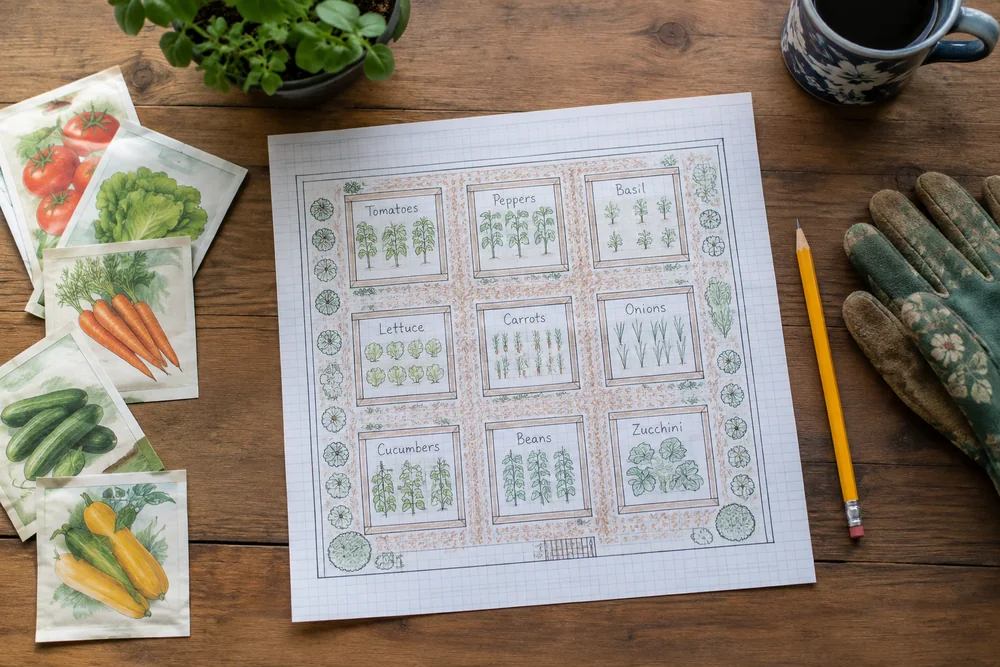
These layouts show how the pieces fit together. Adjust crops to what you eat and to your zone; the spacing logic stays the same.
Plan 1: one 4×8-foot bed (beginner, 1-2 people)
Divide the bed into four 2×4-foot sections running from north to south.
| Section (north to south) | Spring | Summer | Fall |
|---|---|---|---|
| 1 (north end) | Peas on a trellis | 2 tomatoes, staked or caged | Tomatoes until frost |
| 2 | Spinach and lettuce | 2 peppers plus a few basil plants | Garlic planted after peppers come out |
| 3 | Radishes, then carrots | Carrots | Kale transplants |
| 4 (south end) | Lettuce and green onions | Bush beans (two short rows) | Lettuce and spinach |
Plan 2: three 4×8-foot beds (small family)
Three beds make a natural three-year rotation: each year, every group moves one bed over.
| Bed | Main crops | Notes |
|---|---|---|
| A: tomato family | 4 tomatoes, 4 peppers, 2 eggplant | Underplant early lettuce before warm-season transplants go in |
| B: legumes and vines | Pole beans and cucumbers on a north-side trellis, 1-2 summer squash, bush beans | Peas on the trellis in spring, followed by cucumbers |
| C: roots, onions and greens | Carrots, beets, onions, lettuce, spinach, chard, kale | Resow lettuce and radishes every 2-3 weeks; fall greens follow spring roots |
Plan 3: a 10×20-foot in-ground garden
Run rows across the 10-foot width, starting with the tallest crops on the north end. The second column shows how much of the 20-foot length each row takes, including its share of path.
| Row (north to south) | Space used | Crop and spacing |
|---|---|---|
| 1 | 2 ft | Pole beans on a trellis, 4-6 inches apart |
| 2 | 3 ft | 4 caged tomatoes, about 30 inches apart |
| 3 | 2 ft | 6 peppers, about 18 inches apart |
| 4 | 4 ft | 2 summer squash plus 3 cucumbers on a short trellis |
| 5 | 2 ft | Bush beans, sown in two batches 3 weeks apart |
| 6 | 1.5 ft | Carrots and beets, 5 feet each |
| 7 | 1.5 ft | Onions, 4 inches apart |
| 8 | 1.5 ft | Lettuce and spinach in spring, kale and collards for fall |
| 9 (south end) | 2.5 ft | Potatoes, about 12 inches apart |
Sweet corn is left out on purpose. It is wind-pollinated and needs a block of at least four short rows to fill its ears well, which takes more room than a 200-square-foot plot can spare.
The Year-Round Vegetable Garden (2027 Edition)
Plan the whole season in one place: a 225-page month-by-month guide with calendars for six US growing regions, 50 plant profiles (tomatoes included), 5 copy-ready garden plans and 7 printable pages.
Tomato lover? Add Tomato Mastery, our seed-to-harvest tomato blueprint, for just $10 at checkout.
Get the guide ($27)Gear that helps
- Tomato cages: Every layout includes caged tomatoes on the north side.
As an Amazon Associate we earn from qualifying purchases. Check current prices and reviews on Amazon.
Plan for succession planting
Succession planting keeps a bed producing all season instead of once. There are two versions, and a good garden plan uses both.
- Staggered sowings: sow small amounts of fast crops every 1-3 weeks. Iowa State Extension suggests planting every 7-10 days to spread harvests of crops like lettuce and radishes, and Clemson suggests 2-week intervals for peas.
- Follow-on crops: when one crop finishes, plant the next one in its place. University of Maryland Extension gives the classic example of harvesting lettuce or radishes and then planting summer crops in the same spot. Bush beans produce for about three weeks before declining, so plan a second sowing or a fall crop behind them.
Add an inch of compost between crops to keep the soil fed. Our vegetable planting calendar shows when each crop can go in, spring and fall.
Plan your crop rotation
Many soilborne diseases and some insects build up when the same plant family grows in the same spot year after year. University of Kentucky Extension recommends not growing the same or closely related crops in the same place more than once every three years, and Iowa State suggests 3-4 years.
Rotate by family, not by individual crop:
- Nightshade family: tomatoes, peppers, eggplant, potatoes.
- Cabbage family (brassicas): broccoli, cabbage, cauliflower, kale, collards, Brussels sprouts, turnips, radishes.
- Squash family (cucurbits): cucumbers, squash, pumpkins, melons.
- Legumes: peas and beans.
- Onion family: onions, garlic, leeks.
- Others: carrots and parsnips, beets, chard and spinach, lettuce.
In a small garden, perfect rotation is hard. Moving each family to a different bed every year still helps, and pairing rotation with compost and resistant varieties does more than rotation alone.
Watch out: Potatoes and tomatoes belong to the same family and share diseases such as early blight. Do not “rotate” tomatoes into last year’s potato bed.
A garden planning timeline, from winter to spring
| When | What to do |
|---|---|
| Early winter | Review last year’s notes. List the crops your household ate most and least. Look up your frost dates. |
| Mid-winter | Draw the garden map, assign crop families to beds, calculate quantities, and order seeds. Our seed catalog guide can help. |
| 10-12 weeks before last frost | Start onions and leeks indoors. Get a soil test if the garden is new or untested for 3 years. |
| 8-10 weeks before | Start peppers and eggplant indoors. |
| 6-8 weeks before | Start tomatoes, broccoli and cabbage indoors. Build or repair beds. |
| 4-6 weeks before | Add compost to beds; sow peas, spinach and radishes once the soil can be worked. |
| 2-4 weeks before | Set out broccoli, cabbage and onion transplants; plant potatoes; sow lettuce, carrots and beets. |
| Last frost to 3 weeks after | Sow beans, corn and squash; transplant tomatoes, then peppers and eggplant as the soil warms. |
| Midsummer | Plan and plant the fall garden, counting back from your first fall frost. |
For seed-starting details, see when to start seeds indoors.
Keep simple garden records
Records turn one season’s lessons into next year’s plan. Iowa State Extension suggests a three-ring binder or a phone app holding soil test results, planting maps, fertilizer applications and variety notes. University of Maryland Extension recommends noting how each crop performed, which pests showed up, and how weather and watering affected the garden.
A simple system that works:
- Keep this year’s garden map with planting dates written on it.
- Log the date of first and last harvest for each crop.
- Note varieties you would grow again and ones you would drop.
- Write down pest and disease problems, with dates.
- Record frost dates as they actually happened in your yard.
Graph paper and a pencil work fine. A spreadsheet or any garden planner app does the same job; the tool matters far less than the habit.
Garden hack: Take a photo of every bed on the first of each month from the same spot. By fall you have a visual record of spacing, shade and timing that is far more honest than memory.
Gear that helps
- Garden planner journal: A dedicated notebook makes yearly records and rotation easy.
As an Amazon Associate we earn from qualifying purchases. Check current prices and reviews on Amazon.
Common mistakes to avoid
- Starting too big. A small, well-kept garden produces more than a large, weedy one.
- Planting in partial shade. Tomatoes, peppers and squash need full sun; in shade they grow leaves and few fruits.
- Making beds too wide. If you cannot reach the middle, you will step on the soil and compact it.
- Planting everything at once. You get one flood of lettuce and beans, then nothing. Stagger sowings.
- Ignoring mature plant size. A zucchini seedling looks tiny in May and covers a 3-foot circle by July. Space for the adult plant.
- Forgetting water access. Plan the hose, soaker line or drip system at the same time as the beds.
FAQ
How big should a beginner vegetable garden be?
About 25-100 square feet. One 4×8-foot raised bed is a manageable first garden for one or two people, and a 10×10-foot plot or three 4×8 beds suits a small family.
How many tomato plants per person should I grow?
About 3-5 plants per person for fresh eating and 5-10 plants per person if you plan to can or make sauce, according to University of Kentucky Extension.
How much sun does a vegetable garden need?
At least 6 hours of direct sun a day, and ideally 8 or more for fruiting crops like tomatoes, peppers, squash and melons. Leafy greens and root crops tolerate a bit less.
When should I start planning my vegetable garden?
Start in early to mid-winter. That leaves time to map the beds, order seeds before popular varieties sell out, and start onions and leeks indoors 10-12 weeks before your last frost.
How wide should raised beds be?
No more than 4 feet wide, so you can reach the center from both sides. Beds against a fence or wall should be 2-3 feet wide. Leave paths of at least 18 inches between beds.
What is the best layout for a vegetable garden?
Beds or rows running north to south, tall crops on the north side, and crops grouped by plant family so you can rotate them each year. Keep paths permanent so the growing soil never gets walked on.
Keep reading
Sources
- Planning a Vegetable Garden – University of Maryland Extension
- Planning Your Vegetable Garden – Iowa State University Extension and Outreach
- Home Vegetable Gardening in Kentucky (ID-128) – University of Kentucky Cooperative Extension
- Vegetable Planting Calendar (G6201) – University of Missouri Extension
- Early Spring Vegetables – Clemson Cooperative Extension HGIC
- Vegetable Planting Guide – Colorado State University Extension