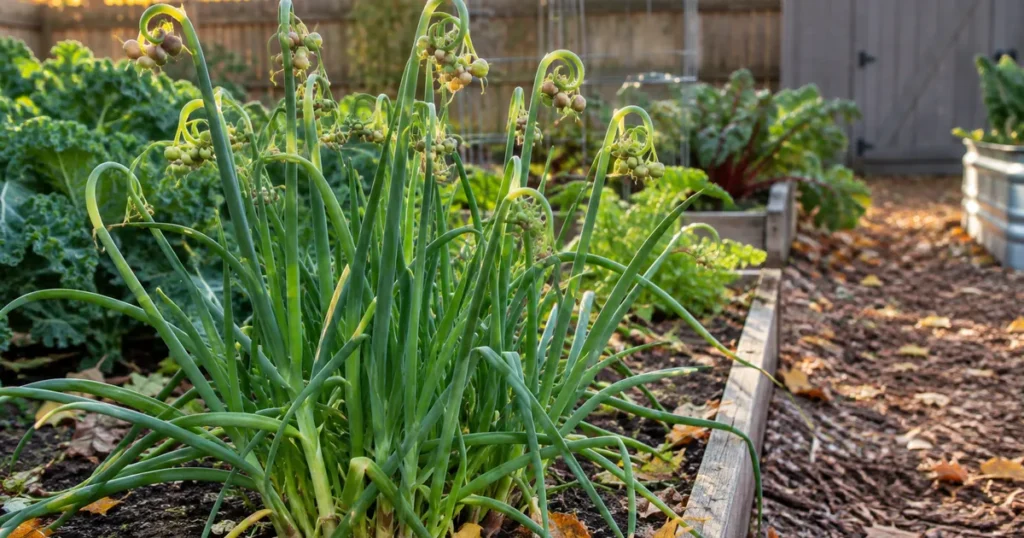
Yes, you can plant onions in fall, but which onions depends on where you live. In the South (roughly zones 8-10), fall and winter are the main season for short-day bulb onions. In the North, fall is the time to plant tough perennial onions, such as Egyptian walking onions, multiplier and potato onions, shallots and special overwintering varieties, about 4 to 6 weeks before the ground freezes.
Quick answer
- South (zones 8-10): sow short-day onion seed in fall and set transplants from fall through winter, depending on your area.
- North (zones 3-7): fall-plant Egyptian walking onions, multiplier and potato onions, shallots and hardy overwintering sets; plant regular storage onions in spring.
- Fall sets go 1-2 inches deep, 4-6 inches apart, then get a straw or shredded-leaf mulch.
- Keep fall transplants small (thinner than a pencil) to reduce bolting in spring.
In this guide
Want every planting date for your region in one place? Get The Year-Round Vegetable Garden (225 pages, $27).
Why day length decides which onions you can fall-plant
Bulb onions start forming bulbs when days reach a certain length. University of Maryland Extension breaks them into three groups:
- Short-day onions bulb at about 10 to 12 hours of daylight. They suit the South, below about 36° north latitude, roughly south of the Virginia-North Carolina and Kentucky-Tennessee state lines.
- Intermediate-day onions respond to about 12 to 15 hours and suit the middle of the country.
- Long-day onions need about 14 to 16 hours and are the classic choice north of about 36° N.
In the South, short-day onions planted in fall grow leaves through the mild winter and bulb as days lengthen in spring. In the North, a long-day onion planted in fall faces a hard winter, and the cold may trigger it to bolt (send up a flower stalk) in spring instead of making a good bulb. That is why Northern fall planting focuses on perennial and specially bred overwintering onions.
Fall onion planting by zone
| USDA zone | What to plant in fall | When | Plant in spring instead |
|---|---|---|---|
| 3-4 | Egyptian walking onions, Welsh (bunching) onions | September to early October | Bulb onions (long-day), most shallots |
| 5 | Walking onions, potato and multiplier onions, shallots (heavy mulch) | Late September to mid-October | Long-day bulb onions |
| 6 | Walking, multiplier and potato onions, shallots, hardy overwintering sets | Late September to late October | Long-day and intermediate storage onions |
| 7 | All perennial types, shallots, overwintering sets and transplants | October to early November | Intermediate-day onions for storage |
| 8 | Short-day onion seed, shallots, multipliers; transplants later in winter | Seed mid-September to November; transplants December to February | Little; spring is late for bulbs |
| 9-10 | Short-day onion sets or transplants, shallots, green onions | September to December (Florida); Texas transplants mostly mid-January to February | Not recommended for bulbs |
Clemson Extension gives September 15 to October 15 for onion seed in the South Carolina Piedmont and September 15 to November 15 on the coast, with transplants from late December through February. UF/IFAS recommends planting onions in Florida from September through December, and Texas AgriLife extension offices typically set out onion transplants starting in mid-January. Local timing varies with your microclimate, so check your frost dates or call your county extension office.
Short-day onions in the South
If you garden in zones 8-10, fall is your onion season. Choose short-day varieties: Clemson lists Candy, Granex, Yellow Granex, Texas Early Grano and Stockton Sweet Red, and Texas growers add 1015Y (Texas Super Sweet), Red Burgundy and Southern Belle. Candy is often classed as intermediate-day but performs well in much of the South.
- Depth: about 1 inch for sets or transplants (UF/IFAS and AgriLife give 3/4 to 1 inch).
- Spacing: 4 to 6 inches apart, rows about 12 inches apart.
- Transplant size: Clemson recommends transplants about 6 inches tall and about half the thickness of a pencil.
- Harvest: usually late spring, 4 to 5 months after planting, when the tops start to fall over.
Garden hack: Sort your onion transplants by thickness before planting. Set the skinny ones out as bulb onions, and plant the thick ones, which are more likely to bolt, close together to pull early as green onions.
Gear that helps
- Short-day onion transplants: Southern gardeners plant short-day transplants in fall and winter.
As an Amazon Associate we earn from qualifying purchases. Check current prices and reviews on Amazon.
Egyptian walking onions
Egyptian walking onions (Allium × proliferum), also called tree onions or top-set onions, are the easiest onion you can plant in fall. Instead of flowers, they grow clusters of small bulbils at the top of the stalks. As those clusters get heavy, the stalk bends over, the bulbils touch the soil and root, and the plant “walks” a short distance each year.
Iowa State Extension notes they are very cold-hardy and usually survive Iowa winters with no help. The green tops, the bulbs below ground and the bulbils are all edible; the mature bulbs and bulbils can be quite pungent, so many people eat the greens and young bulbils.
- Get bulbils or small sets from a gardener friend or a seed company in late summer or fall.
- Plant in fall, about 4 to 6 weeks before the ground freezes. Virginia Cooperative Extension suggests late October or early November in Virginia.
- Set them 1 to 2 inches deep and about 4 to 6 inches apart.
- Give them a permanent spot, such as a bed edge or perennial corner, since they come back every year.
- Harvest greens early in spring and again in fall, and pick or replant bulbils each summer to keep the patch under control.
Gear that helps
- Egyptian walking onion bulbs/sets: Readers need a source of top-sets to start a patch.
As an Amazon Associate we earn from qualifying purchases. Check current prices and reviews on Amazon.
How to grow shallots
Shallots (Allium cepa, aggregatum group) grow as clumps: one planted bulb divides into a cluster of several bulbs. Utah State reports that well-spaced bulbs can make clusters of 10 to 15.
- When: in mild climates, plant in fall for a late spring or early summer harvest. Utah State says fall planting after the first frost works there. In zones 3-5, Iowa State notes shallots are not reliably hardy, so either plant in early spring or fall-plant only under a thick mulch.
- Depth and spacing: 1 to 2 inches deep, with the tip at or just below the surface, about 6 to 8 inches apart (Clemson) in rows 12 to 18 inches apart.
- Soil: loose, fertile and well-drained, rich in organic matter.
- Harvest: when the tops yellow and fall over. Cure 1 to 2 weeks in a dry, airy place until the skins are papery.
- Storage: Utah State recommends cool (32 to 40°F), dry conditions in mesh bags. Save the best bulbs to replant.
Shallots are planted much like garlic; if you are already setting cloves, our how to plant garlic guide covers bed prep that works for both.
The Year-Round Vegetable Garden (2027 Edition)
Plan the whole season in one place: a 225-page month-by-month guide with calendars for six US growing regions, 50 plant profiles (tomatoes included), 5 copy-ready garden plans and 7 printable pages.
Tomato lover? Add Tomato Mastery, our seed-to-harvest tomato blueprint, for just $10 at checkout.
Get the guide ($27)Gear that helps
- Shallot bulbs for planting: Planting-grade shallot sets for fall or spring planting.
As an Amazon Associate we earn from qualifying purchases. Check current prices and reviews on Amazon.
Multiplier onions and potato onions
Multiplier onions are a family of clumping onions closely related to shallots. The potato onion is the best-known type: each planted bulb splits underground into a nest of several bulbs, much like a hill of potatoes. Large bulbs tend to make many small ones, and small bulbs make a few larger ones, so you replant some of each.
University of Maryland Extension notes that fall plantings made from late September through mid-October can give larger bulbs in spring, along with fall greens. Virginia Cooperative Extension recommends late October or early November there, 4 inches apart. Iowa State calls potato onions only marginally cold-hardy and advises heavy mulch if they overwinter in the ground, so in zones 3-4, spring planting is safer.
Overwintering onions and winter onions
“Overwintering onions” are bulb onion varieties bred to survive winter as small plants and bulb up early the next summer. Oregon State Extension names Walla Walla as one that does well in Oregon, and seed catalogs list others such as Bridger and Desert Sunrise. They suit zones 6-8 and the Pacific Northwest.
- Plant sets or small transplants in early fall so they root but stay small before winter.
- Mulch with straw or shredded leaves once the ground starts to freeze. Maryland Extension recommends shredded leaves or straw for overwintering alliums; see our guide to composting leaves and leaf mulch.
- Expect harvest in early summer, weeks before spring-planted onions. These are sweet, juicy onions to eat fresh, not long keepers.
“Winter onions” is an old name used for several hardy perennials, most often Egyptian walking onions and multiplier onions, and sometimes Welsh (bunching) onions, Allium fistulosum. Iowa State notes Welsh onions are grown for their green tops, are hardy and are among the first plants up in spring. For more crops that handle cold, see our list of winter vegetables.
Watch out: Onion transplants or sets that are thicker than a pencil when winter cold arrives are more likely to bolt in spring. A bolted onion makes a hard flower stalk and a poor bulb. Use small sets for fall planting and eat bolting plants early as green onions.
Common mistakes to avoid
- Planting long-day storage onions in fall in the North and getting bolted plants.
- Planting long-day onions in the South, where days never get long enough for them to bulb.
- Using oversized sets or transplants for fall planting.
- Skipping mulch on shallots and potato onions in zones 5-6.
- Planting walking onions in the middle of a bed you till every year.
- Planting in soggy soil, which rots bulbs over winter.
FAQ
Can you plant onion sets in the fall?
Yes, in zones 6-10, and in colder zones for perennial types. Use small sets of overwintering or short-day varieties, plant them 1 to 2 inches deep and mulch after the ground starts to freeze in cold areas.
When should I plant onions in fall?
In the North, plant perennial and overwintering onions about 4 to 6 weeks before the ground freezes, usually September to October. In the South, sow short-day seed from mid-September to November and set transplants from fall through February, depending on your area.
Are Egyptian walking onions perennial?
Yes. They come back every year, spread by their top bulbils and are very cold-hardy. One fall planting can give green onions for years.
Do shallots come back every year?
Shallots are perennial by nature, but most gardeners harvest the clumps and replant the best bulbs each season. Left in the ground, they can survive mild winters.
What is the difference between a shallot and a multiplier onion?
Both belong to the aggregatum group of Allium cepa and form clumps of bulbs. Shallots tend to be smaller and milder, with a distinctive flavor; potato and other multiplier onions are often larger and taste more like regular onions.
Keep reading
Sources
- Growing Onions in a Home Garden – University of Maryland Extension
- Onions and Day Length – University of Maryland Extension
- The Other Onions – Iowa State University Extension and Outreach
- Onion, Leek, Shallot & Garlic – Clemson Cooperative Extension HGIC
- Onions, Garlic, and Shallots – Virginia Cooperative Extension
- Shallots in the Garden – Utah State University Extension
- Onions and Shallots – UF/IFAS Gardening Solutions
- Texas Onions – Texas A&M AgriLife Extension, Williamson County
- Plant onions early for bigger summer bulbs – Oregon State University Extension