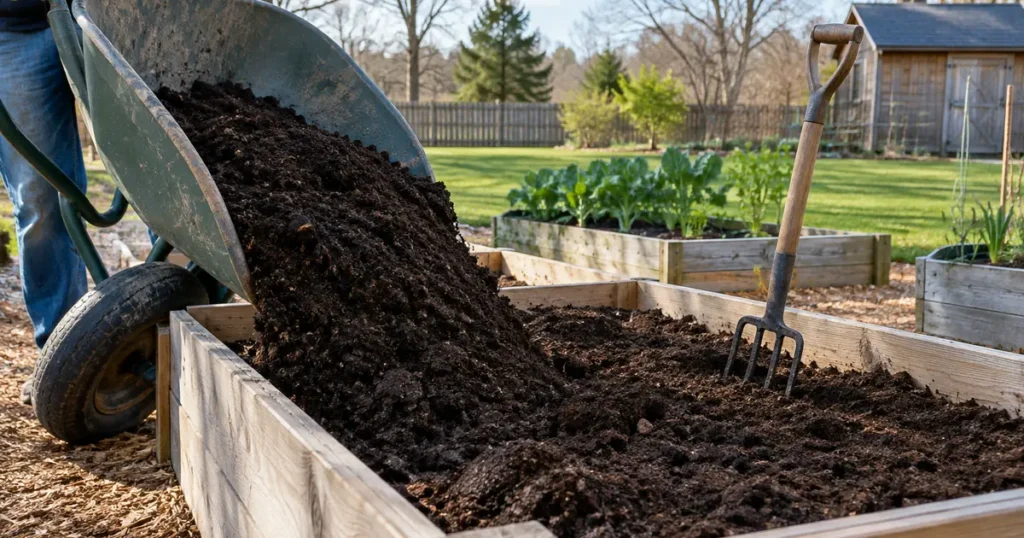
The best raised bed soil is a blend of quality topsoil and compost, mixed together, not layered. Most extension recipes fall between two parts topsoil to one part compost and roughly equal parts of each. To work out how much you need, multiply length x width x depth in feet: a 4 x 8 bed that is 1 foot deep takes 32 cubic feet, about 1.19 cubic yards.
Quick answer
- Raised bed soil mix: about 2 parts topsoil to 1 part compost is a reliable default; extension ranges run from 10-20% compost up to 50%.
- How much soil: length x width x depth (feet) = cubic feet; divide by 27 for cubic yards.
- Cheap fillers: logs and branches (hugelkultur) or lasagna layers can fill the bottom of deep beds, but expect settling and nitrogen tie-up.
- Avoid: potting mix alone, unmixed layers, soil of unknown origin, fresh manure and treated or walnut wood.
In this guide
 Every planting date for your region in one place: The Year-Round Vegetable Garden ($27, PDF).
What is the best soil for a raised bed?
Good raised bed soil does three jobs at once: it drains freely, holds enough water between waterings and feeds plants steadily. A blend of mineral topsoil and organic matter does all three. For the basics of texture and structure, see Garden Soil 101.
- Topsoil provides the mineral body of the mix: weight, structure and water-holding capacity. Minnesota Extension recommends a loam or sandy loam; if the topsoil is heavy clay, add some sand.
- Compost adds organic matter, nutrients and soil life, and improves both drainage and moisture retention. Use finished, mature compost; Iowa State warns against compost that is too salty.
- Optional extras such as composted pine bark, aged manure, perlite or vermiculite appear in UF/IFAS recipes for lightening very heavy mixes.
Why not just use bagged potting mix? Potting mixes are built for containers and dry out quickly in a bed, and filling a whole bed with them gets expensive. Minnesota Extension specifically notes that potting soil dries too fast for raised beds.
Raised bed soil mix recipes from extension services
Extension services do not agree on one formula; several mixes work. The main difference is how much compost to add.
| Source | Recommended mix | Notes |
|---|---|---|
| Penn State Extension | 2 parts topsoil : 1 part compost | A balanced, easy-to-order default |
| University of Minnesota Extension | About 1/2 to 2/3 topsoil, 1/3 to 1/2 compost | Too much compost causes water problems; avoid relying on peat or coir |
| Iowa State University | Equal parts topsoil, organic matter and coarse sand, or about 70% topsoil and 30% compost | Sand version suits heavy native soils |
| University of Maryland Extension | Compost to soil at 1:2 or 1:1 | Test existing soil, including for lead |
| Clemson Cooperative Extension | Topsoil with compost at 10-20% of total volume | The leanest recipe; too much or too little organic matter can cause problems |
A practical way to read this table: start with about two-thirds topsoil and one-third compost. If your topsoil is sandy or you garden in a hot, dry climate, you can lean toward more compost for water retention. If it is a rich loam already, stay closer to Clemson’s leaner figure.
Garden hack: Buy in bulk by the cubic yard if your bed needs more than about 1 cubic yard. Minnesota Extension points out that bulk topsoil is much cheaper than the same volume in bags, and a delivery saves dozens of trips to the store.
How much soil do I need for a raised bed?
Use inside dimensions and actual depth in feet:
Length (ft) x width (ft) x depth (ft) = cubic feet. Divide cubic feet by 27 to get cubic yards.
Example: 4 ft x 8 ft x 1 ft = 32 cubic feet. 32 / 27 = 1.19 cubic yards. For depth in inches, divide by 12 first: an 18-inch bed is 1.5 feet deep.
| Bed size (L x W) | Soil depth | Cubic feet | Cubic yards | 2-cu-ft bags |
|---|---|---|---|---|
| 4 x 4 ft | 6 in | 8 | 0.30 | 4 |
| 4 x 4 ft | 12 in | 16 | 0.59 | 8 |
| 2 x 8 ft | 12 in | 16 | 0.59 | 8 |
| 3 x 6 ft | 12 in | 18 | 0.67 | 9 |
| 4 x 8 ft | 11¼ in (one 2×12) | 30 | 1.11 | 15 |
| 4 x 8 ft | 12 in | 32 | 1.19 | 16 |
| 4 x 8 ft | 18 in | 48 | 1.78 | 24 |
| 4 x 8 ft | 24 in | 64 | 2.37 | 32 |
| 4 x 12 ft | 12 in | 48 | 1.78 | 24 |
| 4 x 12 ft | 18 in | 72 | 2.67 | 36 |
These figures use the outside size for simplicity. Wall thickness reduces the real volume a little: a 4 x 8 bed built from 1½-inch lumber has an inside area of about 45 x 93 inches, which holds roughly 27 cubic feet at 11¼ inches deep.
Plan for settling, too. UF/IFAS notes that bed soil settles about 2 inches, so fill to the very top. On a 4 x 8 bed, 2 inches of settling equals about 5⅓ cubic feet, roughly three more 2-cubic-foot bags.
Gear that helps
- Garden cart or wheelbarrow: Moves a cubic yard of soil and compost from the driveway to the bed in far fewer trips.
As an Amazon Associate we earn from qualifying purchases. Check current prices and reviews on Amazon.
How to fill a raised garden bed, step by step
- Test first. Test the native soil under the bed and, ideally, a sample of the topsoil you plan to buy. University of Maryland Extension recommends asking for a lead test when you plan to grow food. Our guide on how to test soil pH explains the process.
- Remove sod and loosen the ground. Strip grass, then loosen the soil underneath with a spade or fork so roots can keep growing down. Leave the surface rough rather than smooth.
- Blend the bottom. Spread a few inches of your mix and work it into the loosened native soil. This avoids a sharp boundary that water and roots struggle to cross.
- Mix, then add. Combine topsoil and compost on a tarp or in a wheelbarrow, or have the supplier deliver a blend. Add it a few inches at a time, mixing as you go rather than dumping in separate layers.
- Fill to the top. Bring the soil level up to the rim of the frame to allow for settling. Grade the surface so it is level or very slightly crowned.
- Water deeply and wait. Soak the bed, let it settle for a few days if you can, then top off any low spots before planting.
Watch out: Iowa State and Missouri extension both warn that distinct layers of different soils can impede water movement and root growth. Whatever cheap filler you use at the bottom, the top root zone should be a single, well-mixed blend.
Haven’t built the frame yet? See how to build a raised garden bed for a 4 x 8 cut list, and our raised garden beds guide for sizing and placement.
Gear that helps
- Soil test kit: A quick check on pH and nutrients before you plant; a lab test is more complete.
As an Amazon Associate we earn from qualifying purchases. Check current prices and reviews on Amazon.
Cheap fillers: hugelkultur and the lasagna method
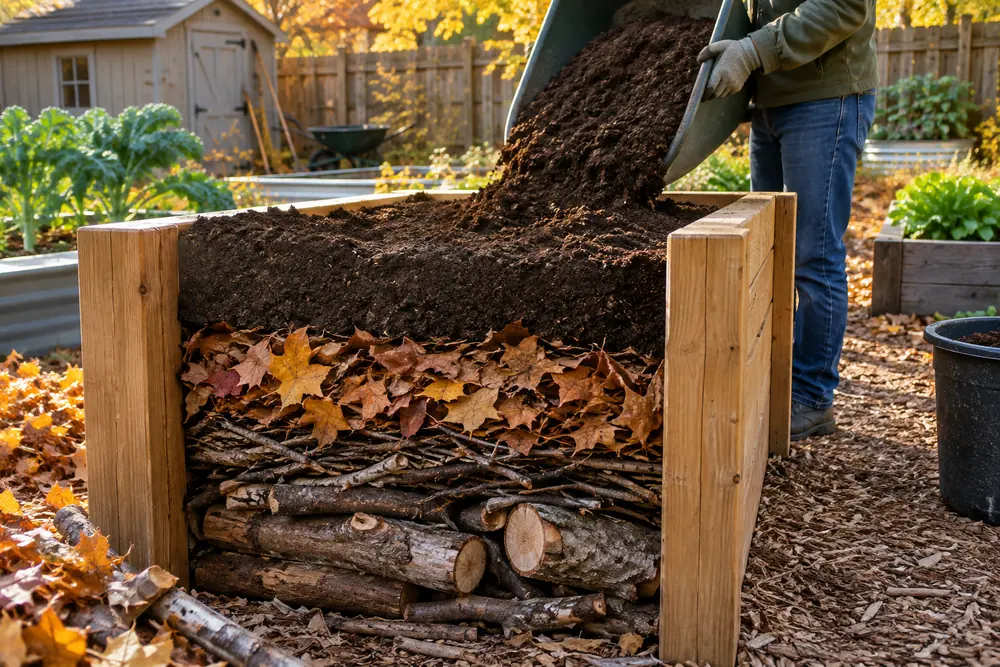
A tall bed can swallow 2 cubic yards of soil or more. To cut costs, gardeners often fill the lower part with organic material that breaks down over time. Minnesota Extension notes that in beds taller than 2 feet, layering sticks, leaves, compost and soil can reduce the cost of filling, as long as you add soil as the layers sink.
What is hugelkultur?
Hugelkultur (from the German for “hill culture”) is a raised planting bed built over a core of rotting wood. Oklahoma State University Extension describes it as a mound of logs, branches, other organic matter and topsoil that slowly composts in place and holds moisture as the wood decays.
To use the idea inside a raised bed:
- Lay the largest logs on the bottom, then branches, then smaller twigs.
- Fill gaps with leaves, grass clippings or other green material, watering and tamping each layer.
- Top with at least 6 to 12 inches of your topsoil-compost blend for the root zone. In beds about 17 inches or taller, Oklahoma State suggests roughly the lower half woody material and the upper half planting soil.
Choose hardwoods such as oak, maple, alder, aspen, birch or poplar. Skip black walnut (it can inhibit plant growth), cedar (it resists decay), and any treated or painted wood.
Hugelkultur caveats
- Nitrogen tie-up. Decomposing wood is high in carbon, and soil microbes borrow nitrogen to break it down. Plants may look pale the first season or two. Oklahoma State suggests growing legumes such as peas early on or adding supplemental nitrogen.
- Settling. As wood and leaves rot, the bed sinks. Plan to add compost or topsoil every year.
- Watering at first. The water-holding benefit builds as the wood decays; new plantings still need regular watering.
The lasagna (layering) method
Lasagna composting, also called sheet mulching, builds soil right in the bed. Oregon State University Extension describes this approach:
- Lay plain brown cardboard (tape and staples removed), soaked and overlapped by at least 8 inches, to smother grass and weeds.
- Alternate nitrogen-rich “greens” (grass clippings, kitchen scraps, coffee grounds, manure) with carbon-rich “browns” (leaves, straw, shredded paper), each about 1 to 6 inches thick, starting with a green layer.
- Sprinkle a little garden soil between layers, water each layer, and finish with browns. Build to 18 inches or more.
Lasagna beds compost slowly. Oregon State suggests allowing about six months or more, which makes fall the ideal start for spring planting. If you want to plant right away, add 2 to 3 inches of compost or soil on top and plant into that. Shredded fall leaves make an excellent brown layer; see composting leaves for ideas.
When to start each method by zone
| USDA zone | Topsoil-compost fill | Lasagna or hugelkultur fill |
|---|---|---|
| 3-5 | Fall before freeze-up, or spring as soon as the ground thaws | Late summer to early fall for spring planting |
| 6-7 | Fall through early spring | Fall for spring planting |
| 8 | Late summer for fall crops, or late winter | Spring for fall planting, or fall for spring |
| 9-10 | Late summer before the main fall/winter season | Spring for fall planting; layers break down faster in heat |
Rainfall, temperature and materials change how fast layers break down, so check with your local extension office.
Gear that helps
- Compost bin: Turns kitchen scraps and leaves into the compost you will top off with every year.
As an Amazon Associate we earn from qualifying purchases. Check current prices and reviews on Amazon.
What not to put in a raised bed
- Potting mix as the only fill. It dries out too fast at bed scale.
- Soil of unknown origin. Free fill dirt may carry lead, pesticides, weed seeds or disease. Iowa State and Minnesota both stress using topsoil free of contaminants and pathogens.
- Fresh manure or too much manure. Use only aged or composted manure, and sparingly: Minnesota Extension notes manure is high in phosphorus and should follow a soil test.
- Too much compost. An all-compost bed can hold too much water, build up salts and phosphorus, and shrink dramatically as it decomposes.
- Fresh wood chips or sawdust mixed into the root zone. Like hugelkultur wood, they tie up nitrogen. Use them as mulch on top or in paths instead.
- Black walnut, treated lumber scraps, painted wood or glossy cardboard. These can add growth inhibitors or contaminants.
- Plastic sheeting under the bed. It blocks drainage. Use galvanized hardware cloth if you need a rodent barrier.
Garden hack: Top off every spring with 1 to 2 inches of compost rather than replacing the soil. Alabama Extension recommends replacing about that much each year as the organic matter breaks down. Our guide on how to make compost shows how to produce your own.
Common mistakes to avoid
- Calculating soil with nominal board sizes. A “12-inch” board is really 11¼ inches, and wall thickness shrinks the inside area.
- Not ordering enough. Settling of about 2 inches is normal, so buy a little extra.
- Dumping materials in separate layers. Blend topsoil and compost in the root zone.
- Skipping the soil test. Without one, you are guessing on pH, lime and fertilizer.
FAQ
What is the best soil mix for a raised bed?
A blend of about two parts quality topsoil to one part finished compost is a reliable default. Extension recipes range from 10-20% compost up to about half compost, depending on your topsoil.
How many bags of soil do I need for a 4 x 8 raised bed?
A 4 x 8 bed 12 inches deep holds 32 cubic feet, or sixteen 2-cubic-foot bags. At 11¼ inches deep (one 2×12 board), plan on about 15 bags, plus a few extra for settling.
Can I fill a raised bed with just compost?
It is not recommended. Pure compost can hold too much water, build up salts and phosphorus, and shrinks as it breaks down. Mix it with topsoil.
What can I put in the bottom of a raised bed to fill space?
In deep beds, logs, branches and leaves (hugelkultur style) or lasagna layers can fill the lower part. Keep at least 6 to 12 inches of mixed topsoil and compost on top for roots.
Can I use garden soil in a raised bed?
Yes, if it is good loam free of contaminants and weeds. Blend it with compost to lighten it. Heavy clay benefits from added sand and organic matter.
Sources
- Raised bed gardens – University of Minnesota Extension
- What would be a good soil mix for a raised bed? – Iowa State University Extension
- Raised Beds (HGIC 1257) – Clemson Cooperative Extension
- How to Build a Raised Bed – Penn State Extension
- How to build a raised bed vegetable garden – University of Maryland Extension
- Gardening in Raised Beds (ENH1211) – UF/IFAS Extension
- Creating a Hügelkultur for Gardening – Oklahoma State University Extension
- Sheet mulching and lasagna composting with cardboard – Oregon State University Extension
- Raised Bed Gardening (ANR-1345) – Alabama Cooperative Extension System
- Raised-Bed Gardening (G6985) – University of Missouri Extension