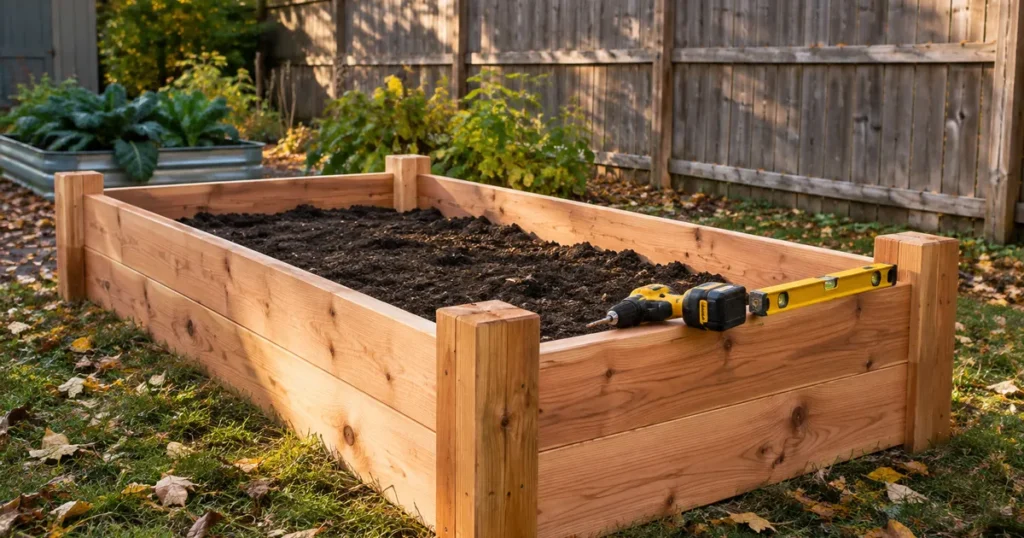
To build a raised garden bed, you cut four boards, screw them to corner posts to make a box, level it on cleared ground and fill it with a topsoil-compost mix. A classic 4 x 8 foot bed made from 2×12 lumber takes three boards, one 4×4 post and a box of exterior screws, and most people finish it in an afternoon. Below: the cut list, tools, steps, fixes for slopes and gophers, and DIY raised garden bed ideas.
Quick answer
- Materials for a 4 x 8 bed: three 2×12 boards 8 feet long, one 4×4 post 8 feet long, about 40 exterior-rated 3-inch screws.
- Real height: a 2×12 actually measures 1½ x 11¼ inches, so one board gives an 11¼-inch-tall bed.
- Key steps: clear and loosen the ground, cut, assemble around corner posts, level, add hardware cloth if gophers are around, then fill.
- Cheap options: untreated pine, concrete block or a frameless mounded bed.
In this guide
- Before you build: size, site and lumber
- Tools and materials for a 4 x 8 raised bed
- How to build a raised garden bed, step by step
- How to build a raised bed on a slope
- Raised bed lining: hardware cloth for gophers and voles
- Cheap raised garden bed ideas
- Raised garden bed ideas beyond the wooden box
- Common mistakes to avoid
- FAQ
 Every planting date for your region in one place: The Year-Round Vegetable Garden ($27, PDF).
Before you build: size, site and lumber
Settle three decisions before you buy anything (our complete raised garden beds guide covers sizes, depth and materials in depth).
- Width: 4 feet maximum so you can reach the middle from both sides, 3 feet if one side sits against a fence.
- Site: at least 6 hours of direct sun, close to a hose, on ground that is level or can be made level.
- Wood: cedar or redwood for a chemical-free bed, untreated pine or fir for the lowest cost (it rots fastest), or modern pressure-treated lumber rated for ground contact. Skip railroad ties and any treated lumber made before 2004.
Nominal vs actual lumber sizes
Lumber is sold by its nominal size, which is larger than the board you bring home. Penn State Extension reminds builders to account for this before cutting. These are the standard dressed sizes for softwood lumber:
| Nominal size | Actual size | Use in a raised bed |
|---|---|---|
| 2×6 | 1½ x 5½ in | Two stacked = 11-inch-tall wall |
| 2×8 | 1½ x 7¼ in | Low beds over good soil |
| 2×10 | 1½ x 9¼ in | Medium beds |
| 2×12 | 1½ x 11¼ in | One-board, 11¼-inch-tall wall |
| 2×4 | 1½ x 3½ in | Mid-side stakes and braces |
| 4×4 | 3½ x 3½ in | Corner posts |
Tools and materials for a 4 x 8 raised bed
Cut list (4 x 8 feet outside, 11¼ inches tall)
| Part | Lumber | Cut length | Qty |
|---|---|---|---|
| Long sides | 2×12 x 8 ft | 96 in (no cut) | 2 |
| End pieces | 2×12 x 8 ft (one board) | 45 in | 2 |
| Corner posts | 4×4 x 8 ft (one post) | 11¼ in | 4 |
| Mid-side stakes (optional) | Leftover 4×4, or a 2×4 | about 22 in | 2 |
| Screws | 3-in exterior-rated (coated deck or stainless) | n/a | about 40 |
The end pieces are 45 inches, not 48, because they fit between the two long sides. Two 1½-inch side boards plus a 45-inch end makes exactly 48 inches outside. The finished bed holds roughly 27 cubic feet of soil, about 1 cubic yard. If you prefer stacked boards, swap each 2×12 for two 2x6s cut to the same lengths for an 11-inch wall.
Tools
- Tape measure, pencil and a speed square (L-square)
- Circular saw, miter saw or hand saw (many home centers will make straight cuts for you)
- Drill/driver with a pilot-hole bit and a driver bit to match your screws
- 2- to 4-foot level and a flat shovel or spade
- Rubber mallet or small sledge for stakes
- Work gloves, safety glasses and hearing protection; add a dust mask when cutting treated wood
- Tin snips and a staple gun if you are adding hardware cloth
Garden hack: Use stainless steel or coated exterior screws rated for treated lumber. UF/IFAS specifies stainless screws for its pressure-treated bed design, and copper-based preservatives are known to be hard on plain steel fasteners.
Gear that helps
- Exterior deck screws for treated lumber: Coated or stainless screws hold up to soil moisture and copper-treated wood.
- Raised bed corner brackets: An alternative to corner posts that makes assembly fast and square.
As an Amazon Associate we earn from qualifying purchases. Check current prices and reviews on Amazon.
How to build a raised garden bed, step by step
- Mark the spot. Lay out the 4 x 8 footprint with stakes and string, running the long sides north to south if you can. Check that it gets at least 6 hours of sun.
- Clear and loosen the ground. Strip sod and weeds, then loosen the soil underneath with a spade or fork 6 to 8 inches deep so roots can grow past the frame. Do this when the soil is dry enough to crumble, not when it is wet and sticky.
- Cut the parts. Cut one 2×12 into two 45-inch end pieces and the 4×4 into four 11¼-inch posts. Measure twice, mark with the square and keep cuts square so corners close tight. If you use treated wood, brush a cut-end preservative on fresh cuts, as Oregon State Extension recommends.
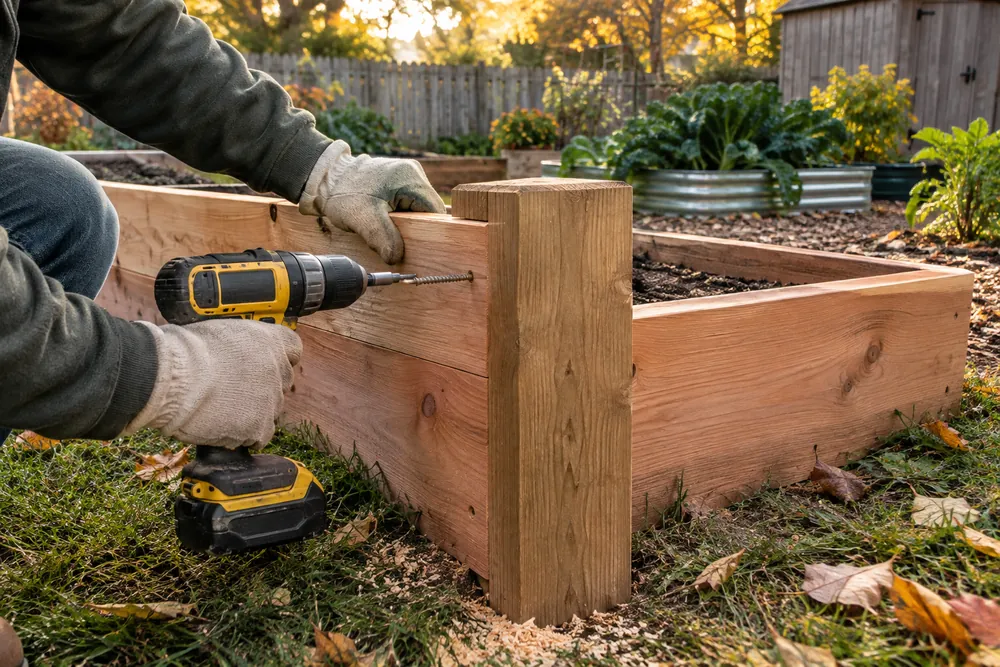
- Build two end assemblies. Stand a post at each end of a 45-inch board, flush with the top and outside edge. Drill pilot holes and drive three screws in a zig-zag pattern through the board into each post.
- Attach the long sides. Stand the two end assemblies 8 feet apart, set a 96-inch side board against them, and screw it into the posts, again three screws per post. Repeat on the other side. Always screw into the posts, not into board end grain, which splits and holds poorly.
- Square the frame. Measure both diagonals corner to corner. When they match, the box is square.
- Set and level it. Move the frame onto the prepared ground. Check level along each side and across each end, scraping soil away under high spots and packing it under low spots until the bubble is centered.
- Brace the long sides. Eight-foot boards bow outward once the bed is full of wet soil. Drive a stake at the middle of each long side, inside the bed, about 10 to 11 inches into the ground, and screw the board to it.
- Add a pest barrier if needed. In gopher country, line the bottom with galvanized hardware cloth (see below) before filling.
- Fill. Add a blended topsoil-compost mix to the top edge; it will settle an inch or two. Our guide on how to fill a raised garden bed covers recipes and how much to order.
Watch out: Do not line the bottom of the bed with plastic. It traps water and drowns roots. If you want to keep treated wood away from soil, line only the inside walls with heavy plastic and leave the bottom open.
How to build a raised bed on a slope
Soil in a raised bed should sit flat, or water runs off the high end and pools at the low end. University of Georgia Extension recommends setting the bed’s short side across the slope and stepping multiple beds down the hill like stairs.
- Gentle slope: dig a shallow trench on the uphill side so the bottom board sits partly below grade, then check level and adjust.
- Steeper slope: add a second board on the downhill side only, so the frame is taller where the ground drops. Bury the bottom edge an inch or so to stop soil washing out underneath.
- Steep hillside: build a series of short terraced beds rather than one long bed. Each bed stays level, and the walls reduce erosion.
Longer corner posts help on slopes. Missouri Extension suggests stakes about twice the height of the bed with half buried in the ground for a firm anchor.
Raised bed lining: hardware cloth for gophers and voles
An open bottom is best for roots and drainage, but in many Western and Southern yards, pocket gophers will empty a bed from below. UC IPM advises lining the bottom of raised vegetable beds with wire mesh to keep gophers out.
- Use galvanized or stainless hardware cloth with openings of about ½ inch; UC IPM’s gopher barriers use ½- to ¾-inch mesh.
- Cut it a few inches larger than the inside of the bed so it can run up the walls.
- Overlap any seams by several inches and fold the edges up the inside walls.
- Staple it to the frame every few inches, then fill with soil.
Minnesota Extension also suggests hardware cloth to stop mice and chipmunks. As for landscape fabric under the bed, opinions differ: Penn State staples fabric across the bottom to separate the mix from the ground, while Minnesota notes that barriers can stunt roots and are usually unnecessary. On native soil, an open bottom over loosened ground is the simplest choice. Over asphalt or concrete, use a permeable fabric rather than plastic.
Gear that helps
- Galvanized hardware cloth 1/2 inch: Lines the bed bottom to stop gophers while letting water drain.
As an Amazon Associate we earn from qualifying purchases. Check current prices and reviews on Amazon.
Cheap raised garden bed ideas
A raised bed does not have to be expensive. These budget approaches still give you loose, deep soil.
- Frameless mounded beds. Clemson describes beds heaped 4 to 8 inches high with sides sloped at about 45 degrees. No lumber at all, just soil and compost.
- Untreated pine or fir. The cheapest wood frame. It will rot sooner, but it buys you several seasons.
- Shorter beds. Over good native soil, a single 2×8 or 2×10 wall is enough and cuts the soil you need to buy. Our garden soil guide helps you judge what you already have.
- Salvaged stone or block. Free fieldstone or leftover concrete block makes a durable wall if you level the first course carefully.
Avoid used tires, old railroad ties and lumber treated with creosote or pentachlorophenol; the University of Delaware specifically advises against them for food gardens.
Raised garden bed ideas beyond the wooden box
Cinder block beds
Concrete blocks stacked one or two courses high make a long-lasting bed, and UF/IFAS lists pre-cast concrete blocks as acceptable for edibles. The base course must be level because errors grow with each row. The hollow cores can hold herbs or flowers. Masonry can raise soil pH a little over time, so test every few years.
Metal raised beds
Corrugated galvanized steel panels screwed to wooden corner posts make a light, thin-walled bed that is easy to cut. Washington State University master gardeners also suggest galvanized feed troughs, with a series of ½-inch drainage holes drilled in the bottom. If you would rather assemble a kit, compare options in our best raised garden beds roundup.
Tiered beds
Stacking smaller boxes on top of larger ones, like a wedding cake, puts deep soil in the center and shallow edges around it. It suits strawberries, herbs and salad greens and works well on slopes.
Keyhole beds
A keyhole bed is a circle up to about 6 feet across with a pie-shaped notch cut out so you can reach a compost basket in the center. Texas A&M AgriLife master gardeners describe walls about 2½ to 3 feet high and a wire cage about 1 foot across for kitchen scraps, which feed the surrounding soil.
Elevated beds on legs and accessible beds
A planter box on legs lets you garden standing up or from a chair. The University of Georgia notes that 10-inch-deep planters raised on legs or blocks work for many crops and use less soil, and suggests beds about 24 inches tall for wheelchair users and 36 inches to avoid bending. Keep accessible beds about 3 feet wide so the center is within reach, and add a flat cap board on top as a seat.
Garden hack: Build in fall. Soil in a new bed settles over winter, and you can top it off and plant on schedule in spring. See the zone timing table in our raised garden beds guide.
Common mistakes to avoid
- Cutting to nominal sizes. A 2×12 is 11¼ inches tall, not 12. Plan heights and soil volumes on actual dimensions.
- Screwing into end grain. Joints loosen quickly. Always fasten into corner posts.
- Skipping the level. A tilted bed waters unevenly and sheds soil on the low side.
- No mid-span support. Eight-foot walls bow out under wet soil without a center stake or cross brace.
- Using the wrong wood. Pre-2004 treated lumber, railroad ties and painted salvage do not belong around vegetables.
FAQ
What is the cheapest way to build a raised garden bed?
A frameless mounded bed of soil and compost costs the least. For a framed bed, untreated pine or fir boards or salvaged concrete block are the lowest-cost options.
How many boards do I need for a 4 x 8 raised bed?
For an 11¼-inch-tall bed, three 2×12 boards 8 feet long: two for the sides and one cut into two 45-inch ends. Add one 8-foot 4×4 for corner posts.
Should I put anything in the bottom of a raised bed?
Usually not. Loosen the ground and leave the bottom open. Add galvanized hardware cloth only if gophers, voles or other burrowing animals are a problem, and never use plastic.
How tall should a raised garden bed be?
About 10 to 12 inches suits most vegetables over loosened native soil. Build 18 to 24 inches or taller on hard surfaces or for gardeners who need to sit or avoid bending.
Do I need corner posts for a raised bed?
Corner posts make the strongest joints because every screw goes into solid wood instead of end grain. Metal corner brackets are an alternative for kit-style beds.
Sources
- How to Build a Raised Bed – Penn State Extension
- Gardening in Raised Beds (ENH1211) – UF/IFAS Extension
- Raised Garden Bed Dimensions (C1027-4) – University of Georgia Extension
- Pest Notes: Pocket Gophers – UC Statewide IPM Program
- Raised-Bed Gardening (G6985) – University of Missouri Extension
- Raised bed gardens – University of Minnesota Extension
- Pressure-treated wood for raised bed construction in Oregon – Oregon State University Extension
- Raised Beds (HGIC 1257) – Clemson Cooperative Extension
- Raised Bed Gardening – University of Delaware Cooperative Extension
- Gardening with Raised Beds – WSU Skagit County Extension Master Gardeners
- Keyhole Garden – El Paso County Master Gardeners, Texas A&M AgriLife Extension