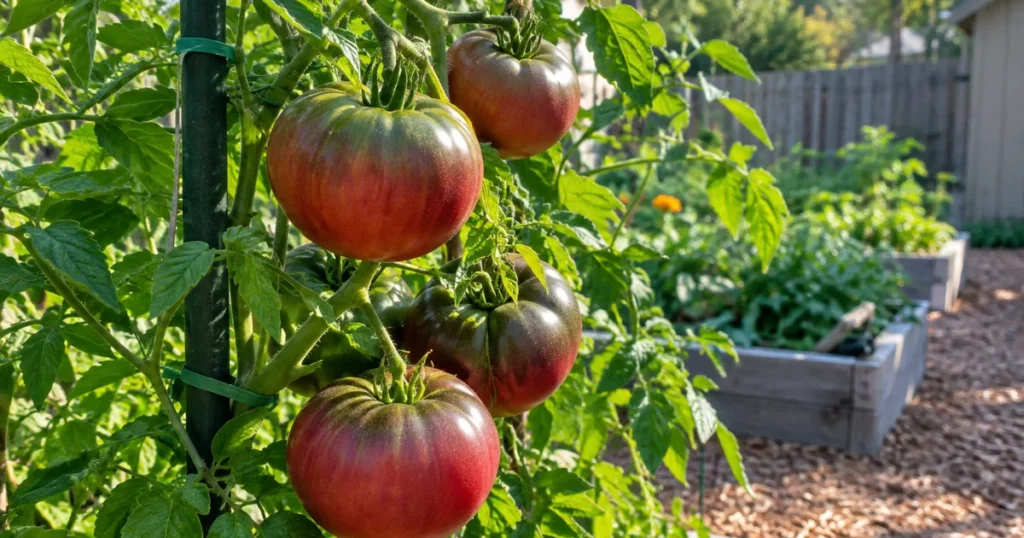
The Cherokee Purple tomato is an indeterminate heirloom beefsteak that produces 10- to 16-ounce, dusky rose-purple fruit with green shoulders and a rich, sweet, complex flavor, ripening roughly 72-80 days after transplanting. It is one of the most popular dark tomatoes in American gardens, and it is open-pollinated, so you can save your own seed. Grow it on a tall support, water it evenly to limit cracking, and pick it by color and feel, not by waiting for red.
Quick answer
- Type: indeterminate, open-pollinated heirloom beefsteak.
- Days to maturity: about 72-80 days from transplant, depending on the seed company.
- Fruit: 10-16 oz, flattened globe, dusky pink-purple with greenish shoulders.
- Weak spots: cracking and catfacing, and no listed disease resistance.
- Harvest: when the skin turns deep rose-purple and the fruit gives slightly, even if the shoulders stay green.
In this guide
- Where does the Cherokee Purple tomato come from?
- Cherokee Purple tomato traits
- How to grow Cherokee Purple tomatoes
- When to pick Cherokee Purple tomatoes
- Cherokee Purple vs Black Krim, Paul Robeson and Carbon
- Where Cherokee Purple does well, by region
- Saving Cherokee Purple seeds
- Common mistakes to avoid
- FAQ
 Grow tomatoes in season for your region, month by month: The Year-Round Vegetable Garden ($27, PDF).
Where does the Cherokee Purple tomato come from?
The documented part of the story starts in 1990. Heirloom tomato collector Craig LeHoullier of North Carolina received an envelope of seeds from John Green of Sevierville, Tennessee. Green’s note said the variety came from a neighbor family who had grown it for about 100 years, and that the seeds originally came from the Cherokee people.
LeHoullier grew the seeds out, liked the dark, unusual fruit, and named it Cherokee Purple. He passed seed to Southern Exposure Seed Exchange, which first listed it in its 1993 catalog. From there it spread to growers, farmers markets and seed catalogs across the country, and Seed Savers Exchange later listed it among its top heirloom tomatoes.
What remains uncertain is everything before 1990. The Cherokee connection and the century of family growing come from a single handwritten note, and nobody has traced the seed line further back. LeHoullier himself has described heirloom stories as fascinating but frustrating because most cannot be verified. Some catalogs describe it as a “pre-1890” variety; treat that as family lore rather than a proven date.
Cherokee Purple tomato traits
- Growth habit: indeterminate. Vines keep growing and producing until frost and can reach 6 feet or more, so they need a sturdy stake, cage or trellis. See our guide to determinate vs indeterminate tomatoes for what that means in practice.
- Days to maturity: Johnny’s Selected Seeds and Clemson Extension list about 72 days; Baker Creek and Southern Exposure list about 80. Expect your first ripe fruit roughly 10-12 weeks after transplanting in most summers.
- Fruit: medium-large flattened globes, usually 10-16 ounces, sometimes lobed or irregular. The skin is a dusky pink to purple-brown, and the shoulders often stay olive green even when ripe.
- Flesh and flavor: dense, juicy brick-red to purplish flesh with scattered seed cavities. The flavor is rich, sweet and full, often described as smoky or wine-like.
- Disease resistance: none listed. Clemson Extension’s variety table notes it has no disease resistance, unlike modern hybrids such as Better Boy.
Cherokee Purple belongs to the group often called “black” or “purple” tomatoes. Their dark color comes from red pigment combined with green chlorophyll that stays in the flesh and shoulders as the fruit ripens. For a wider overview of colors and shapes, see our guide to the types of tomatoes.
How to grow Cherokee Purple tomatoes
Cherokee Purple grows like any other indeterminate tomato, so the basics in our pillar guide on how to grow tomatoes apply: full sun (at least 6-8 hours), rich well-drained soil, pH around 6.2-6.8, and about 1 inch of water a week. The tips below target its specific weak points.
Starting and planting
Transplants of this variety can be hard to find outside spring garden centers, so many gardeners start their own. Sow seed indoors 6-8 weeks before your last frost; our guide on growing tomatoes from seed covers each step. Transplant once nights stay above 50°F and the soil reaches about 60°F, burying the stem up to the top two or three sets of leaves. Check when to plant tomatoes for zone-by-zone dates.
Support
Set a 6- to 8-foot stake, a tall heavy-gauge cage or a trellis at planting time. Heavy beefsteak fruit can snap side branches on a flimsy cage. On a single stake, prune to one or two main stems by removing suckers weekly; in a cage, you can leave three or four stems for more leaf cover over the fruit.
Preventing cracking and catfacing
Large heirloom beefsteaks crack more easily than smooth modern hybrids, and Cherokee Purple is no exception. Growth cracks appear when fruit swells quickly after a heavy rain or deep watering following a dry spell.
- Water deeply and on a steady schedule, about 1 inch a week, more in hot weather.
- Mulch with 2-3 inches of straw or shredded leaves once the soil has warmed to even out soil moisture.
- Pick fruit at the first blush of color when heavy rain is forecast.
Catfacing, the scarred, puckered blossom ends common on big heirlooms, is linked to cool weather during flowering. You cannot fully prevent it, but avoiding very early planting into cold conditions helps, and the fruit is still fine to eat once you cut away the scar.
Garden hack: When storms are in the forecast and your Cherokee Purples are just starting to color, pick them. Fruit harvested at the first sign of color (the “breaker” stage) finishes ripening indoors with full flavor and no longer takes up the extra water that splits the skin.
Handling heat
Like all tomatoes, Cherokee Purple drops its blossoms when daytime highs run above 90°F or nights stay above 75°F, because the pollen stops working. Fruit already set keeps growing, but new fruit stops forming until the weather cools. Plant early enough in the South that the vines set most of their fruit before midsummer, and use mulch to keep roots cooler.
Watch out: With no disease resistance, Cherokee Purple can be hit hard by early blight, septoria leaf spot and wilts. Rotate tomato beds, space plants for airflow, remove the lowest leaves touching the soil, and water at the base instead of overhead. If you have had wilt problems before, grow a resistant hybrid alongside it as insurance.
Gear that helps
- Heavy-duty tall tomato cage or stake: Indeterminate Cherokee Purple vines and heavy beefsteak fruit need tall, sturdy support.
- Drip irrigation kit or soaker hose: Even watering at the base reduces fruit cracking and leaf diseases.
As an Amazon Associate we earn from qualifying purchases. Check current prices and reviews on Amazon.
When to pick Cherokee Purple tomatoes
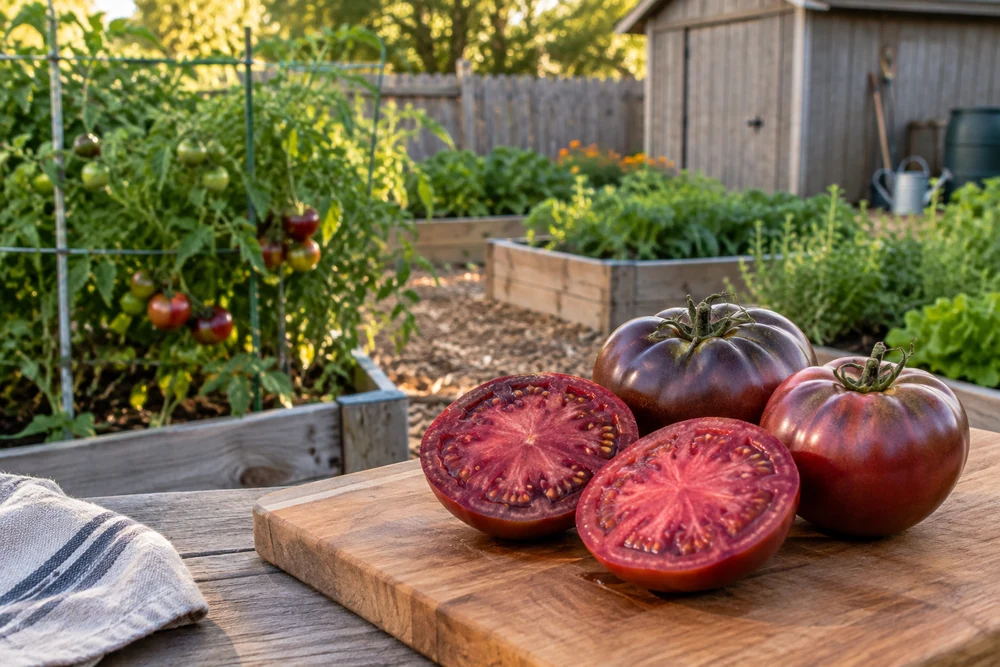
The most common beginner mistake with this variety is waiting for it to turn red. It never will. A ripe Cherokee Purple is a deep, dusky rose to purple-brown over most of the fruit, and the shoulders may stay greenish.
- Check the color: the bottom (blossom end) darkens first; pick when the color has spread most of the way up the sides.
- Feel the fruit: a ripe one gives slightly to gentle pressure, like a ripe peach.
- Twist and lift: ripe fruit releases easily from the stem.
In hot spells, picking a bit early pays off. Penn State Extension notes that ripening slows sharply above 85°F, and University of Illinois Extension notes that heat above 85°F interferes with the pigments that give tomatoes their color. Fruit picked at first blush and ripened on the counter at 68-77°F develops good flavor. For end-of-season fruit, see how to ripen green tomatoes.
Cherokee Purple vs Black Krim, Paul Robeson and Carbon
If you like Cherokee Purple, these three dark heirlooms are worth a trial row. Days to maturity vary by seed company and climate, so treat the numbers as ranges.
| Variety | Origin | Days to maturity | Fruit | Flavor | Best for |
|---|---|---|---|---|---|
| Cherokee Purple | Tennessee (seed shared 1990) | 72-80 | 10-16 oz, dusky rose-purple, green shoulders | Rich, sweet, full | All-around slicing, humid regions |
| Black Krim | Crimean Peninsula, Black Sea | About 80 | 8-16 oz, dark red-purple beefsteak | Bold, sweet, slightly smoky, very juicy | Flavor seekers, salads |
| Paul Robeson | Russia (shared by Marina Danilenko) | About 90 | Medium, brick red to dark | Smoky-sweet, balanced acidity | Mid- to late-season slicing |
| Carbon | Open-pollinated, origin less documented | About 76-90 | Large blocky beefsteak, olive shoulders, deep brick-red flesh | Rich; won “Best Tasting Tomato” at the 2005 Heirloom Garden Show | Gardeners who struggle with cracked fruit |
Carbon’s main selling point is that it resists cracking and catfacing better than other large black heirlooms, according to Johnny’s Selected Seeds. For more variety ideas, browse our list of the best tomatoes to grow.
Where Cherokee Purple does well, by region
This variety has a reputation for coping with humid Southern summers better than many heirlooms, but it can succeed almost anywhere with the right timing.
| Region (zones) | How it performs | Timing tip |
|---|---|---|
| Northern tier, upper Midwest, Maine (3-4) | Possible, but the season is tight for a 72-80 day beefsteak | Start seeds indoors early April, use warm-season tricks like black plastic, and grow an earlier variety too |
| Midwest, Northeast, mid-Atlantic (5-6) | Good; main harvest in August and September | Transplant mid to late May (zone 5) or early to mid-May (zone 6) |
| Southeast and mid-South (7-8) | Very good; its home region | Plant out in April so fruit sets before peak heat; watch for leaf diseases in humid weather |
| Gulf Coast, Florida, Texas (9) | Fair; heat and disease limit summer crops | Transplant in February to March, and try a fall crop set out in August to September |
| Desert Southwest, Southern California (9-10) | Good in spring and fall; stalls in midsummer heat | Plant early spring, add afternoon shade, and replant for fall |
| Pacific Northwest (7-8, cool summers) | Fair; cool nights slow ripening | Use your warmest, sunniest spot or a south-facing wall |
Zones describe winter lows, not summer heat or frost dates, so confirm your average last frost date with your local extension office and adjust for your microclimate.
Saving Cherokee Purple seeds
Because Cherokee Purple is open-pollinated, seed saved from your plants grows into the same variety. Tomato flowers mostly pollinate themselves, so crossing is uncommon, but separate it from other varieties by at least a few plants if you want to be safe.
- Choose a fully ripe fruit from your healthiest, most typical plant.
- Scoop the seeds and gel into a jar with a little water and let it ferment at room temperature for several days, until a thin layer of mold forms.
- Pour off the mold and floating seeds, rinse the sunken seeds, and dry them thoroughly on a plate or paper.
- Store in a labeled envelope in a cool, dark, dry place.
Gear that helps
- Seed saving envelopes: Keeps saved, fully dried tomato seed labeled and organized for next season.
As an Amazon Associate we earn from qualifying purchases. Check current prices and reviews on Amazon.
Common mistakes to avoid
- Waiting for red. Ripe Cherokee Purples are dusky rose-purple with greenish shoulders; waiting longer risks split, soft fruit.
- Using a short cage. Indeterminate vines outgrow 4-foot cages by midsummer.
- Uneven watering. Dry-then-soaked cycles are the main cause of cracked fruit.
- Planting too late in the South. Fruit set stops when nights stay above 75°F.
- Saving seed from a hybrid look-alike. Some “Cherokee” hybrids exist; only seed from true open-pollinated Cherokee Purple comes true.
FAQ
Is Cherokee Purple determinate or indeterminate?
Cherokee Purple is indeterminate. The vines keep growing and producing until frost and need a tall stake, cage or trellis.
How do you know when a Cherokee Purple tomato is ripe?
It is ripe when the skin turns deep rose to purple-brown over most of the fruit and it gives slightly when pressed. The shoulders may stay green.
Why do my Cherokee Purple tomatoes crack?
Cracking happens when fruit takes up water quickly after heavy rain or irregular watering. Water evenly, mulch, and pick at first color before storms.
Is Cherokee Purple a true heirloom?
It is an open-pollinated heirloom first shared in 1990 from Tennessee. Its claimed Cherokee origin and century of family growing come from family lore and have not been documented.
Keep reading
Sources
- Tomato – Clemson Cooperative Extension Home & Garden Information Center
- Is this tomato ready to harvest? – Penn State Extension
- Stalled green tomatoes: why won’t they turn red? – University of Illinois Extension
- Blossom drop – NC State Extension
- Growing tomatoes in home gardens – University of Minnesota Extension
- Cherokee Purple: the story behind one of our favorite tomatoes – GBH News
- Cherokee Purple organic tomato seed – Johnny’s Selected Seeds
- Cherokee Purple tomato – Baker Creek Heirloom Seeds
- Carbon organic tomato seed – Johnny’s Selected Seeds