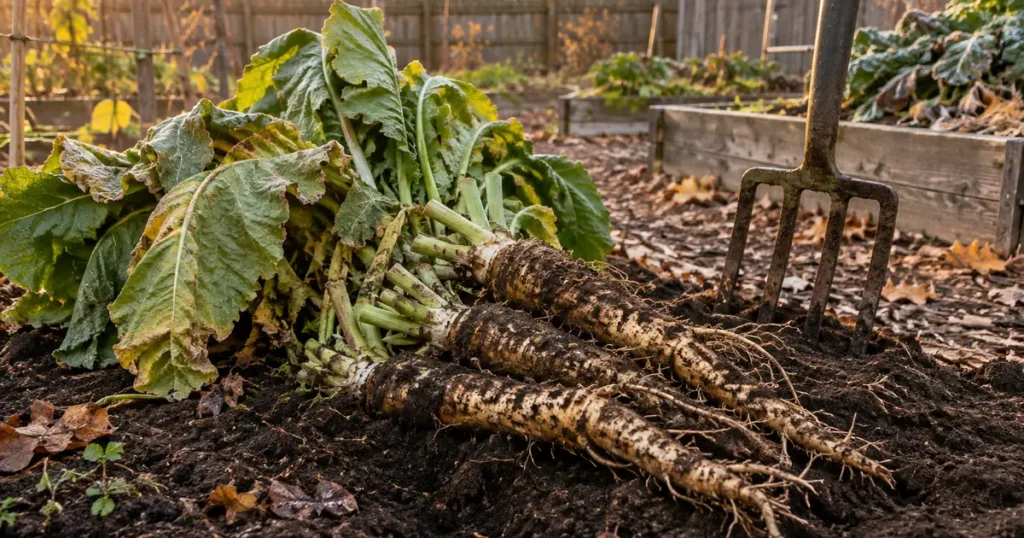
Horseradish is one of the easiest perennials you can grow: plant a pencil-thick root cutting in early spring (or fall), give it sun and deep, loose soil, and dig the roots after a few fall frosts. The hard part is stopping it. Every bit of root left in the ground can sprout a new plant, so the smartest growers plan containment before they plant.
Quick answer
- Plant: root cuttings (“sets”) 8 to 12 inches long, in early spring as soon as the soil can be worked, or in fall.
- Spacing and angle: about 12 inches apart, set at a 45-degree angle, top end 2 to 3 inches below the soil.
- Climate: hardy in roughly zones 3-9; it needs a cold fall and struggles in Florida and similar hot climates.
- Harvest: late October to November after frost, or in early spring before new growth.
- Containment: grow it in a sunken bottomless tub, a deep container or a dedicated corner, and dig out every root at harvest.
In this guide
 Every planting date for your region in one place: The Year-Round Vegetable Garden ($27, PDF).
What is the horseradish plant?
Horseradish (Armoracia rusticana) is a hardy perennial in the mustard family, grown for its thick white taproot. Above ground it forms a clump of large, coarse leaves about 2 feet tall; below ground it makes a long main root plus a web of side roots.
The heat comes from compounds released when the root is cut or grated. Enzymes act on a glucosinolate called sinigrin and produce allyl isothiocyanate, a mustard oil. An intact root barely smells; a grated one can clear your sinuses from across the kitchen. Texas A&M notes the leaves have no real culinary value, so the root is the crop.
Horseradish is hardy in USDA zones 2 or 3 through 9 (Wisconsin Extension lists 2-9). It does best where summers are mild and falls are cold, because the root bulks up in late summer and early fall. UF/IFAS states plainly that it does not grow well in Florida.
Is horseradish invasive?
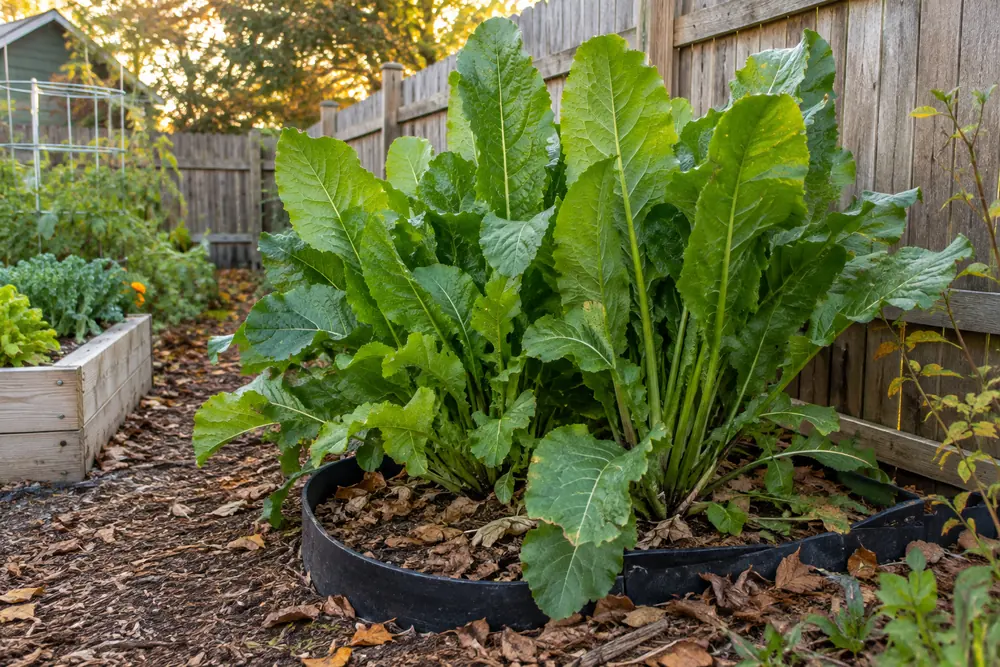
In the garden, yes, it behaves like a weed if you let it. Texas A&M calls it difficult to eradicate once established, and Wisconsin Extension notes it spreads by underground shoots and that a small piece of root can grow a whole new plant. Tilling an old patch often makes things worse, because the tiller chops roots into dozens of new starts.
The good news: the spread happens underground, root by root, so containment works well if you set it up from day one.
- Sunken barrier: bury a large plastic tub or pot with the bottom cut out, rim an inch or two above the soil. Wisconsin Extension recommends this method.
- Pipe sleeves: Utah State suggests planting in buried PVC pipe about 12 inches wide and 24 inches long, one plant per sleeve.
- Dedicated spot: give it a corner of the yard, away from your main vegetable beds and anywhere you till. UC Master Gardeners recommend a permanent dedicated area for this reason.
- Clean harvest: dig out all roots each time you harvest, then replant only the sets you want.
Watch out: Do not plant horseradish in a shared vegetable bed or in raised garden beds you plan to dig and replant every year. Root scraps left behind come back next spring, mixed in with your other crops.
Gear that helps
- Deep root barrier or large nursery pot: A buried barrier or bottomless pot keeps horseradish roots from wandering into the rest of the garden.
As an Amazon Associate we earn from qualifying purchases. Check current prices and reviews on Amazon.
When to plant horseradish by zone
Horseradish is planted from root cuttings in early spring, as soon as the soil can be worked, or in fall. Spring planting is the classic method. Wisconsin Extension notes that spring-planted roots often are not big enough to dig the first fall, while Utah State says a first-year harvest is possible where the season runs about 150 days.
| USDA zone | Plant root cuttings | Harvest roots |
|---|---|---|
| 3-4 | Late April to May, as soon as soil thaws and dries; or early fall | October, after the first frosts and before the ground freezes; or early spring |
| 5 | April; or September to early October | Late October to November, after frost kills the leaves |
| 6 | Late March to April; or October | Late October to November; also in late winter when soil is not frozen |
| 7 | March; or October to November | November through winter, any time the soil is workable |
| 8 | Late winter (February to early March) | Late fall to winter |
| 9-10 | Late winter, as a trial crop | Late fall to winter; expect small roots, since warm falls limit growth |
Use these windows as a guide, not a rule: check your local frost dates and your county extension office, because microclimates vary. If you are unsure of your zone, look it up on the USDA hardiness zone map.
How to plant horseradish root cuttings
Horseradish is propagated from root pieces rather than seed. Gardeners plant sets: straight side roots trimmed off a harvested main root. Buy them from a nursery or seed company, or take them from a friend’s patch. UF/IFAS describes sets as 8 to 14 inches long and about as thick as a pencil.
- Pick the site. Full sun, deep and loose soil, good drainage. University of Minnesota Extension notes that hard, shallow or stony soil produces forked, misshapen roots.
- Prepare the soil. Loosen it 8 to 10 inches deep and work in well-rotted compost. Skip fresh manure, which causes forked roots and excess leaves. Utah State gives a target pH of 6.0 to 7.5; a simple soil test tells you where you stand.
- Check the ends. Sets are traditionally cut square at the top and slanted at the bottom, so you know which end goes up.
- Plant at an angle. Set each cutting vertically or at about 45 degrees, square end up, with the top 2 to 3 inches below the surface. Space plants about 12 inches apart (12 to 15 inches if you have room).
- Point them the same way. If you plant a row, angle all the tops in one direction. It makes weeding and harvest easier.
- Mulch and water. A layer of compost or shredded leaves keeps moisture even and weeds down.
Four to six plants are plenty for most households, according to Utah State.
Garden hack: Push a short stake in at each end of the row (or beside each plant) the day you plant. In fall, when frost has flattened the leaves, the stakes show you exactly where to dig so you can lift every root and leave no fragments behind.
Caring for horseradish through the season
Once it is up, horseradish needs little attention. Weed carefully early in the season while the leaves are small. After that, the big leaves shade out most competition.
- Water: about 1 to 2 inches a week, soaking deeply. Utah State notes that too little water makes roots woody and weak in flavor, while too much makes them soft.
- Fertilizer: go light on nitrogen. Too much pushes leafy growth and branchy roots.
- Cleanup: pull off yellowing lower leaves during the season.
- Pests: flea beetles may chew holes in the leaves; overwatering can lead to root rot. Do not replant in the same spot more often than every 3 to 4 years if root rot shows up.
Serious growers also “lift and strip” the roots: when the largest leaves are 8 to 10 inches long, they pull soil away from the top of the main root, snap off the side roots from the crown and upper root, and re-cover it, then repeat about six weeks later. It is optional, but it produces a cleaner, thicker root.
When to harvest horseradish
Horseradish puts on most of its growth in late summer and early fall, so be patient. The classic harvest is late October or early November, after several frosts have killed back the leaves; Utah State notes that frost improves flavor. You can also dig any time over winter when the soil is not frozen, or in early spring before new growth starts.
- Cut the leaves back to about an inch above the crown.
- Dig a trench 12 to 24 inches deep along one side of the plant, then loosen and lift the root from the other side with a garden fork.
- Trim off side roots. Save straight, pencil-thick pieces 8 inches or longer as next year’s sets.
- Sift through the soil and remove every leftover fragment unless you want the plant to return there.
Do not leave roots in place too long. University of Minnesota Extension notes that roots left two growing seasons tend to turn stringy and woody, and UC Master Gardeners recommend treating the plant like an annual by replanting fresh sets each year.
Gear that helps
- Garden digging fork: A fork loosens long, brittle roots without slicing them into pieces that regrow.
As an Amazon Associate we earn from qualifying purchases. Check current prices and reviews on Amazon.
Growing horseradish in containers
A container is the simplest way to enjoy horseradish without the spreading problem. Choose a large, deep pot with drainage holes, ideally about 2 feet deep (the same length as the PVC sleeves Utah State suggests), so the long taproot has room. Fill with quality potting mix blended with compost, plant one or two sets at an angle, and keep the mix evenly moist.
In cold zones, roots in a pot are more exposed than roots in the ground, so harvest in fall or sink the pot into the soil for winter. At harvest, tip the pot out and pull the whole root ball apart. You will find every fragment, which makes containment easy.
Preparing and storing fresh horseradish safely
Freshly grated horseradish is far stronger than chopped onion. Missouri Extension recommends working in a well-ventilated area, and UC Master Gardeners suggest eye protection. Grate outdoors or next to an open window, keep your face away from the food processor when you open the lid, and wash your hands before touching your eyes.
- Scrub the root and peel off the brown skin.
- Dice it and grind in a food processor or blender, or grate by hand. A little cold water or crushed ice in the processor helps.
- Add vinegar to stop the heat at the level you like. Missouri Extension explains that adding it right away gives a milder sauce, while waiting a few minutes lets more heat develop. Wait too long and the mixture can darken and turn bitter.
- Use white or white wine vinegar. University of Minnesota Extension notes that cider vinegar discolors horseradish quickly.
Storage:
- Whole roots: unwashed, in a plastic bag in the refrigerator or packed in moist sand in a cool, dark cellar. Oregon State Extension says intact roots keep their flavor up to about 3 months.
- Grated horseradish in vinegar: refrigerated in a sealed jar; it loses pungency within 1 to 2 months, so make small batches.
- Sets for replanting: tied in bundles in moist sand at 32 to 40°F, in the dark so they do not turn green.
Garden hack: In zones where the soil freezes only off and on, leave a few roots in the ground and dig them through winter as you need them. Missouri Extension notes roots can be dug any time the soil is not frozen. Just lift them all before spring growth starts.
Watch out: Keep horseradish roots, leaves and scraps away from livestock. Utah State Extension warns that its volatile oils can cause severe stomach inflammation in animals.
Common mistakes to avoid
- Planting it loose in the main garden. Without a barrier or a dedicated spot, it spreads and is hard to remove.
- Tilling an established patch. Chopped roots become new plants.
- Harvesting too early. Roots dug in summer are small and less flavorful; wait for fall frosts.
- Leaving roots for years. Old roots get woody, stringy and sometimes hollow.
- Using fresh manure or heavy nitrogen. You get big leaves and forked roots.
- Grating in a closed kitchen. The fumes sting the eyes and nose; ventilate.
FAQ
Does horseradish come back every year?
Yes. It is a hardy perennial, and any root left in the ground regrows the next spring. Most gardeners still replant fresh sets yearly for better roots.
Can you grow horseradish from a store-bought root?
Often, yes. Wisconsin Extension notes cuttings can come from a grocery store. Choose a firm root with intact ends and plant a side piece or the top section.
How long does horseradish take to grow?
Plant in spring and harvest after fall frosts. In short seasons roots may need until the following spring or fall to reach a good size.
Does frost make horseradish hotter?
Extension sources recommend harvesting after several fall frosts because flavor improves. The plant grows most in cool late-summer and fall weather.
Why is my homemade horseradish not hot?
Vinegar was probably added too soon, or the batch is old. Waiting a few minutes before adding vinegar builds heat, and grated horseradish fades within weeks.
Keep reading
Sources
- Growing horseradish in home gardens – University of Minnesota Extension
- How to Grow Horseradish in Your Garden – Utah State University Extension
- Horseradish, Armoracia rusticana – University of Wisconsin-Madison Extension
- Beat the heat with horseradish – University of Missouri Extension
- Preserving Horseradish – Oregon State University Extension Service
- Horseradish – UF/IFAS EDIS
- Horseradish – Texas A&M AgriLife Extension Vegetable Resources
- Horseradish Harvest – UC Marin Master Gardeners