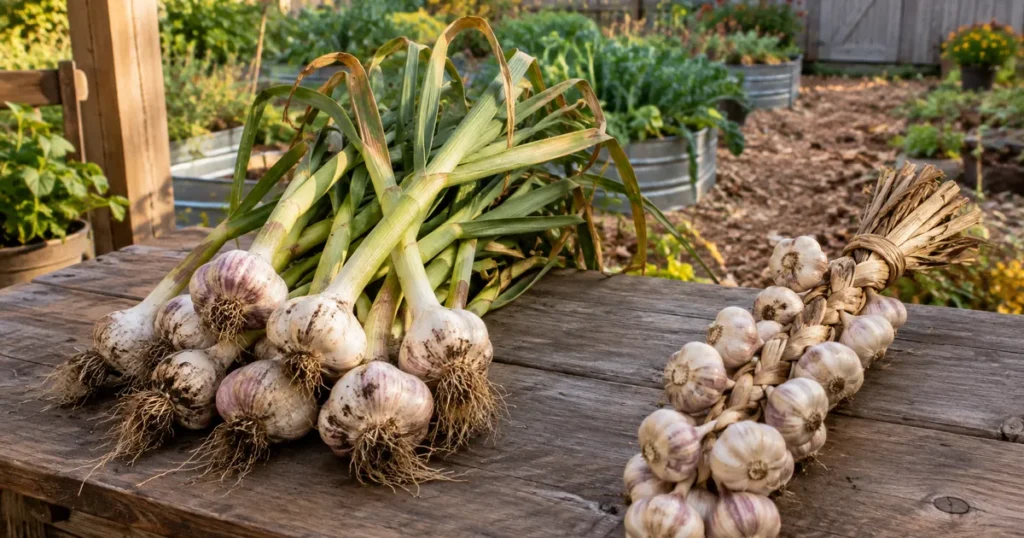
Hardneck garlic grows a stiff flower stalk (the scape), makes fewer but bigger cloves and thrives in cold winters. Softneck garlic has no scape, packs more cloves per bulb, stores longer and handles mild winters better. In zones 3-6, hardnecks are usually the top choice; in zones 8-10, softnecks and Creole types tend to win; zone 7 can grow both.
Quick answer
- Hardneck: very cold-hardy, 4-12 large cloves in one ring, rich flavor, scapes to eat, stores about 3-8 months.
- Softneck: 10-40 cloves, braidable, stores about 6-9 months or longer, best for mild winters.
- Elephant garlic is not true garlic; it is a leek relative with huge, mild cloves.
- Buy seed garlic from a regional grower in late summer, not from the grocery store.
In this guide
Want every planting date for your region in one place? Get The Year-Round Vegetable Garden (225 pages, $27).
Hardneck vs softneck garlic: the main differences
All true garlic is Allium sativum. The two subspecies differ mostly in whether they bolt, which shapes everything else, from clove count to shelf life.
| Feature | Hardneck garlic | Softneck garlic |
|---|---|---|
| Flower stalk (scape) | Yes, a stiff woody stalk in late spring | Rarely |
| Cloves per bulb | About 4-12, in a single ring around the stalk | About 10-40, in several layers |
| Clove size | Large, easy to peel | Mixed, inner cloves small |
| Flavor | Often stronger and more complex | Often milder |
| Storage | About 3-8 months, by group | About 6-9 months, longer for silverskins |
| Best climate | Long, cold winters (zones 3-7) | Wide range; best in mild winters (zones 6-10) |
| Braiding | No | Yes |
University of Wisconsin Extension describes hardnecks as best suited to long winters and short seasons, and softnecks as adaptable to a wide range of climates and soils. Grocery-store garlic is almost always softneck, because it stores and ships well.
How to tell them apart
Look at the top of a dry bulb. A hardneck has a stiff, woody stub of stalk running down through the center, with one ring of cloves around it. A softneck has a soft, papery neck that bends easily and no central stalk; cut it in half and you see several layers of cloves, with small ones packed in the middle.
In the garden, the difference shows up in late spring. Hardnecks send up a scape that curls into a loop, while softneck plants keep producing only flat leaves until they mature.
Hardneck garlic varieties
Hardnecks fall into several groups. Wisconsin Extension gives these typical traits:
- Rocambole: 6 to 11 cloves, prized flavor, peels easily, stores only about 3 to 4 months. Examples: Spanish Roja, German Red.
- Porcelain: 4 to 6 very large cloves with tight white wrappers, stores about 4 to 8 months. Examples: Music, Georgian Crystal, Georgian Fire.
- Purple Stripe: 8 to 12 cloves streaked with purple, stores slightly longer than rocamboles. Examples: Chesnok Red, Persian Star.
Hardnecks also give you scapes in late spring, a bonus crop for pesto and stir-fries.
Softneck garlic varieties
- Artichoke: the most adaptable group and the main commercial type in California. Large bulbs, many cloves, harder to peel. Examples: Inchelium Red, California Early, Lorz Italian.
- Silverskin: many small cloves, tight wrappers, often the longest-storing garlic, and the classic braiding type. Examples: California Late, Silver White, Nootka Rose.
- Creole: often grouped with softnecks, with rosy to purple cloves. Clemson Extension notes Creoles tolerate hard weather well, and they are a go-to group for the South. Examples: Burgundy, Ajo Rojo.
Asiatic and Turban types are early-maturing groups that also suit mild winters; you will see them in specialty catalogs.
Best garlic varieties by zone
Use this table as a shortlist. Zone ranges are approximate; local growers in your region are the best guide to what performs well in your soil.
| Variety | Type and group | Suited zones (approx.) | Why grow it |
|---|---|---|---|
| Music | Hardneck, porcelain | 3-7 | Very large cloves, cold-hardy, stores well for a hardneck |
| German Extra Hardy | Hardneck (usually sold as porcelain) | 3-7 | Bred for harsh winters, big cloves |
| Georgian Crystal | Hardneck, porcelain | 3-7 | Large cloves, mild flavor |
| Spanish Roja | Hardneck, rocambole | 3-6 | Classic rich flavor; eat it first, short storage |
| Chesnok Red | Hardneck, purple stripe | 3-8 | Great for roasting; recommended by NC State for North Carolina |
| Inchelium Red | Softneck, artichoke | 4-8 | Widely adapted, mild, good keeper |
| Lorz Italian | Softneck, artichoke | 5-9 | Strong flavor, tolerates heat |
| Silver White / Nootka Rose | Softneck, silverskin | 5-9 | Long storage, best for braids |
| California Early | Softneck, artichoke | 7-10 | Recommended by Texas A&M AgriLife; reliable in mild winters |
| California Late | Softneck, silverskin | 6-10 | Hot flavor, long storage |
| Creole types (Burgundy, Ajo Rojo) | Creole | 7-10 | Handle Southern heat and short winters |
| Elephant garlic | Not true garlic (A. ampeloprasum) | 5-9 | Huge, mild cloves |
Garden hack: Plant two or three varieties your first year, labeled in separate rows. After harvest, keep the one that made the biggest bulbs in your garden and replant your best heads every fall. Within a few seasons you have seed garlic adapted to your own backyard.
What is elephant garlic?
Elephant garlic looks like garlic on steroids, but it is Allium ampeloprasum, the same species as the leek. Wisconsin and Oregon State extension both classify it as a type of leek. Bulbs are huge, often with only 4 to 6 cloves, and can weigh close to a pound. The flavor is much milder than true garlic, closer to a sweet onion.
You grow it like garlic: plant cloves in fall at the same time, pointed end up, but space them wider, about 8 to 12 inches apart, and a little deeper. It also produces a flower stalk you can cut and eat. Small hard “corms” often cling to the base of the bulb; planted, they take a season or two to size up. Texas A&M AgriLife lists elephant garlic among its suggested garlic crops for Texas, and it grows well across much of the country.
Gear that helps
- Elephant garlic bulbs for planting: Readers searching elephant garlic often want to grow it.
As an Amazon Associate we earn from qualifying purchases. Check current prices and reviews on Amazon.
Garlic bulbs for planting: why grocery-store garlic disappoints
Store garlic sprouts readily, so it is tempting to plant it. Extension services from Ohio State to Colorado State advise against it, for three reasons:
- Wrong climate. Most supermarket garlic is grown in California, or imported, from mild-winter softneck strains. UMass notes these are not adapted to Northeastern conditions.
- Sprout inhibitors. Some store garlic may have been treated to slow sprouting, which can mean weak or no growth.
- Disease risk. Bulbs can carry pests such as the stem and bulb (bloat) nematode or fungal diseases such as white rot. Once white rot is in your soil, it can persist for many years and limit what alliums you can grow there.
The Year-Round Vegetable Garden (2027 Edition)
Plan the whole season in one place: a 225-page month-by-month guide with calendars for six US growing regions, 50 plant profiles (tomatoes included), 5 copy-ready garden plans and 7 printable pages.
Tomato lover? Add Tomato Mastery, our seed-to-harvest tomato blueprint, for just $10 at checkout.
Get the guide ($27)Where to buy seed garlic
“Seed garlic” simply means bulbs selected for planting: large, firm, clean heads from a grower who manages disease. Good places to look:
- Regional garlic farms. A grower within a few hundred miles grows in a similar climate. Many sell online and at farmers’ markets in late summer.
- Seed companies and catalogs that offer named garlic varieties and describe how their stock is grown or tested.
- Local garlic festivals and farmers’ markets. Wisconsin Extension specifically suggests locally produced bulbs from markets or small growers.
- Your own harvest, once you have a variety that thrives.
When comparing sources, ask whether the stock is inspected or tested for bloat nematode and white rot. Some states have certified or inspected seed garlic programs; where they exist, certified stock is worth the extra cost.
When to order seed garlic
Order in July or August. Popular varieties often sell out by early fall, and most growers ship in September and October, timed for planting. If your bulbs arrive early, store them in a cool, dry, airy place (around 50 to 65°F) and keep them whole until a day or two before planting. Avoid the refrigerator unless you are in zones 9-10 and pre-chilling on purpose.
How much seed garlic to buy
Each clove you plant becomes one bulb. A large-clove porcelain like Music may give only 4 to 6 cloves per bulb, so you need more pounds per row than with a softneck. For a 4-by-8-foot raised bed planted on a 6-inch grid (about 120 cloves), plan on roughly 2 to 3 pounds of hardneck seed garlic.
Watch out: Do not buy cheap bulk “seed garlic” with soft, moldy or shriveled cloves, or bulbs with brown streaks at the base. Damaged cloves rot in the ground and can bring disease into your beds for years.
Gear that helps
- Seed garlic variety sampler: Lets readers trial two or three types, as the article suggests.
As an Amazon Associate we earn from qualifying purchases. Check current prices and reviews on Amazon.
Which should you grow?
- Zones 3-5: hardneck porcelains and purple stripes first; add a hardy softneck like Inchelium Red if you want storage garlic.
- Zones 6-7: grow both. Eat rocamboles in fall, porcelains through winter, and softnecks into spring.
- Zone 8: softnecks and Creoles, plus purple stripes such as Chesnok Red.
- Zones 9-10: Creole, artichoke and Asiatic types, with pre-chilled cloves.
Zones only describe winter lows, so your county extension office or a nearby garlic grower is the best source for varieties that perform well in your local soil and frost pattern.
Once you have your bulbs, follow our step-by-step guide to how to plant garlic and check the dates in when to plant garlic by zone.
Gear that helps
- Mesh storage bags for garlic and onions: Hardnecks cannot be braided; mesh bags give airflow in storage.
As an Amazon Associate we earn from qualifying purchases. Check current prices and reviews on Amazon.
Common mistakes to avoid
- Planting grocery-store garlic and expecting big bulbs.
- Growing hardnecks in South Florida or the Gulf Coast without enough winter chill.
- Ordering too late and settling for whatever is left.
- Storing rocamboles for spring. Eat them first; keep softnecks for later.
- Planting small inner cloves of softnecks instead of the large outer ones.
- Treating elephant garlic like true garlic in the kitchen; it is much milder.
FAQ
Which is better, hardneck or softneck garlic?
Neither is better everywhere. Hardneck is best for cold winters and flavor; softneck is best for mild winters, braiding and long storage. Many gardeners in zones 6-7 grow both.
Can you braid hardneck garlic?
Not really. The stiff central stalk will not bend. Bundle hardnecks and hang them, or trim the stalk and store bulbs in mesh bags.
Is elephant garlic real garlic?
No. Elephant garlic is a leek relative, Allium ampeloprasum. It grows like garlic and has garlic-like cloves, but the flavor is much milder.
Can I plant garlic that sprouted in my kitchen?
It may grow, but bulbs are often small, and store garlic can carry disease. Seed garlic from a regional grower is a safer bet.
Which garlic stores the longest?
Softneck silverskins usually store the longest, followed by artichoke types and porcelain hardnecks. Rocamboles have the shortest storage life, about 3 to 4 months.
Keep reading
Sources
- Garlic, Allium sativum – University of Wisconsin-Madison Extension
- Garlic – Oregon State University Horticulture
- Onion, Leek, Shallot & Garlic – Clemson Cooperative Extension HGIC
- Growing Garlic in the Garden – Ohio State University Extension
- Growing Garlic – UMass Extension Vegetable Program
- Garlic – Colorado State University Extension
- Garlic crop guide – Texas A&M AgriLife Extension
- Let’s Plant Some Garlic – NC State Extension
- White Rot: a Returning Problem for Garlic in New York – Cornell Cooperative Extension