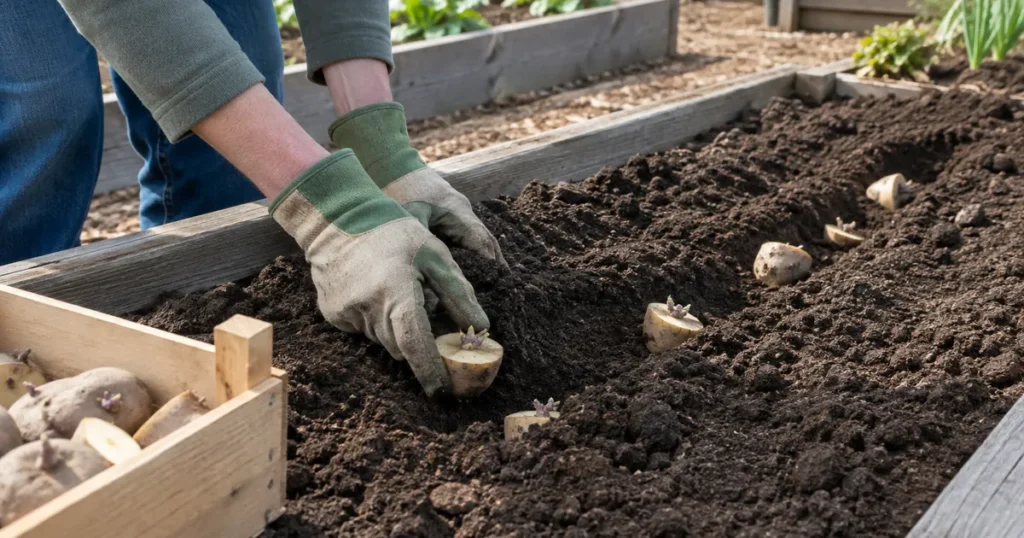
To plant potatoes, buy certified seed potatoes, cut the big ones into pieces of about 1.5 to 2 ounces with at least one eye each, let the cuts heal for a few days, then set them 3 to 4 inches deep and 10 to 12 inches apart once the soil reaches about 45°F. That usually lands 2 to 4 weeks before your last spring frost. As the plants grow, pull soil up around the stems (hilling) so the new tubers stay buried and out of the light.
Quick answer
- What to plant: certified disease-free seed potatoes, not grocery store potatoes.
- Seed pieces: about 1.5 to 2 ounces (egg-sized), each with 1 or more eyes; heal cut pieces 3 to 5 days.
- Depth and spacing: 3 to 4 inches deep, 10 to 12 inches apart, rows about 30 to 36 inches apart.
- Timing: soil at 45 to 50°F, roughly 2 to 4 weeks before the last frost; zones 8-10 also have a fall or winter window.
- Hilling: mound soil around stems when plants are 8 to 12 inches tall, and repeat 2 or 3 times.
In this guide
- Seed potatoes: what to plant (and why not grocery spuds)
- When to plant potatoes by USDA zone
- Should you chit potatoes before planting?
- Cutting seed potatoes the right way
- How deep and how far apart to plant potatoes
- How and when to hill potatoes
- Green potatoes and solanine: a safety note
- Growing potatoes in containers or grow bags
- Common mistakes to avoid
- FAQ
 Every planting date for your region in one place: The Year-Round Vegetable Garden ($27, PDF).
Seed potatoes: what to plant (and why not grocery spuds)
A “seed potato” is not a seed at all. It is a whole tuber, or a piece of one, that sprouts from its eyes and grows into a new plant genetically identical to the parent. That is why the quality of what you plant matters so much: whatever disease the tuber carries goes straight into your soil.
Extension services at Penn State, Iowa State and Utah State all give the same advice: buy certified, disease-free seed potatoes from a garden center, feed store or seed catalog. Certified seed has been inspected for viruses and other diseases that you cannot see on the skin.
Grocery store potatoes are a gamble for two reasons. Many are treated with a sprout inhibitor so they last longer on the shelf, which means they may sprout weakly or not at all. They are also not inspected as planting stock, so they can carry diseases into your garden. Saving last year’s tubers to replant has the same problem: viruses build up from one generation to the next.
Garden hack: Order seed potatoes in winter and look for small tubers about 1 to 1.5 inches across. Penn State notes that seed potatoes this size can be planted whole, which skips cutting and curing and lowers the risk of rot in cold, wet spring soil.
When to plant potatoes by USDA zone
Potatoes are a cool-season crop that goes in before the last frost, though Texas A&M warns that planting too early lets frost kill the tops. Penn State Extension recommends waiting until the soil reaches about 45°F; Utah State and Texas A&M use 50°F at a 4-inch depth. In practice, that puts planting about 2 to 4 weeks before your average last spring frost. Cold, soggy soil is the real enemy, because seed pieces sit there and rot.
In the Deep South and the warmest parts of the West, potatoes also fit into the fall and winter calendar. Texas A&M suggests a fall crop planted about 110 days before the first expected frost, and UF/IFAS lists October through January for South Florida.
| USDA zone | Spring planting window | Fall / winter option |
|---|---|---|
| 3-4 | Late April to late May, once soil can be worked and reaches 45°F | No; too little season after summer |
| 5 | Mid-April to early May | No |
| 6 | Late March to late April | Rarely; only fast varieties in mild areas |
| 7 | Early March to early April | Sometimes, in the warmest parts of the zone, using small whole tubers in mid to late summer |
| 8 | February to early March | Yes: whole small tubers about 110 days before first frost (around mid-August) |
| 9-10 | January to February | Yes: October to January in the warmest areas (South Florida, low deserts, coastal California) |
Treat these windows as starting points. Your local frost dates and soil temperature decide the real day, and microclimates vary, so check your average last frost date and your county extension office. Not sure which zone you are in? Look it up on the USDA hardiness zone map.
Should you chit potatoes before planting?
Chitting (also called green sprouting or pre-sprouting) means letting seed potatoes develop short, sturdy sprouts before they go in the ground. It is optional, but it can give plants a faster start in short-season areas.
The University of Minnesota describes the method: hold seed tubers at about 55 to 60°F in diffuse light, not direct sun. Over a few weeks the sprouts turn short, stubby and green (sometimes purple), rather than long and pale. The same source gives 2 to 12 weeks as the usual range and warns that going past about 10 weeks can age the seed.
- About 3 to 4 weeks before planting, set seed potatoes in a single layer in an egg carton or shallow tray, eyes facing up.
- Place them in a cool, bright room out of direct sun.
- When sprouts are short and green, cut (if needed), let the pieces heal, then plant.
- Handle sprouted tubers gently so you do not snap off the sprouts.
Cutting seed potatoes the right way
Large seed potatoes are cut into pieces so one tuber plants several hills. Each piece needs at least one eye and enough flesh to feed the sprout until it has roots. Texas A&M recommends pieces of about 1.5 to 2 ounces, roughly the size of a medium egg; Utah State says at least 2 ounces. University of Minnesota research notes that pieces under 1.5 ounces rarely make vigorous plants.
- Use a clean, sharp knife, and wipe it with disinfectant between tubers.
- Cut tubers smaller than an egg? Leave them whole.
- Cut larger tubers into blocky chunks, each with 1 to 3 eyes. A pound of seed potatoes typically gives 9 to 10 pieces.
- Spread the pieces in a single layer somewhere airy, around 50 to 70°F, for 3 to 5 days. The cut surface dries and forms a corky skin that resists rot.
Watch out: Do not cut seed potatoes the morning you plant them, especially if the soil is cold or wet. Fresh, unhealed cuts are an open door for rot organisms. And for a fall crop in hot soil, plant small whole tubers instead of cut pieces.
How deep and how far apart to plant potatoes
Most extension guides land in the same range. Penn State calls for a trench about 4 inches deep; Texas A&M and Clemson use 3 to 5 inches, with later plantings in warmer soil going a little deeper. Planting too deep in cold soil slows emergence and raises the chance of seed decay.
- Depth: 3 to 4 inches in cool spring soil; up to 5 to 6 inches for later plantings.
- Spacing in the row: 10 to 12 inches. Closer spacing (about 8 inches) gives more but smaller potatoes; wider spacing gives fewer, larger ones.
- Between rows: 30 to 36 inches, which leaves soil to pull up for hilling.
- Seed needed: about 8 to 12 pounds of seed potatoes per 100 feet of row.
Set each piece cut side down, eyes or sprouts pointing up, and cover with soil. Potatoes want full sun (6 to 8 hours or more) and loose, well-drained soil. In heavy clay, raised garden beds drain faster and warm up sooner in spring, which helps seed pieces get going instead of rotting.
How and when to hill potatoes
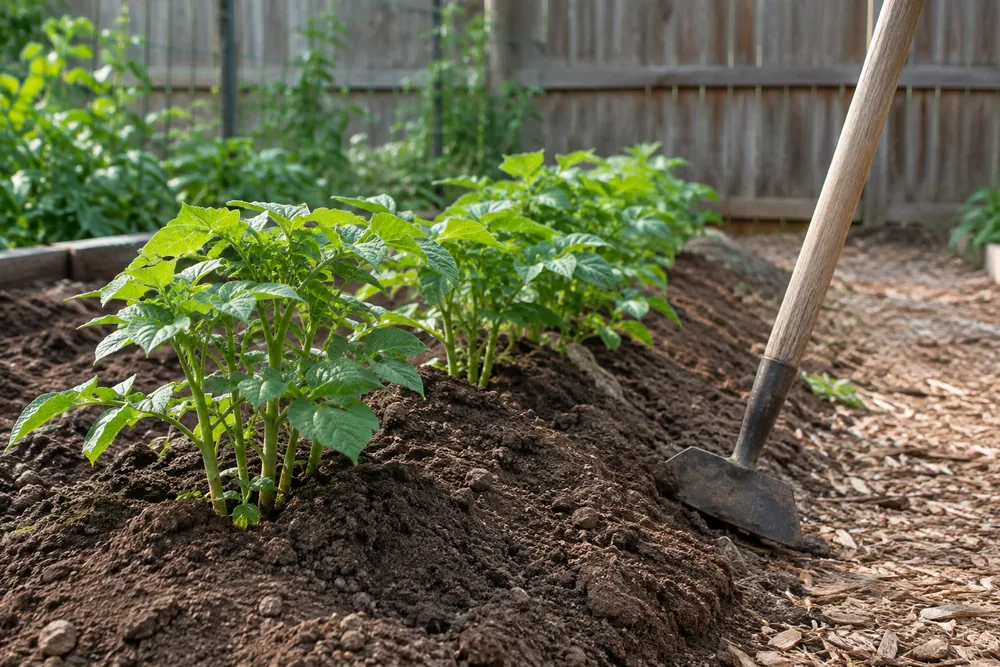
New potatoes form on underground stems above the seed piece. Hilling, or mounding soil around the plants, gives those tubers room to grow and keeps them covered so they do not turn green in the sun.
- Start when the plants are about 8 to 12 inches tall, usually within 3 to 4 weeks of emergence.
- Use a hoe to pull loose soil from between the rows up around the stems, leaving the top few inches of leaves exposed.
- Repeat 2 or 3 times as the plants grow, every couple of weeks.
- Finish hilling before the plants get too big to work between, around flowering time.
A thick layer of straw or shredded leaves can replace part of the soil. Texas A&M notes that mulch blocks light and tends to produce smoother potatoes in heavy soil. Utah State describes a mulch-only method: plant just 1 to 2 inches deep and cover with 4 to 6 inches of mulch, adding more as the plants grow.
Garden hack: Water the bed lightly the day before you hill. Slightly moist soil mounds and stays put; bone-dry soil slides off the hill, and soggy soil clumps and compacts.
Gear that helps
- Garden hoe for hilling: A sturdy hoe makes it quick to pull loose soil up around potato stems two or three times a season.
As an Amazon Associate we earn from qualifying purchases. Check current prices and reviews on Amazon.
Green potatoes and solanine: a safety note
Any tuber exposed to light, in the garden or in storage, can turn green. The green color is chlorophyll, but light also triggers glycoalkaloids called solanine and chaconine. Penn State Extension warns that these compounds taste bitter and, in large amounts, can cause stomach upset, headache and confusion.
- Keep tubers buried by hilling or mulching so sunlight never reaches them.
- Cut away small green spots generously before cooking; discard potatoes that are green throughout or taste bitter.
- Store harvested potatoes in the dark. Our guide on how to store potatoes all winter covers curing and storage conditions.
Growing potatoes in containers or grow bags
No room for rows? Potatoes grow well in grow bags, tubs and barrels as long as the container is opaque, drains freely and gets 6 to 8 hours of sun. UNH Extension suggests a container about 2 to 3 feet tall holding 10 to 15 gallons, with roughly 5 gallons of soil per plant.
- Fill the bottom with 4 to 8 inches of a mix of potting soil and compost (not garden soil).
- Set seed pieces or small whole tubers on top, about 6 inches to a foot apart depending on container size.
- Cover with about 3 to 6 inches of mix.
- Each time the plants grow about 8 inches, add 3 to 4 inches more mix, leaving the top leaves exposed. Stop adding once the plants flower or you reach the rim.
- Keep the mix evenly moist; containers can need daily water in hot weather.
At harvest, tip the container onto a tarp and sift for tubers. UNH Extension notes that mid- and late-season varieties often do better in containers than early types because they keep forming tubers longer.
Gear that helps
- Fabric potato grow bags (10-15 gallon): Opaque, well-drained bags let you grow potatoes on a patio and harvest by simply tipping the bag out.
As an Amazon Associate we earn from qualifying purchases. Check current prices and reviews on Amazon.
Common mistakes to avoid
- Planting grocery store potatoes. Sprout inhibitors and possible disease make them a poor start.
- Planting into cold, waterlogged soil. Wait for about 45 to 50°F and soil that crumbles in your hand.
- Cutting pieces too small. Pieces under 1.5 ounces have little energy to push up a strong plant.
- Skipping the healing step. Give cut pieces 3 to 5 days to dry before planting.
- Forgetting to hill. Exposed tubers turn green and become unsafe to eat in quantity.
- Uneven watering. Swings between dry and soggy can cause knobby or hollow tubers, according to UC Master Gardeners.
- Planting where potatoes, tomatoes, peppers or eggplant grew last year. These relatives share diseases; rotate to a new spot.
FAQ
How deep should you plant potatoes?
Plant seed pieces 3 to 4 inches deep in cool spring soil, and up to 5 to 6 inches for later plantings in warmer soil. You will add more soil on top later by hilling.
How far apart do you plant potatoes?
Space seed pieces 10 to 12 inches apart in the row, with rows 30 to 36 inches apart. In a grow bag, allow about 5 gallons of soil per plant.
Do you plant seed potatoes cut side up or down?
Plant them cut side down with the eyes or sprouts pointing up. Small whole seed potatoes go in with the most eyes facing up.
Can you plant potatoes from the grocery store?
It is not recommended. Many grocery potatoes are treated with sprout inhibitors and are not inspected for disease, so certified seed potatoes are the safer choice.
Do you have to chit potatoes?
No. Chitting is optional, but a few weeks of pre-sprouting in cool, bright conditions can help plants emerge faster, which is useful in short-season zones.
When should you hill potatoes?
Hill for the first time when plants are 8 to 12 inches tall, then repeat 2 or 3 times as they grow, finishing around flowering.
Keep reading
Sources
- Potatoes in the Garden and the Kitchen – Penn State Extension
- How to Grow Potatoes in Your Home Garden – Utah State University Extension
- Easy Gardening: Irish Potato – Texas A&M AgriLife Extension
- Potato – Clemson Cooperative Extension Home & Garden Information Center
- Potatoes – UF/IFAS Gardening Solutions
- Do I need to purchase certified seed potatoes? – Iowa State University Extension
- Crop planning deep dive: pondering potatoes – University of Minnesota Extension
- What is the best way to grow potatoes in containers? – UNH Extension
- Growing Potatoes in Grow Bags – UC Master Gardener Program of Contra Costa