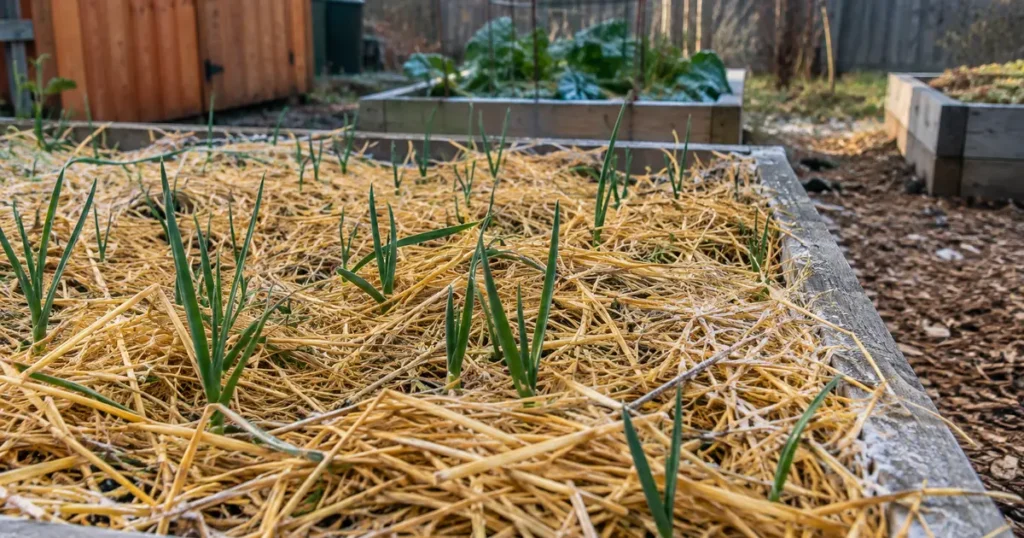
Mulching garlic means covering a fall-planted garlic bed with a loose layer of clean straw or shredded leaves to keep the soil temperature steady over winter. In cold zones, you add it once the ground starts to freeze; in mild zones, right after planting. In spring, you pull it back from the shoots so the soil can warm up.
Quick answer
- Mulch stops freeze-thaw heaving, smothers weeds and holds moisture.
- Zones 3-4: 6 inches or more of loose straw once the top inch of soil starts freezing. Zones 5-6: 4-6 inches. Zone 7: 3-4 inches. Zones 8-10: 2-3 inches right after planting.
- Use weed-free straw or shredded leaves. Skip hay, which is full of seeds.
- Pull mulch back from the shoots in early spring, once hard freezes are mostly over, and leave it between rows for weed control.
In this guide
 Every planting date for your region in one place: The Year-Round Vegetable Garden ($27, PDF).
Why mulch garlic?
Garlic spends 8 to 9 months in the ground, and most of that time is winter. A layer of mulch over the bed does four jobs at once.
- Prevents frost heaving. When bare soil freezes, thaws and refreezes, it expands and shifts, which can push cloves up to the surface where roots tear and cloves dry out. Mulch keeps the soil frozen more evenly instead of cycling day to day. University of Minnesota Extension describes mulch as a way to prevent fluctuating soil temperatures through winter and early spring.
- Insulates in the coldest zones. In zones 3 and 4, mulch plus snow cover is what gets hardneck garlic through nights well below 0°F.
- Smothers weeds. Garlic’s thin leaves shade almost nothing, so it competes poorly with weeds.
- Holds moisture. Garlic has shallow roots. Mulch keeps the top few inches of soil from drying out in spring wind and in warm-climate winters.
When to mulch garlic
Timing depends on how cold your winter gets. The goal in cold zones is to let the cloves root in open soil first, then lock the cold in. In warm zones, there is no hard freeze to wait for.
Cold zones (3-6): after the ground starts to freeze
Plant garlic first, about 4 to 6 weeks before the ground freezes (see our guide on when to plant garlic by zone). Then wait. Apply the full mulch layer once the top inch or so of soil has started to freeze, usually after a few hard frosts. In much of the upper Midwest and New England, that lands in November.
Mulch on warm soil slows cooling, keeps cloves growing leaves late and gives voles a cozy home. If you plant very late, though, mulch right away.
Mild zones (7-10): right after planting
In zone 7 and warmer, the soil freezes shallowly or not at all, so heaving is a minor concern. Mulch right after planting and watering in, mainly to block weeds and hold moisture.
Best mulch for garlic
The ideal garlic mulch is loose, weed-free and easy to rake back in spring.
- Clean straw. Wheat, oat or rye straw is the classic choice. It traps air, stays fluffy and lifts off easily. Buy bales labeled weed-free or seed-free when you can.
- Shredded leaves. Free and excellent. Shred them first by running a mower over the pile; whole maple or oak leaves mat into a wet, airless layer. Our guide to composting leaves and making leaf mulch shows the mower trick.
- Pine needles. A good option where you have them. They stay loose and do not mat.
- Avoid hay. Hay is cut grass with seed heads, so it sows weeds and grass right into your garlic bed. University of Minnesota specifically advises straw free of weed seed.
- Avoid fresh grass clippings and wood chips on top of garlic. Clippings mat and heat up; chips are slow to pull back in spring and can tie up surface nitrogen.
Garden hack: Shake a flake of straw over a tarp before you spread it. If you see lots of grain heads, put that bale between rows or in the compost instead of directly over the garlic. Any wheat that sprouts in spring pulls out easily while small.
Gear that helps
- Weed-free straw mulch: Clean straw is the standard winter mulch for garlic and avoids the weed seeds in hay.
As an Amazon Associate we earn from qualifying purchases. Check current prices and reviews on Amazon.
How thick should garlic mulch be? (by zone)
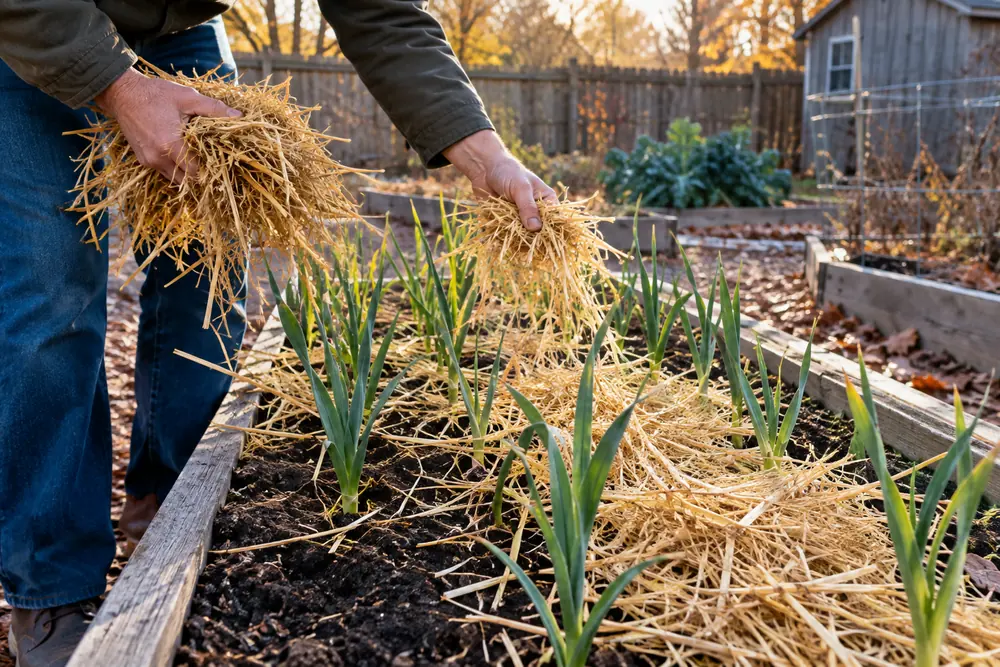
Recommendations scale with your winter. University of Minnesota and North Dakota State both suggest 3 to 4 inches of straw or leaves as a baseline, and gardeners in the coldest zones go deeper, since loose straw is mostly air. Straw settles a lot over winter, so a 6-inch fluffy layer usually packs down to 2 or 3 inches by spring.
| USDA zone | Mulch depth (loose) | When to apply | When to pull back from shoots |
|---|---|---|---|
| 3-4 | 6 inches or more | Once the top inch of soil starts freezing, often late October to early November | Late April to early May, after hard freezes |
| 5 | 4-6 inches | After the first hard freezes, often early to mid November | April |
| 6 | 4-6 inches | After planting or at the first hard freeze, often mid to late November | Late March to April |
| 7 | 3-4 inches | Right after planting | March, or leave a thin layer |
| 8 | 2-3 inches | Right after planting | Not needed; keep a thin layer all season |
| 9-10 | 2-3 inches | Right after planting | Not needed; refresh if it breaks down |
These dates are typical, not fixed. Elevation, lake effects and a warm or early fall can move them by weeks, so check your local frost dates or ask your county extension office. If you are not sure of your zone, look it up on our USDA hardiness zones page.
How to mulch garlic, step by step
- Plant and water. Set cloves 2 to 3 inches deep in cold zones and 1 to 2 inches deep in warm zones, then water once if the soil is dry. Our step-by-step garlic planting guide has the full method.
- Weed the bed first. Mulch smothers small weed seedlings but not established perennial weeds. Pull them now.
- Watch the weather. In zones 3-6, wait until the soil surface starts to freeze. In zones 7-10, mulch the same day.
- Fluff and spread. Break straw flakes apart and shake them loose so the layer traps air. Aim for the depth in the table above.
- Cover the edges. Extend the mulch a few inches past the outer rows. Edges and raised-bed corners freeze hardest.
- Anchor in windy spots. Lay a few branches, a piece of wire fencing or lightweight netting over the straw so winter wind does not strip it off.
Garden hack: Recycle your Christmas tree. Cut off the boughs and lay them over the straw in late December. They hold the mulch down, trap snow and come off in one armful in spring.
Gear that helps
- Garden netting or lightweight bird netting: Holds straw in place on windy sites over winter.
As an Amazon Associate we earn from qualifying purchases. Check current prices and reviews on Amazon.
When to remove mulch from garlic in spring
Pull the mulch back once green tips push through and the threat of hard freezes is mostly over. University of Minnesota frames it exactly that way: remove mulch after hard freezes pass to help the soil warm, or leave it in place for weed control and moisture.
The best approach for most gardeners is a middle path: rake the mulch away from the rows so sun reaches the soil around the shoots, and leave it between the rows to smother weeds. In a very wet spring, UMass and the University of Vermont both suggest pulling mulch further back so the soil can dry, since soggy soil raises the risk of soil-borne diseases.
Keep some mulch handy after you pull it back. Iowa State Extension notes that garlic foliage tolerates temperatures down into the 20s °F, but colder snaps can damage leaves. If a hard freeze is forecast after shoots are up, toss a light layer back over them for a night or two.
Watch out: Green shoots poking through the mulch in fall or during a January thaw are normal. Do not dig the cloves up or cut the leaves. Just make sure the shoots are covered if a deep cold snap arrives; the bulb usually recovers even if the leaf tips burn.
Gear that helps
- Leaf rake / shrub rake: A narrow rake pulls mulch back from garlic rows without damaging shoots.
As an Amazon Associate we earn from qualifying purchases. Check current prices and reviews on Amazon.
Mulching garlic in zones 8-10
In the South and the warm West, fall and winter are the main garlic season, and the soil rarely freezes. Mulch here is about moisture and weeds, not insulation.
- Go light. 2 to 3 inches of straw, pine straw or shredded leaves is plenty. A deep, wet layer in a mild, rainy winter can encourage rot.
- Mulch right after planting. There is no freeze to wait for.
- Keep it on all season. In zones 8-10, spring arrives fast and dry spells hit garlic just as bulbs size up. A thin layer helps hold even moisture.
- Watch drainage. In heavy clay, plant on raised or mounded rows.
Softneck and Creole types are the usual picks in warm zones. Our hardneck vs softneck garlic comparison lists varieties by region.
Common mistakes to avoid
- Using hay instead of straw. You will be pulling grass and weeds out of your garlic all spring.
- Mulching too early in the North. Heavy mulch on warm soil keeps the cloves growing leaves late and invites rodents to nest.
- Skipping mulch in zones 3-5. Bare soil heaves the most.
- Spreading whole leaves. Unshredded leaves mat into a soggy layer that can rot the cloves.
- Leaving thick mulch on in a wet spring. It keeps the soil cold and saturated. Pull it back.
- Piling a thick layer on in warm zones. 2 to 3 inches is enough where the ground does not freeze.
- Removing the mulch completely. Keep it between the rows; garlic hates weed competition.
FAQ
Should I mulch garlic right after planting?
In zones 7-10, yes. In zones 3-6, you can add a light layer after planting, but put the full layer on once the top inch of soil starts to freeze. Very late plantings should be mulched right away.
How deep should mulch be over garlic?
About 6 inches or more of loose straw in zones 3-4, 4 to 6 inches in zones 5-6, 3 to 4 inches in zone 7 and 2 to 3 inches in zones 8-10. Straw settles to roughly half its depth by spring.
Can I use grass clippings or wood chips to mulch garlic?
It is better not to. Fresh clippings mat and heat up, and wood chips are hard to pull back from shoots in spring. Weed-free straw, shredded leaves or pine needles work best.
Do I have to remove mulch from garlic in spring?
Pull it back from the rows once hard freezes are mostly over so the soil can warm, but leave it between the rows to block weeds and hold moisture. In a very wet spring, pull it back further.
What if my garlic sprouts before winter?
Fall sprouts are common and rarely a problem. Leave them alone and keep the bed mulched. The leaves may burn back in hard cold, but the clove usually regrows in spring.
Keep reading
Sources
- Growing garlic in home gardens – University of Minnesota Extension
- Garlic fact sheet – UMass Amherst Extension Vegetable Program
- Growing great garlic – University of Vermont Extension
- It’s only February, but my garlic is coming up – Iowa State University Extension
- Growing Great Garlic – North Dakota State University Extension
- 2023 Plant Hardiness Zone Map – USDA Agricultural Research Service